
Lost in Del Valle
Van Zandt barrels through wrestling demons with blistering force—each beat landing hard. That he’s still standing feels less like luck than a hard-won triumph.
[Review of one-man show that ran at the Huron Room this past April. Now playing a return engagement: September 14 – October 14, 2026]
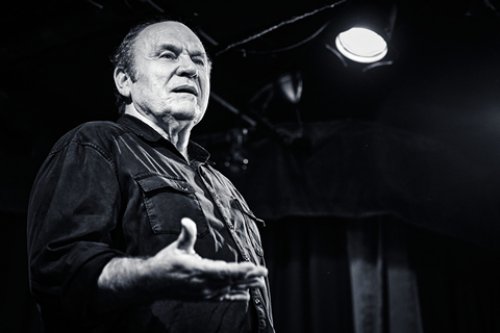
Ned Van Zandt in his one-man show “Lost in Del Valle” at the Huron Room of SoHo Playhouse (Photo credit: Mark Shaw)
Directed with flinty assurance by Amir Arison, Lost in Del Valle, written and performed by Ned Van Zandt establishes its terms immediately. There is no soft entry point, no gentle calibration of tone. Instead, Arison engineers a theatrical environment in which candor is not merely encouraged but demanded, allowing the material to land with an almost confrontational clarity. The result is a staging that feels stripped to its essential nerve—unyielding, unsentimental, and rigorously alive.
Van Zandt is a cyclone that tears through the intimate confines of SoHo Playhouse’s Huron Club, detonating with the force of lived experience refined into art. What might, in lesser hands, resemble a familiar confessional is here transformed into something far more volatile and exacting: a darkly comic, genre-defying work that refuses containment even as it unfolds within a single body onstage.
Van Zandt’s performance achieves the rare feat of appearing both recklessly spontaneous and meticulously controlled. He moves through the evening with a muscular precision, shifting registers and emotional temperatures with such fluency that the boundaries between character, narrator, and witness begin to dissolve. It is acting of a high order—technically exacting, yet fueled by something that feels perilously close to exposure.
The narrative itself resists linear containment, unfolding instead as a series of shards—memories colliding, refracting, and recombining in a structure that mirrors the instability of the life it depicts. Time is elastic, chronology secondary to sensation. Scenes emerge not as fixed points but as impressions, their sequencing governed less by logic than by the associative rhythms of recall.
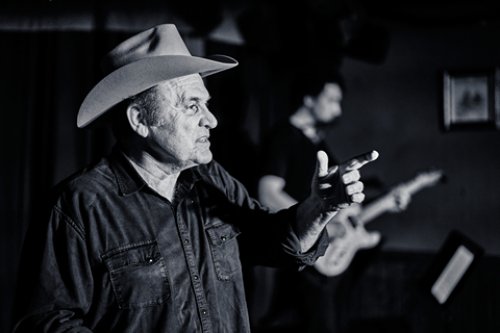
Ned Van Zandt in his one-man show “Lost in Del Valle” with guitarist Mike Moore at the Huron Room of SoHo Playhouse (Photo credit: Mark Shaw)
Early in the piece, a near-fatal overdose is rendered with a visceral immediacy that sets the stakes for everything that follows. The moment is not contextualized or explained away; it simply arrives, raw and disorienting, capturing the terrifying arbitrariness of survival. That it hinges, improbably, on the intervention of the household cat only deepens the sense of existence as something contingent, precarious, and faintly surreal.
If the show’s architecture is fragmentary, its sense of place is anything but. Van Zandt conjures a succession of environments with startling economy, from institutional interiors defined by their rigid hierarchies to cultural enclaves saturated with myth. Among these, the legendary Chelsea Hotel looms large—not as mere backdrop, but as a kind of psychic repository, its corridors echoing with the residue of artistic ambition and personal collapse.
The ghosts that inhabit this world are both literal and figurative. Figures such as Chaka Khan and Iggy Pop flicker at the edges of the narrative, while the doomed orbit of Sid Vicious and Nancy Spungen casts a longer, more unsettling shadow. These presences are not deployed for anecdotal glamour; rather, they function as atmospheric markers of a cultural moment defined by its proximity to excess and erasure.
For all its expansiveness, however, the production never loses sight of the granular. Van Zandt’s ability to delineate character—often with little more than a shift in posture or vocal inflection—is quietly astonishing. A fleeting figure becomes, in an instant, fully dimensional; a passing encounter acquires the weight of lived history. The cumulative effect is a densely populated theatrical landscape conjured by a single performer.
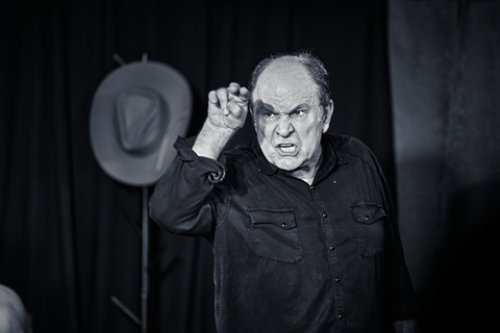
Ned Van Zandt in his one-man show “Lost in Del Valle” at the Huron Room of SoHo Playhouse (Photo credit: Mark Shaw)
It is within the carceral sequences that the production finds its most exacting register, the storytelling honing itself to a point of almost unsettling clarity. Here, a succession of figures materializes with remarkable precision: Jesus, a Mexican American inmate whose presence carries both pragmatism and latent threat; Jimmie, mercurial and unmoored, his volatility registering in quick, destabilizing shifts; and Donnie Haynes, a Junior Grand Dragon of the Texas Aryan Brotherhood, whose authority is conveyed less through overt menace than through an unnerving composure, outwardly a fearful menace who trades physical and even sexual protection in exchange for acting lessons.
These are not sketches but fully inhabited lives, rendered with an attention to behavioral detail that resists simplification. Each encounter illuminates the tacit codes governing the space—the hierarchies, allegiances, and instantaneous calculations upon which survival depends. In this compressed ecosystem, identity is never neutral; it is currency, liability, and shield all at once, and Van Zandt makes palpable the speed with which one must discern the difference.
Integral to this environment is the live accompaniment by Mike Moore, whose guitar work threads through the evening like an exposed nerve. The music does not illustrate so much as interrogate, pushing against the narrative, amplifying its tensions, and occasionally offering a counterpoint that borders on the elegiac. It is a collaboration that expands the piece’s emotional vocabulary without diluting its intensity.
Beneath the surface volatility lies a more intricate inquiry into inheritance and identity. Van Zandt gestures toward a lineage that might suggest stability—familial prominence, cultural capital—only to reveal how little such structures can withstand the pressures of personal unraveling. The resulting portrait is one in which origin exerts influence without offering protection, and where self-definition must be forged under far less forgiving conditions.
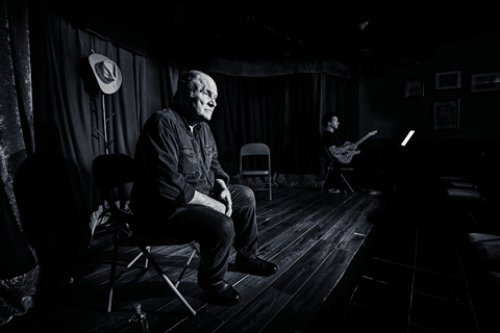
Ned Van Zandt in his one-man show “Lost in Del Valle” with guitarist Mike Moore (at right) at the Huron Room of SoHo Playhouse (Photo credit: Mark Shaw)
What distinguishes Lost in Del Valle is the degree to which it transforms extremity into form. The material is undeniably harrowing, yet it is shaped with a discipline that prevents it from tipping into indulgence. Each revelation is calibrated, each escalation earned. The evening accrues power not through excess alone, but through the intelligence with which that excess is rendered. He proves less interested in polishing his own mythology than in rendering, with unsparing fidelity, the texture of street life in his native Texas—most memorably in his account of his friends Gary and Belinda, whose makeshift meth lab becomes less a lurid anecdote than a sharply observed microcosm of a world governed by improvisation, desperation, and a precarious, combustible intimacy.
By the time the performance reaches its final movements, what lingers is not the catalogue of transgression but the clarity that has been wrested from it. The act of telling becomes, in itself, a kind of reconstitution—a means of imposing order on what once resisted it. There is, in this, a quiet but unmistakable generosity: an offering of experience transmuted into something communicable, even communal.
In the end, Lost in Del Valle stands as a testament to the capacities of solo theatre at its most exacting. It is at once intimate and expansive, chaotic and controlled, brutal and unexpectedly lucid. Above all, it is the work of an artist who has not merely survived his material, but mastered it—shaping it into a theatrical event that is as disquieting as it is exhilarating.
Lost in Del Valle (return engagement: Septembr 14 – October 14, 2026)
Huron Room at SoHo Playhouse, 15 Vandam Street, in Manhattan
For tickets, call 212-691-1555 or visit www.sohoplayhouse.com
Running time: 65 minutes without an intermission


Leave a comment