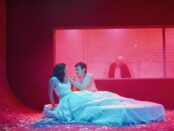
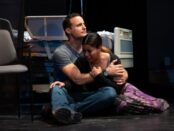
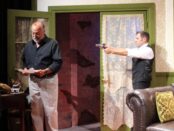
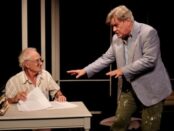
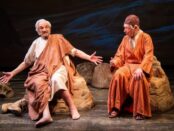
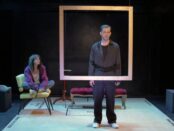
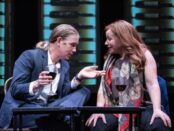
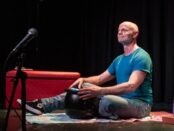
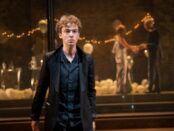
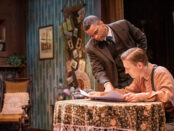
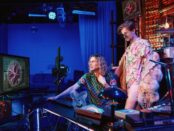
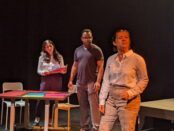
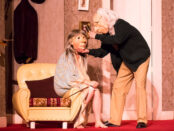
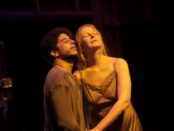
On paper, Diane Davis’ play "Complicity" offers a stark, yet refreshing take on the now familiar Harvey Weinstein-tainted Hollywood story of women being victimized by a male-run, male-driven industry. On stage what we have instead are sometimes too-clipped scenes where an audience is left the chore of filling in the many blanks. The actors sometimes attempt to do just that with histrionics that are unfortunately not reined in by director Illana Stein. [more]
There are two truisms in life in addition to the one about death and taxes: it takes all kinds of people to make a world and something will get everyone in the end. The world premiere of Gracie Gardner’s "I’m Revolting" beautifully proves both points. A sensitive and perceptive play set in the waiting room of a private New York City skin cancer clinic, the play introduces us to all walks of people and many reactions to medical reports. The ensemble cast includes several veteran actors (Laura Esterman, Glenn Fitzgerald, Peter Gerety and Patrice Johnson Chevannes) and several not so well known faces. Knud Adams’ direction is subtle and unobtrusive allowing life to pass on the Linda Gross stage of the Atlantic Theater Company. [more]
If you like your W.W. II history unadulterated, you may object to a love story between a French teenage girl and a Nazi soldier even if they are inexperienced and innocent and unaware of what is to come. The fact that they are both hopeful of life in the future in the middle of war and devastation notwithstanding, were people ever this naïve and unworldly? While "This Beautiful Future" is tastefully presented, it does not deal with the moral issues that the play hints at but refuses to recognize. [more]
Is it possible to be completely truthful in attempting to tell the life of a famous author in a biofilm? That is the premise of Argentinian novelist and playwright Romina Paula’s "Fauna" now having its English language premiere at New York’s Torn Page Theater. As the play is philosophical, poetic, cerebral, and literary with quotes from many authors including Argentinian writers unfamiliar to Americans, it may be too erudite and esoteric for most theatergoers. However, April Sweeney’s production at the vest pocket Torn Page Theater is so intense that it carries its audience with it. With the actors only feet from the viewers so that you feel you are in the room with them, the play is a powerful experience that few productions ever achieve. [more]
Although Alan Cumming is a charismatic performer, the distracting video design, the often overpowering music, and the often flashing lighting by Tim Lutkin, gets in the way of viewing the show. Much of the effect is created by the atmospheric lighting which periodically changes color (blue, green, red) yet at times it turns the evening into a multimedia event. Since none of the poems are clear enough to be understood, we learn little of Burns’ output as a poet though we do hear about his triumphs that lead to being lionized in Edinburgh. The contemporary music only rarely suggests the period. The dance elements also seem an eccentric way to portray this 18th century man who attempted to live life to the fullest. Cumming charmingly depicts this Scottish icon though he does come off as a lovable rogue. It is all an example of too much being too much. The rather coy ending has Cumming sitting on the edge of the stage declaiming Burns’ now famous poem, “Auld Lang Syne,” after the final curtain has already descended. [more]
Greenspan isn’t always totally clear when switching points of view, but made up for this by turning the entire, long script into a wonderland of gestures, vocalizations, postures and movements. His eyes and his hands are masterful communicators. His lean body’s dancelike movements add dimension to the onslaught of words. This is a performance that must be seen to appreciate how mindboggling his accomplishment is. [more]
Most poignantly, when Drew starts to wonder if maybe their son's survival has been the opposite of a blessing, Andrea expresses horror for a thought that, thanks to Pimentel's touchingly subtle performance, we know she's had herself. To its strongest credit, MacDermott's play affords all three of its actors the opportunity to find meaning beyond their characters' words. Though, of course, with a less capable trio, this sort of dramatic freedom could have been a disaster. [more]
Mark Wilding’s "Our Man in Santiago" is billed as a “raucous political farce” but it is neither loud and noisy nor hilariously funny. Inspired by Gabriel Garcia Marquez’s 1974 article in Harper’s Magazine concerning the CIA involvement in the death of democratically elected President Salvador Allende, the play supposes that the CIA had operatives in Santiago ready to kill Allende when General Pinochet launched his coup that took out Allende’s government and democracy in Chile for the next 16 years. While Charlie Mount, who also directed LA’s Theater West production in 2021, keeps the play bubbling along, the one-dimensional characters and the lack of real farcical stage business diminish the play to an overlong attempt at satire. [more]
"Love, Sex & Real Estate" moves swiftly, thanks to John D. McNally’s direction. He skillfully manages the quick shifts between romantic liaisons, real estate discussions, Ugo’s youthful angst, and Valter’s artistic stumblings. The writing, including an over-the-top version of a Feydeau farce, complete with slamming doors, tends toward cliché, but is saved by the performances of the eager cast of fine actors. [more]
Aside from his ability to create multiple characters with his voice and body language, Strathairn’s physicality is remarkable in aging from a young man to a senior citizen before our eyes as well as using the table for enacting various events such as jumping off of a train or Karski’s torture by the Nazis. (The movement director is Emma Jaster,) In the brief 90 minutes of playing time, Strathairn is able to establish a quietly heroic man’s entire life and career with modesty, sincerity and simplicity. It is not only a remarkable performance, it is also an impressive reconstruction of another man’s character and deeds. [more]
Revived by Retro Productions, we are treated to Eric Overmyer’s alternative Victorian fantasy, "On the Verge or The Geography of Yearning," that takes three vibrant, independent women of 1888 on an expedition not just through deepest, darkest “terra incognita” but also forward 67 years into a very different America. Mores, as well as language as they know it, are at risk. [more]
From the clever double entendre title to its fantastical involvement of three famous long dead physicists, Carole Buggé’s "Strings Attached" tries very hard to rise out of the morass what is basically a sad love triangle but is ultimately overwhelmed by frippery and cliché. [more]
Although "Burbank: Walt Disney in Crisis" occasionally has its actors delivering monologues out to the audience, the most compelling drama occurs from the interactive scenes between the actors themselves; more of this would have absolutely been welcome. Nevertheless, the play does entertain and inform, revealing the financial struggles Disney went through to make such iconic films as "Pinocchio," "Fantasia," and "Bambi," even in the wake of "Snow White"’s success. Bossert also managed to squeeze in the fact that Disney attempted to block Adriana Caselotti, the voice of Snow White, from getting other work, in order to not “spoil the illusion” of the character. [more]
Commissioned by the Ma-Yi Theater Company, Daniel K. Isaac’s brilliant "ONCE UPON A (korean) TIME" was born out of the actor-playwright’s realization that he knew way more about Shakespeare and the Western canon than his own rich Korean culture of folk tales and origin myths. He has fashioned, over the course of five scenes, beautifully layered storytelling in situations clouded by utter despair, without sacrificing great brushstrokes of humor. [more]
As a piece of writing, "The Near Disaster of Jasper & Casper" is whacky and creative, and except for a couple of out-of-place bits of humor, one involving a middle finger and another a candle called “Blow Me,” it is charmingly humorous. The story even becomes lightly touching when Jasper’s love for his brother Casper is tested, and Jasper learns the real meaning of family and what it is to be responsible for others besides himself. "The Near Disaster of Jasper & Casper" is a thoroughly enjoyable, quirky fairy tale told by an expert storyteller, Jason Woods. By the end of this foray into the woods, it was time to go, I hated to leave, I had to, though. Worth a second viewing. [more]
If Samuel Beckett had been a Jew, his "Waiting for Godot"’s Estragon and Vladimir could have emerged as the equally quirky "Two Jews, Talking," in the appealing new two-hander by Ed. Weinberger starring Hal Linden and Bernie Kopell, all three TV legends. The two characters in each one-act play, talk and talk and get nowhere—very pleasantly with just the right touch of surreal mystery. Weinberger ("The Tonight Show," "The Mary Tyler Moore Show," "Taxi," etc.) has fashioned a quiet tour de force for these two veterans. Linden, a spry 92, is not only a TV veteran ("Barney Miller") but a star of the Broadway stage, including his Tony Award winning performance in "The Rothschilds." Kopell (89) is remembered for his long-running turn as the ship’s doctor in "The Love Boat" among many other appearances. [more]
Part of Ramón’s game plan to increase attendance is to create a Randy’s Dandy Coaster Castle mascot. In a move that changes his life, Arlo is drafted to don a hilarious, smelly rat costume transforming himself into the character Kuddly Kyle. Suddenly Arlo, the sweet, directionless shlub has found meaning in his life via this subterfuge. While in the costume, Arlo is the delightfully entertaining Kyle. Without the costume, he’s just Arlo. This is the most moving part of Coaster, a play that revolves around the emotions and inner lives of these everyday, working class characters, beautifully evoked by Perez and carefully chaperoned by director, Rebecca Martínez to keep it all down to earth and accessible. The fade-out is particularly moving as the workers have no idea that there is a disaster looming. Their lives will be changed—for the worse. [more]
'Hyprov" is a delightful and surprising evening as there is no telling how it will turn out. Will the Hyprovisers be good at their improvs? Will they stay in character? How will they deal with the somewhat preposterous suggestions by the audience or Colin’s instructions? Will the improvs make complete skits? Will the volunteers all remain on the same wavelength? One could see this show several times as both the improvs and the volunteers will vary from night to night. A clever evening is had by all with the charming Asad Mecci running the first half and Colin Mochrie organizing the second half. [more]
It is not until the last 15 minutes of Sophie McIntosh’s new play, "macbitches," that a dramatic event takes place. Up until then the play is mostly the chit chat of acting majors talking about productions they have been in, eccentric directors they have worked with at the college, rehearsal horrors, and theater experiences elsewhere. While this has some interest for theater buffs, it goes on too long and tends to be more and more of the same. If you know such shows as "The Drowsy Chaperone," "The Crucible," "Hedda Gabler," "Antigone," "Guys and Dolls" and "Macbeth" very well you may be able to follow the gossip. If not, you may grow very bored by all the anecdotes. There is some talk of the toxic environment of male-run academic departments but very little of it makes much of an impression. We never hear what the male acting students think of the department or its practices, only their bad behavior in rehearsal. [more]
If you have ever seen a play by Aeschylus, you know how static and slow they are, made up entirely of monologues and choral odes with hardly any action. It was Sophocles and Euripides who added what we consider drama to ancient Greek plays. Director Robert Icke’s new version of Aeschylus’ "Oresteia," the only complete Greek trilogy that remains extant, has been adapted into a updated tetralogy that is accessible, easy to identify with, and dramatically exciting. The Almeida Theatre production now at the Park Avenue Armory features magnificent performances by Anastasia Hille (Baptiste's wife Celia in the television series of the same name) and Angus Wright (Claudius, in Icke’s current also modern dress production of "Hamlet" running in repertory with Oresteia) as Klytemnestra and Agamemnon. Presented as a long evening of four plays, this is a commitment for the audience as the running time is three hours and 35 minutes with three intermissions. [more]
Jake Shore’s "Hit the Wall," though limited in its range, is very successful in its goals. It gives Adam Files and Alexandra Guerrero juicy roles as the aging mentor and the younger student who may have surpassed the master. It also depicts a world unfamiliar to most of us. Whether this world is entirely accurate is another question which only those in the know can tell us. However, the play as it now stands is an impressive but small piece of work. [more]
Ng has a far-reaching imagination and spins the many stories and characters of her "Happy Life" with admiral skill and abandon. But it is just too heavy-handedly, head-scratchingly abstruse, not to mention unnecessarily full of foul language that somehow doesn’t jibe with the characters. This is Theater of the Absurd put through the David Mamet grinder. [more]
While the play is rooted in its original 1955 period (its language, social mores, references, three-act form), this revival directed by Joe Rosario has attempted to place it in the present from the contemporary set and clothing and such props as cell phones and a great many uses of the f-word. However, without updating the dialogue, the play does not make sense reset in 2022, particularly in its archaic handling of homosexuality as it was referenced pre-Stonewall. Its themes of deception, greed and “mendacity” (a word made famous by this play) would seem to make the play contemporary but everything else about it including its hothouse atmosphere marks it as dated. [more]
The chips fall into place by the end of A Black and White Cookie, perhaps a bit too smoothly, but the path to the ending is well constructed and fascinating. Morgenstein has caught the nuances of each character and his dialogue rings true particularly as inhabited by these five actors who are ably directed by Marcello Rollando who quite wittingly provides the play-by-play radio commentary of the Mets games which Harold listens to throughout the story. [more]
For its 35th anniversary, PTP/NYC (Potomac Theater Project) continues is exploration of little known British plays by major playwrights with the New York premieres of one acts by Steven Berkoff and Caryl Churchill. The triple bill entitled "Sex, Grift and Death" includes the first local productions of Berkoff’s "Lunch" and Churchill’s "Here We Go," as well as the first NYC revival of Churchill’s "Hot Fudge," last seen here at The Public Theater in 1990. While the productions directed by Richard Romagnoli (Berkoff) and Cheryl Faraone (Churchill) are fine as far as they go, they all seem a little too underheated to be truly theatrical for these in-yer-face, confrontational authors. The evening’s title sums up the themes of this triple bill. [more]
D'Astolfo (that’s duh-STAHL-fo, mkay?), who also wrote the piece, sends Taylor off like a firecracker from the moment he comes onto the stage, speeding through Taylor’s wry and witty dialect so fast, why Mother of Jefferson Davis, he’s passing the fox! D’Astolfo’s dialogue is chock full of delightful West Virginian-isms, gay and regional. Taylor is described in the script as “wide-eyed and winning,” and this definitely describes D'Astolfo in the role. He also adds to the play’s humor in a totally different capacity as the voice of the wry, off-stage announcer and master of ceremonies. [more]
And of his behavior Richard continues to explain, “And therefore, since I cannot prove a lover, I am determined to prove a villain.” In this production we see none of this though this speech comes near the beginning of the play. What we are offered is a one-dimensional action production which dilutes the play and entirely throws out historical authenticity. While Dede Ayite’s costumes are mostly period there are entirely modern touches like the two young princes, sons of the previous king, wearing gold sneakers. Instead, Richard is surrounded with people who have disabilities or physical challenges which somehow turns the play on its head: Lady Anne in a wheelchair, two deaf actors use sign language, Richmond (later King Henry VII) has cerebral palsy, and one of the courtiers who plays several roles is a dwarf. Nice to give all of these actors work but in this play it reverses the focus of the story and theme. [more]
If you ever lived through the angst of an unrequited love, a romance impossible for one reason or another, then Billy Hipkins’ "Prince Charming, You’re Late" will hit the spot. Directed by Perry Dell’Aquila, the monologue flows smoothly and movingly. Hipkins, a forty-something gay man with a gentle, softly sardonic nature, fell for a much younger actor in a Broadway show where he was employed as a dresser. Unfortunately, this was a job that put him up close and personal with the object of his frustrated affections. Hipkins’ description of this unattainable young man is both heartbreaking and heartwarming, a vision of unattainable perfection in every way. [more]
Modern dress "Hamlet" productions can be problematic when the directors don’t plan out all the details. Robert Icke’s staging for London’s Almeida Theatre now at New York’s Park Avenue Armory is that rare production which has updated the play so well that it appears to be intended to be set in our time all along. Original, surprising and ingenious, the production amazes to the point we wonder why no one has though of these ideas before. The sleek, cool settings and costumes by Hildegard Bechtler brilliantly convey the corridors of power while the video design by Tal Yarden, a sort of closed circuit CNN, make William Shakespeare's tragedy feel up to the minute. This "Hamlet" is also accessible and easy to follow, even at a running time of three hours and 30 minutes. [more]
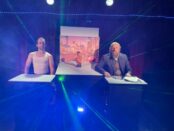
"The Rise and Fall, then Brief and Modest Rise Followed by a Relative Fall of…Jean Claude Van Damme as Gleaned by a Single Reading of His Wikipedia Page Months Earlier" is the brobdinagian title of a tongue-in-cheek, hour-long comic riff on the life of a faded movie star. The title is almost as long as the play. Timothy Haskell has written what is actually an extended elaborate skit brought to life by Joe Cordaro (perfect as a clueless Van Damme and other characters) and John Harlacher (hilarious as the all-knowing narrator) using puppets designed by co-director Aaron Haskell. The other director is Paul Smithyman who also designed the efficient conglomeration of a set which includes two podiums for the actors and a screen for the snippets of films and slides used to illustrate the story. In front of the screen is a slotted board into which the actors insert funny two-dimensional stick puppets. [more]
The Mint Theater Company continues its three play mini-festival of the forgotten plays of Elizabeth Baker with "Chains." Given a polished – maybe too polished – production like the earlier "The Price of Thomas Scott," this play is also problematic, but in another way. Unlike her contemporaries John Galsworthy, George Bernard Shaw and Harley Granville-Barker, Baker’s "Chains" has a very narrow focus: the discontents of the lower middle-class white collar folk. All of the characters in the play’s first half (the script’s Act I and II) do nothing but either complain about the grind of their daily six-days-a-week jobs (half-holiday on Saturday) or laugh at those who would give up a steady employment. You would think that back in 1909 when the play was written there wasn’t anything else to talk about. Jenn Thompson’s direction is conventional and sedate where something more animated might have been more to the point. [more]
Originally broadcast on "Soul!," an early PBS program dedicated to showcasing Black arts and politics, Baldwin and Giovanni's one-on-one echoes contemporary concerns while also remaining decidedly of its era. Unearthed by a theater collective and other trapped-at-home artists during the pandemic for an online recreation, it has now been transformed again, this time into a staged adaptation titled "Lessons in Survival: 1971." In truth, "googled" is likely the more appropriate verb for how someone found the Baldwin-and-Giovanni conservation, since it is entirely available on YouTube, where, to be honest, it is best experienced, not least because in that digital form it can be rewound for another listen, which a few of Baldwin and Giovanni's complex, unannotated arguments definitely require. [more]
In 'Circle Jerk," this cocky duo confidently preen, bray and cavort while donning various wigs and flamboyant costumes as multiple fey stock characters for over two numbing hours of their self-congratulatory twaddle. Their grating characterizations are achieved by intently staring into the camera, making faces, raising eyebrows and doing voices. It’s not "Your Show of Shows," but a niche audience of friends, relatives and trustafarians who could be amused by their antics. Cat Rodríguez appears in several female roles with campy flair. [more]
Romy Nordlinger has written and is performing the monodrama, "Garden of Alla: The Alla Nazimova Story," at the TheaterLab. Directed by Lorca Peress, "Garden of Alla" gives us this eccentrically talented artist up close and personal. Nordlinger has a history of portraying Nazimova and has honed her interpretation to the point that it fits her like a second skin, helped by Peress’ sense of pacing and stagecraft. [more]
Shekar’s script is extremely smart, funny at just the right moments, and morally gripping. Her characterizations of Ariel and Sanam are fully formed, uniquely individual and carefully complementary: Ariel is a crunchy-granola, bee-loving, single mom who’s desperate to prove Monsanto’s guilt, and Sanam is intense, strong-minded and honest to a fault. Through the character of Arvind, Shekar introduces the notion to Sanam that she and Ariel are looking at their study through the impartial lens of confirmation bias. The character of Dr. Hayes adds just the right amount of antagonism, almost sinister. Although there’s lots of statistics jargon in the script, it never impedes the progress of the story, thanks to the actors and director Aneesha Kudtarkar, who skillfully shapes the piece, finely intertwining the performances to maximum impact. [more]
Kaliski attempts a clever conceit marrying "The Oresteia" characters to the modern tragic story of the homeless hordes. Does "The Oresteia" provide an effective jumping off point to explore this timely and heartbreaking issue? Sadly, the answer is no. Kaliski has written a play whose subject matter is only tangentially connected to the characters Orestes, Electra and Clytemnestra who, in Greek mythology, lived in ancient Argos. Their stories of patricide and matricide and other ‘cides have no connection—emotional or situational—to the problem at hand and Kaliski doesn’t try very hard to splice the two subject matters together. [more]
Tennessee Williams’ full-length play’s titles, characters and dialogue have been part of the consciousness since "The Glass Menagerie"’s 1944 premiere. During his peak years of the 1940’s and 1950’s, he also wrote many one-acts, exploring his familiar concerns, chiefly the naïve preyed upon by the worldly. "Five By Tenn" is an enchanting program drawn from these, which are uniformly satisfying. This modest Off-Off-Broadway production is presented by the Out of the Box Theatre Company, whose members are artists mostly over the age of 50. The show serves as an introduction to rarely performed obscure Williams works, all of which take place in drab bedrooms, and as a showcase for the talented mature cast. [more]
The animated Aline Salloum fearlessly embraces all of Najaf’s unsettling complexities, delivering a riveting performance. In the early sexually frank verbal exchanges, Ms. Salloum marvelously recalls Elaine May’s matter of fact comedic brilliance. With his captivating boy next door presence, Erik Larsson as Drew offers a smashing characterization combining naiveté and Machiavellianism. As Josh and Ben, the equally commanding and personable Jalen Ford and Jake Bryan Guthrie wonderfully evoke boyish randiness and adolescent confusion. Though clearly not teens, this youthful quartet are totally and effortlessly believable in their roles. [more]
"Mr. Parker," the latest play by Michael McKeever whose "Daniel’s Husband" has been produced twice Off Broadway, has been given a stylish production by director Joe Brancato who also directed the earlier play. David Goldstein’s one-room studio set situated in the East Village is elegant and cozy. The costumes by Myra Oney are chic. The acting by its trio of actors is polished and urbane. Even its premise of a gay man dealing with the sudden death of a long-time partner and husband is up-to-date and timely However, as written the play seems superficial and slight. Dramatically it avoids all the big scenes that might have been included. It remains entertaining but without the payoff one wants in such a drama. [more]
Diriwachter is particularly skilled in writing working class vernacular. The Father and Tim speak the same language and he catches all the subtleties of decades of ups and downs. He also is wonderful with the two salesmen, cleverly finding the rhythm of their spiels that build up to the final pitches. His salespeople are written as clever but not unfeeling so that the audience never totally believes that the Father and son are being betrayed and cheated. [more]
Can a 27-year-old Black gay professional journalist and a 21-year-old Blatino bicycle messenger with an out of wedlock son find love and happiness together in Brooklyn? That is the crux of author James Earl Hardy’s compelling class-conscious drama "B-Boy Blues The Play," where all of its characters are confident of their varied sexuality. Mr. Hardy, an accomplished entertainment reporter, published his novel, "B-Boy Blues: A Seriously Sexy, Fiercely Funny, Black-on-Black Love Story," in 1994. It led to five sequels, a short story and an upcoming film version. Hardy’s stage adaptation premiered at New York City’s 2013 Downtown Urban Arts Festival (DUAF), which is also presenting this production. [more]
Following the lead of Francis Ford Coppola’s "Apocalypse Now," Siting Yang has updated Conrad’s "Heart of Darkness" to the present but left the story mainly set in Africa. In "Sky of Darkness" as the narrator Ma Luo (Yang’s new Marlow) is Chinese, the tale is now an exposé of Chinese interference in African affairs both financial and military. However, Yang complicates the story by having it periodically interrupted by The Ghost of Nigerian novelist Chinua Achebe who famously gave a lecture criticizing Conrad’s novella in 1975 from an African point of view as racist and stereotyped. But this Achebe doesn’t object to the story as a xenophobic work of post-colonialism but criticizes Conrad for what he says he did not see. He doesn’t take into consideration that Conrad’s story is told by a series of narrators and that Captain Marlow is horrified by the repression he does see by the European rulers (in his time the brutal Belgian occupation). [more]
Origin Theatre Company’s stark production of Kees Roorda’s A Kid Like Rishi is a totally involving Rashomon-like take on a real-life tragedy: In November of 2012, 17-year-old Rishi Chandrikasing, a young man of Indian descent, was shot and killed at a train station in the Hague by a policeman. Was it a case of racial profiling? A justified shooting? Accidental? In the English translation by Tom Johnston, Roorda thoroughly examines the event through the testimony of twenty or so witnesses all played by three disparate, but complementary actors: Sung Yun Cho, Atandwa Kani and Kaili Vernoff, all three quietly intense. The cell theatre’s well-known flexibility was put to good use by the scenic designer Guy de Lancey who placed the audience on four sides of a long wooden table around and upon which the actors performed Koorda’s sad docudrama. [more]
In four scenes spanning a few months, Ra renders his gay family trio’s life events, medical situations, numerous clashes and resolutions with pungent topicality. The pandemic is referenced, gender and pronouns are discussed, and cultural bromides are stated: “Black people can’t be racist. I read that on the Facebook.” Ra’s characters are given rich portrayals by the splendid cast. With his melodious voice, priceless facial expressions and stage presence, veteran actor Keith Randolph Smith grounds the production with his towering performance as Bartholomew. As Maxwell, the fiery Emerson Brooks supremely conveys the character’s bottled-up emotions, offering a moving psychological portrait. The personable Gerald Caesar’s Tony is a vivid take on adolescent struggle. Randy Harrison as Charles offers a winning take on the supportive spouse with his straightforward vocal delivery and calm manner. Lithe, animated and spunky Ryan Jamaal Swain hilariously and poignantly tranmits all of Antoine’s facets. The radiant Tiffany Villarin combines levity and warmth as the noble Chloe. [more]
James Ijames’ "Fat Ham" (all puns intended) is the latest and most successful modern riff on the Bard turning Hamlet into an expression of the Black experience while at the same time having much fun at Hamlet’s expense. As one of the few comedies to ever win the Pulitzer Prize, we should be hearing more soon from this talented playwright whose "Kill Move Paradise" in 2017 appears to be his only other New York credit, also directed by Saheem Ali. Already an associate artistic director/resident director with The Public Theater, Ali has previously worked wonders with "Merry Wives," "Nollywood Dreams," "Shipwreck," "Fires in the Mirror," "The Rolling Stone," "Passage," and "Fireflies," among others at various theaters around town. As usual his casting choices are perfect to the nth degree. [more]
Written by Renee Philippi, this witty mockery of authoritarianism is derived from Friedrich Schiller’s play "The Robbers" and the Korean novel "The Story of Hong Gildong." Composer and lyricist Lewis Flinn’s smart original score joyously recall’s Kurt Weil’s galvanizing melodies and Bertolt Brecht’s biting lyrics. It’s rousingly rendered by musical directors Jacob Kerzner and Hee Eun Kim. [more]
Takiff is a skilled performer who never loses the audience no matter how angry or sardonic he gets. He is helped by the mood setting lighting of Elizabeth M. Stewart and the sound and video contributions of Matthew Chilton. Mark Mindek provides some minor, but effective, dance bits. Brian Lane Green’s direction made all of pieces fit together into a cogent whole. As difficult as the subject matter is, "Jews, God, and History (Not Necessarily in That Order)" should be seen as a fresh, in depth consideration of the subject matter. [more]
Although playwright Anchuli Felicia King’s plays have been performed in London, Washington, D.C., Staunton (Virginia), Melbourne, and Sydney, her Susan Smith Blackburn Prize-nominated "Golden Shield" appears to be her first New York main stage production. Ostensibly about a young, idealistic lawyer’s attempt to bring her sister on board as a translator in a risky legal battle with a multinational tech corporation, the play is about half a dozen other things as well: sibling rivalry, child abuse, ethical turpitude, human rights issues, governmental suppression of the internet, legal loopholes, and corporate greed. The play actually conflates two different very real lawsuits (against internet giants Yahoo and Cisco) which may explain why it is initially so complicated. [more]
While this is not an in-depth interpretation and at times seems a bit superficial, Will Pomerantz’s production of "Three Sisters" is a true ensemble making it appear that these people have lived together for years. His new adaptation in contemporary idiom is easy on the ears and easy to comprehend. The pacing of the production is always on the move which is saying a good deal when it comes to Three Sisters which is often performed in a glacial style to mirror the characters’ boredom and disappointments. Here the characters complain about their fate but get on with their lives. [more]
This premiere five-performance Off-Off-Broadway showcase run of "The Oracle" is best viewed as a tryout, and the production’s presentational flaws are cited with that belief. Co-author Elliott also directed; while he’s assembled, well-positioned and guided the industrious cast to lively performances, his physical staging is variable. The play is structured as 34 brief scenes over two acts. Instead of rapid transitions, there’s a pause between each scene while recorded music plays as the actors get in place. This intrusive strategy slackens the pacing and adds to the running time. [more]
Alison Leiby’s "Oh God, A Show About Abortion" is probably the most level-headed work about that much debated subject, perhaps too level-headed. While the United States is going through social and political paroxysms over a leaked Supreme Court argument that portends the overturn of Roe v. Wade, Leiby’s matter-of-fact attitude toward the subject is a balm. [more]
Adam Kraar’s new drama, "The Karpovsky Variations," is a memory play about a dysfunctional family of driven people and the music that inspired them. Unfortunately, in its current form it is both confused and confusing. Without a family tree, it is difficult to keep straight all of the names of characters both seen and mentioned. Director Tasha Gordon-Solmon has eliminated almost all of the scenic elements described in the script which does not make it any easier to follow. There is a fascinating story hidden in this material but it hasn’t been allowed to surface yet. [more]
This charming show comes from the acclaimed Spanish troupe, Kulunka Teatro. The ensemble of Jose Dault, Garbiñe Insausti and Edu Cárcamo all offer awesome physically commanding silent portrayals of a variety of types while encased in Ms. Insausti’s stupendously created caricaturist masks. Their handling of props is majestic. During the exhilarating curtain call, the cast appears without masks, and their magnetism is even more visible. André & Dorine’s engaging wry scenario was devised by Insausti, Mr. Dault, Iñaki Rikarte, Mr. Cárcamo and Rolando San Martín. [more]
Though there’s two well-delineated characters and a compelling plot, "A Case for the Existence of God" plays out like a 90-minute cerebral exercise, reaching an unsatisfying pseudo-fantastical conclusion. This is explained by Hunter’s stage directions which explicitly have the actors sitting for a good deal of the time. He has several dictates as to how his dialogue should be delivered, one example is “Dialogue written in italics is emphatic, deliberate; dialogue in ALL CAPS is impulsive, explosive. Dialogue in [brackets] is implied, not spoken.” [more]
Alice Childress’ "Wedding Band," which is a difficult play to stage due to its shifts in tone, is a major rediscovery. However, it straddles a thin line between realism and romance and its poetry needs to be handled very carefully. Unlike the tamer "Trouble in Mind," "Wedding Band" has a very strong message and a good deal to say about racism in American in telling its sensitive interracial love story about a time when it was a love that dared not speak its name. While this production makes some problematic choices, the time has certainly arrived for this play to be returned to the American stage. [more]
Freshman playwright Charles Gluck, a retired gastroenterologist who has finally followed his dream to write a play, has turned out one terrific piece of theater. There is virtually no superfluous dialogue in this script; almost every line serves a specific purpose, whether it’s to provide key exposition, continue to build the play’s fully three-dimensional characters or to accelerate and intensify the dramatic through point. [more]
In the 13 years that span this earnest, thought-provoking play, three weddings, fear, war, and death all serve to test the strength and sanctity of these women’s bonds. Toossi’s script is intimate, and searching, both funny and heartbreaking; "Wish You Were Here" is a beautiful testament to the strengths and allegiances women find with each other in times of turmoil and oppression. [more]
Direction by Victoria Pérez could have better negotiated the script transitions and emotional shaping of the piece; however, script, director and actors, as well as lighting design by Miguel Valderrama and sound design by Michael Hernandez all come together to create a moving ending which comes with no answers but does provide a sense of closure. "Bloom" hasn’t fully flowered in this incarnation, but perhaps more will be revealed in future productions. [more]
Playwright Martin Crimp, an adherent of the ”in-yer-face” school of British playwriting, has taken Edmond Rostand’s turn-of-the-last century verse drama, Cyrano de Bergerac, and not only blown off the cobwebs but exploded it into an entirely new 21st century experience. Staged by innovative director Jamie Lloyd, it has become a showcase for titanic Scottish stage and screen actor James McAvoy making an unforgettable New York stage debut in the title role as the 17th century poet and soldier. [more]
Lee peppers his worn scenario with plenty of pop, cultural and political references, well-crafted zingers and familiar conflicts. Dating apps, "Dancer from the Dance," "Sex and the City" are among the totems cited and a Trump supporter is declared to be a “MAGA fag.” "To My Girls" succeeds as a rote genre-piece for a niche audience desiring a simplistic gay play where there’s laughter, tears and resolution in drag danced to The Pointer Sisters. Lee’s thinly drawn characters are highly playable. [more]