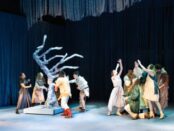
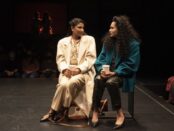
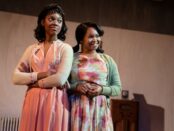
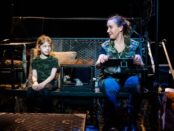
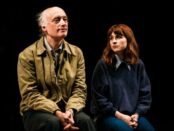
"GAS" by Charles Cissel explores the “never-never land” of a war without end. It is a time when the characters examine the unreality of the experience. It occurs within an ill-defined dimension resembling a bombed-out children's playground. Felicia Lobo guides the able cast through what is, at times, a complicated, multilayered story that ultimately fails to deliver the nuances of the script engagingly. [more]
The world premiere of Emma Sheanshang’s "The Fears" is a hilarious and poignant satire on self-help groups and the sort of people who take their emotional temperature all day long – literally. It is the latest in a new genre of plays in which the humor comes from something that may be painful but it is still possible to laugh at. Smoothly and astutely directed by Dan Algrant who has mainly worked in film, the ensemble of seven actors are entirely convincing as a group of damaged people who meet once a week at a Buddhist center in New York City to deal with early traumas that are keeping them from moving on in their lives. While the play fails to make a bigger statement, it remains entertaining and engrossing throughout. [more]
While the painstaking entry upon entry yearn to be something of import, we can’t help but feel it takes a certain steadfastness and desperate commitment to make the banal seem so extraordinary. This is where the brilliant attack of performance by Ms. Lauren as Evelyn, and Violeta Picayo as Evelyn Brown, come into play. Ms. Picayo can be thought of as the younger Evelyn, but the fact is they are both the same person usually on the stage at the same time, experiencing the same ennui. Ms. Lauren is the human map of a sometime wordless exploration of isolation. There is nothing secretive about it. We are witnesses to every one of her emotions as it makes its way across her face and into her beaten down yet stalwart physical life. Ms. Picayo sometimes has that innocent wide-eyed wonder that gets her through to the end of a scene, making us pity her for her stiff upper lip and beatific smile in the face of a life not well-lived. [more]
Eboni Booth’s "Primary Trust" at the Roundabout Theatre Company’s Laura Pels Theatre is a genial, gentle tale of a genial, gentle young man and his difficulty negotiating the speed bumps of life. What keeps "Primary Trust" afloat is the light touch of its director, Knud Adams, who never lets Booth’s play bog down. Rather than wallow in sadness, Adams permits the actors—all fine—to ride the gentle waves of their fates. [more]
As directed by the astute Josh Sharp, Kayne begins his show as a stand-up act, but warns us “This is a comedy show. BUT it is also sad. There will be long stretches where you will not be laughing. I don’t want to feel like I tricked you, so I’m telling you in advance.” However, Kayne is able to find the absurdity in things that are inherently sad so that there is much humor in his one-man show. After his stand-up comedy routine, he gives a short math lesson using a white board and a black board (set design by Brett Banakis) to demonstrate that things are often not what they seem. [more]
Abortion, pro or con? The Blessed Unrest theater company has taken on this thorny issue. Steven Wangh’s "Misconceptions"—an ironically perfect title—unfolds in the form of a series of interviews which take us into every nook and cranny of the issue—pro and con. It is by no means just a dry documentary or a blasting screed, but a warm, sophisticated and ultimately moving humanization of the subject. [more]
All of this is told by Baer in Twain’s humorous and inimitable style filled with anecdotes both true and untrue. As we are told from the author himself, “I have never been a man to allow the truth to stand in the way of a good lie.” The presentation also includes sections from travel letters in Twain’s own words besides a large section of Huckleberry Finn’s adventures down the Mississippi. The presentation also sets Twain’s life in the context of the growing America of those days, events like the Gold Rush, the transcontinental railroad, the election of Abraham Lincoln, the burgeoning of literacy and the press, etc. Even if you know a good deal about the life of Samuel Clemens a.k.a. Mark Twain, Joe Baer’s one-man show fills in a great many gaps with fascinating adventures of a world traveler who had a keen eye for the ridiculous and the satiric. In "Samuel Clemens: Tales of Mark Twain," he remains good company throughout the evening. [more]
And the production is loaded with action. Except for the tender love scenes, the play moves at almost breakneck speed. Where most modern productions of Shakespeare tend toward languor, this "Romeo & Juliet," skillfully directed by the playwright and her co-director Dustin Wills, fills the moments that traditionally let the mind wander. A couple of back-to-back scenes that inform the audience, but with virtually the same content, are now played simultaneously. This makes the audience work more industriously to listen and separate out the conversations and Hansol Jung’s contemporary take on Shakespeare’s text make it that much easier to accomplish. [more]
The play is structured as a mystery and that is being revealed with sensitivity and care. As each element is shown, a clearer picture of what is at stake emerges. A discussion in Act II about Hannah Arendt's work "Eichmann in Jerusalem, A Report on the Banality of Evil" triggers a conversation on the meaning of evil. This discussion of the idea of the banality of evil is the thought-provoking idea being acted out in the play: How does one judge what is truly good and what is truly evil? [more]
However, both every scene as written by Maldonado and directed by Theatre East’s artistic director Judson Jones is staged as though it were the climax. It is one thing to enact a play up to the hilt. Here there is no arc or build up. Every scene begins at the top and leaves the actors with nowhere to go. Although performed by a tight quartet of actors, as written the characters are two dimensional, telling us no back story and little about them. [more]
"shadow/land" by Erika Dickerson-Despenza is a play about the August 2005 disaster, Hurricane Katrina. It is the first episode of a ten-part magnum opus. "shadow/land," though, is more than a play. It is a painfully rich vision of what hundreds and hundreds of stranded rooftop denizens, so touted in the media, must have gone through behind the waterlogged walls of New Orleans. It is the rare theatrical work that recreates the agony and frustration of a natural disaster that transcends the fourth wall, seemingly without artifice, so involving is the entire endeavor. [more]
There’s no shortage of race-related storytelling in today’s theater and film arenas, and it takes a special entry to become seen among the offerings. "Being Chaka" is one such play; thoughtful, sensitive, and earnest, it weaves an exploration of racism throughout its distinct and intriguing characters, with compassion and without a heavy hand. [more]
Under the direction of Chad Austin, Droxler uncannily becomes not only Williams (and all of Williams cinematic characters who each serve up different helpful advice), but also his father Ed; mother Mary; and other characters, all, of course, just facets of his own persona. He even conjures the comic actor Jim Carrey who, for a short time replaces Robin Williams as an ad hoc advisor. Even Jack Nicholson makes a guest appearance. [more]
From the moment he walks out with a stuffed “Disneyfied” dragon to tell us a fairy tale his mother told him when he was little, we are enraptured by Pinky, an 11-year-old Chinese boy growing up in San Francisco’s Tenderloin. Written and performed by Wesley Du, "Hong Kong Mississippi" is a coming-of-age tale that speaks innocently, yet often in frank terms, of racism. And providing the real dose of irony, the only other character to experience a seismic shift in the play is the man who resents Pinky the most, a man who against his better judgment unknowingly becomes Pinky’s mentor and father figure he never had. [more]
Directors Noah Brody and Emily Young, both of the Fiasco Theater, have neatly trimmed the dialogue and some of the minor characters so that the play comes in at two hours and 15 minutes. However, they have made some choices that work much less well. Except for a rolling doorway to designate Merrythought’s home, Christopher Swader & Justin Swader’s scenic design does not differentiate one scene from another due to its lack of design elements. Other than the musical interludes, the productions lacks atmosphere in all its scenes. They have also used doubling and tripling to the point where it is difficult to keep straight who most of the actors are when they appear on stage in this play that has probably never been seen by most members of the audience. Most distracting is actress Royer Bockus playing three male roles – Merrythough’s son Michael, Little George, and a Servant as well as a horse named George. The role of Venturewell has had a change of gender but as Tina Chilip is still called “Merchant” but does not suggest one in her 17th century matron costume, this remains a little disconcerting. Characters who play major roles in one scene return to play minor roles in others which is more than a little confusing. [more]
The direction by Nicholas Viselli ultimately misses a key point in this plot, which is that Alan and Annette should be staged as perpetually trying to leave Veronica and Michael’s apartment. These two couples are strangers to each other; they are not friends or even acquaintances. Yet the staging plunks the four of them together with too much familiarity and intimacy. Their situation does not call for them to remain in each other’s company for so long, or for backrubs to be exchanged, etc.; it’s just not believable. The entire premise of the plot is made implausible by blocking and acting choices that should have been redirected. [more]
I left with questions about what I had just experienced. It was not a feeling of dismissal but one of consideration for the experience. It was and is not a question of good or bad but whether it works or not as a play. The average theatergoer thinks "Waiting for Godot" or "Endgame" are bad plays because understanding them is not readily accessible. While "The Singing Sphere" is not an easy play to engage with, I think it does work, but it is for a select audience. [more]
While the playlets seem too slight to have much dramatic weight as they are mainly about one minute long, they do have a cumulative effect summing up a year that was like no other in recent memory. Often the scenes feel like they want to go and continue, but Parks keeps them short. Periodically, we have a one sentence scene telling us how many people have died from Covid as of that date. Beginning on March 13, 2020, the first full day of the shutdown, the playlets continue until April 13, 2021, a year and a month from when Parks started. An electronic sign above the stage states the date of each scene and its name which include such titles as “Home,” “Broadway Is Closed,” “The City at 7 PM,” “Who’s Gonna Pay For This?,” and “Hiatus 4 Months: Holding It Together Together.” [more]
Where does one begin to tell the story of two manifestly successful lawyers who mixed professionalism with adolescent ideation? A case where one wants a career as a serious law practitioner and the other not so much. But they both want to make money, and they both have egos that want to be in the spotlight. I suspect that Mike Breen and David Rafailedes, the writers, performers and directors of "Cellino v. Barnes: The Play," asked themselves the same question in 2017 when they decided to write a humorous play about the creation and impending demise of the Cellino & Barnes personal injury law firm. Unfortunately, in their effort to find the broad humor in the partnership's creation and end, Breen and Rafailedes missed the mark. [more]
Tangredi’s script has some lines that could stand revisiting, but even in its lack of polish it does have good dramatic bones. Unfortunately, "Muse" fails utterly on delivery. Although the direction by Hazen Cuyler demonstrates some inventive staging in scenes which take place simultaneously in different times, it completely misses the mark by not insisting the actors listen to each other in earnest and find their dialogue organically. Thus, the acting is unilaterally unbelievable; the performances are stiff and filled with maudlin, melodramatic mugging and grandstanding. [more]
Fortunately for us, “Magisian” Drance is quite the storyteller. Under the reasonably succinct direction of Jackie Lucid, he spryly moves around the space, emphasizing parables with chalk drawings and applying subtle changes to his inflection, body language, and eye contact to make the various characters distinct. Intense and playful, somber and jubilant, he makes this story engaging yet simple, without the help of costumes, scores, and songs which allow shows like "Godspell" and "Jesus Christ Superstar" to thrive in the contemporary theater canon. The Magis Theater Company endeavors to share this gospel as it might have been done in older times, from start to finish and on the backs of its storytellers alone. [more]
Bossert directs his own work here, thereby unfortunately removing any crucial distance from the material. Where the story of the play and the relationships we see are engaging, the play-within-the-play enacted by Sandra and Barry is not. The narrative there is a sequence of conversations cut off by interruptions that neither add nor detract from the scene at hand. The real-life interruptions by Wesli as the “director” unhappy with the way the scenes are moving are almost a relief from what the audience has just listened to. The fact that an entire town anxiously awaits each new episode is somewhat unbelievable unless they are truly desperate for diversion. [more]
Gunderson uses two actors to play Emilie and writer Voltaire who was her mentor, companion and lover, and then three actors to play everyone else, from Emilie’s mother, husband and daughter, to servants and mathematician Sir Isaac Newton and poet Jean-Francois de Saint-Lambert. As they do not change their costumes, we are never entirely certain who they are when they reappear. Throughout the play Emilie is working on the physics formula F=mv2 (known as force vive) which she attributes to German mathematician and thinker Gottfried Wilhelm Leibniz. Unfortunately, this math will be foreign to most theatergoers who have not studied physics. Emilie narrates and addresses the audience, then turns back and interacts with the other characters on stage. She also keeps score in chalk on the walls as whether Love or Philosophy is in the ascendance. The play, cast as a flashback, has very short scenes so that a great deal passes in a short time. While the first act seems to be bits and pieces, the second act settles down into a more dramatic confrontation between Emilie and Voltaire and becomes more involving. MacGowan never finds the right tone to accomplish all of this. [more]
Silliness and whimsy can often be admirable qualities in a play, but not when taken to the degree playwright Julia Izumi has in her new work, "Regretfully, So the Birds Are," a co-production of and WP Theater and the Playwrights Horizons where the show has been well launched. "Regretfully," directed by Jenny Koons, centers on the trials and tribulations of the Whistler family: mother, Elinore, in prison for burning her husband alive; Illy and Neel, brother and sister who want to marry each other; sister Mora the cynical third sibling; and Cam, the dead father who has morphed into a snowman. [more]
"Bringer of Doom," written by Joe Thristino and smoothly directed by Mark Koenig, is a comedy about Lotte and her effort to exact revenge against her estranged mother, Esme, because of a public humiliation her mother inflicted. She uses an ex-comedian, Demetrius, or more precisely, a no-longer-performing comedian, as the waiter to serve her revenge, cold, but with a measure of spice. His job is to "roast" Lotte's mother with clever rejoinders and barbed put-downs when she comes for dinner at Lotte's apartment. He is to make her highly uncomfortable without causing her to leave. [more]
Mary Elizabeth Hamilton’s Smart has an interesting premise but does not carry out its goal turning quickly into a domestic drama and later a bittersweet love story. The two acts seem to be two different plays while the sketchy characters do not give the fine three actresses much to work from. Even the production values get in the way of understanding the play. Hamilton has a good ear for dialogue but needs to work on plotting and characterization in order to make this a satisfying theatrical experience. [more]
For the audience, there is an ease of losing sight of the fact that what we are watching is a piece of theatre. Campbell is direct and warm and instructing and sensitive in this piece that he has written. He has the right amount of connection to the material, obviously, as this is a scene from his life, yet he creates the minimal distance from the piece so the audience doesn’t obsess over how maudlin the subject matter is. Instead, the audience can be enlightened by his path. [more]
"Darkness of Light: Confessions of a Russian Traveler," written and directed by Michael Mailer and Alexander Kaletski, is a story of an artist's journey from the restrictions of one political and economic system to the compromises needed in a more open and accepting system. It explores how a Russian artist, Nikolai Rodnin (Jonathan Glass), tries to hold onto the truth of his artistic expression while dealing with the material needs for survival. An important, subtle, and contrasting story is that of his brother Sergei Rodnin (Alex Yuille). [more]
Composer/librettists O-Lan Jones and Emmett Tinley have created what they refer to as “a re-Creation Myth” in this fascinating interdisciplinary opera theater work entitled "Iceland." It is profoundly musical in that it embraces both opera and contemporary musical theatre by casting 12 opera singers as The Hiddenfolk and Mythic Beasts of Icelandic folklore and two musical theater singers who would be equally comfortable sitting on the Billboard Hot 100 as the two leads that are pushed together romantically over the course of 17 hours one New Year’s Eve in Iceland. [more]
"Lunch Bunch" by Sarah Einspanier and directed by Tara Ahmadinejad is a rapid-fire comedy with farce ensemble timing in the service of a serious underlying topic, presented on a bare-bones set. It is about a group of overstressed lawyers in a public defender's office who think they have the perfect antidote for their daily struggles by sharing lunches. It is funny, touching, and worth experiencing the comic talent of the cast and the amazing flow of the story. [more]
The Israeli Artists Project, dedicated to bringing the art and artists of Israel to American audiences, has mounted a production of Anat Gov’s "Best Friends," a zippy portrait of three best friends through the years. The play, presented alternately in Hebrew and English, fits snugly on the stage of the Rattlestick Theater in the West Village. [more]
Some critics would say Eric Bogosian’s "Drinking in America" is dated, but that’s very much up for argument. The script given to critics for the new production at the Minetta Lane Theatre is marked “Tweaked Drinking In America Script For Audible,” all in caps actually. In all fairness, some of the “current references” particularly with regard to in-demand actor names bandied about in the scene entitled “Wired” are names clearly from another age. That could have easily been “tweaked,” if they really wanted to do that. References to Quaaludes in the scene “Our Gang” reek of history rather than current usage, but then again, is there an easy 2023 replacement for Quaaludes, a drug that was taken off the market around the time the play was first produced? Aside from those references, the twelve scenes that comprise the play remain shockingly topical for our era. [more]
Unfortunately, Monohon’s play which takes its cues from Miller’s drama, assumes a thorough knowledge of "The Crucible" and leaves out a great deal of information that would make it easier to follow. For example, John Proctor’s name is never uttered by the girls even after Abigail goes to work for him and his wife in the play. Caitlin Sullivan’s direction is too tame by far so that the play is not very dramatic. The most exciting event, the trial itself, is left as an afterthought and narrated years later by one of the girls after her death. [more]
"Trilogy II" by Garry Batson, directed by Evria Ince-Waldron, is three one-act plays depicting the struggles of African-American families faced with difficult and troubling events. The good and bad things that happen seem random or unfair. According to Batson, the common link among the stories is the clash between good and evil. However, except for "Fort Knox," the remaining two plays, "Flight Risk" and "Ill Winds," focus on aspects of good and bad, not specifically evil. For this reviewer, something evil is an extreme form of bad because not all bad things are necessarily evil. [more]
The problem with this production is that although the characters’ behavior is utterly outrageous on the verge of satire, Berger has directed in so flat and bland a style, that shocking lines that should get embarrassed laughter fail to make any impression. Has Berger directed the play absolutely straight knowing that his audience is unlikely to be familiar with it? It would be more fun and rewarding if was as over-the-top as the murderers’ plotting. [more]
The direction by Ella Jane New delivers this emotionally complex story with skill and sensitivity. There are only a few instances when the action doesn't entirely ring true, such as the opening scene when the brothers first enter the house. Gostkowski's presentation is somewhat distracted as if he is looking for the character's voice. Rysdahl is more in tune with his character at this early stage but is also somewhat flat in affect. They may be trying to bring out the awkwardness of two brothers trying to find their emotional footing with each other after a number of years apart. They find their footing as Act I progresses and deliver fine performances. [more]
Not for everyone, this minimalistic theatrical event is performed entirely in Japanese with English language supertitles above the stage so that for non-Japanese speakers it requires reading of the text throughout. More’s the pity as Nakatani is a very expressive actress (having won six Japanese Academy Awards) and one doesn’t want to miss a moment of her performance. [more]
When it comes to plot, characters, or often both, even the best theater tends to require a suspension of disbelief. Given that it's hardly a sucker's bet for indolent playwrights to pin their hopes on the lack of effort it requires an audience not to think, what Keith Bunin does in "The Coast Starlight" is astonishing. Taking its title from the Amtrak overnight sleeper that scenically services an ocean-hugging route from Los Angeles to Seattle, the play is primarily set in one of the train's coach cars, where the passengers, a group of strangers, are reluctant to break the silence between them. Mostly, like real human beings, they don't, or at least not when it might have done some good. [more]
"The Conductor," by novelist Ishmael Reed and directed by Carla Blank, is a play that uses the revival of the Underground Railroad system as a device to address several contemporary socio-political issues related to race and ethnicity. It is a show that directly addresses extremist conservative groups and their movements that seek to restrict and limit governmental and social actions used to address institutional inequality. Reed utilizes the result of a school board recall election in San Francisco as the basis for illustrating the insidious nature of these reactionary groups. [more]
While playwright Scovell has a facility for language, she does not have the wit to mimic Wilde’s classic one-liners. Instead, she borrows expressions from the play and attempts to imitate the format of his humor. Lines like “It is imperative to be an attentive hostess, but never forgot that you are your most important guest” and “I’m glad to hear that your fervor for the truth is tempered by your humanity” pass for witticisms. Much time is spent on whether a wedding was “elegantly extravagant” or “extravagantly elegant.” The opening scene of the first act (and the end of the second act) is devoted to a discussion of cucumber sandwiches, which Wilde did justice to in his play and as such this comes as no surprise to an audience versed in the earlier work. [more]
What makes "Elyria" intriguing is how its American location affects the hidebound ritual social rules of its Southeast Asian characters. That all the characters emerged from an African diaspora that seemed to have little influence on their ingrained Indian culture only adds to the colorful rendition of an old-hat story. [more]
While this first New York revival of the 1995 "Crumbs from the Table of Joy" does not reach the heights of Nottage’s later Pulitzer Prize-winning plays, "Ruined" and "Sweat," it proves to be a very charming and competent look at growing up Black in Brooklyn during the McCarthy Era. Under the direction of Colette Robert, the fine cast holds our interest with this domestic comedy drama. Always engrossing, the play demonstrates Nottage’s ability to write about race, social change and economic deprivation in an engaging manner. Nottage proves to have been a very accomplished playwright from the outset of her career. [more]
Director David Herskovits must have looked at this as a true labor of love, but not all of the touches support the hard work of the actors. In some of the early ensemble scenes, the actors put on exaggerated courtly poses. The poses do nothing to further what is going on dramatically;, they appear done just for the sake of being curious. But Mr. Herskovits succeeds with the handling of deeply humane and touching scenes. [more]
Eric Bogosian’s latest play to reach New York is his 2008 "1+1" which feels like a made for television movie written without taking into consideration the #MeToo movement that has occurred since then. While its Hollywood milieu of pornography, drugs, and easy money exists, this seems like a rather simplistic view of it all. Director Matt Okin, founder of The Black Box theater company of Englewood, N.J. which has coproduced the play now at the SoHo Playhouse, has done the actors no service allowing for a kind of soap opera acting. The minimalist production values undercut the discussion of the perks and glitz of the film world. [more]
"War Dreamer" is a compelling exploration into the psychology of a female veteran who served in Iraq. It is a depiction of the struggles of a veteran to make sense of the memories, nightmares, paranormal events, and mental dislocations that intrude daily. Those experiences are more than a function of post-traumatic stress disorder. They result from a life lived in the alien world of war and all that is that experience. The play is a frighteningly accurate presentation of the process that some veterans must navigate as they try to return to a "normal" life. Written by Leegrid Stevens, "War Dreamer" has a storyline that is not straightforward in time and place. It is disconnected from a regular flow of action, with jumps in time, place and reality. However, he skillfully keeps the audience guessing what is real and what is not without losing the story's underlying thread. Stevens makes the audience both witness and participant as he brilliantly weaves his story of trauma and disassociation. [more]
While it may have appeared a huge gamble to mount this 'Cat" again, the results are so well worth it. While other productions of "Cat on a Hot Tin Roof" have been mounted as star vehicles for actors whether they were right for the roles or not, this new Ruth Stage production brings it back to what the playwright originally intended – an incredibly solid ensemble piece. Here we see it as we’ve come to know it – one of the finest American plays of its generation. It is unequivocally a must-see! [more]
Shayok Misha Chowdhury’s "Public Obscenities" having its world premiere at the Soho Rep is an immersive story into Bengali culture in Kolkata, formerly known as Calcutta. Directed by the author in 12 episodes which are given chapter names, this two hour and 50 minute play is as much like a television mini-series as it is a family saga. The realistic production resembles a film as much as it is possible on a stage with our attention being guided to various alcoves as though they were film cuts on the remarkable setting by the collective dots. The play is challenging as the first long extended scene is mainly in Bangla, the language of Kolkata, without supertitles. While the rest of the play is translated when it is bilingual, the dialogue is studded with Bangla words which are left up to the audience to figure out. [more]
Absurdist to an increasingly ho-hum degree, Szadkowski and Knox let their imaginations run amok with silly speculations about pre-double-homicide life in the Borden household that are punctuated by head-scratchingly anachronistic jokes involving Tinder, Cabbage Patch Kids, John Belushi, and whatever other free associative references apparently sprung to mind during their no-doubt personally enjoyable writing sessions together. The problem is that Szadkowski and Knox are incapable of bridging the gap between their evident fun and our actual entertainment, an obnoxious shortfall made cringe-worthy by the fact that they both star in "Fall River Fishing." For the charitable among us, I suppose, seeing Szadkowski and Knox delivering their own unfunny dialogue might compel a forced giggle, especially in such close downtown quarters. But theater is expensive and time is fleeting, so a lack of chortling generosity is also perfectly understandable. [more]
Borinsky’s dialogue is filled with colorful, quirky lines which are often funny and entertaining, but the entire script borders on absurdity without a cohesive through point. There are a handful of lines which carry a promise of meaning, but most are tossed into the air like tweets, missing connections and lacking purpose. There’s a passage inspired from Deuteronomy 20:19, which, if it’s supposed to be the inspiration for the plot, stands alone as one of the few sage moments in the story. [more]
Hands down Emily Feldman’s "The Best We Could (a family tragedy)," at the Manhattan Theatre Club, wins the most ironic title of the year. Not one character does the best he or she could in this heart-twisting five-actor drama. The play details the long, slow descent of a family, cushioned only by an occasional jest and buoyed by the intensely moving acting by the ensemble with Frank Wood standing out in a superb demonstration of artistry. [more]
Alexander Zeldin’s "LOVE" seems much longer than it actually is due to much silence and the reenactment of everyday tasks usually skipped onstage in plays. There is little dialogue and what there is tends to be rather ordinary talk about daily living. The play mainly works as a sort of experiment in the way that the Federal Theatre Project dramatized burning issues in the 1930’s. However, the play is a valuable record of life in a shelter using a documentary approach so real that it makes us feel like voyeurs. While the title remains unexplained, by the end each of the adult characters get to say it as a reminder that they have the backs of the others. [more]
When a tall, lanky Max Ritvo entered Sarah Ruhl’s playwrighting class at Yale, she knew this was no ordinary 20-year-old student. Self-described as a poet with a sense of humor, he managed to capture her heart, and she remained forever changed. "Letters from Max, a ritual," now being presented by Signature Theatre, is not just a collection of correspondence between the two, but a document of a deep emotional bond between two creative souls that can’t even be severed by the untimely death of one of them. [more]
Aside from the problem of which translation from the Russian to use, the thorny problem with American productions of the plays of playwright Anton Chekhov is how to deal with the fact the author himself called them comedies but everyone from his early director Konstantin Stanislavski on has seen them as tragedies. Playwright Thomas Bradshaw has neatly solved both problems: in his new adaptation renamed "The Seagull/Woodstock, NY" which recasts the play as an updated modern comedy, he also made the play a very funny satire of today’s culture vultures, thespians and the literati. His version in which all of the names have been Anglicized makes Chekhov’s turn-of-the-last century play very accessible to contemporary audiences which is not often the case with Chekhov adaptations - without making drastic changes. In doing so, it makes whatever parody there was in the original of theater and literary icons of Chekhov’s time now understandable to today’s audiences due to updated references they can recognize. [more]
Originally entitled "Francie Nolan," the same as the title character of her later "A Tree Grows in Brooklyn," but unrelated to that story except for sharing its Brooklyn setting, the play does incorporate anecdotes and scenes that would later appear in Smith’s novels. "Becomes a Woman" is uneven in tone, with a first act that is comedic, a second that is melodramatic, and a final act that is dramatic. On the one hand, the play is now a period piece depicting strict mores and values that have loosened up a great deal; on the other hand, much of its cavalier treatment of women is still unfortunately true today. While the first two acts resemble a great many films and plays of the 1930’s concerning fallen women, it is the third act which is progressive and ahead of its time, so much so that it may have scared off the all-male producing fraternity of those days. While the women are beautifully written, the male characters are undeveloped and not believable. As a result, the acting is the same with the best performances by the actresses and some unreal work by the men. [more]
The second play of Samuel D. Hunter’s residency at Signature Theatre is the first New York revival of his 2011 Obie Award winning 'A Bright New Boise," not seen by too many people in its short schedule run at The Wild Project in the fall of 2010. Oliver Butler’s production is a taut drama with rising tensions throughout until the climax. At first appearing to be a workplace drama set in big box store breakroom, the play turns out to be a meditation on faith, relationships and expectations. The ensemble cast is excellent and makes this a riveting piece of theater. The title is ironic in that all of the characters are going through crises and do not see the promise of a new world, in fact, they are mostly pessimistic about the future. [more]
Garner is a wonderful actor, shifting easily and subtly from one character to another, her voice, posture and gestures are just right. She avoids being maudlin and thereby makes her narrative even more heartbreaking. Even when Eleanor is reunited with her favorite apple tree back in New Jersey, she hits just the right note of sweetness and hope. [more]
Setting aside societal shame and judgment, anonymous sexual encounters have their benefits. If the chemistry works, then there’s the immediate gratification in the form of pleasure. If the connection isn’t perfect, then deciding to make a quick exit (either before or after the experience) can be awkward, as well as deciding whether a “repeat” is in order. A bigger question which might come to mind is why does a person choose an anonymous “quickie” over getting to know someone first? Are they looking for validation, or avoiding fears of loneliness, commitment, or rejection? Are they wearing anonymity like armor? Such thoughts come to mind as Mark O’Halloran’s swift and engaging play “Conversations After Sex” unfolds, a collection of scenes in which the unnamed character of “She” (played by Kate Stanley Brennan) engages in post-coital dialogues with several different men she has met on-line, in bars or in passing (all portrayed by Fionn Ó Loingsigh). [more]
The ensemble in this show does an outstanding job. Christina Bennett Lind as Annie gives us a direct and well executed view of a frightened, emotionally conflicted woman amid a psychological breakdown. Wilson convincingly plays Izzy, showing us a character who appears balanced and somewhat detached from the emotional conflict but still leaves room for questions about what may be behind that stable, rational façade. Eckert, as the Warden, plays a crucial part as the bridge to the understanding of the show's central theme and later provides a path to the ending. Finally, Ingulsrud is both Paul and Eddie, presenting characters who, although growing up together, developed radically different reactions to the dysfunction that was and is their family. His embodiment of the disturbed mental state of Paul is exceptional, as is his detached, somewhat arrogant depiction of Eddie. [more]
Denise Manning as Amani is totally believable as a 9-year-old who has had to grow up quickly without parents and her naiveté about love as she maneuvers through growing pains is touching. Her scenes with her father move from precocious to acutely heartfelt to ultimately switching roles when she has to lay down tough love right back at him. It is a performance layered with so many emotions all at once. Although the play is performed without an intermission, it is clearly broken up into three acts, with the second act culminating in a “I deserve to live” soliloquy for Amani that, as performed by Ms. Manning, is breathtaking in its scope. [more]
The latest play to reach New York by Anna Ziegler, author of 'Photography 51," "Boy," "The Last Match" and "Actually," has a complicated structure she appears to have invented. "The Wanderers," her fascinating study of faith, love and fulfillment, parallels two Jewish couples a generation apart who appear to have been each other’s destiny (the Jewish concept of “bashert”) but who do not seem to be able to live together successfully. The play also has an email correspondence between a celebrated and controversial novelist and a Hollywood film star played by Katie Holmes, who really is a Hollywood film star. Barry Edelstein who also directed the play’s world premiere at The Old Globe theatre in San Diego keeps the separate parts bubbling along but without achieving the depth of character that the play implies. [more]