
Death of a Salesman
A revival of the Arthur Miller tragedy that rips the varnish off the Lomans and leaves the delusion bare.
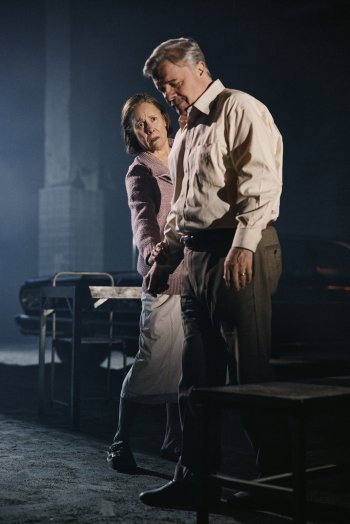
Laurie Metcalf as Linda and Nathan Lane as Willy in the revival of Arthur Miller’s “Death of a Salesman” at the Winter Garden Theatre (Photo credit: Emilio Madrid)
As you may have read, a lot of critics are saying that “attention must be paid” to the sixth Broadway revival of Death of a Salesman, Arthur Miller’s 1949 “tragedy of the common man,” innovatively directed by Joe Mantello at the Winter Garden. Indeed, it is an attention‑getting, nearly three-hour mounting, led by sterling performances from Nathan Lane and Laurie Metcalf as Willy and Linda Loman, and Christopher Abbott and Ben Ahlers as their sons, Biff and Happy. My companion was so moved when it ended she could barely speak. I was impressed but with tearless results.
First, regarding Mantello’s intensely driven, strikingly mounted production, Chloe Lamford’s set completely eliminates any specific semblance of time and place. The Winter Garden’s vast space is divided from front to rear by two rows of square concrete pillars, their lower portions wrapped in aging black tiles, each pillar topped with an old‑fashioned lighting sconce. A huge, yellowing, stained, opaque window or skylight hovers upstage left. The effect is at once industrial and vaguely municipal, as if the Lomans’ tragedy were unfolding in a warehouse or a truck depot. Up left, entering through a rising garage door, is a red 1964 Chevy that remains throughout—its lights sometimes glaring at us, and used variously as an entrance, an exit, and even a platform. It stands as a symbol of Willy’s aspirations, failures, and fate.
Smoky effects suggesting fog or dust circulate around the space, hinting at the clouds in Willy’s increasingly delusional brain. This helps Jack Knowles create exquisitely moody chiaroscuro effects that are a tremendous gift to the production.
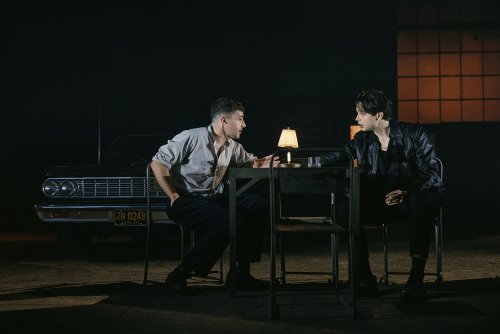
Christopher Abbott as Biff and Ben Ahlers as Happy in the revival of Arthur Miller’s “Death of a Salesman” at the Winter Garden Theatre (Photo credit: Emilio Madrid)
Like the car, anachronisms abound: a Starbucks coffee cup here, a 1940s wire recorder there, all mingling with costumes that similarly mix eras. Realistic furniture is largely replaced by metal tables, benches, and chairs. A phone conversation is spoken to the air, not to a prop.
A bold stroke in casting allows two younger actors, Joaquin Consuelos and Jake Termine, to play Biff and Happy during their high‑school days, as does Karl Green for their neighbor Charley’s nerdy son, Bernard, played as an adult by Michael Benjamin Washington. Most notably, Bernard and Charley (K. Todd Freeman) are played by African American actors—highly unlikely in Willy Loman’s 1940s Brooklyn, but effective within the production’s anachronistic framework and offering a plausible rationale for Willy’s disturbingly misguided refusal to accept a job from Charley.
Death of a Salesman charts the unraveling of Willy Loman, a traveling salesman whose dwindling income, fraying mental state, and lifelong self‑mythologizing collide over the course of two days. Returning shaken from a failed New England trip, he oscillates between present disappointments and idealized memories, clinging to fantasies of professional triumph and filial devotion that never existed. His sons—Biff, a former high‑school golden boy turned drifter, and Happy, a compulsive womanizer—mirror his delusions in different keys, each trapped in the family’s shared belief that charm and “being well liked” can substitute for competence, responsibility, or self‑knowledge.
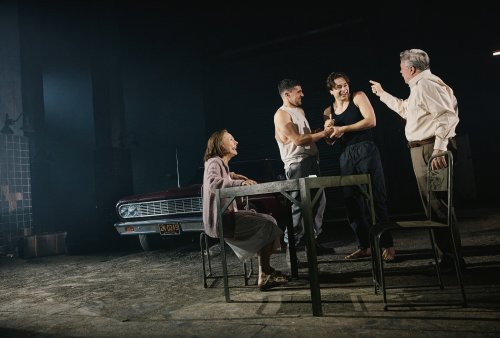
Laurie Metcalf as Linda, Christopher Abbott as Biff, Ben Ahlers as Happy and Nathan Lane as Willy in the revival of Arthur Miller’s “Death of a Salesman” at the Winter Garden Theatre (Photo credit: Emilio Madrid)
The play’s dramatic engine is Willy’s refusal to face reality: his stalled career, his infidelity, his bullying of Linda, and the emotional damage he’s inflicted on his sons. Biff’s attempt to confront the truth—about himself and about Willy—sparks the climactic rupture, culminating in Willy’s final, disastrously unnecessary act of self‑sacrifice.
But the very elements Miller frames as tragic—Willy’s dreams, his pride, his “common man” heroism—are also the play’s central problems. The Loman family’s delusions are so pervasive, and Willy’s behavior so boastful, abusive, and self‑pitying, that the production must work hard to convince us of the nobility Miller insists upon. Rather than a fallen hero, Willy often emerges as a man whose insecurity fuels cruelty, whose fantasies excuse irresponsibility, and whose self‑image is built on quicksand. The result is a drama in which the emotional stakes depend on sympathies the text doesn’t always earn.
Nathan Lane, the most likable of stars—loved especially for his comedic gifts—is startlingly effective in making Willy obnoxious. He shows how Willy’s obsessiveness prevents him from allowing anyone else to voice an opinion when he’s on his high horse, and how he insists on codes of behavior he himself subverts daily. Never before have I felt such a lack of empathy for Willy. When he refuses Charley’s job, I lose all patience with him and cannot forgive his ultimate choice when he had the solution in his hands. It seems almost surprising that Miller even gives him this potential out.
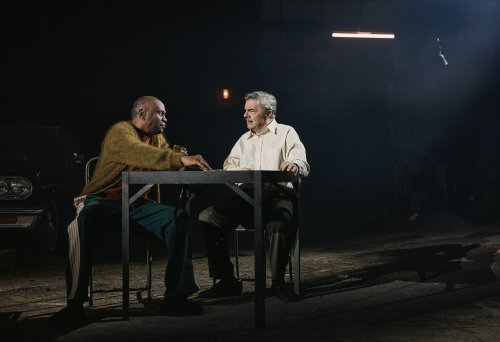
K. Todd Freeman as Charley and Nathan Lane as Willy in the revival of Arthur Miller’s “Death of a Salesman” at the Winter Garden Theatre (Photo credit: Emilio Madrid)
In short, Lane’s aggressive attack on the role suggests that if Willy doesn’t have dementia, he’s certainly psychopathic. I’d even lay odds on where his political sympathies would lie if he were a real person today.
Willy’s sons, played by Abbott and Ahlers as if fueled by hyped‑up levels of histrionic testosterone, are equally obnoxious and delusional, swallowing their old man’s rhetorical bullshit as if it were Coca‑Cola and belching it out in bad behavior. The play’s big reveal exposes why Biff blew his chance to go to the University of Virginia, but what may once have seemed an explosive discovery now feels like a flimsy excuse by someone already a borderline student to avoid facing a real test of aptitude. And the narcissistic Hap—much of the role played shirtless—has rarely seemed so cruelly self‑centered, especially in that eternally painful betrayal in the restaurant.
Anchoring the family dysfunction is Linda, given yet another remarkably sculptured performance by Broadway treasure Laurie Metcalf. For all her relative groundedness, Linda is also deluded, convinced that with her encouragement Willy can pull himself out of despair and pay off the mortgage and other bills. But does she ever pick herself up and try to get a job? The war was over, and women were increasingly going to work. Perhaps the question is whether she’s afraid to test Willy’s reception to the idea.
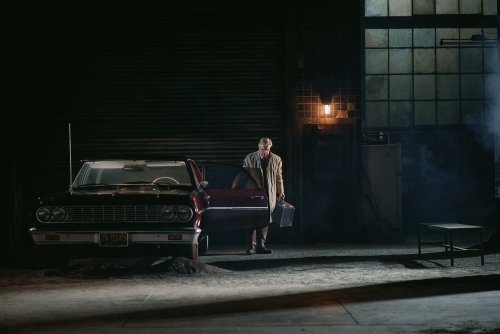
Nathan Lane as Willy Loman in the revival of Arthur Miller’s “Death of a Salesman” at the Winter Garden Theatre (Photo credit: Emilio Madrid)
As for the other Broadway revivals, each was highly lauded, and all but the first received at least one nomination for its Willy or Linda (actors in other roles were also nominated and won): 1975: George C. Scott and Teresa Wright—no nominations because revivals weren’t yet eligible; 1984: Dustin Hoffman and Kate Reid (Hoffman won); 1999: Brian Dennehy and Elizabeth Franz (both won); 2012: Philip Seymour Hoffman and Linda Emond (Hoffman won, she was nominated); 2022: Wendell Pierce and Sharon D Clarke (both nominated). The 1984, 1999, and 2012 versions all won Best Revival. And I could go on.
The point is that, properly cast and directed, Death of a Salesman captures Tonys and other awards the way a lepidopterist captures butterflies. They fly right into the net. If I were betting on this year’s awards, I’d have a pretty good idea where to put my money.
Death of a Salesman (through August 9, 2026)
Winter Garden Theatre, 1634 Broadway, between 50th and 51st Streets, in Manhattan
For tickets, visit http://www.telecharge.com/Death-of-a-Salesman-tickets
Running time: two hours and 55 minutes including one intermission


Leave a comment