
Scorched Earth
Luke Murphy & Attic Projects deliver a gripping true-crime drama, pulsing through exhilarating dance-theater with kinetic, electrifying force.
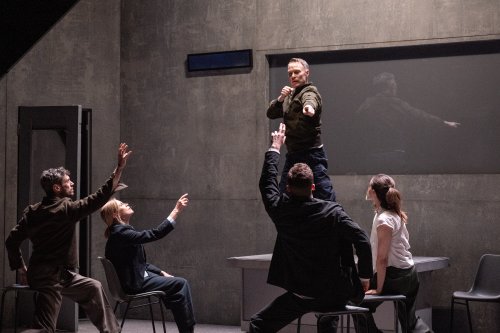
Ryan O’Neill (standing on desk) with Luke Murphy, Sarah Dowling, Will Thompson and Tyler Carney-Faleatua in a scene from Murphy’s “Scorched Earth” at St. Ann’s Warehouse (Photo credit: Teddy Woolf)
In Luke Murphy’s astonishing Scorched Earth, a vitality is rendered with a ferocity that feels at once ancient and bracingly new. Murphy, working under the banner of his multidisciplinary company Attic Projects, has fashioned a work that does not so much adapt John B. Keane’s play The Field (which went on to great acclaim in the landmark film starring Richard Harris) as detonate it—scattering its themes across a landscape of dance, film, sound, and theatrical invention, and then reassembling them into something hypnotic and wholly its own.
The evening begins in a Garda interview room, though even this ostensibly prosaic setting refuses to remain fixed. A two-way mirror—cool, bureaucratic, implacable—flickers into life as a projection surface, its reflective opacity yielding to images of land: a field, yes, but also an idea, an obsession, a wound. Sepia-toned newspaper clippings, cataloguing generations of agrarian violence, pulse across the surface like half-remembered nightmares. From the outset, Murphy insists that land, in Ireland, is never merely land; it is inheritance, identity, and, here, a kind of slow-burning fuse.
Out of this charged stillness, the ensemble emerges—five bodies already in motion, as if the dance had begun elsewhere, beyond our sight, and has only now spilled into the room. Their movement is serpentine, collective, uncanny: a single organism thinking through limbs and torsos. The mirror becomes a window, and through it steps Sarah Dowling’s Detective Kerr, a figure of crisp authority whose inquiry—into a suspicious death in East Cork, now a reopening of a cold case—serves as the narrative’s skeletal frame. Opposite her sits Murphy himself, as John McHale, a man whose relationship to land is less proprietorial than existential, less ownership than possession in the most haunted sense of the word. In essence, a years-old murder that has lingered in a state of uneasy suspension—not for want of evidence, but for want of will—its truth hovering in plain sight, is an open secret quietly sustained by the tacit complicities of a small town.
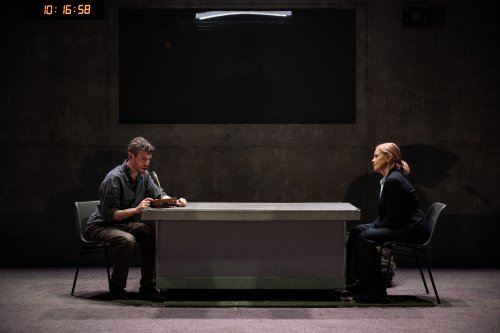
Luke Murphy and Sarah Dowling in a scene from Murphy’s “Scorched Earth” at St. Ann’s Warehouse (Photo credit: Teddy Woolf)
The plot, in its broad contours, parallels Keane: an outsider, the English émigré William Dean (a superbly composed Will Thompson), returns to ancestral soil with designs of development, only to collide with McHale’s immovable claim. Yet to describe Scorched Earth in terms of plot is to miss its method entirely. Murphy fractures and refracts the story through an exuberant array of forms. A pub erupts into line dancing, cowboy hats bobbing to country rhythms with a wink that never quite dissolves the underlying menace. Ryan O’Neill’s insomniac sergeant, also under Detective Kerr’s scrutiny prowls the night in a fugue of guilt—“If I don’t walk, I don’t sleep”—his body caught in a loop of restless compulsion, haunted by his earlier, inconclusive investigation, as if the failure to resolve the crime has lodged itself somewhere in his very musculature. Tyler Carney-Faleatua, in a feat of mercurial doubling, becomes both radio host and coroner, interviewing the dead man with eerie nonchalance before clinically enumerating the “multiple impacts with severe force” that ended his life.
Murphy’s genius lies in the precision with which these disparate elements cohere. Nothing feels ornamental; everything is in dialogue. His fidelity to Keane is not literal but thematic, and it yields images of startling potency. McHale’s obsession with his field finds expression in a duet of startling intimacy, as he dances with a grassy humanoid manifestation (designed with tactile wit by Alyson Cummins, who designs the set as well as the cast’s lived-in clothing), the land itself rendered as both partner and adversary. A long-eared apparition—an unmistakable nod to the doomed donkey of Keane’s play—hovers at the edges of the action, a mute witness to the corrosive effects of possessiveness.
The production’s visual and sonic worlds are equally exacting. Stephen Dodd’s expressive lighting and Rob Moloney’s composition and sound design do not merely accompany the action; they sculpt it, creating an immersive environment in which memory, hallucination, and reality bleed into one another. A sequence set to Fleetwood Mac’s classic “The Chain” unfurls with exhilarating inevitability, its rhythmic propulsion dovetailing with the ensemble’s muscular phrasing. A throbbing sonic motif asserts itself with a near-tactile urgency as an intentional provocation—an aural pressure that punctuates the work’s emotional stakes and deepens the immersive precision of an already exquisitely calibrated score. Patricio Cassinoni’s arresting audio-visual design, the evidentiary detritus of the case—police photographs, legal documents, even the fleeting ephemera of Instagram screengrabs—accumulates into a kind of digital palimpsest, a layered archive through which the past insists on being seen, parsed, and, perhaps, finally understood.
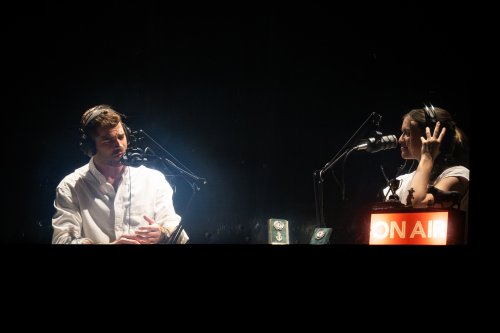
Will Thompson and Tyler Carney-Faleatua in a scene from Luke Murphy’s “Scorched Earth” at St. Ann’s Warehouse (Photo credit: Teddy Woolf)
What lingers most, however, is the image of the field itself. A pure-dance epilogue—arriving after Cummins’ set is quite literally dismantled before our eyes, its structures stripped away to reveal a newly risen grassy gradient—emerges as the production’s ecstatic culmination. It rises before us as a steep, punishing incline—a literal and metaphorical summit. The ensemble hurls itself against it, sliding, scrambling, clawing for purchase, their bodies articulating the cost of attachment with breathtaking athleticism. At one point, they join hands midway up the slope, suspended in a fragile equilibrium that feels like both triumph and impasse. It is an image of communal striving haunted by individual ruin.
By the time the production circles back to its opening imagery—those fields, those headlines—now devoured by fire, Murphy’s thesis has become devastatingly clear. To adopt a scorched-earth policy, to deny another man the land one believes is rightfully one’s own, is to enact a destruction that cannot be contained. It consumes not only the contested ground but the self that clings to it.
Blurring, with elegant defiance, the porous boundary between dance and theatre, playwright-director-choreographer-performer Murphy composes a richly textured tapestry in which narrative, image, and movement are inextricably entwined—each thread reinforcing the next to yield a work of uncommon immediacy and visceral power. Murphy’s bravura Scorched Earth is a work of rare ambition and even rarer realization: a piece that trusts the intelligence of its audience, that revels in the permeability of form, and that understands, with almost frightening clarity, how the past continues to choreograph the present.
Scorched Earth (through April 19, 2026)
Luke Murphy & Attic Projects
Joseph S. & Diane H. Steinberg Theater at St. Ann’s Warehouse, 45 Water Street, in Brooklyn
For tickets, visit www.stannswarehouse.org
Running time: 90 minutes without an intermission


Leave a comment