Articles by Victor Gluck, Editor-in-Chief
Richard Alfredo’s 'The Dark Clothes of Night," a brilliant parody/homage to film noir and hardboiled fiction, the third play of Summer Shorts – Series B, is so good it alone is worth the price of admission. The other two plays which precede it in this year’s 10th Festival of New American Short Plays have interesting but undeveloped premises. But "The Dark Clothes of Night" is an instant classic, a humorous satire that is also a brilliantly theatrical study in paranoia, fear and evil and the elements that made film noir irresistible. Directed by playwright Alexander Dinelaris, the three actors in this memorable short work play multiple roles with assurance and aplomb. [more]
Troilus and Cressida
While "Troilus and Cressida" is rarely staged, Daniel Sullivan’s production full of bombs and smoke suggests that in our time of endless wars it speaks to us again, and the play’s cynicism also seems to capture the current zeitgeist. It also features memorable performances from John Glover, John Douglas Thompson, Max Casella, Sanjit de Silva, and Alex Breaux, among others. [more]
Summer Shorts 2016 – Series A
As might be expected LaBute’s new one act, "After the Wedding," contains a shocker. However, when it arrives in Maria Mileaf’s production, it is so matter-of-fact that it has little or no impact. Elizabeth Masucci and Frank Harts play a married couple of six years. Named simply “Him” and “Her,” they alternate telling (different) versions of their years together without interacting. However, both of them recall an event that occurred on their way to their honeymoon which should have been a game-changer. For these self-absorbed people millennials, it was simply another incident along the way. Sitting in chairs facing the audience, Masucci and Harts are rather charming as the amoral couple but the play seems like a scene from a longer play not yet written. [more]
A Class Act
While "A Class Act" covers material dramatized elsewhere, Norman Shabel’s play, seen at The Playroom earlier this year, is always absorbing, always unpredictable. The seven member cast is totally believable in their roles as lawyers and corporate bigwigs. This is a tense and enlightening evening in the theater that demonstrates the startling inner workings of the legal system even in what seems like an open and shut case. [more]
Small Mouth Sounds
Inspired by the playwright’s attending a silent spiritual retreat at an upstate New York institute in the woods, this is an absorbing play which immediately causes the viewers to listen intently as our world is never really silent. In Stowe Nelson’s remarkable soundscape, the play begins with a torrential rain, and then proceeds to a great many sounds we usually take for granted (both performed by the actors and recorded): breathing, laughing, clicking of a pen, sighing, a gong ringing, whispers, giggling, crickets chirping, the crunching of chips, birds, a sip of tea, a sneeze, coughing, a cell phone ringing. As a result of this state of affairs and the fact that the actors (in general) don’t speak, we become attuned to watch the smallest facial expression and other forms of non-verbal communication. [more]
Privacy
Playing his most mature role to date, Radcliffe, late of Harry Potter, is charming as he begins as an introverted, reticent Englishman and then slowly panics as he realizes the extent to which his obsession with the Internet has left him vulnerable to outside forces. He is particularly fine in the computer dating sequence in which he must do a great deal of quick thinking and ad libbing as the participants change nightly. The mainly British production team includes set designer Lucy Osborne who has created a witty New York apartment for The Writer made up almost entirely of boxes made to look like iconic skyscrapers, and the clever projection design of Duncan McLean. [more]
2 by Tennessee Williams: “27 Wagons Full of Cotton” & “Kingdom of Earth”
While the play can be a tour de force, Kathryn Luce Garfunkel is so one dimensional that her Flora has little weight. She exudes languidness and laziness, but fails to make Flora anything other than whiney and needy over the course of the play’s three scenes. Even after her encounter with Vicarro she doesn’t seem that much different. Holcomb seems miscast as the wily Latin though he does make Vicarro shrewd and knowing. Keller gives the most convincing performance as the sinister and abusive Jake. Unfortunately, the rhythms of the production do not make the play either the comedy that Williams subtitled it or the tense revenge drama that it also is. [more]
Simon Says
Three-time Tony nominee Brian Murray returns to the New York stage for the first time in four years as a retired professor of parapsychology who has put aside his own career to foster that of a young psychic from the time he was a teenager who is able to channel a spirit named Simon. However, the play belongs entirely to virile newcomer Anthony J. Goes who plays psychic James. The role is both vocally and physically demanding and he is totally convincing in a play that asks you suspend your disbelief. [more]
Liberty: A Monumental New Musical
The production team uses most of the same people who were involved with the show’s 2014 run at Theater 80 St. Marks as well as four of the eight actors. Directing again, Evan Pappas keeps the show moving along, but some of the characterizations are allowed to descend into caricature and the waiting game for the money to be raised becomes a bit wearisome. Shapiro, now two years older, is charming as Liberty and has a sweet voice but it fails to project in this venue. Emma Rosenthal is impassioned as Emma Lazarus, caught between her liberal beliefs and her family’s conservative leanings. [more]
Runaways
The most remarkable thing about the Encores! Off-Center revival of the late Elizabeth Swados’ 1978 musical "Runaways" is that it is as fresh as when it was written almost four decades ago. The concert staging is perfect for this revue like show which deals with youthful alienation and abuse, making it feel extremely contemporary. Credit director Sam Pinkleton and a cast of 25 high-powered multi-racial and multi-ethnic performers, mostly New York City school children from 12 – 19. Among the performers are a deaf actor working in sign language (Ren), two actors who perform in Spanish (Claudia Ramirez and Joshua DeJesus), and a transgendered actress (MJ Rodriguez). It would not be hyperbole to say that among this cast are the stars of tomorrow. [more]
The Healing
Samuel D. Hunter’s latest play, "The Healing," is a commission by Theater Breaking Through Barriers, dedicated to advancing the work of performers with disabilities. Not surprisingly, the play gives roles to six disabled actors out of the seven characters in the play, and they acquit themselves well. This story of a reunion of childhood friends in their thirties who have gathered for the funeral of one of their members is made very real by the acting of the cast. The problem with the play is that it appears so tentative and low-key that the explosion we keep waiting for never happens. Under the direction of Stella Powell-Jones, the healing of the title is so subtle that the play could be said to be anti-theatrical. [more]
I’ll Say She Is
Only a 30 page treatment and five songs remained from the original show by the Johnstone brothers, writer Will B. and composer Tom. Diamond has written new lyrics for music by Tom Johnston and his brother Alexander as well as using songs from other shows written by Tom and Will. He has rearranged the plot, left out some sequences, and reduced the number of characters. The show at the Connelly Theater is not so much a revival as a homage to Marx Brothers musicals. [more]
Hero’s Welcome
Now having its American premiere in repertory with "Confusions," one of Ayckbourn’s earliest plays, with the same actors in both, the production which is directed by the author is from the Stephen Joseph Theater, Scarborough, where most of the author’s plays have had their world premieres. This is a powerful and engrossing study of friendship, love, jealousy, competition and betrayal. [more]
The Taming of the Shrew (Shakespeare in the Park)
Aside from the obvious misogyny of Shakespeare’s comedy for modern audiences, there is the problem of the heroine’s unpalatable final speech in which she berates women for not being more subservient to their husbands. Lloyd’s solution is to frame the play as a country-western beauty pageant to choose “this year’s Miss Lombardy” whose emcee sounds an awful lot like presidential candidate Donald Trump. In fact, there is a good deal of satiric political talk with comedian Judy Gold as suitor Gremio doing an interpolated monologue complaining that the director is a woman and that “we’ve got a broad running for President.” [more]
The Purple Lights of Joppa Illinois
Adam Rapp’s plays are often about loners and people outside of mainstream society. "The Purple Lights of Joppa Illinois" now at Atlantic Stage 2 in a production directed by the author falls into this category. Its strength is that the play is a detailed well-developed character study. However, as a drama, it seems more like a sketch or a section of a longer play yet to be written leaving many unanswered questions. [more]
O’Neill (Unexpected): Two Early Plays by Eugene O’Neill
"Now I Ask You" turns out to be comedy of pretentious New York bohemians in 1916, while "Recklessness" is a Strindbergian psychological revenge play. While both have hints of the more famous plays to come, they also stand on their own as the work of a major playwright trying to find his own voice. Whatever you think of the plays and whichever one turns out to be your favorite, Alex Roe’s staging is always entertaining and the plays are truly surprising and unexpected. [more]
2016 Tony Awards Bestow Much Love on “Hamilton”
Although "Hamilton" had been nominated for 16 awards in 13 categories, it failed to break the record of Mel Brooks’ "The Producers" which remains the all-time winner with a total of 12. Hamilton took all of the top musical awards including Best Musical and Best Direction of a Musical (Thomas Kail, previously nominated for Lin-Manuel Miranda’s In the Heights) except for Best Performance by an Actress in a Leading Role in a Musical which went to British actress Cynthia Erivo. (Making her Broadway debut, Erivo was reprising her role as Celie Harris in "The Color Purple" from the 2013 Menier Chocolate Factory production re-envisioned by John Doyle.) Star Miranda won his second and third Tonys with his awards for Best Original Score (Music and/or Lyrics) Written for the Theater and Best Book of a Musical. He previously won for Best Score with his 2008 Broadway musical, In the Heights. [more]
Universal Robots
'Universal Robots" uses historic characters like journalist and playwright Capek and President Masaryk of Czechoslovakia, characters taken from Capek’s play like Rossum, Helena and Radius, as well as fictional characters to fill out Rogers’ story. Seen in a different version at the 2009 New York Fringe Festival under the same name, "Universal Robots" has a long, leisurely expository first act and an exciting, tense, fast-paced second act. Director Jordana Williams allows the talky, intellectual ‘play of ideas’ in the first half to be a drag on the exciting, adventurous, plot-driven second half with its unusual twists and turns. [more]
A Doll’s House & The Father (TFANA)
Maggie Lacey as Nora Helmer and John Douglas Thompson as Torvald Helmer in a scene from “A [more]
Incognito
This is heady theater and demands concentration. However, the excellent cast of four made of Geneva Carr (Theatre World Award winner for "Hand to God"), Charlie Cox (Netflick’s" Daredevil"), Heather Lind (AMC’s "Turn: Washington’s Spies"), and Morgan Spector (Drama Desk Award nominee for "Russian Transport") make this an unforgettable evening in the theater. The versatile cast play 20 characters, some as many as six, without changing costume but with different accents and demeanors, while the succeeding scenes take place almost as fast as the synaptic functions in the brain. The play which alternates in its telling of the three stories is also divided into three parts: "Encoding," "Storing' and "Retrieving." Before each section the cast perform hand gestures create by Peter Pucci that mimic the synaptic actions in the brain. [more]

Peer Gynt
As with many CSC productions, the modern dress costumes (here designed by Ann Hould-Ward) are entirely in black and white. A small handful of props are used (a tin of buttons, an onion) but the production is basically reduced to its dialogue and story. Since there are no breaks of any kind, the scenes segue one into another without transitions. As a result the audience has to stay focused on the play or it finds itself somewhere new and doesn’t know how it arrived there. The lighting design by Jane Cox alternates between light and dark without creating much atmosphere on the empty stage. [more]
The Judas Kiss
British film star Rupert Everett gives a bravura performance as playwright and author Oscar Wilde in the Chichester Festival Theater revival of "The Judas Kiss" by David Hare now at the BAM Harvey. His nuanced performance is remarkable considering how little active the play allows him to be. Wilde dominates the plot even though he sits center stage in the play’s two acts, first in a hotel room in London immediately before and then in a villa outside of Naples immediately after his arrest and incarceration for “gross indecency,” what Victorian England called homosexuality. This is a Wilde we haven’t seen before: rather than tossing off quips and aphorisms, this is a man who is deeply in love and conflicted about questions of self-identity and legacy. He attempts to remain true to his persona at a tremendous cost. [more]
Princess Ida (2016)
Completing New York Gilbert & Sullivan Players’ 40th Season was a rare revival of 1884 "Princess Ida," the team’s eighth operetta and the only one in which the dialogue is in blank verse, it is presented in three acts, and it is based on a previous play by Gilbert. In the playwright/librettist’s second parody of Tennyson’s book-length poem "The Princess," the themes include feminism, education for women, Darwinism and the Battle of the Sexes. While the operetta still displays its relevance and timeliness, the NYG&SP production proved to be uneven in several categories. [more]
Indecent
The production of "Indecent" now on the stage of the Vineyard is remarkable on many levels, not the least which is how engrossing it is considering the events are all historical record and the play deals with several serious ethical issues. It is ultimately an extremely moving document of human achievement, betrayal, and destruction. Cheers to Paul Vogel and Rebecca Taichman and their superb ensemble cast for this memorable theatrical evening. You will not be untouched by the final scene. [more]
American Psycho The Musical
Stylish and stylized, the stage design includes Es Devlin’s white box of a set which transforms instantaneously into apartments, offices, restaurants, discos, a health club, a locker room, and the beach in the Hamptons. Color-coordinated with lighting by Justin Townsend and costumes by Katrina Lindsay, the stage picture is often black and white with a touch of red, a tie, the men’s suspenders, a leopard, a bikini, or eventually splashes of blood. Townsend’s lights turn the set blue, green or red. The spectacular ever-changing video design by Finn Ross includes abstracts, cartoons, cityscapes, computer generated designs. Initially the main characters all in black, but as the story spins out of control other colors are added. And for eye candy, there are the hardbodied members of the cast with physiques to die for, with the men with enviable abs often in their shorts. [more]
Port Cities NYC
On the ferry, audience members listen to a previously downloaded soundscape which includes a voice-over by Katie (played by Emma Meltzer) who has always seen ghosts and ends up investigating her family inheritance as an archeologist, plus a moody original score by Cameron Orr. Upon docking in the working port on the Brooklyn side, audiences walk three minutes to the Waterfront Museum Barge where the live performance begins on the pier in which four actors carry crates slowly towards us. The audience is then invited into the Museum Barge for the actually theatrical performance. [more]
Tuck Everlasting The Musical
The problem with the new show with a libretto by first timers Claudia Shear and Tim Federle now at the Broadhurst Theatre is that it is all so bland - which is not true of the novel which had grit as well as many surprises. The new prologue pretty much gives away the secret of the Tuck family’s discovery of the fountain of youth. The score by Chris Miller and Nathan Tysen (who wrote the Off Broadway musical 'The Burnt Part Boys") is pleasant but innocuous. Director/choreographer Casey Nicholaw who currently has the more flashy "Book of Mormon," "Aladdin" and "Something Rotten!" simultaneously running on Broadway has created a low-key production, atypical of his usual style, which seems a bit lost on the big Broadway stage. This might have worked better in a smaller Off Broadway house. [more]
Dido and Aeneas
Staged by director/choreographer Doug Varone, "Dido and Aeneas" was amusingly presented in modern dress with Varone’s dancers playing the ensemble in both operas and pantomiming unseen props and scenery. As the original Purcell music to the surviving Nahum Tate 1689 prologue has been lost, LaChiusa has created a witty new one entitled" The Daughters of Necessity: A Prologue," and lasting 15 minutes. After the Chorus (men in bleachers on stage left, women on stage right) welcomed us, they recounted the myth of the Fates: Nono (Sarah Mesko) who spins the thread of life, Decima (Anna Christy) measures it, and Morta (Clark) snips the thread with her scissors. [more]
The School for Scandal
Red Bull Theater which has specialized in Elizabethan and Jacobean tragedies has moved on to the 18th century with Marc Vietor’s exquisite and stylish revival of "The School for Scandal," Richard Brinsley Sheridan’s famous but rarely revived classic comedy of manners. With impeccable casting and a pitch-perfect production team, this School is as witty, delightful and accessible as one could wish. The 18th century look of the play is both historic and satiric. Anna Louizos’ clever settings transform one into the other with the turn of a wall or a door and a rearrangement of the furniture, highlighted by Russell H. Champa’s lighting. Her witty use of props (a chamber pot, a trunk, empty picture frames) adds to the fun. [more]
The Dingdong
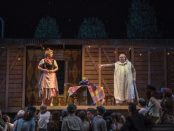
Shanahan’s adaptation has a great many delicious one-liners and double-entendres (“I don’t go out for mutton when I can have filet mignon at home;” “Keep referring to me as a plate of food and you’ll be dining a la carte;” “I put a leash on my ‘inner beast’ and take him out for a walk every once in a while;” “Looks like you have a bad case of the puberty, kid. You should see a doctor,”) as well as witty exchanges between the warring couples. Much of the fun of the play is seeing the same actors return over and over again in different roles often within a matter of seconds. Best is Kelly Curran who throws herself into four very different women, one more enticing than the other: the Parisian vixen Claudia Pontegnac, the tempestuous Italian Fabiola Soldignac, the oversexed New Yawker Mandy, and a very sexy French maid in bouffant costume with a feather duster. [more]
Revolt. She Said. Revolt Again.
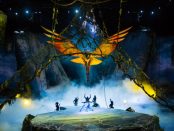
While many of the scenes are right on target, others seem too metaphoric and anarchic to make much impression, while others take on too many targets to make their point. The best ones deal with our long-held accepted beliefs both of our ways of speaking and our societal conventions. In its American premiere, Revolt. She Said. Revolt Again. is challenging theater which doesn’t always land where it wants. However, Alice Birch is definitely a unique new voice in the theater and someone to watch closely in the future. [more]
When I Was a Girl I Used to Scream and Shout
You might wonder why Morag, Fiona’s mother, in Sharman Macdonald’s groundbreaking Scottish play, "When I Was a Girl I Used to Scream and Shout," is so repressive about sex. What the program doesn’t tell you about this play having its Off Broadway premiere at the Clurman Theatre is that it was first produced in 1984 in London and that the daughter’s childhood goes back to the fifties when female sexuality was frowned upon. Then it becomes obvious that this play is now a period piece dealing with a time when feelings about female sexuality were changing but the older generation was still stuck on the other side of the divide with the teachings of their childhood. While the play seems to be two generations behind the times, what the play continues to be is a blistering portrait of a toxic mother-daughter relationship. [more]
King and Country: Shakespeare’s Great Cycle of Plays
The Royal Shakespeare Company’s "King and Country: Shakespeare’s Great Cycle of Kings" is a magnificent achievement and a fitting tribute in this 400th anniversary of the bard’s death. Not only are the four plays an accessible presentation of what is often confusing for Americans unversed in British history, but taken together they are a very great study in the use and abuse of power and authority in this year of our own contentious political wranglings. Gregory Doran’s unfussy and intelligible productions set a bench mark by which others will be measured and offers star performances that should become legendary. [more]

The Crucible
Van Hove sets his version in a modern classroom. When the curtain goes up we first see the girls who will later accuse various people in Salem, Massachusetts, of having bewitched them, seated at desks and singing in unison. The curtain descends and then the play begins with Miller’s first scene. Puritan Reverend Samuel Parris has caught his daughter, his niece Abigail Williams, his black servant Tituba, and other girls in the community dancing in the forest around a cauldron, all forbidden behaviors. On seeing him, his daughter Betty has become catatonic. When expert witch hunter Reverend Hale, who has been sent for, questions Tituba, she confesses to communing with the devil, an idea he plants in her mind. [more]
The Father
Florian Zeller is the most famous French playwright you probably never heard of. He won France’s highest theatrical honor, the Moliere Award, in 2011 for his play, "The Mother," and the Moliere Award again in 2014 for "The Father." This last named international hit is currently running in both Paris and London with major stars in the leading role. Manhattan Theatre Club now brings the Christopher Hampton translation to Broadway with Frank Langella in the title role. As André, an 80-year-old man beset with dementia in which his reality keeps shifting, Langella turns in a virtuoso perform but you won’t be bored for a moment. [more]

Blackbird
The problem with the staging begins from the outset. Daniels' Ray, tense and rigid, pushes demanding, triumphant Una into a corporate break room. He is upset to see her, and she is all confidence and gloating. Unfortunately, this scene starts at so high a peak of emotion that the play has nowhere to go. In fact, while their startlingly different accounts of the night they ran off together ought to be the high point of the play, the opening scene is peak of emotion instead. It is a calculated risk and it damages the play. [more]
Head of Passes
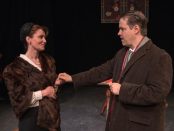
Tarell Alvin McCraney’s "Head of Passes" is an advance over his earlier work seen in New York ("The Brother/Sister Plays," "Wig Out," "Choir Boy") in its attempt to take on bigger themes and archetypes. In creating the role of Shelah, he has put on stage a magnificent role for an actress of tremendous gifts. Phylicia Rashad rises to Greek tragic heights required by Shelah’s plight. However, the meaning and message of the play remains obscure and tends to leave the audience outside of the play’s dramatic action. We watch mesmerized in horror as events unfold, but why they are happening and what is the underlying cause remains a mystery. [more]
The Effect
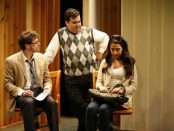
"The Effect" investigates the emotional, physical and ethical effects of drug testing, certainly a hot button issue in our time when we have come to expect a pill to solve all of our problems. The scientific portions are made human as we see them through the eyes of Connie and Tristan who must do everything at the same time as foils in the experiment. The parallel stories of test takers and warring doctors with a past history add to the visceral and intellectual pull of the play. [more]
Wonderful Town
"Wonderful Town" is one of those musical comedies which seem to get better as they age due in this case to the classic quality of the Bernstein/ Comden & Green score and the witty book by Fields and Chodorov. Director Evan Pappas has given the Musicals Tonight! revival a bright, breezy, high-spirited production that is certain to put a smile on your face, while for a change you can go out humming the songs. Much more should be seen of Elizabeth Broadhurst who sparkles as would-be writer Ruth Sherwood. [more]
Dry Powder
Thomas Kail (one of the geniuses behind Hamilton) has staged the world premiere of Sarah Burgess’ riveting "Dry Powder" in as cool a fashion as Rachel Hauck’s cobalt blue set with its cubes and rectangular modules that are rearranged for the various scenes by stage hands dressed as stockbrokers. This A-list cast best known for their television roles, along with talented Sanjit De Silva as Landmark’s moral CEO, give us indelible, full-bodied performances. Making his Broadway debut after his eight seasons on "The Office," Krasinski (sleekly dressed in Dior and Ermenegildo Zegna) is the idealist who wants to make the world a better place for his wife and daughter and new child on the way, although he likes his job which makes it possible for him to own a yacht. He has promised Jeff (Sanjit De Silva), the CEO for Landmark, that none of his employees will lose their jobs. All our sympathy goes to him. [more]
Stupid Fu**ing Bird
Posner has turned Chekhov’s four-act play into two-part meta-theater: not only do the actors acknowledge the audience and solicit our participation, but they each have a monologue addressed directly to us. The actors sit around the stage when they are not in a scene, almost like they are attending a rehearsal. Aside from the obvious use of contemporary American vernacular, Posner has fun with iconic Chekhov lines that have grown stale. When asked why she always wears black, Mosh at first says, “Black is slimming,” before giving her original answer (“I’m in mourning for my life.”) He has changed Mosh and Dev’s story, giving them a different ending. While Chekhov’s Konstantin talks of the theater needing new forms, Posner’s version is the very new form that was predicted all those years ago. Finally, Posner has added an epilogue in which the actors address the audience one by one and give us a new take on the original ending. [more]
Hold On to Me Darling
In the hands of someone other than Timothy Olyphant, Strings McCabe might be a self-pitying monster too extreme to take seriously. However, this brilliantly accomplished actor has just the right amount of blarney to make Kenneth Lonergan’s "Hold On to Me Darling" one of the most satisfying plays in town. And you will learn a good deal about the lives of the rich and famous and how they get away with the antics they commit. [more]
Straight
The authors of "Straight" would have you believe that in 2016 26-year-old straight- acting investment banker Ben, living in Boston where same sex marriages have been legal for the last eight years, would still be in the closet. Seeing girlfriend Emily for the last five years since senior year at college, Ben finds sex with men more satisfying than with women, but he does not see himself as gay. He has just begun a sexual relationship with almost 21-year-old Boston College student Chris and he doesn’t want Emily to find out. However, Emily’s roommate is moving out and she wants him to move in. After all, it is five years and what is he waiting for? [more]
The Royale
The staging is unusual in that no punches are thrown. When the actors are supposed to be delivering their blows, they stamp their feet which is actually more sinister and startling. The cast clap in unison to punctuate various dramatic moments. The ringside bell is live, delineating each of the six scenes, in Matt Hubbs’ sound design. During the fight scenes, the boxers face the audience and we hear what they are thinking moment by moment, rather than see their punches. Nick Vaughan’s set doubles beautifully as gym, boxing ring and locker room. During the first boxing match, ropes on a frame are moved around to give the audience different views of the ring. Austin R. Smith’s subtle lighting helps direct attention to the right spot throughout the play. All of this leads to a remarkable and memorable evening in the theater. [more]
Wolf in the River
Directed by the author, "Wolf in the River" is an environmental production as the audience is invited to sit in folding chairs around a mound of earth with forlorn flowers, garbage and debris. However, there are set pieces and props located in the four corners of the venue as well. When the play begins, a man sitting in the audience gets up, strips off his shirt and shoes, and becomes the play’s narrator and master of ceremonies, as well as one of the characters. In an unnamed Southern American location, we are on the banks of a river (the audience is the river) filled with alligators. Six actors in pasty make-up wander around the outer perimeter of the room. Although the program does not explain their presence, the script reveals that they are the ghosts of those who have perished in the river. [more]
Do Re Mi
One problem with reviving musicals from the pre-Sondheim era is that they were often created around the talent of a big, unique star like Ethel Merman, Bob Hope, Mary Martin, Al Jolson, Fanny Brice or Eddie Cantor. Unfortunately, not only are these talents not around, there are very few oversized personalities in musical theater today. Musicals Tonight!’s revival of the Jule Styne/Comden & Green musical, "Do Re Mi," runs into this problem. Originally tailored to fit comedians and singers Phil Silvers, Nancy Walker, Nancy Dussault, John Reardon, and Al Lewis, their presence is sorely missed. [more]
Southern Comfort
"Southern Comfort" is an ambitious and admirable attempt to depict a community that till now has been left off of our stages. Though the material at times seems tamer that the content would warrant, it is ultimately a very moving musical. It also is a showcase for Annette O’Toole to give one of the finest performances of the season. [more]
Hungry: Play I of The Gabriels
"Hungry" is both an occasional play (written for this moment in time) and a chamber play. Not much happens but a great deal is implied. It will not please all theatergoers. However, it will be interesting to see how Nelson develops the next two plays in the series, "What Did You Expect?" and "Women of a Certain Age," with the same actors. Demonstrating their expertise, the cast is real enough to make you think they are not performing. [more]
Red Speedo
The play is made up of a series of six confrontations in which the dialogue is delivered like bullets flying back and forth. While the story is engrossing, the individual conversations all go on a bit too long, and get tiresome before they are each over. Then the next one takes us by surprise all over again. However, what is unique about the play is that the athlete in question eventually is seen to be a monster. His sense of entitlement has been overwhelming: he has expected his lawyer brother to get him out of trouble each time he got himself into another mess, and his brother has been supporting him all these years, paying all of his bills but with a family of his own to provide for. But worst of all is Ray’s absence of a sense of morality in a culture where winning is everything. He is willing to kill for fame and fortune and whoever he destroys along the way does not concern him. [more]
Women Without Men
Thompson’s direction is taut, nuanced and compelling and she found the ensemble to not only make their characters entirely distinct but to make us feel these women have lived together for years. Emily Walton is charming as the idealistic Jean who comes to feel that there is no place for her in such a poisonous environment. As her nemesis Miss Connor, Kellie Overbey is sympathetic as a woman who feels that life has given her a poor hand but that her writing makes it all worthwhile. Mary Bacon is a tower of strength as the stalwart Miss Strong who after 18 years refuses to be pulled into the petty wrangling as her way of survival. [more]
Walk Hard
Imani’s production of 'Walk Hard" for Metropolitan Playhouse is an exciting piece of theater from an eye-opening rediscovery. Historically, it comes nine years after Clifford Odets’ 'Golden Boy" which covers similar content and 13 years before Lorraine Hansberry’s "A Raisin in the Sun" in which the Younger family fights a similar battle. Current racism condemned by the Black Lives Matter movement and much talk of income inequality in this election year make Walk Hard relevant once again at this time. [more]
Babes in Arms
The musical known for its “Let’s put on a show!” plot has a great deal more going for it than one might expect. First off, it has one of the greatest scores ever written for a Broadway musical comedy adding the witty and lilting “Where or When,” “I Wish I Were in Love Again,” “Way Out West (on West End Avenue),” “Johnny One Note,” “The Lady Is A Tramp,” “Imagine” and the title number to the American Songbook. This represented more hits than any other R&H show. The political plot (which was sanitized in 1959 under the auspices of the composer himself) has been restored and the show is positively electric with hotly debated ideas, philosophies and theories. As performed by Andrews’ cast, the satiric show has a colorful array of dynamic characters. [more]
The Body of an American
The inspiration for the play began when poet and playwright Dan heard the Fresh Air interview. Paul was already famous as the photographer who took the now iconic 1993 picture of U.S. Staff Sgt. William David Cleveland’s body being desecrated in Mogadishu. As he took the photo, Paul heard a voice say, “If you do this, I will own you forever,” which led to his continuing post-traumatic stress syndrome. The public outcry caused President Clinton to pull the American forces out of Somalia which led to other political repercussions. Dan, suffering his own traumas, identified with Paul and emailed him. Surprisingly the reclusive Paul answered him and this led to a long correspondence and finally a face-to-face meeting in the Arctic. [more]
A Room of My Own
The most colorful character in more ways that one is Uncle Jackie (Cantone) who lives upstairs. A closeted gay man in a society that doesn’t accept him, he has become an angry, self-loathing misanthrope with a barbed tongue to match. Cantone gives a bigger-than-life performance that makes Jackie a truly memorable character. In the play’s quieter moments we find out what he has sacrificed all his adult life in order to remain in the old neighborhood and it is he who is keeping the family going with handouts that continually avert disaster. [more]
Pericles (Theatre for a New Audience)
Nunn’s adaptation rearranges some of the scenes and adds material from a prose version of the work by George Wilkins, believed to be Shakespeare’s collaborator. Using music, song, dancing, jousting and a veritable rainbow of colorful costumes, he has created an epic-sized revival that is always eye-filling and easy to follow. While some of the acting is uneven in this large cast of 29 including seven members of the Pigpen Theater Co., it must be said that this is not one of Shakespeare’s best plays as it makes use of unexpected events, many locations, and a large canvas, rather than psychological depth and deathless poetry. [more]
Nice Fish
Todd Rosenthal’s remarkably atmospheric and evocative setting is waiting for the audience when they come into the theater: a huge expanse of a corrugated ice flow in Northern Minnesota in forced perspective with miniature cars, ice fishing huts and a train in the far distance. Erik, a dour, taciturn ice-fishing enthusiast played by Jim Lichtscheidl, dressed in a green parka and yellow cap, and Ron (Rylance), a fishing novice dressed in a glowing orange parka and matching hat, appear on the ice to drill holes in the frozen lake on this last day of the ice fishing season. As Ron tells us in his first monologue, “If you go into the woods, the back country, someplace past all human habitation, it is a good idea to wear orange and carry a gun, or, depending on the season, carry a fishing pole, or a camera with a big lens. Otherwise it might appear that you have no idea what you are doing…” [more]
Smokefall
The play seems to be saying that life is full of suffering but love will conquer all, not a very new or profound message. One flashback (Violet and Daniel’s first date) is replayed at least three times with no new significance with each repeat. The title is a quote from T.S. Eliot’s "The Four Quartets": “The moment in the draughty church at smokefall/ Be remembered; involved with past and future./ Only through time time is conquered.” Unfortunately, like a great deal of late T.S. Eliot, these lines are too abstruse to have much bearing on the play. Smokefall is the sort of work that you either go with its whimsy or hate it. This is definitely not a play for all theatergoers. [more]
Tennessee Williams 1982
Under the umbrella title "Tennessee Williams 1982" (the year of both play’s composition the year as well as that of playwright’s death), The Playhouse Creatures Theatre Company is presenting the world premiere of “A Recluse and His Guest” (to be published this summer) and the New York premiere of “The Remarkable Rooming-House of Mme. Le Monde,” (included in the 2008 volume, The Traveling Companion and Other Plays.) Not only are these unfamiliar plays uncharacteristic of the writer’s other work (a fable and a Grand Guignol), they have been given a surrealistic production by director Cosmin Chivu who directed the 2013 provocative revival of "The Mutilated" which demonstrated the viability of that black comedy once consigned to the scrap heap. Both plays in this doublebill are unified by their cynicism and their dark view of the world. While the plays may not be to everyone’s taste, the doublecasting of the two plays demonstrates remarkable versatility on the part of the talented cast, which is at times uneven. [more]
Smart People
The satire begins early: it turns out that although the department likes having Brian doing his research proving that whites are genetically racist, they are not happy with his conclusions. Although Jackson may be the smartest doctor in the room, he has trouble working with others and bending to authority on the job. Although Valerie has a Harvard degree, she cleans houses to pay her rent which ticks off her upper middle-class mother. However, she is not pleased when she attends an audition for “Mary, the social worker” and is asked instead to read for the part of “Shlonda” from the ‘hood. Ginny finds that her therapy clients perceive her as white, but she knows that in the talk of race in America, she is invisible as race is defined as between blacks and whites in modern discourse. [more]
Prodigal Son
Television and film actor Timothée Chalamet (Showtime’s "Homeland" and Christopher Nolan’s "Interstellar") makes an impressive New York stage debut as the play’s young protagonist. The role is almost too small to contain his bigger-than-life portrayal: kinetic, animated, provoking, questioning, vital, dynamic. His moods turn on a dime and he can shift from being a sophisticated adult back to being a little boy in a moment. Tall and lanky, he suggests the author but as he must have looked back in 1965. Also making his Manhattan Theatre Club debut, David Potters as his roommate Austin is tremendously sympathetic as a young man afraid of breaking the rules who has led a very sheltered life up until now. [more]