News Ticker

Articles by Victor Gluck, Editor-in-Chief

About Victor Gluck, Editor-in-Chief (1183 Articles)
Victor Gluck was a drama critic and arts journalist with Back Stage from 1980 – 2006. He started reviewing for TheaterScene.net in 2006, where he was also Associate Editor from 2011-2013, and has been Editor-in-Chief since 2014. He is a voting member of The Drama Desk, the Outer Critics Circle, the American Theatre Critics Association, and the Dramatists Guild of America. His plays have been performed at the Quaigh Theatre, Ryan Repertory Company, St. Clements Church, Nuyorican Poets Café and The Gene Frankel Playwrights/Directors Lab.

Berlin to Broadway with Kurt Weill: A Musical Voyage

February 15, 2017

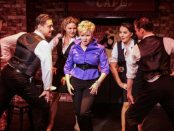
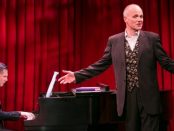
One of the remarkable things about the theater songs of Kurt Weill is that like the later songs of Stephen Sondheim they are all really little one act plays which give the performers a great deal of latitude in how to perform them. As sung by Karl Josef Com, Rachel de Benedet, Michael Halling and Meghan Picerno and as narrated by Brian Charles Rooney, Berlin to Broadway with Kurt Weill is an extraordinary musical voyage through some of the greatest theater songs of all time written by among the best talents of the 20th century. [more]

Jonah and Otto

February 15, 2017

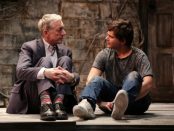
While the play is at times Pinteresque, it is talky in a way Pinter never is, explaining everything over and over, covering the same ground again and again. Nothing much happens other than that the men become more confiding and reveal more of their personal pasts. The play implies that Jonah is menacing, but under Hughes’ direction, he never seems much of a threat. The pace is slow and methodical, too slow for its own good. Sean Gormley’s Otto and Rupert Simonian’s Jonah are well-rounded characters but the acting style is too refined, too genteel to make much impression. [more]

Hi-Fi | Wi-Fi | Sci-Fi: Predictions Past Present and Future

February 11, 2017

The only real high-tech exchanges take place only three times during the run of the show. At the performances of February 6, 9 and 17, one of the roles in "Camera Obscura" will be performed telematically from Seoul Institute for the Arts in Korea and directed by Il Kyu Park. "Hi-Fi | Wi-Fi | Sci-Fi" which uses a great many sound specialists for little effect is an interesting idea but doesn’t go far enough either dramatically or in terms of modern technology to have much impact. As a cautionary tale, time has caught up with these plays and passed them by. [more]

Bound to Rise

February 9, 2017

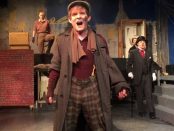
Unfortunately, Policoff’s book is too cluttered with characters too allow for much development. While some of his lyrics are clever, most are prosaic and heavy-handed. As played by music directors Gregory Nissen and Jonathan Matthews, the score sound tinny, rather than melodic, for its 1890’s period. The direction by Oliver Conant, with an assist by Paul Murphy and Regan Batuello, is all over the place using various parts of the shabby (uncredited) set, so that it is too busy for its own good. This free-wheeling approach would be more suitable to a movie rather than the stage without a much strong hand in control. Occasionally the actors make a pithy remark about society or the political order and then freeze, starring at the audience. This Brechtian technique goes against the grain of the rest of the production, as does various character narrating themselves or others. [more]

The Liar

February 6, 2017

However, it is Ives’ joy in language that is the most infectious. The rhymed couplets keep coming and surprising us over and over again (bitter/twitter; prize/rhapsodize, jocular/interlocutor, kiss/dentrifice, carbuncle/uncle). He has also created remarkably agile, felicitous and contemporary turns of phrase: meet-and-greet/ bittersweet; Chanel perfume/key to my room; perfect ten/tragic flaw again; chance to laugh/some dumb gaffe; believe this boy/pure trompe l’oeil. Considering the nature of lying, the anachronisms like contact lens, superglue, outed me, Kid Dorante, party clown, pants on fire, etc., seem like natural hyperbole for these poseurs who take themselves all too seriously. So too Kahn’s clever direction is highly in tune with this style: Dorante and Alcippe’s duel is fought without swords in pantomime and Cliton appears with a modern paper coffee cup. [more]

92Y’s Lyrics & Lyricists Series: “Get Happy: Harold Arlen’s Early Years”

February 4, 2017

The show began with Arlen’s first hit, “Get Happy,” 1930, and ended with his 1939 score for the MGM film, "The Wizard of Oz." The first half of the evening was devoted to Arlen’s stand-alone popular tunes, his songs written for the Cotton Club Revues (1932-1934), and musical numbers for early sound movies. Blackhurst recounted how Arlen (born Hyman Arluck of Buffalo, New York), was a child prodigy singing in his father’s choir when he was seven, forming his own bands in his late teens, and occasionally appearing as a vocalist with them on records in his twenties. [more]

Yen

February 3, 2017

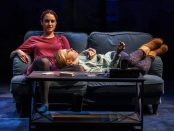
There are many questions that the author fails to answer. Although the boys have not attended school in years and Bobbie has been diagnosed as ADHD and should be in the British equivalent of special education, no social worker seems to have visited to check up. Who is paying the rent or the electricity? Is the mother on welfare and are these items paid automatically? There is no explanation of how the boys are eating and how Taliban stays alive if they have not been feeding it for days or even weeks. While the neighbors are aware of Bobbie’s stealing, he seems to be getting away with it. The dog’s continual barking from his locked room can be heard on the street but no complaints have been filed. Is all this a metaphor or a slice of life drama? [more]

Milk and Honey

January 30, 2017

While the jokes may be hoary, Unger’s production has cut down on the show’s sentimentality and given it a sharp edge which elevates the material. As the heroine Ruth, Runofsson is genuine, contemplative and sympathetic, while Delavan’s Phil is the strong silent type. They have the bulk of the songs and give lovely renditions of “There’s No Reason in the World,” “That Was Yesterday,” “Let’s Not Waste a Moment,” “As Simple As That.” Korey as the gossipy yente Clara Weiss who is free with her advice steals every scene she is in and gets to sing the clever ode to her late husband, “Hymn to Hymie” as well as lead the hilariously staged number, “Chin Up, Ladies” which includes witty audience participation. [more]

Jitney

January 28, 2017

Director Ruben Santiago-Hudson has himself won a Tony Award for his performance in Wilson’s "Seven Guitars" and has directed acclaimed Off Broadway revivals of "The Piano Lesson" and "Seven Guitars." He has assembled a cast of nine in which seven of the actors are veterans of Wilson play including Antony Chisholm who appears in the 2000 production. A true ensemble led by John Douglas Thompson and André Holland (currently in "Moonlight"), a better staging could not be imagined of this involving and engrossing play. [more]

Yours Unfaithfully

January 28, 2017

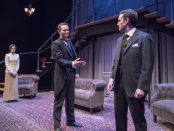
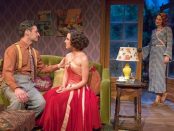
One problem is that the play (unlike Noel Coward’s "Design for Living" or Somerset Maugham’s "The Constant Wife" which cover similar territory) is neither witty not clever, and none of the lines are particularly sparkling or original. While the play may delineate liberated sexual behavior, its drawing room comedy format is too conventional and refined. All five performers always seem to be acting as their style is too arch to be truly believable. [more]

Orange Julius

January 23, 2017

On the one hand, it is a punch in the gut dramatizing the cold hard facts of disintegrating with this disease; on the other, the non-linear time scheme is difficult to follow, offering more questions than it answers. What "Orange Julius" really is could be described more accurately as a screenplay or a teleplay with cuts and fades. There is a powerful work hiding in this material but it still remains unshaped. Under Dustin Wills’ fast-paced direction, Jess Barbagallo, Ruy Iskandar, Irene Sofia Lucio, Stephen Payne and Mary Testa give fine performances despite the fact that the play seems to wander around trying to find its center. [more]

The Present

January 21, 2017

Upton’s version solves some problems and creates others. Updated to the 1990’s, the play is no longer about life in Tsarist Russia but the post-Perestroika world of Glasnost. While the original has characters talk about how much better life will be in the future, the new version has the characters wax nostalgic about the recent past but also talk about the challenge of the new Russia in the present. It is not obvious for much of the first scene that the play takes place in the Russian country. [more]

Blueprint Specials

January 10, 2017

Never before seen on mainland U.S.A, the current show is an amalgam of the four existing shows ("P.F.C. Mary Brown;" "Hi, Yank!;" "About Face" and "OK, USA") of the six that were written. Directed and adapted by Tom Ridgely, co-artistic director of Waterwell, the entertaining show is a co-production of Waterwell in association with the Intrepid Sea, Air & Space Museum under the auspices of the Public Theater’s Under the Radar Festival. Performed on the hangar deck of the USS Intrepid just like it might have been done in 1944 or 1945, the show is a site-specific environmental production with limited scenery but using a combination of Broadway stars and featured players, Waterwell members, Active Duty U.S. military and veterans, and Reserve Special Members. The dance chorus is provided by the Limón Dance Company. [more]

Martin Luther on Trial

January 10, 2017

Set in The Afterlife, a crossroad between Heaven and Hell, the play presupposes a trial of Luther on the grounds of being guilty of “the unforgiveable sin.” The prosecuting attorney is The Devil and the defending attorney is Katie von Bora, also known as Mrs. Martin Luther, with Saint Peter acting as judge. The witnesses called are Hitler on Luther’s anti-Semitism in his later years, Dr. King on Luther’s stance on civil rights, Dr. Freud on Luther’s Oedipus complex, and the current Pope on the Catholic Church’s stance on Luther’s objections today. Along the way, the play also dramatized scenes from Luther’s life. Ultimately, it ends with a recreation of Luther’s trial before the Diet of Worms officiated over by the Holy Roman Emperor in 1521. [more]

What We Wanted

January 7, 2017

While Harms has a fine ear for dialogue, the play moves by revelation and incident. Consequently, it plays like a sophisticated soap opera as every scene brings a new wrinkle not previously suggested. Drew Foster’s direction is smooth and polished but he can’t prevent the play’s plot from having too many incidents that aren’t foreshadowed. Steven Hauck, Elizabeth Rich and Amy Bodnar are charming in a worldly, cultivated way. However, we learn so little about each of them other than how events affect them that they seem one-dimensional. Important facts are left out: what is the rooming situation, are Julian and Agnes married, etc.? The sexual tension is clearly defined: dancing seems to be foreplay to sex. But one can’t live on love alone. [more]

The Mikado Reimagined (NYGASP)

January 5, 2017

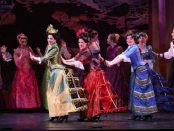
In keeping with Sullivan having been hit over the head, the cast is clothed in a motley collection: a combination of late Victorian and Japanese styles. Some are in all Japanese, some in all Victorian, most are in a combination of the two. Even the Victorian costumes have baroque additions to make them look exotic. The women all wear Victorian gowns with bustles open in the back just as though they had not finished dressing. The concept while colorful is quite a mess with every possible variation on stage at the same time. [more]

God of Vengeance

December 31, 2016

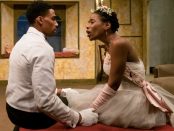
Surprisingly, Eleanor Reissa’s production for New Yiddish Rep has made some debatable choices which damage the power of the play. First of all and most obviously, although not a word has been updated, the characters wear contemporary clothing and use modern objects like headphones, a plastic umbrella and platform shoes. Since there are references to opening a horse stable and the sexual mores of 1907 have changed considerably, this is both distracting and confusing. (The word “roubles” has been eliminated for the more innocuous bucks and coins.) [more]

Sweet Charity

December 28, 2016

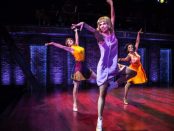
The real reason to see the new "Sweet Charity," its third major New York revival, is for Sutton Foster’s bravura performance. Aside from nightclub singer Reno Sweeney in Anything Goes, Foster has usually played innocent, clean-cut young women caught up in unusual situations. Here she again plays to type – but with a difference: Charity Hope Valentine works as a taxi dancer in a New York dance hall, a sleazy environment. However, she keeps her infectious innocence and her indomitable spirit despite one unfortunate romantic encounter after the other due to her gullibility. Under Leigh Silverman’s direction, Foster may just be the most convincing actress to ever play Charity. [more]

Life is for Living: Conversations with Coward

December 24, 2016

Green’s dry delivery is in the Coward manner, crisp, almost spoken to the music, with impeccable diction. Shrubsole’s accompaniment supports him without ever getting in the way. The most famous song is probably “I Went to a Marvelous Party,” and there are five songs from Coward’s last all-original Broadway musical "Sail Away." However, there are also unfamiliar songs from "After the Ball" (“Something on a Tray”) and" Pacific 1860" (“I Saw No Shadow”), London shows that never made it to Broadway. In addition is “London Pride,” recently heard in the rediscovered post-war musical, "Hoi Polloi." Stand-alone songs include the poignant “There’s No More to Say about Love” and “I Travel Alone.” [more]

Natasha, Pierre & The Great Comet of 1812 on Broadway

December 23, 2016

We knew it was a great novel, but who knew Leo Tolstoy’s "War and Peace," Part I, would make such an exciting and innovative electro pop-rock opera? Not that the epic novel isn’t a fantastic read, but how to successfully put this 1,200 page novel on the stage? (Prokofiev’s opera needed 70 characters and 13 sequences.) First seen in 2012 for a sold-out 39 performance run at Ars Nova, this sung-through electro pop-rock opera, was then presented in 2013 at a supper club called Kazino (Russian for “Casino”) in the Meatpacking District, twice the size of the Ars Nova space, built specifically to house the show, and later it was moved uptown to a Kazino put up on 45th Street. [more]

Othello (New York Theatre Workshop)

December 21, 2016

Two ways to invigorate Shakespeare in our time is to either cast actors not identified with classical roles or to reset the play in some unfamiliar setting. Sam Gold’s magnificent production of "Othello" at the New York Theatre Workshop has done both. [more]

The Band’s Visit

December 17, 2016

Seven musicians of Egypt’s Alexandria Ceremonial Police Orchestra have been sent to Israel to open the new Arab cultural center at Petah Tivah. Due to a mix up at the border, they end up in the dead-end desert town of Bet Hatikva which has no hotel, no culture, and no bus until the morning. However, their visit is the most interesting thing to happen in Bet Hatikva in years as these unlikely visitors represent something different from the outside world. Restaurant owner Dina (Lenk) once a dancer in a big city, now resigned to her boring fate, takes pity on them, feeds them and arranges for them to stay the night in three places including her home. She takes dour, formal conductor Tewfiq (Shalhoub) and young ladies’ man, Haled (Ari’el Stachel). Although the visit is only one night, none of them will ever be the same again. [more]

Ride the Cyclone

December 10, 2016

Rockwell who also choreographed has turned each of the songs into an extravagant, go-for-broke production number. Best are Wardell’s “Noel’s Lament” in which he reveals he wants to be Monique Gibeau, a French street walker in black lingerie à la Marlene Dietrich’s Lola Lola, and Misha’s rap number, “This Song is Awesome” which segues into “Talia,” in which he reveals his rage and passion. Rohm’s semi-operatic aria, “The Ballad of Jane Doe,” has her flying over the audience as she continues to sing. [more]

This Day Forward

December 6, 2016

"This Day Forward" shows much tighter control than many of Nicky Silver’s early anarchic plays. However, aside from offering a few wonderful characters in Malka and the older Irene, the play is disappointing as it sets up expectations which don’t play out. When "This Day Forward" is over, it leaves a feeling of something missing that has failed to take place. It can’t simply be saying that the sins of the parents are visited on the children – or could it? [more]

Party People

December 3, 2016

The framework is a fictional fiftieth anniversary party given in a New York art gallery by collaborating media/visual/performing artists Malik “Mk Ultra” (Christopher Livingston) and Jimmy “Primo” (William Ruiz a.k.a. Ninja) to commemorate the creation of both the Black Panther Party and the Young Lords. Their interest is familial: Jimmy is the nephew of Tito (Jesse J. Perez), a former Young Lords Party member still involved with union organizing, and Primo is a “Panther Cub” as he is the son of a Panther member now in prison. They want to pay homage as well as reveal unspoken truths. Malik and Primo have created a video of the many former party members that they have interviewed that they plan on debuting at the event. The party with people who have not spoken for years will be a charged reunion. The troubled legacy of the two organizations is thoroughly explored in the course of "Party People." [more]

Terms of Endearment

November 30, 2016

It isn’t until the second act of Dan Gordon’s stage adaptation of "Terms of Endearment," based on both the Larry McMurtry novel as well as the Academy Award-winning screenplay by James L. Brooks, that the play takes off. Featuring the now grown-up film star Molly Ringwald in the role of Aurora Greenway that won Shirley MacLaine the 1984 Oscar for Best Actress, the first act jumps around, skipping huge chunks of time as you can in movie cutting, but seems like something is has been left out on stage. [more]

Finian’s Rainbow

November 28, 2016

Moore’s adaptation successfully uses the small, recently renovated stage of the Irish Repertory Theatre so that even with 13 actors the performance area always looks populated with the people of Rainbow Valley. James Morgan’s clever unit set is redolent of the South with its huge live oak draped above the stage. Mary Jo Dondlinger’s lighting is redolent of the warm southern sun as well as the cool evening moonlight. The four piece orchestra sits neatly tucked in the back of the stage without distracting from the performance. [more]
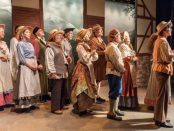
Women of a Certain Age – Play 3 of The Gabriels: Election Year in the Life of One Family

November 14, 2016

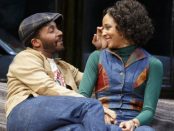
Told in real time from five to seven PM on Election Day, November 8, 2016, not much happens in the play but as the Gabriel women talk, they reveal their hopes, their fears, their desires and their memories. By the end of the play, we know everything there is to know about them. Under Nelson’s direction, his cast of six who now have played these people in three plays since February 27 (first "Hungry" and then "What Did You Expect?" which began previews on Sept. 19) are not so much acting these characters as living them. [more]

The Front Page

November 14, 2016

Ben Hecht and Charles MacArthur’s "The Front Page" remains the quintessential comedy about the tabloid newspaper racket. Jack O’Brien’s production plays it safe while a more brazen and outrageous style might have obtained more laughs. The current revival with its many recognizable names and faces is still entertaining fun. And it does bring back to the Broadway stage the incomparable Nathan Lane in top form in an unforgettable role. [more]

Sweat

November 12, 2016

"Sweat," which won the 2016 Susan Smith Blackburn Prize, is reputed inspired by interviews conducted by playwright Nottage and director Kate Whoriskey in Reading, Pennsylvania, named the poorest city in America in 2011. By 2007, Reading had seen its factories and mills closing as NAFTA and globalization made it cheaper to produce goods in Mexico or China, without offering its residents anything but unemployment insurance. The play could probably have taken place in one of a dozen places in the Rust Belt. "Sweat"’s main characters are all eventually affected by this downward trend in a community that has few opportunities. [more]

Vietgone

November 8, 2016

Not only does Nguyen have a unique sensibility and style, but the story is told entirely from the Vietnamese-American point of view, one not often seen on our stages. We hear the Americans as the Vietnamese do and as the Americans attempt to speak in Vietnamese. While the structure of the play is quite challenging going backwards and forwards in time from July 1975 in a Middle America relocation camp and breaking out in rap songs periodically, "Vietgone" is a very compelling portrait of displaced people trying to make a new life for themselves while wishing they were back home where they cannot go. [more]

Two Class Acts: Squash & Ajax

November 5, 2016

Whether you see one or both of Gurney’s "Two Class Acts," these are provocative plays of ideas on topics of the day. The playwright continues to demonstrate that he has a wise and discerning view of the human condition. Director Stafford Arima has done a beautiful job of obtaining all of the nuances and humor out of the two sharp and intelligent situations. The casting for both plays could not be improved as the actors make their roles their own. The Flea Theater leaves White Street on a high note with two entertaining and superior productions that will close the space with honor and distinction. [more]
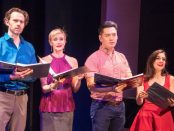
Hoi Polloi

November 4, 2016

"Hoi Polloi" was Coward’s tribute to the London working class that was trying to get back on its feet after the devastation of World War II. Partly out of his element and partly as Coward never saw the show in production, both the book and the score seem like part of a first draft which needs to be fleshed out. Mindy Cooper’s tame production with a hard-working cast of ten seems at best second-rate Coward rather than any unjustly lost rediscovery. The Master may have realized that he had not solved his story’s problems. [more]

Cox and Box & Trial by Jury

October 31, 2016

Introducing what he dubbed a pair of “Comedies of Crime,” NYGASP’s artistic director Albert Bergeret offered what he said was a first of a new series for the company: intimate performances of works by Sir Arthur Sullivan in the jewel box Marjorie S. Deane Little Theater performed to one piano, rather than to the usual full orchestra. In addition, the cast of "Trial by Jury" was comprised of the NYGASP’s Wand’ring Minstrels, a quintet of singers made up from the company, rather than using the full chorus, while the production of "Cox and Box" featured a newly edited version by singer/director David Macaluso. The new format for these delightfully entertaining productions had their advantages and disadvantages. [more]

Plenty

October 29, 2016

In his Broadway productions, David Leveaux has often used a strong directorial concept such as his Chekhovian 'Fiddler on the Roof" and his interracial "Romeo and Juliet" which did not work for all theatergoers. Here he seems to have decided that Susan finds life in Britain gray on her return and all of the sets by Mike Britton other than the final one (ironically suggesting the hope of the post-war generation) are made up of gray walls. As a result, none of them have any atmosphere aside from all resembling each other. It is left to the costumes by Jess Goldstein to give clues to the year of each scene which they sometimes do, and sometimes not. [more]

Paris (Company XIV)

October 27, 2016

Company XIV has applied its inimitable Baroque-Burlesque style to the Greek myth of the Judgement of Paris for the second time and come up with Paris, an exotic and erotic adults-only entertainment that is like nothing else you will see this year. Conceived, directed and choreographed from the fevered imagination of Austin McCormick, Paris combines the arts of dance, opera, circus, theater, storytelling and high fashion to tell its story of the competition between the goddesses Athena, Juno and Venus for the Golden Apple. As you may know, the future outcome was eventually The Trojan War. [more]

What We’re Up Against

October 25, 2016

The play is both satiric and trenchant. The conversations of the men are laced with profanity much like David Mamet’s real estate men in Glengarry Glen Ross. Eliza is called everything in the book (arrogant, aggressive, disrespectful, impatient, a loose cannon) as well as names you can’t print in a family newspaper. Eventually it rubs off on Eliza and Janice and they are cursing as crudely as the men: if you can’t beat them at their own game, then join them. The men’s fear of the women getting ahead would be pathetic if it weren’t so typical and true. Rebeck dramatizes office politics as each member of the staff worries about his or her own skin, either with lies, evasions or manipulation, and the circle keeps widening, until Eliza beats them at their own game. [more]

The Cherry Orchard

October 25, 2016

Directed by high profile new British director Simon Godwin, associate director of the U.K.’s National Theatre, making his New York debut, this "Cherry Orchard" seems to have no interpretation or explanation for a new staging. Stephen Karam, the author of last season’s acclaimed "The Humans," has written a new version which seems to be heavy on American ideas in this Russian play, while both the sets and costume designs get in the way of coherence and understanding. All in all this is a great disappointment considering the talent involved. [more]

Funny Face

October 24, 2016

Aside from the syncopated, bouncy score, the single best element is the sensational choreography by director Colgan whose dances also impressed in his revival of Oh, Kay! last year. While the cast has obviously been chosen for their dancing skills than their voices, there are some stand-outs in the production. As the rebellious Frankie (the original Adele Astaire role), Jessica Ernest in a platinum blonde wig is an irresistible bundle of energy. Doing a spot-on imitation of early Marilyn Monroe she steals every scene she is in and does a mean Charleston. Whitney Winfield as her level-headed sister June in love with their guardian gives memorable renditions of “How Long Has This Been Going On” and “Shall We Dance.” Caitlin Wilayto is an extremely fine comedienne as the ditzy sister Dora. [more]

End of Summer

October 22, 2016

While S. N. Behrman was one of the leading Broadway playwrights from the twenties through the early sixties, he went into an eclipse after his death in 1973. Since 2000, however, there have been New York revivals of his major comedies "The Second Man," "Biography," "No Time for Comedy" and "Rain from Heaven." Set in the living room of a summer cottage on an estate in Northern Maine where the rich Frothinghams go to get away from the problems of the world, circa 1936, End of Summer resembles Chekhov’s "The Cherry Orchard" in that they both concern wealthy people refusing to recognize the changing social order. However, S. N. Behrman’s play is very much a comedy with its cool, urbane witticisms and very American in its outlook and content. [more]

The New York Pops: The Musical World of Lerner and Loewe

October 18, 2016

Music Director/Conductor Steven Reineke chose three fine singers, Colin Donnell, Laura Osnes and Nathan Gunn, to animate the Lerner and Loewe songbook, along with the terrific choir, Essential Voices USA (Judith Clurman, Music Director). They, plus the lusty sounding New York Pops, brought songs from "Camelot," "Paint Your Wagon," "Gigi," "Brigadoon" and, the biggest hit, "My Fair Lady" to life. [more]

Public Enemy

October 16, 2016

Ibsen’s "An Enemy of the People" is a classic of modern drama but at times it can seem musty in a poor translation. David Harrower’s "Public Enemy" is not only a shrewd, accessible adaptation, it also makes clear the contemporary relevance of the dangers of the herd instinct in a seemingly just society. The Pearl Theatre Company production is a must-see for all good citizens, particularly in these perilous times. [more]

The Clearing

October 16, 2016

Playwright Helen Edmundson whose stage plays have been mostly adaptations of famous literature ("The Mill on the Floss," "War and Peace," "Anna Karenina," as well as "Coram Boy" and "Thérèse Raquin" both seen on Broadway) tells her story in the leisurely way one might write a novel. While the material is both shocking and surprising, director Pamela Moller Kareman has undercut the inherent tension in the play by the choices she has made. [more]

Kurios: Cabinet of Curiosities (Cirque du Soleil)

October 10, 2016

Cirque du Soleil's "Kurios: Cabinet of Curiosities" has a wonderful premise and an eye-filling mise en scène. However, without the needed narration or program notes, the idea remains still in embryo. The problem one supposes is how to narrate a show that is intended for international audiences. [more]

Divine Comedy

October 9, 2016

The problem with Peter Dobbins’ productions is not the quaint spiritual underpinnings of the plays but the fact that they are directed too leisurely and consequently do not generate any laughs, fatal for comedies. Several of the actors are innocuous where they should be more incisive. The rhythms of both plays seem much more formal and genteel than they need to be. The short, curtain raiser plays like an extended anecdote, while the longer, more famous play is a comedy of manners play that seems rather thin for its length. The stilted, old-fashioned translations from the French also do not help. [more]

Twenty Thousand Leagues under the Sea

October 6, 2016

The live action elements of the show are performed on various platforms and screens on which are projected Deco Dawson’s designs which give the dramatization a 3-D look. In addition to 2 -D minatures, Miller manipulates tiny action figures (the scientists, etc.) and puppets (the Giant Squid, etc.) which are projected life size. Other moments take place in the audience. The audience is also asked to put their smart phones on mute to await developments. Among the magical moments are the walk on the bottom of the sea and the school of jelly fish. Aside from the marvelous visuals, the creators seem to want to have it both ways: although we are transported to a Victorian world, smart phones and computer monitors seem to work – although the younger members of the audience will most likely not notice the anachronisms. [more]

Marie and Rosetta

September 30, 2016

The two women size each other up, first by Sister Rosetta singing such gospel numbers as “This Train,” “Rock Me” and “Sit Down,” while Marie demonstrates her style with “Were You There When They Crucified My Lord.” Then they move into a series of dynamic duets, each one more robust and rousing then the last. Eventually they sing a few of the pop songs that Sister Rosetta has made famous: “I Want a Tall Skinny Papa” and “Four or Five Times.” A sleight of hand is their writing “Up Above My Head” together while we watch and listen to the song unfold as if for the first time. Lewis brings her powerful, full-bodied voice to her songs, while Jones has a smaller, mellower sound (the real life Knight was a contralto). However, when they join together in song, the results are glorious, and each duet will make you hungry for the next one. [more]

Hamlet (Mobile Unit 2016)

September 24, 2016

The single disadvantage of director Patricia McGregor’s approach is that in cutting so much text, the events of the play seem to occur one on top of each other, making the play a bit melodramatic, and a good deal of character development is sacrificed by the way. However, with dangerous-looking fight direction by Lisa Kopitsky and intriguing movement by Paloma McGregor, this is a "Hamlet" that lives up to its mission to be accessible and entertaining to all, those who know the play well and those seeing it for the first time. [more]

Fiorello!

September 24, 2016

Under Bob Moss’ vigorous and energetic direction, the cast of 20 young actors grab hold of the show and never let up for a moment playing a multitude of colorful New York types with energy and verve. The musical numbers are excitingly staged with excellent period choreography by Michael Callahan. In the title role, Austin Scott Lombardi, making his Off Broadway debut, is a forceful and charismatic presence as the lawyer who is always on the right side of every issue and never takes no for an answer. As his love interest Thea, the beautiful Italian American from Trieste, Rebecca Brudner is a charming presence, impressively maintaining her Italian accent even during her musical numbers. Katie Birenboim obtains our sympathy as Fiorello’s long-suffering secretary with her wry view of the world. Chelsea Cree Groen and Dan Cassin are an engaging if unlikely romantic couple as the savvy sweatshop seamstress and the dim-witted cop who arrests her best friend for picketing. [more]

A Taste of Honey

September 22, 2016

Director Austin Pendleton made some choices which don’t help the now creaky play. Although Peter is described as ten years younger than Helen, Pendleton has cast the ever reliable Bradford Cover who unaccountably looks to be Helen’s age or older. This changes the dynamic of the play as with a younger man it would be obvious why Helen doesn’t think she has much hold over him. While the apartment is described as dirty with junk all over it, Harry Feiner’s set is spotlessly clean. This changes the environment a good deal and makes Jo’s life much less intolerable than described. In addition to the on-stage jazz combo which was also part of the original 1958 London production, Pendleton has several of the characters occasionally speak directly to the audience which makes this play more surreal than the kitchen sink milieu would imply. All of this makes the revival much less affecting than it might have been. [more]

What Did You Expect? – Play 2 of The Gabriels: Election Year in the Life of One Family

September 21, 2016

Like his "Apple Family Plays," Nelson’s "The Gabriel" cycle all take place in a kitchen on a specific day in almost real time using the same six actors to play the family members. These are occasional plays which define a moment in time, as well as being chamber plays, small cast plays set in one place. Not much happens but much gets said and discussed. Described as “Chekhovian” by Oskar Eustis, artistic director of the Public, "What Did You Expect?" is less so as there really is no dramatic event as in such Chekov plays as "The Cherry Orchard" or "The Sea Gull." However, leisurely told and extremely detailed, "What Did You Expect?" offers its own rewards but may not be for all theatergoers. It is an evening of excellent talk which defines a family of have nots in our own time. [more]

The Birds

September 16, 2016

Unlike the original short story which was set on a rural farm in Cornwall, England, and the film which was reset in Bodega Bay, California, the play takes place entirely in the main room of an isolated house in New England. Stefan Dzeparoski’s production which puts the audience in the same room with the characters has its strengths and weaknesses making this an evening of mixed success. [more]

Aleko & Pagliacci (New York City Opera)

September 12, 2016

While the New York City Opera’s staging of "Aleko" could not be called a major rediscovery, it was an admirable attempt to offer a non-standard repertory work that had probably not been seen by any of its New York audience. The real surprise was the thrilling and commanding performance of "Pagliacci" which bodes well for NYCO’s future life and health at Lincoln Center. In addition, the New York City Opera Chorus, under the direction of William Hobbs, gave persuasive performances in both operas, another feather in the City Opera’s cap. [more]

Toruk – The First Flight (Cirque du Soleil)

September 10, 2016

The show includes pole vaulting, giant flowers that rise up out of the ground, the building of the bone structure of the totemic Thanator, the high flying of the Toruk, a flock of birds played by kites, pulsating live drumming, two earthquakes, the lava flow, a three story water fall, and the rise of the river by which the Pandorans are saved. Along the way the questers are beset by various exotic animals played by 16 huge puppets (designed by Patrick Martel) which are manipulated from inside by the performers. As the trio travel from one clan to another, the environment before us morphs from one colorful place to another in Carl Fillion’s monumental set and prop design. [more]

The Layover

September 6, 2016

Following "Bachelorette" and "Assistance," Leslye Headland’s latest play, The Layover, is a taut psychological thriller told in an updated film noir style. Trip Cullman, who has directed all of her New York productions, has made the play a tour de force of tension and unease. As acted by Annie Parisse, Adam Rothenberg, Amelia Workman, John Procaccino and Quincy Dunn-Baker, the tone is marvelously sustained. The only fly in the ointment is the ending which will take you entirely by surprise and may feel unmotivated. [more]

Twelfth Night (Public Works)

September 5, 2016

Taub’s eclectic score to original lyrics includes jazz, rhythm and blues, pop, Broadway and ragtime. Among Kwei-Armah’s ingenious touches were his use of a series of community cameo groups play back up for individual songs: the Jazz Procession for Countess Olivia’s father was played by the spirited Jambalaya Brass Band. Viola’s inner monologue was interpreted expressively in pantomime by New York Deaf Theatre. Malvolio’s solo Can-Can was performed by the nine energetic and enthusiastic dancers of The Love Show. The duel provoked by Sir Toby was backed up by the thrilling drummers of COBU while his duel masters were portrayed by the electrifying Ziranmen Kungfu Wushu Training Center. Throughout the evening, the Illyriettes made up of six ladies dressed identically in purple sequined sheaths played back up group for various singers and musical numbers. [more]

The Trojan Women

September 4, 2016

Written in 415 B.C. as a criticism of the Athenian capture of Melos and the subjugation of its population earlier that year, "The Trojan Women" has remained relevant throughout the last 2,500 years due to mankind’s penchant for war. Although Ellen McLaughlin’s new adaptation makes some changes to the Euripides original, it retains its power pertinent for our own time in the wake of the refugee crisis. While at times callow, Anne Cecelia Haney’s production for The Bats is persuasive, potent and poignant. It also provides an excellent introduction to the plays that make up Greek tragedy for those who have not experienced them on stage. [more]

A Day by the Sea

August 30, 2016

Now that we have been through all the angry play movements, literate writers like N.C. Hunter and Terence Rattigan are once again ripe for revival. While in his own time, Hunter was criticized for being too much like Chekhov that now seems a plus in the days of sloppy craftsmanship and plays that are really movie scenarios staged in the theater. "A Picture of Autumn" was obviously a post-war British variation on Chekhov’s "The Cherry Orchard," while Waters of the Moon resembles "The Sea Gull." "A Day by the Sea" owes a great deal to Chekhov’s "Uncle Vanya" and includes the same basic cast of characters. [more]

Touch

August 27, 2016

Toni Press-Coffman’s "Touch" is a rather challenging play both in that a great deal of it is narrated in recollection and also that it deals with much naked emotion. The cast led by Peter McElligott who is onstage almost throughout the evening could not be bettered. Director Nathaniel Shaw has made this under-dramatized play into a more theatrical experience. While Touch will not be for everyone, it is an impressive document of the workings of the human heart. [more]

LUNT AND FONTANNE: “The Celestials of Broadway” (The New York International Fringe Festival 2016)

August 20, 2016

While "LUNT AND FONTANNE: The Celestials of Broadway" is a fine and concise review of their careers for people who have never heard of them, Murphy and Lang make them seem more superficial than necessary. It is true that Fontanne was born in England, but Murphy and Lang play both of them as very English and exceedingly refined and proper, not backed up by their performances as themselves in "Stage Door Canteen." The Lunts’ famous use of overlapping dialogue which was years ahead of its time can be seen in the video of their film of "The Guardsman." Murphy and Lang often use it to talk over each other’s lines making them unintelligible, while the Lunts came in on the last syllable of their cues which is much more realistic. The Lunts may have appeared in many light drawing room comedies, but to portray them as delivering their lines on the same level all time would not have made them as famous as they were. [more]
1 13 14 15 16 17 20