Victor Gluck was a drama critic and arts journalist with Back Stage from 1980 – 2006. He started reviewing for TheaterScene.net in 2006, where he was also Associate Editor from 2011-2013, and has been Editor-in-Chief since 2014. He is a voting member of The Drama Desk, the Outer Critics Circle, the American Theatre Critics Association, and the Dramatists Guild of America. His plays have been performed at the Quaigh Theatre, Ryan Repertory Company, St. Clements Church, Nuyorican Poets Café and The Gene Frankel Playwrights/Directors Lab.
Although director Indhu Rubasingham’s production is engrossing and entertaining, this talky and dense play may be difficult to follow for Americans who either do not know or have forgotten the details of Thatcher’s 11 year career as the first woman British prime minster and the longest serving P.M. of the 20th century. Among characters depicted by the male actors whom Americans may have trouble placing are Kenneth Kaunda, Neil Kinnock, Michael Shay, Kenneth Clarke, Arthur Scargil, Peter Carrington and Michael Heseltine. Many of these men were Thatcher’s cabinet ministers who are no longer on the political scene. However, with two actresses playing each of the women in both younger and older incarnation, it is quite remarkable how much they reflect the real life people they play. [more]
Director Kenny Leon has made his reputation with trenchant productions of contemporary and new plays by such authors as Lorraine Hansberry, August Wilson, Katori Hall and Lydia R. Diamond. Now with his delightful all-black modern dress version of "Much Ado About Nothing" at the Delacorte Theater for Free Shakespeare in the Park he demonstrates a light touch with classic plays. Led by Danielle Brooks, star of "Orange is the New Black" and Tony nominated for her performance as Sofia in the 2015 revival of "The Color Purple," the generally youthful cast is up to the requirements of this witty Shakespeare comedy. [more]
Kate Hamill who has had success with "Sense and Sensibility" (Bedlam), "Pride and Prejudice" (Primary Stages), and "Vanity Fair "(The Pearl Theatre) has now turned her sights to Louisa May Alcott’s beloved novel of growing up, "Little Women." With this stage adaptation she seems to want to have it both ways: although still set during the Civil War with the women in long dresses and singing “The Battle Hymn of the Republic,” Jo wears men’s clothing and she and Laurie often speak of feeling like they do not fit their gender role. A note in the script states that the play “MUST be cast in an inclusive fashion. It is an American play, and should reflect America today.” As a result, the Primary Stages production makes the March family sisters Hispanic, African American, and Caucasian. This new "Little Women" has a modern sensibility at war with the material. [more]
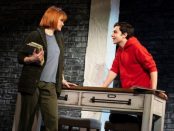
Under Shinn’s direction, Winstead making her stage debut is very low-key, almost as an observer in her own story. True she works as a therapist, one who tries not to reveal her personal feelings to her patients, but in her private life she ought to show more emotion given the provocations. In the original production directed by James Macdonald, Pablo Schreiber as both Peter and Craig was devastating, leaving the audience almost quaking in their shoes. Here Woodell is almost indistinguishable as the twin brothers, thorough dressed in an olive green t-shirt as Peter and a button-down striped flannel shirt as Craig so that we have no trouble keeping them apart. The revelations come periodically but the play and the production seem under heated. It also seems to be too dependent on emails and phone calls, rather than dramatizing the story. [more]
The play offers no catharsis as the actors are so low-key throughout, all much too calm even when the stakes are rising. As a result, there is little or no tension even when we realize the pattern that each scene will offer a worse revelation than the one before. Tergesen’s black sheep Billy gives us no clue as to the reason for his malignant behavior. Both AuCoin as his brother David and Parisse as David’s wife Molly are cool and sophisticated when they should be losing their temper. Wolff’s Brown University freshman is too inarticulate, but unfortunately he is straitjacketed by the dialogue he has been given. [more]
Bekah Brunstetter’s new play, "Public Servant," has its heart in the right place. It shares with The Cake, seen earlier this year at Manhattan Theatre Club, the first part of a trilogy with the new play, a similar theme: private issues of public figures, with both plays set in North Carolina where the author hails from. Like Della in "The Cake," Ed in "Public Servant" is a well-meaning man whose personal beliefs do not always agree with all members of the community - including his own college-age daughter. Unfortunately, "Public Servant" has many of the same problems and drawbacks that marred "The Cake." [more]
G. Austin Allen’s set is a larger-than-life closet draped in purple cloth and which also includes a kitchen. To this room comes the older man in his mid-60’s who has discovered that as his husband Steven is dying of cancer, nursing homes are ambivalent about taking in gay men. Next is a middle-aged man in his mid-40’s who has had an emotional meltdown having realized he is soon to turn 50 and has no partner to fill his lonely life at which he was bartending. And then there is the hunky man in his late 20’s who is in the midst of a trial against his boss and his friend who raped him after a sex party. They are also there to give advice to teenage John, still asleep in the next room, when he wakes up confused after his first gay sexual encounter. [more]
Schmidt’s streamlined adaptation of Shakespeare’s Scottish tragedy is played by a cast of seven schoolgirls who meet in an abandoned urban field after school without any set up other than that they throw down their book bags before launching into the first scene. Designed by Jessica Pabst, their school uniforms made up of cape with hood, a blazer, a skirt, and tie are made of Scottish tartan which is appropriate for this play. Every prop in the show comes from the backpacks and purses they carry with them. The girls perform the play without reading from the text as though they have studied it in school and are thoroughly versed in it. Once they enter the scene, the girls never exit but sit on the sidelines watching for the rest of the play. [more]
"Luzia: A Waking Dream of Mexico" is Cirque du Soleil’s 38th original production and its 18th performed under The Big Top. The name is a combination of the Spanish word for light (luz) and the word rain (illuvia). Written and directed by Daniele Finzi Pasca (co-authored by Julie Hamelin Finzi) with Patricia Ruel as Director of Creation, the colorful show is a surrealistic journey through the various landscapes and arts of the country. Using the frame of a traveler parachuting into a land of memories, the show moves from a movie set to the ocean to a smoky dance hall to the desert. It touches on the music, design, sports, entertainments, animals and mythology of Mexico. [more]
As David, Chris Dwan does not make one forget the inimitable Grisetti who spun every moment into a comic turn. However, Dwan is charming as the undaunted hero who must deal with problems behind his ken but always comes up with a possible solution even if it doesn’t work out. David Schramm’s alcoholic and hammy Harrison Marlowe is not quite as clipped as that of the late George S. Irving whose signature role this became but his sarcasm and slow burns are still entertaining. Though Farah Alvin’s Angela Marlowe is not as affected as her predecessor as the predatory performer, she still is delicious as an actress who falls in love with all of her co-stars. [more]
Never really losing her cool, Pressley always commands the stage even though scenic designer Alexis Distler has made it difficult by creating a huge private room, beautiful in its understated way in blues and beiges, but difficult for one person to fill the space. Yes, Maurice is presumed to be in his hospital bed on stage right, and Lashonda is on the smartphone, but Pressley must negotiate the entire stage herself. Director Jade King Carroll has found reasons for her to move around from chair to sofa to a chair on the other side of the room, but has not helped much in making the play build an arc. The effective lighting by Mary Louise Geiger subtly shifts from afternoon to evening light without our realizing how much time has passed. [more]
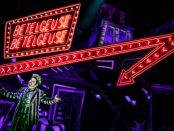
Not all cult movies need to be made into musicals, particularly those that are dependent on special effects which the cinema does better than the stage. This is demonstrated by the new Broadway musical based on "Beetlejuice," the Tim Burton horror-comedy-fantasy. This theme park-type show is visually a spectacle with a set that does all sort of tricks and changes, but as the adage goes, you can’t go home singing the scenery. And the score by Australian composer/performer Eddie Perfect (whose only other American score has been "King Kong the Musical") is eminently forgettable. In the title role, Alex Brightman, who was charismatic in a similar role in "The School of Rock," is so over-the top that he becomes tiresome very quickly. To paraphrase Mae West, too much of a good thing is not wonderful. [more]
Poet Aziza Barnes’ first play, "BLKS," now at MCC Theater Space is raucous, vulgar, outrageous and contemporary in Robert O’Hara’s hilarious, over-the-top production. Following the adventures of three black women roommates from Brooklyn over a day and a half, it shows us how the Girls are living today - Lena Dunham would approve. However, the loud and busy production in the Newman Mills Theater stage will thrill twenty and thirty somethings, while older people may not be in tune with it. It is an insightful view of modern life today from the black female perspective and as liberated as a play can get at this moment in time. There is likely to be a generational divide to this comedy which pushes the envelope. [more]
Christopher Chen’s exquisite and mystical "Passage" being produced by the Soho Rep is inspired by E.M. Forster’s "A Passage to India," borrowing its plot and character relationships. But while Forster’s novel was simply about the British colonization of India, Chen has something bigger in mind. Chen calls the two locales Country X and Country Y so that the audience can fill in whatever two countries they wish in whatever time. Director Saheem Ali’s superb multicultural cast offers the maximum in diversity. And in this age of nations all over the world cracking down on immigrants and immigration, the play is an investigation into our complicated feelings about The Other. [more]
Witnessing the LOTNY production makes one wonder why "Owen Wingrave" is not performed more often: it has a small cast of eight with juicy roles for all of the characters, evenly divided between men and women’s roles, not true of either of the composer's operas, "Peter Grimes" or "Billy Budd." Although it makes use of the twelve tone scale, its dissonances are not hard on the ear. The plot is simple to follow and it can be performed in a unit set as was demonstrated by Josh Smith’s attractive and flexible design with six playing areas at the GK Arts Center. With the use of video or slide projections and atmospheric lighting, one can make the production as spooky as one wishes for this late Victorian ghost story. [more]
As president of International PEN, the worldwide association of writers, from 1966 – 1969, playwright Arthur Miller moved about Eastern Europe freely and witnessed a great many troubling events concerning writers of all genres. These occurrences led to his writing "The Archbishop’s Ceiling," his most political play, which was presented at the Kennedy Center in 1977. Revised after the failure of this production, it had its world premiere at the Cleveland Playhouse in 1984 but was not picked up for a New York production. Since then it has been seen in London at the Royal Shakespeare Company in 1986, Budapest in 1989, Westport, Ct., in 2006 and Denver in 2015. It has finally made it to New York courtesy of Regeneration Theatre in residence at Urban Stages. [more]
In "Caroline’s Kitchen," British playwright Torben Betts ("Invincible," "The Unconquered," "Muswell Hill") has written a state of the nation farce which has no laughs. As the play under the title "Monogamy" has been very successful in England, it is possible that it just too British for American audiences. Similar to the plays of Alan Ayckbourn in dealing with middle-class people confronted with chaos not entirely of their own making, "Caroline’s Kitchen" unfortunately has only unlikable, self-absorbed characters caught up in a series of situations that simply get worse without having us on their side. Don’t blame the actors in this Original Theatre Company and Ghost Light Theatre co-production if Betts’ characters are unsympathetic although that may be his take on the nation at this moment in time. [more]
MasterVoices performed a beautifully sung and played rendition of the legendary 1941 musical "Lady in The Dark" as part of New York City Center’s 75th Anniversary Season for three sold-out performances. Conducted and directed by MasterVoices’ artistic director Ted Sperling and starring Tony Award winner Victoria Clark as heroine Liza Elliott, the production offered a world premiere of a new adaptation of the Moss Hart book by Christopher Hart (the author’s son) and Kim Kowalke, and the complete critical edition of the Kurt Weill/Ira Gershwin score. While the musical portions were excellent, this concert version only made clear the strengths and weaknesses of this rarely revived musical play. [more]
Retro Productions which has staged both old and new plays has turned its attention to this unjustly neglected comedy from 1961 which has not had a New York revival that made it into the record books. Shay Gines’ production proves that it is still witty and literate and has a great many quotable one-liners. A window on the 1960’s, the problem for younger people will be the number of household names that aren’t well-known anymore like Orville Prescott, Elizabeth Arden, Jack Warner, Louella Parsons, Gerold Frank, Jackie Coogan and David Susskind, pioneers who should not have been forgotten. The show program conveniently has a Pop Culture Glossary in the back which explains them all. The problem for older people is that the pacing is a bit slow where it should be played at farce tempo which would make the repartee all that much more scintillating. [more]
As the elderly king of Britain who deludedly decides to give up his kingdom to his three daughters, Goneril and Regan, the two older married ones, and Cordelia, his younger unmarried daughter, in exchange for their regaling him before his court with how much they love him, the 83-year-old Jackson dressed in Ann Roth’s fitted tuxedo and with a severe masculine haircut would seem believable casting. However in the first half of the evening (Acts I-III) which take about two hours, Jackson is nothing but haughty, sarcastic and arrogant, with little or no variety. In the production’s second half when the king who has been turned out of the castles of both married daughters (Cordelia having left the country to marry the King of France), Jackson seems mad but wise and more compassionate, turning the king’s anger on himself, but it is too little, too late. [more]
The dazzling Broadway production of Anais Mitchell’s musical "Hadestown" proves director/developer Rachel Chavkin to be a creative genius. If you had not known it after she fitted her theater-in-the round production of "Natasha and Pierre and the Comet of 1812" into a Broadway theater, it is even more obvious now. This time she has turned her 2016 New York Theatre Workshop staging in the round into a production suitable for Broadway’s Walter Kerr Theatre with its proscenium stage without losing the sense that the musical takes place in many different places. Along with gripping choreography and movement from David Neumann and an onstage jazz band of six, the show simply takes your breath away, telling the joint stories of Orpheus and Eurydice, and Hades and Persephone. [more]
Unfortunately in a play that is already crammed full of ominous hints, O’Brien’s production is very heavy-handed, underscoring the foreshadowing with a double line under each and every clue and signal of things to come. While the play has been given a most realistic production for the backyard of a house on the outskirts of an Ohio town by set designer Douglas W. Schmidt and costumes by designer Jane Greenwood that are redolent of the late 1949’s, the actors have been allowed to emote from the moment the curtain goes up. If you don’t guess the surprise ending in this production, you haven’t been paying attention. This may be intended to suggest Greek tragedy by the final curtain but there is no need to make it look like an antique production of "Medea," "Electra" or "Oedipus the King" – which would probably be more subtly staged today. [more]
Playwright Taylor Mac’s Broadway debut, "Gary: A Sequel to Titus Andronicus," comes with a great many pluses: three consummate clowns, Nathan Lane, Kristine Nielsen and Julie White, directed by George C. Wolfe, and a terrific set by Santo Loquasto. This ribald yet philosophical downtown comedy is making its debut at the Booth Theatre, usually home to sedate, serious dramas. While low humor seems to be the name of the game, the play also has a good deal to say on various topics like comedy and tragedy, political systems, class structure, the little people who generally do the dirty work, and parodying Elizabethan revenge plays. The humor in Gary is not for everyone, but those who relish low comedy will have a ball as do the actors on stage. [more]
Laurie Metcalf and John Lithgow are such consummate stage performers that they could read the phone book and keep us mesmerized. As directed by Joe Mantello in Lucas Hnath’s "Hillary and Clinton," they have the kind of rapport of actors who have worked together for years. Unfortunately Hnath, who gave Metcalf a Tony Award winning role in his "A Doll House, Part II" in 2017, hasn’t given them much to work with. True, his play inspired by real people is entirely supposition with enough true facts to make us curious. But at 80 minutes playing time, Hillary and Clinton seems padded, and set in 2008 there isn’t a lot to wait for as we all know it how turned out. [more]
"Be More Chill," the dazzling and inventive musical based on the cult Young Adult novel by Ned Vizzini, has made a successful transfer to Broadway Lyceum Theater with the same cast and an expanded production team after a tryout production at Two Rivers Theater in Red Bank, New Jersey in 2014, and a YouTube soundtrack that has had over 150,000,000 hits which led to an Off Broadway production at the Pershing Square Signature Theatre Center during the summer of 2018. If memory serves after ten months, in some ways the show is strong and in other ways weaker. Bobby Frederick Tilley II’s costumes are more colorful, while Charlie Rosen’s orchestrations seem to be less so. On the plus side the performances of Will Roland as Jeremy, Jason Tam as the Squip, Tiffany Mann as Jenna and Lauren Marcus as Brooke have deepened. The show seems less comfortable at the Lyceum Theatre than it was at the Irene Diamond Stage but a good many more fans can now get to see the show at each performance. [more]
Like John Doyle’s reconceived musical revivals ("Allegro," "Passion," "Pacific Overtures," "Carmen Jones," "The Cradle Will Rock"), Fish’s production is minimalist but with a difference. While Doyle strips away the trappings both of sets and costumes and offers nothing in their place, Fish has turned his "Oklahoma!" into environmental and communal theater. When the audience enters the Circle in the Square, they are confronted with set designer Laura Jellinek’s giant dance hall with long tables around the perimeter with red crock pots on the center of each. The plywood walls of the theater are covered with rifles, the kind used by real cowboys on the range. The bluegrass band is located in a pit off center, at one end of the circular stage. Some lucky audience members sit at the first row of tables with a ringside view. Scott Zielinski’s lighting is kept on for most of the show so not only does every member of the audience see every other one but it is as though we are part of the show, not just audience members. This communal feeling is continued during the intermission when the audience is invited onto the stage to taste corn bread (that we watched Aunt Eller and Laurey preparing in the opening scene) and chili. [more]
Those who loved The Mad Ones’ "Miles for Mary" which had an extended run at Playwrights Horizons last year after its premiere at The Brooklyn Starr in 2016, will be greatly disappointed by their latest group effort called "Mrs. Murray’s Menagerie." The beautifully renovated Greenwich House offers the first play of the Ars Nova residency a lovely venue for this new play and the Lila Neugebauer production is impeccable acted and designed. However, this fictional recreation of a focus group, like most cinema verité, has no discernable dramatic event, making it a long 90 minutes. [more]
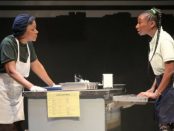
Delving into black life and attitudes now, the play is hilarious - but not laugh-out-loud funny. Unfortunately, in Stevie Walker-Webb’s fine production at The Public’s LuEsther Theater, the sketches go on too, long, way past their due date and long after we have gotten the point of the satire. Of the talented cast of six African American actors, five are all in the majority of the scenes while playwright Cooper appears in three solo sketches. [more]
The show also uses the 3D holographic technology called IceMagic which attempts to bring us the late Oscar Hammerstein II as a hologram enacted and spoken by actor Bob Meenan. Aside from an incorrect accent for Hammerstein, a native Manhattanite, the new technology does not seem to allow much latitude. He is either seen sitting at a desk, standing before it, or seated in a rocking chair. Although the text that he is saying claims to be drawn from “personal correspondence, unpublished lyrics, interviews and rare memoirs,” it has been taken from his most banal remarks usually around the word “Dream” which is spelled for us on a screen before him. One learns nothing about the man or his work from the texts chosen by Ms. Taylor. [more]
A three and half hour play with only three actors spanning 163 years might not be your idea of entertainment, but the National Theatre’s production of "The Lehman Trilogy" is one of the most exciting theatrical events to be seen in New York in over 50 years. Making its North American premiere at the Park Avenue Armory, Sam Mendes’ swiftly paced production of Stefano Massini’s play features Simon Russell Beale (often called the finest classical actor of his generation), Ben Miles (Cromwell in the Royal Shakespeare’s production of "Wolf Hall"), and Adam Godley (Broadway’s 2002 "Private Lives" and 2011 "Anything Goes"), three of the most versatile British actors alive today. While "The Lehman Trilogy" tells the story of the three brothers who founded the family institution that eventually became one of the leading financial firms on Wall Street and later precipitated the crash of 2008, it also recounts the story of the rise of modern banking with the financial history of the last 150 years. [more]
In Mara Nelson-Greenberg’s new play, "Do You Feel Anger?," which had its world premiere at the 2018 Humana Festival of New American Plays at Actors Theatre of Louisville, she has attempted to write a Theater of the Absurd dark comedy about sexism in the workplace. Starting out offbeat and humorous, it quickly devolves into repeating itself endlessly without enough new material to keep us amused or shocked. In the Vineyard Theatre production, director Margot Bordelon and the high powered cast of seven are fully in tune with the author’s sensibility. Unfortunately, there are not enough surprises in this schematic play to keep us interested although the subject matter is eminently topical. [more]
Not seen in New York since 1965, John Webster’s Jacobean revenge play, "The White Devil," has been given a juicy, vigorous modern dress production by Red Bull Theater which specializes in Elizabethan and post-Shakespearean dramas. While not as great as Webster’s "The Duchess of Malfi" or Shakespeare’s psychological dramas, this second-rung tragedy from 1612 has been directed by Louisa Proske with live video and contemporary trappings in a style that is always riveting, always engrossing, particularly notable for a play that will be unfamiliar to most theatergoers. [more]
Shakespeare’s politically charged Roman tragedy, "Julius Caesar," has always been a touchstone for inflaming emotions. In earlier times, monarchs used to ban the play when uprisings were imminent. In the 1930’s, the play was presented as an anti-Fascist rallying cry. In our own era, it has been presented with various American presidents as the stand-in for Caesar. While Shana Cooper’s production for Theatre for a New Audience here called "The Tragedy of Julius Caesar" is vigorous, lusty and lucid, it offers no political point of view. We never understand why the conspirators want to get rid of Caesar nor what they want to replace him with instead. [more]
Playwright Thomas Bradshaw seems to have taken literally the dictum in theater to “Astonish!” His plays like "Burning," "Intimacy," "Job," and "Fulfillment," to name only a few seen in New York in recent years, are shocking, disturbing and an assault on both the actors and audience. In The Flea Theater revival of his 2008 play, "Southern Promises," director Niegel Smith seems to have taken this one step further. In this play about race relationship between masters and slaves set in 1848 Virginia, an antidote to the theory of the benevolent slave owner, the ten-member cast of The Bats, The Flea’s young repertory company, informs us that they are all people of color and that they do not have legacy of confronting slavery on their terms. Several of them reveal that they have had DNA tests performed and discovered that they are of mixed blood, making them both black and white. [more]
John Guare’s career as a playwright has had three stages. His early plays were examples of Theater of the Absurd with an American accent. Later his plays became more realistic, sometimes based on a true story or historic characters. In his new play "Nantucket Sleigh Ride" now at Lincoln Center Theater’s Mitzi E. Newhouse, he has returned to his absurdist roots with a wild comedy, configured in the form of a memory play by a former playwright which returns him to the summer of 1975. With a cast led by Broadway stars John Larroquette, Will Swenson and Douglas Sills, the play initially has a fascinating premise but goes off the deep end in its second half. Don’t blame the actors who work very hard to try to keep the play on the rails. [more]
If Phoebe Waller-Bridge’s "Fleabag" sounds familiar, it may be because of the cult television show now in its second season adapted from this one-woman play. Having premiered at the Edinburgh Festival Fringe in 2013 and having had three successful London runs, it finally arrives in New York with its author-star in a sold out production at the SoHo Playhouse. Not only is this a riveting, liberated evening in the theater, it marks the local debut of a supremely talented actress and writer. [more]
You can hear a pin drop during Michael McKeever’s "After," an exciting, riveting play about the aftereffects of bullying. During the final scene in Jo Brancato’s production now at 59E59 Theaters, the tension is so thick that no one in the audience seems to be breathing to see how it will play out. Like McKeever’s "Daniel’s Husband," the author wants us to see the events from more than one side but his message is clear by the end: parents make excuses for their children and allow for bullying to go on unchecked. Bad parenting is as bad as bullying children. [more]
Although there is a great deal of talent behind the new musical Superhero at Second Stage Theater, it unfortunately makes little impact. It doesn’t help that the thin book by Tony Award winning playwright John Logan ("Red") is a little too much like the smash hit "Dear Evan Hansen" which goes much deeper with similar material. Pulitzer Prize winning composer Tom Kitt ("Next to Normal") has written his own lyrics for the first time and they mainly tell us what we know in pedestrian rhymes and phrases. Don’t blame the hard-working cast led by Tony Award nominees Kate Baldwin and Bryce Pinkham. You want to like "Superhero "with its heart in the right place but it is missing the wow factor and never takes us by surprise. [more]
Huppert, the consummate actress, commands the stage at all times, making all the other performers pale in comparison. As Anne, she travels from familiar to sarcastic to manic to depressed to suicidal. Initially her heavily French accented English and her staccato rhythms are difficult to follow, but eventually it becomes accessible, even appropriate to this very French play. While the role does not require much action, Huppert has found all sorts of ways of building her character: stretching out on the sofa as if sleeping, playing with a cigarette, dancing with her son in manic fashion, examining herself in a mirror. Anita Yavich’s chic costumes fit her to perfection: the severe grey turtleneck and black shirt that we first see her in, and later the short red party dress with black stockings that looks like it might be a throwback to her youth. [more]
Brunstetter overloads the issue in the play by making Jen have doubts about being in love with a woman against her parents’ religious teachings, even though she cannot imagine life without the caring, compassionate, uninhibited Macy. Additionally, when Della quotes the Bible to Macy, Macy retaliates by pointing out that as a childless woman Della has not fulfilled her religious duty as a wife. The plot then goes in another direction to show us Della and her husband Tim who has lost interest in sex since he discovered he had too low a sperm count. The play builds to Jen revealing her real childhood feelings to Macy, as well as Della demanding that after years of estrangement Tim make passionate love to her as he did at the beginning of their marriage. Ultimately, Brunstetter wants to have it both ways with an ending that does not resolve the religious question at all. [more]
Chisa Hutchinson’s "Surely Goodness and Mercy" has its heart in the right place but as produced by Keen Company at the Clurman Theatre it is not a play at all but an after school movie script. We know we are in trouble when we see seven sets side by side on stage on three levels when we first enter the theater. Jessi D. Hill has directed her adept cast to believable characterizations but the script is so short at 73 minutes (plus a totally unnecessary intermission) and the 30 scenes so brief (some no more than four exchanges) that we never learn enough about them. It is as though the whole story has been told in a kind of shorthand and we are expected to fill in the dots. [more]
Jeremy O. Harris’ “Daddy” is the work of a unique voice, a little self-indulgent in its length, and a little underwritten in its characterizations. It attempts to shock with its use of nudity and sadomasochistic sex, but nothing we have not seen before. The play’s message is not entirely clear but the play is provocative nevertheless. It is a work for the mature playgoer who wants to see a new direction that our theater is heading. [more]
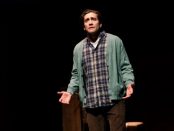
Both plays deal with young husbands who are coping with new fatherhood as well as their new responsibilities and their relationships with the dominant male figures in their lives. In Stephens’ "Sea Wall," Sturridge speaks admiringly of his father-in-law, while in Payne’s "A Life," Gyllenhaal speaks with love of his own father. Both men are madly in love with their wives who they could not consider living without. These plays are ultimately tragedies of the accidental kind, events that one has no control over and cannot see coming. The double bill is performed on a basically empty stage with a brick wall behind (designed by Laura Jellinek), on which Peter Kaczorowski’s poetic and atmospheric lighting is a kind of additional onstage character. Carrie Cracknell's assured direction pilots both plays. [more]
Being described as a “theatre event,” the unwieldy titled "Rocco, Chelsea, Adriana, Sean, Claudia, Gianna, Alex" is a throwback to the happenings and performance art of the 1960’s, without having the same visceral effect. Based on original work by the devising company, playwright Dan Hasse attempts to be up to the minute by including a great many hot button issues, but the endless scenes and vignettes seem to be part of a checkoff list of items to include rather than any great need to link these disparate topics. [more]
However, the play may not be to the taste of regular Mint theatergoers as it seems much more dated that the usual lost masterpieces rediscovered at this esteemed venue. Thomas Scott is so rigid in his thinking that he is against not only dancing beer, and theater, but also the Literary Society which has put on "Twelfth Night," a Shakespeare comedy in which the young lady playing Viola had to wear pants. In general except for singing hymns, Scott is against all pleasures. A great many of his neighbors no longer take exception to these activities and his own family could desperately use the money they are being offered to better themselves. [more]
Howard Lindsay and Russel Crouse’s 1946 Pulitzer Prize winning political play, "State of the Union," should be, by all accounts, dated in its depiction of the 1948 presidential political campaign with 1940’s references to people no longer household names. However, it seems more relevant than ever thanks in part to Laura Livingston’s smart and sassy revival for Metropolitan Playhouse, whose mission is to explore America’s diverse theatrical heritage. Her crackerjack production of this fast-paced political and romantic comedy moves like a house on fire and lands every one of its jokes. In addition, the play is so wise about the ways of backroom politics and Lindsay and Crouse have isolated a great many post-W.W. II issues that are now front page news again that this well-written and well-crafted comedy, although a period piece, has a great deal to say once more. Great fun will be had by all, both Republicans and Democrats, as well as independents. [more]
The York Theatre Company is to be applauded for taking the risk of staging this famously controversial musical in its New York premiere. It is also fulfilling its mission to bring to the stage musicals of quality that might not be done elsewhere. As Alan Jay Lerner is one of the legendary giants of the musical theater, it is a pleasure to be able to see this lost musical in a workable version. However, despite the excellent staging by director Emily Maltby, "Lolita, My Love," the casting still seems problematic and the musical is ultimately disappointing. And while music director Deniz Cordell has performed yeoman's work reconstructing the score and playing it entirely solo at the piano, John Barry’s music is not aided by being heard in this cut-down orchestration. [more]
Mystery writer Patricia Highsmith ("Strangers on a Train," "Carol," "The Talented Mr. Ripley") was famously alcoholic, depressive, misogynistic and racist. She was unique as an internationally famous writer who had created in Tom Ripley the only serial killer ever created by a woman writer. In "Switzerland," Joanna Murray-Smith, one of Australia’s most successful playwrights, has written a play about the last days of this reclusive writer’s life. Directed by Dan Foster, the initially fascinating premise takes a sharp turn into territory that requires a good deal of suspension of disbelief. [more]
With the audience sitting ringside on three sides of the new theater, and performed by Masden and Belcher at the top of their game, The Light is thrilling theater. Their Gen and Rashad are both sympathetic, attractive characters and their story and their dilemma is entirely gripping. As the former football star (and a boxing pro in The Royale seen at Lincoln Center’s Mitzi E. Newhouse Theater,) Belcher has a tremendous physical presence. Masden is so articulate as the school principal that she elevates the debate to a high level of drama. Even if there are coincidences or sudden revelations that are hard to believe, this play that makes use of the themes of both the #MeToo and Black Lives Matter movements is cracklingly provocative theater. And like an excellent boxing match, director Vaughn has her actors come out ready to spar from the moment they enter the stage. [more]
Clark has chosen to direct the play as though it were drawing room comedy. Beginning and ending the play with a game of cards, there is the suggestion that for Edgar and Alice this is all a series of games. Outsiders cannot understand this, particularly her cousin Kurt who visits them for the first time in 15 years. Whether this is the fault of the new translation or the belief that modern audiences unfamiliar with Strindberg’s psychological nightmares would have trouble sitting through this disturbing ritual, the effect is to make "The Dance of Death" seem very superficial, as though Neil Simon had chosen to rewrite an Eugene O’Neill tragedy simply for laughs. [more]
It has been well publicized that the Harper Lee estate filed a lawsuit in February 2018 alleging that the play deviated too much from the novel. They should not have worried. As directed by Bartlett Sher, Aaron Sorkin’s astutely scripted "To Kill a Mockingbird" with Jeff Daniels as Atticus Finch is a magnificent and moving theatrical experience that treats the novel with respect and dignity. The additions and changes from the novel only make the material more stage worthy and a better experience in the new medium. Harper Lee’s justly famous lines about it being a sin to kill a mockingbird and never knowing a person until you walk around in his or her skin brought an audible reaction from the audience at the performance under review, demonstrating that they were with the story all the way. [more]
The 1970 play was originally adapted by playwright Saul Levitt (who previously turned the Pulitzer Prize winning novel "Andersonville" into a successful trial play) from Berrigan’s free verse version based exclusively on the trial transcript. Not seen in New York in 30 years, "The Trial of the Catonsville Nine" has been reimagined in a new version making use of additional sources by Jack Cummings III, artistic director of the innovative Transport Group theater company. A powerful experience, the revival proves to be a provocative investigation of what a citizen should do when he or she feels that the government is engaged in immoral actions. [more]
The York production has been directed and adapted by Marc Acito who has condensed the original two act script into a long one-acter. Realizing that the original setting of 1948 for a tenth year college reunion with no reference to W.W. II or returning veterans does not make a lot of sense, he has moved the romantic comedy plot up to 1959 with some new appropriate references to the fifties (Davy Crockett caps, McCarthyism). Although the story seems to flow well enough the new problem is that with the deletion of some of the plot and dialogue, the characters seem to have been reduced to one-dimensional stereotypes which gives the actors a great deal more to do in order to make them real. [more]
If this family seems familiar, Winkler wrote about them in her 2016 play, "Kentucky," set seven years ago, when Hiro returned home for the first time from NYC in order to stop her sister’s wedding. Author Winkler, a Japanese-American, wrote the play sitting by her mother’s bedside in a hospital in Lexington, Kentucky, while her mother dealt with an aggressive form of cancer and she does have a sister who is a born-again Christian, though nothing like Sophie. While the play has an air of authenticity, most of the family are so unpleasant and unlikable that it is hard to penetrate behind their armor and facades. [more]
In recent years the play has not fared with such acclaim. A 2008 Broadway revival starring Frank Langella eliminated the narrator character of The Common Man, the play’s cleverest device, and was not well received. Now Fellowship for the Performing Arts has brought the play to the Theater Row’s Acorn Theatre directed by Christa Scott-Reed, who also staged FPA’s revival of Shadowlands last season. Unfortunately, the academic and unimaginative production fails to bring the ideas and the tensions in the play to a boil. [more]
Though not in the same class with Alan Jay Lerner’s masterpiece, "My Fair Lady," "Carmelina" has a similar theme: how a young woman reinvents herself. While the three soldiers are under the impression that they invented Carmelina Campbell in the classic Pygmalion and Galatea fashion, in fact Carmelina has reinvented herself, also a major theme in the Lerner canon, along with "Coco" and "Dance a Little Closer." This charming musical comedy also features a Tony Award nominated score which deserves a second and a third hearing. [more]
While Jessica Dickey’s "The Convent" may not have any new answers and may cover familiar material, it does so with such vitality and theatricality, that it becomes a memorable experience. Under the direction of Daniel Talbott, the seven actresses led by Samantha Soule and Wendy vanden Heuvel are compelling and expressive. By the time the play is over, the audience have experienced much that the inmates of the retreat have gone through. [more]
Six actors, three men and three women, in a company of seven, play many roles in this fluid production designed by Anna Driftmier that uses several different doorways, on-stage props and furniture that is rolled out swiftly to tell Ann’s story from age 16 in 1828 to her untimely death at 66 in 1878. Jessica O’Hara-Baker is a towering Ann Lohman, aka Madame Restell, level-headed, goal-directed yet humorless as she sees a need and methodically goes about taking care of it, caring little for the mores of times or proscribed women’s roles. Narrated by Ann and including newspaper headlines read by the other cast members as well as period songs of 19th century ballads sung and played by the company, "Wickedest Woman" begins with her 1848 trial which is interrupted repeatedly in order to tell the story in chronological order. [more]
Humorist and journalist Calvin Trillin has made his wife Alice Stewart Trillin, educator, writer, mother and muse, famous from such books as "Alice, Let’s Eat," "Travels with Alice" and "Family Man." When she passed away in 2001, many readers felt they knew her well enough to send Trillin condolence notes. His acclaimed 2006 memoir, "About Alice," introduced her to a wider audience. Now Theatre for a New Audience has commissioned Trillin to dramatize the book as a two hander under the direction of Leonard Foglia. The play with Jeffrey Bean as Calvin and Carrie Paff as Alice is quite charming but Alice herself remains elusive. [more]