Victor Gluck was a drama critic and arts journalist with Back Stage from 1980 – 2006. He started reviewing for TheaterScene.net in 2006, where he was also Associate Editor from 2011-2013, and has been Editor-in-Chief since 2014. He is a voting member of The Drama Desk, the Outer Critics Circle, the American Theatre Critics Association, and the Dramatists Guild of America. His plays have been performed at the Quaigh Theatre, Ryan Repertory Company, St. Clements Church, Nuyorican Poets Café and The Gene Frankel Playwrights/Directors Lab.
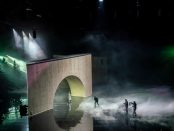
A product of the tumultuous thirties whose work was banned by the Nazis even though he was not Jewish, Von Horváth was particularly interested in social criticism of the middle-class and warnings about the rise of fascism. His major themes include tales of herd psychology and moral responsibility. By dealing with these timely topics, Judgment Day given a monumental visual production design by set designer Paul Steinberg in the cavernous Drill Hall at the Armory, the play seems as powerful and relevant as if it had been written in this decade, not 80 years ago. The production makes this expressionistic drama as contemporary as if this style were newly born. Starring Luke Kirby (Emmy Award for his Lenny Bruce in "The Marvelous Mrs. Maisel") in the leading role of Stationmaster Thomas Hudetz, the play offers juicy roles to several of the minor characters. [more]
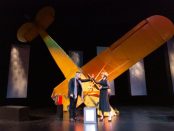
Beloved television stars Harry Hamlin (L.A. Law) and Stefanie Powers (Hart to Hart) return to the New York stage in Joshua Ravetch’s "One November Yankee" which they previously performed at the Delaware Theatre Company, was initially seen in Los Angeles’ NoHo Arts Center Theatre in 2012. It is their star power which keeps this old-fashioned, rather sit-com-ish, interconnected triple bill as lively and as entertaining as it is despite clichéd writing and passé jokes. Playing three different sets of siblings all connected by one plane crash, they manage to be convincing in weak material. [more]
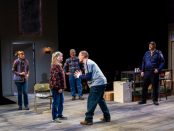
Told in leisurely style, Greater Clements is about the decline (and possible fall) of the American dream. Hunter appears to be saying that this is a long-time coming and its roots go very deep. The play begins with a flashback prologue with Maggie’s son Joe giving a tour of the mine, describing the 1972 fire on the 6,400 foot level that killed 81 men including his grandfather. However, on the weekend that the play takes place Maggie is expecting Billy, her high school beau, a Japanese-American who took her to the prom, now a widower and who is returning to visit 50 years later. Maggie, now 12 years divorced from Caleb who left her for another man, may be at loose ends but this is possibly a new beginning. [more]
Another way to look at the play is as the twelve stages of man and woman, going Shakespeare five more steps. Unlike Tracy Letts’ Mary Page Marlowe, in which the heroine was played by a different actress at each stage of her life, here we are asked to adjust to multiple versions of Chris whose name changes in each of the play’s 12 scenes: Chris, Christine, Kris, Christopher, Kristin, Topher, Christoph, Kit, Christina, and finally Khris. [more]
Having won the 2014 Harold and Mimi Steinberg/American Theatre Critics Association New Play Award for "I and You," this is the fourth production of a Lauren Gunderson play in New York since then including her solo play "Natural Shocks" on domestic abuse which was produced in 100 American theaters in 2018. A specialist in biographical plays, her "The Half-Life of Marie Curie" is of particular interest in that it tells a little-known story of a very famous figure. It is also notable for the vivid performances of Kate Mulgrew and Francesca Faridany. Although Gunderson is not yet a household name, she has been the most produced American playwright since 2016. [more]
For those younger members of the audience who do not know Edmond Rostand’s classic French play, "Cyrano de Bergerac," the new musical "Cyrano" presented by The New Group at the Darryl Roth Theatre may be entertaining enough. However, for those of us who know the original, the compromises and excisions from the text make it a shadow of its former itself. Don’t blame film and television star Peter Dinklage who gives a vigorous performance in the title role. However, he is hampered by the adaptation by director Erica Schmidt who happens to be his wife. [more]
While María Irene Fornés' "Fefu and Her Friends" is considered a feminist statement, in performance the play seems not to be very revealing about women or their positions other than the fact that the cast is entirely female. Set among the very rich in the 1930’s, the play is liberated only to the extent that the women have enough money to do what they wish. With its attractive sets and stylish clothes and the novelty of moving from one set to the other, the play seems to be rather a period piece than a statement of women’s lib. Unlike such all-female plays as Hazel Ellis’ "Women without Men," Clare Boothe’s "The Women" and Jane Chambers’ "Last Summer at Bluefish Cove," "Fefu and Her Friends" does not have a lot to say although it remains entertaining throughout. Of course, it is possible that a women critic might have a very different take on this work. [more]
Having had a success with Of Thee I Sing in 2017, MasterVoices had chosen to stage the sequel with an equally starry cast made up of most of the singers from the previous show in the same roles. With a chorus of 125 voices in this most choral of musicals and nine stars, "Let ’Em Eat Cake" was gloriously sung. The orchestra of St. Luke’s under the baton of artistic director Ted Sperling gave the complex score a vigorous reading, suggesting that it is more than just a musical. While the story is quite silly (the White House gets painted blue, among other things), it is also quite dark predicting a fascist takeover of the American presidency - which may explain its quick failure in its own time. Topical in 1933, many of the topics and issues are currently in the headlines again as Washington deals with an imperial White House. The musical also offered a great many unfamiliar Gershwin songs aside from its one hit “Mine,” and familiar and unfamiliar reprises from "Of Thee I Sing" like “Wintergreen for President.” [more]
As produced by Bedlam in association with The Nora, Arthur Miller’s 1953 tragedy, "The Crucible," based on the Salem Witch Trials proves to be both riveting and relevant all over again. In the past, the play was seen as a cautionary tale about the McCarthy Era witch hunt that destroyed so many lives. Now in 2019 it becomes a story of truth and lies, fiction and fact. One of the judges refers to the situation in Salem as “this swamp.” In the age of Trump, Miller’s play has new meaning for our time. You could hear a pin drop during Eric Tucker’s unfussy production which becomes more and more scary as the Salem witch trials progress and the townspeople become entirely carried away by the hysteria. [more]
Alan Lightman’s 1992 internationally best-selling novel "Einstein’s Dreams" would seem like an unlikely choice for stage adaptation as the original book is made up of 30 variations on theories of time but includes no plot. However, as adapted by Joanne Sydney Lessner (book and lyrics) and Joshua Rosenblum (music and lyrics) it is a charming period musical that makes Einstein’s theories (at least the ten dramatized) quite accessible to audiences not made up of physicists. Its lovely score and excellent production directed by Prospect Theater Company’s Cara Reichel led by Zal Owen and Alexandra Silber are both entertaining and mind-expanding. Its deficiencies are ones that were also true of the novel. [more]
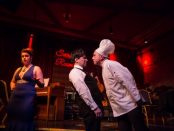
"Truffles: Music! Mushrooms! Murder!!!" is a dinner theater musical mystery set in the very restaurant (The Secret Room) where the audience is having dinner. This return engagement of the long-running show originally conceived by Sonia Carrion has been extensively rewritten by Gregg Ostrin inspired by characters initially created by Billy Manton, Carrion and Hal Galardi. This mildly amusing evening includes dinner (if you so choose), a score with 11 clever songs, and a murder mystery which keeps morphing into various other genres. [more]
"Slava’s Snowshow" is a unique experience. It is clowning of a sophisticated sort with its wordless skits which takes it beyond language. Its set pieces are outrageous enough to transcend anything other clown shows are doing at present. At 110 minutes, it is just long enough to not overstay its welcome. The audience participation sequences will make you feel that you are part of the show and the clowns play off of audience reactions throughout. However, as the clowns are more somber than playful it may not be for people easily depressed or very young children who have not seen the magic of theater before. [more]
Produced by Transport Group in association with The Public Theater and directed with precision, clarity and simplicity by Transport Group’s artistic director Jack Cummings III, this story of three generations of an African American family grappling with of racism, violence and inequality in the South is as moving and trenchant as a story by Harper Lee. Each act is a monodrama exquisitely acted, sung and directed for a very discerning audience. While there is dialogue in both halves, the extraordinary music makes it feel sung through. [more]
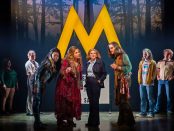
There have been many adaptation of Shakespeare’s Macbeth but none of them probably as entertaining as the new musical "Scotland, PA." Presented in the cartoon style of "Little Shop of Horrors," the show does not break any new ground but proves to be a fun evening. However, director Lonny Price who has staged musicals both big ("Sunset Boulevard)" and small ("Lady Day at Emerson’s Bar and Grill") gives the interest high and the show bubbling. [more]
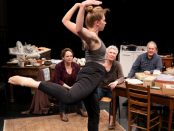
Richard Nelson’s latest play, "The Michaels" (subtitled a “Conversation During Difficult Times”) is a thing of beauty. Low-key like his "Apple Family" quartet and his "The Gabriels" trilogy, it is Chekhovian in the best sense of the word: very little happens but life passes by. The characters who sit in a Rhinebeck, New York, kitchen (also the setting for the other seven plays) talk of life and death, love and desire, memories and accomplishments. They reveal secrets and ponder changes and ultimately make decisions. Not much takes place but then again all of life occurs in the course of the play’s two hours. [more]
As directed by Moritz von Stuelpnagel, the play is fast-paced and engrossing and the smell of garlic coming from the stage convinces us that real cooking is going on. The completely working industrial kitchen designed by Tim Mackabee is a wonder of economy on the small stage of the Susan & Ronald Frankel Theater at The Robert W. Wilson MCC Theater Space as we watch many meals get prepared in record time. The flaw in the play is that Esparza’s Harry spends so much time ranting about his beliefs and requirements that he becomes both tiresome and unsympathetic. Harry may be an artist fighting capitalist necessities, but he also sabotages his own success. We eventually discover that he is not as ethical as he pretends to be even though he claims not to care about money – or adulations. And as none of the money in the restaurant is his, ultimately he has no say in what is decided. [more]
Plays about lives of quiet desperation are difficult to pull off because you run the risk of boring the audience. Liza Birkenmeier’s “Dr. Ride’s American Beach House” has all the elements of a fascinating drama but as presented by Ars Nova at Greenwich House it is all about subtext and undercurrents which may go right over the heads of many audience members. Little happens but there is much tedious talk which is a cover-up for what goes unsaid. [more]
Kathleen Chalfant adds another feather to her cap as Emily Dickinson’s posthumous editor Mabel Loomis Todd in the world premiere of Rebecca Gilman’s new one-woman play, "A Woman of the World," presented by The Acting Company in association with Miranda Theatre Company at 59E59 Theaters. Staged by Miranda’s artistic director Valentina Fratti with elegant assurance, Chalfant is both fascinating and seductive as this real life woman who in the 1880’s and 1890’s scandalized conventional Amherst, Massachusetts, with her liberated and bohemian behavior long before such goings on became acceptable for women – or men. [more]
"The Lightning Thief - The Percy Jackson Musical" settles down a bit more in the second act and becomes more engrossing but the damage has been done. The actors in the first act all seem to be racing for a train and the sound levels continue to damage many of the songs throughout the show. The show remains an excellent introduction to Greek mythology made relevant for our own time. Faithful to the source material, it may please both teens who have read the book and those who have not. The five of the seven-member cast playing 28 roles demonstrates their versatility as they change from one colorful three-dimensional character to another. If only the director and the production had trusted the original show and did not feel it necessary to make it bigger and better for Broadway, a common complaint when shows make the move from their smaller Off Broadway venues. [more]
While the original production had a great many one-of-a-kind stars supporting Merman, one of the distinctions of the York production is its cast: Montel has been able to obtain the services of Klea Blackhurst for Hattie Maloney, the Ethel Merman role. Blackhurst, you may know, has specialized in Merman for years including her tribute show "Everything the Traffic Will Allow" as well as appearing in the Merman roles in revivals of "Anything Goes," "Red, Hot and Blue," "Call Me Madam" and The York’s staging of "Happy Hunting." Montel has also surrounded her with seasoned theater veterans including Stephen Bogardus, Simon Jones, Gordon Stanley and David Green. The members of the singing and dancing chorus are equally talented. [more]
There has been a recent trend to perform Shakespeare as minimally as possible and with as few actors as possible. However, the question arises what is gained? When the doubling of roles proves confusing so that when actors appear it is difficult to know who they are playing, what is the point? Here the two actors who play the murderers Macbeth hires to kill Banquo report to him and then take their seats with the guests at his banquet which is quite disconcerting. In Doyle’s version, Macbeth himself kills Lady Macduff and her children rather than his henchmen – so who is minding the palace? Antonio Michael Woodard, the young man who plays Banquo’s son Fleance, appears in this scene as Macduff’s son but we know we have seen him before. [more]
Tracy Letts’ latest play to reach New York via the Chicago Steppenwolf production is the comedy drama, "Linda Vista," in which a 50-year-old white man in San Diego going through a messy divorce finds his life spiraling downward as he attempts to deal with his personal demons in a major midlife crisis. Presented in New York by Second Stage Theater, the play delineates a case of toxic masculinity and will most likely fascinate men and infuriate women. While Dick Wheeler played by Ian Barford, longtime Steppenwolf ensemble member, is reprehensible in the comic first act, he is redeemed by the end of the poignant second act where one’s sympathies finally go out to him. [more]
The performances as well as the dialogue are cool and unemotional as you might expect from four professionals used to doing their jobs, until about three quarters of the way through when Winner confesses to having mailed out the document that they have been asking her about after admitting that she had printed it out to read it. From then on for the last 15 minutes, the tension rises as it become obvious that Winner will not be allowed to go home. [more]
As part of its Fall 2019 Musicals in Mufti Cole Porter Series, The York Theatre Company has smartly revived this 1965 Ben Bagley - Cole Porter revue not seen in New York in 54 years. Pamela Hunt’s delightfully sophisticated production uses four talented performers at the height of their powers: Danny Gardner, Lauren Molina, Diane Phelan and Tony Award nominee Lee Roy Reams, with the estimable Eric Svejcar at the piano. Hunt has tweaked the show a bit eliminating five of the songs which have inappropriate lyrics for modern sensibility and handed Reams the role of speaking Bagley’s droll narration rather than dividing it up between the original five performers. Although the Muftis are performed concert style with book in hand, these performers appear to be letter perfect and hardly look at their sheet music. [more]
The problem with Vaynberg’s play, now being given its Off Broadway premiere, in which she plays the lead female role, is that it has so many interlocking plots that it can give you a headache trying to keep them straight. And as all of the actors play two and five roles it is difficult to always know who is who. While director Geordie Broadwater keeps the pace zipping along, this often makes it more of a strain to follow the convoluted plotting. Plus the extensive quoting from Tennyson’s Arthurian narrative poem, Idylls of the King (not identified until late in the play) doesn’t help a bit. [more]
What is evident is that Zeller writes tremendous roles for actors. Frank Langella won the Tony Award back in 2016 for the title role of "The Father," and "The Height of the Storm" may well win others. The current production includes all but one of the British cast from Jonathan Kent’s London presentation and two-time Tony Award winner Jonathan Pryce and three-time Olivier Award winner Eileen Atkins give the kind of performances that legends are made of. As André, Pryce is like a lion in winter: confused, detached, incoherent at times, yet raging due to his loss of power, and completely bereft when his wife is not in the room. His anger is always palpable and makes him seem bigger than his actual stature. [more]
Despite the fine writing and acting, these two plays do not stand alone: we are given no backstory to understand the context for these relationships in the longer saga; both plays dealing with a character’s depression, they are too similar in the theme of being haunted by the past; and thirdly, as they are basically two-character plays, both are too long for the limited story and plot lines they contain. Unlike the first two plays, these use two different directors (Loretta Greco for "runboyrun," and Awoye Timpo for "In Old Age"), ironically making them seem quite similar in style. [more]
When the Gingold Theatrical Group’s revival of Bernard Shaw’s epic "Caesar and Cleopatra" begins, the characters are wearing white contemporary clothes and sitting on what looks like an excavation site which might give one pause. Like David Staller’s revival of "Heartbreak House" last year, his Caesar and Cleopatra tries to give this 1898 play a more contemporary relevance, but unlike Heartbreak House which pointlessly updated that play to W.W. II rather than the usual W.W. I setting, this modern approach works extremely well and proves to be quite charming. [more]
Still delightful, mainly due to Porter’s score, the book by Herbert Fields (who went on to write six more Porter shows) has its charms with its snappy Jazz Age dialogue which makes fun of the ugly Americans in Paris, loaded with money but making one faux pas after another while mangling the French language. The version being used by the York Theatre production is that of the 1991 Tommy Krasker/Evans Haile adaptation for the Cole Porter Centennial first performed at the French Institute/Alliance Française which reduces the cast from 100 to a manageable eleven. It also reallocates some of the songs and includes some of the songs cut both on the road and after the opening. [more]
Legendary director Peter Brook has always investigated the big questions. In recent years his productions have become more intimate and the questions bigger. In "Why?", written and directed by Brook and his collaborator of four decades, Marie-Hélène Estienne, the performance takes place on a nearly empty stage and uses only three actors to tell its story. While the performance is mesmerizing, the play seems unfocused, beginning with the question why do we do theater and ending with the political dangers to theater artists who create experimental theater. [more]
Cusi Cram’s "Novenas for a Lost Hospital" (with dramaturgy by Guy Lancaster) presented by Rattlestick Playwrights Theater is an unusual site-specific theatrical event that pays tribute to the now defunct St. Vincent’s Hospital which for 161 years was situated three blocks from the theater’s location. Directed by Daniella Topol, the play is both uneven and scattershot in its non-linear format and content. However, it conveys a great deal of information in an entertaining manner and has some affecting scenes of life in the hospital in two eras: the 1849 cholera epidemic when it was founded in the mid-19th century and the AIDS crisis in the final years of its tenure in the late 20th century. [more]
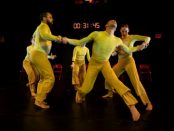
Co-presented by The Theater at the 14th Street Y, '…it’s time…" explored the dynamics of a small group of five—excellent—performers whose existence appeared to be controlled by a large digital countdown clock that frowned down upon them from the back wall. They were all dressed in tight outfits in shades of yellow, uniforms designed by Mondo Morales.To a stark, ingenious percussive score by Dani Markham, co-arranged and played brilliantly by drummer Price McGuffey situated high above the stage in his own cubbyhole, the dancers meandered onto a stage occupied only by five red folding chairs in a neat row. The score ranged from clicks to drum rolls to bossa nova rhythms. [more]
The Flea Theater is honoring one of its co-founding members, playwright Mac Wellman, with a five play festival called “Perfect Catastrophes” which includes two world premieres and three revivals, with casts made up of The Bats, The Flea’s youthful resident company. First up are the one-act plays, "Sincerity Forever" and "Bad Penny," which require separate admissions but can be seen back to back on the same evening or afternoon. Any two of the plays in this festival are an immersive view of the avant-garde playwright who has created new works for almost 50 years and has won three Obie Awards. [more]
If you are put off by the idea of women defining themselves based on the men in their lives, then Lois Robbins’ one-woman play "L.O.V.E.R." is not for you. However, if you concede that there are women today whose mothers brought them up to believe that they are nothing without a man, then you will find "L.O.V.E.R." entertaining if not enlightening. Last seen Off Broadway in the revival of "Cactus Flower," Robbins proves to be a very personable and genial narrator of this semi-autobiographical story of love, sex and finding contentment. [more]
Cobb is titanic in this piece bringing his resonant voice and impressive physical presence to bear on the most famous classic role for a Black actor in the canon as well as his thoughts about race and the theater. His justifiable anger when the director tells an anecdote about a woman who drove across the country in diapers to confront her rival as an example of the effects of jealousy is enough to flay one alive. His analysis of the man Othello and his relationship to the white Venetians is a brilliant explication of both character and society. Cobb’s understandable problem with white directors who want to tell him how to play a Black man exposes race in America from a new point of view. American Moor may make you angry but it is always enlightening and right on target. Although Cobb’s passion gets the better of him, you will never feel that he has gone too far or misrepresented things as they are. [more]
Making is U.S. debut 19 years after its Scottish premiere in an actual park, Douglas Maxwell’s "Decky Does a Bronco" is a worthy addition to the dramatic literature of plays about childhood and the loss of innocence. Under the direction of Ethan Nienaber, the talented cast of five gives indelible performances which remain with the viewer long after the final curtain. The guilty that the narrator David’s expresses as to what he might have done differently leaves a poignancy that cuts very deep. [more]
Hopkins had added selections from Lewis Carroll (references to the Jabberwock and “The White Knight’s Song: The Aged Age Man,” the poem which gives her the new title), Emily Dickinson (“I’m Nobody! Who are you?”), Alfred Lord Tennyson’s “Ulysses” (“To strive, to seek, to find and not to yield”), and unidentified poems from Dylan Thomas. Aside from the fact that these are several centuries newer, all of these have a different rhythm than Shakespeare’s Lear. The music credits include Satie’s “Gymnopedie” No. 1, Chopin’s “Nocturne in E minor,” excepts from Beethoven’s Symphony No. 7 and Piano Sonata No. 23 in F minor, and “Ombra mai fu” from Handel’s opera Serse. The most outstanding problem is that we have other associations with this material so that they stick out like a sore thumb. [more]
Poseidon Theatre Company’s "The Cooping Theory 1969: Who Killed Edgar Allan Poe?," described as a "new immersive paranormal experience,” is set at the RPM Underground which is more interesting than the play. This interactive event leads the audience through many of the 18 rooms, all of which are different, in this unusual venue by designer Seok Huh. As for the show, it may be “the only story-driven, multi-room immersive experience in the heart of Times Square,” but as written by Nate Raven it is very thin on information about 19th century writer Poe. As conceived and directed by Aaron Salazar it is mainly participation in a séance to reach the author in order to hear his version of his mysterious death, which is neither spooky nor scary. Poe never actually appears except in spirit and not much happens. However, it takes a long time getting there. [more]
Bess Wohl’s new play, "Make Believe," is a fascinating study of how the traumas of childhood affect our adult lives, particularly the damage seen and unseen parents inflict on their offspring. Director Michael Greif whose trenchant productions go back to the 1990 "Machinal" at the Public has piloted a fine cast of eight actors both young and mature. Make Believe is at the same time entertaining and enlightening in its dramatizing childhood and its aftermath in an inventive way. [more]
Deborah Whitfield’s 'Tech Support" offers a clever idea in order to review feminism in the past century. Unfortunately, her rather superficial approach misses a great many opportunities. The romantic comedy aspect of the play is not entirely believable and works to the detriment of the play’s serious elements. The slick production is entertaining without ever delving below the surface even though it attempts to cover a great many important and serious issues, many of which are not yet solved today. Don’t blame the actors who do their best with the material they have been given. [more]
Jonathan Spector’s "Eureka Day" now having its East Coast premiere at Walkerspace is a blisteringly satiric and provocative play torn right out of the headlines. Ostensibly about how one progressive elementary school handles a case of mumps due to many anti-vaxxers, the play also tackles many other hot button topics. Ultimately, the play’s message is that with too much sensitivity and too much political correctness nothing can be accomplished. It is a wake-up call for all of us. [more]
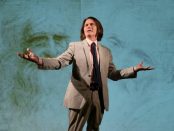
Described as a multimedia production, "Da Vinci & Michelangelo: The Titans Experience" is actually a lecture by art historian Mark Rodgers to slides of the masterpieces of these two geniuses. Both enlightening and dense, the performance by this animated and exuberant lecturer tells you a bit more than you can take in in one sitting. It is a little like two art classes back to back. However, one comes out of the show with an even higher respect for these two Renaissance men who were far ahead of their time and are still at the top of their professions after 500 years. [more]
Lenore Skomal’s "The Exes" wants to revive the Broadway-style sex comedies of the 1950’s and 60’s, earlier called boulevard comedy. Unfortunately, not only is the formula passé but television sit-com now does it better. The play is also too heavily plotted with two main characters with the same name and a great many petulant, entitled people. Worse still, the play fails to deliver any witty or clever lines, instead giving us quotes and references from much better works without much point. Directed by Magda S. Nyiri, "The Exes" has at least two false endings before it comes to an unearned conclusion. [more]
"Midsummer: A Banquet" is an auditory and oral treat, a light entertainment for this time of year. Using Zach Morris and Victoria Rae Sook’s skillfully adapted abridgment of Shakespeare’s comedy, the evening of dinner theater is a delightful way to experience the Bard. The meal designed by Emilie Baltz contains various surprises that coincide with the events in the play and are tasty enough to be a filling repast. Shakespeare as dinner theater may not be a new idea but this is an evening of many pleasures. [more]
Kelley’s adaptation begins with the murder of Mary which avoids preparing us for the limited life of opportunity that Bigger leads in the Black Belt of Chicago. Told in a fragmentary form often with flashbacks within flashbacks, it is only possible to put the chronology together if one knows the novel. Kelley has also eliminated the powerful speech to the jury by Bigger’s lawyer which is one of the most famous of all statements on social racism and the constricted environmental influences on people living in the ghetto. [more]
Composer-lyricist Joe Inconis’ follow up to his teen favorite, "Be More Chill," is not only a showcase for musical comedy actress Annie Golden but a tribute to the Blaxploitation and Martial Arts movies of the 1970’s and 1980’s. While "Broadway Bounty Hunter" is very entertaining, it might have been a better show if had not been so anxious to not be a parody or a satire. Written by Iconis and longtime collaborators Lance Rubin and Jason Sweettooth Williams, energetic cast, fully attuned with their concept has been directed and choreographed with fierce energy by Jennifer Werner who has previous created the dances for five of Iconis’ last six shows. [more]
While Shakespeare’s "Coriolanus" has a great deal to warn us about as a cautionary tale, it is also not as deep or as poetic a play as his major tragedies. Daniel Sullivan’s production for Free Shakespeare in the Park is fine with the surface values of this historical tragedy but less so with creating the subtext of the story. In his second time around as its titular hero, Jonathan Cake is excellent as the brutal warrior, not so accomplished as the public man wrestling with his own demons. [more]
Neil LaBute’s “Appomattox” is the most substantial of the three plays and deals with a topic new to his work. Two long-time friends, Frank, black, and Joe, white, are having a picnic in the park without their wives where they get to throw around a football. Joe tells Frank about a story he read in the newspaper that the freshmen at Georgetown University have decided to pay an annual reparation to the families of slaves who were sold off by the college centuries before as collateral to keep the school going. He is impressed that the $27.20 will be annually added to their tuition. For Frank, this is nothing but a symbolic gesture. He would like to see the figure sting a little for 400 years of slavery. [more]
Following up on Luis Alfaro’s critically acclaimed Chicano retelling of Sophocles’ "Oedipus Rex" called "Oedipus El Rey," The Public Theater now stages his equally relevant and timely "Mojada" which melds Euripides’ "Medea" with the Latinx immigrant experience in the big American cities. Those who know the Greek myth of Jason and Medea will be prepared; those who at the performance under review obviously did not know what was coming were shocked and horrified by the ending. Either way the play is spellbinding theater. Chay Yew, artistic director of Chicago’s Victory Gardens Theater who also directed the Public’ production of Oedipus El Rey, has staged the stunning and devastating play with an excellent cast of Hispanic-American actors which is as timely as tomorrow’s headlines. [more]
Series A of this year’s Summer Shorts: 13th Festival of New American Short Plays is unified around the theme of death and dying and how it affects the living. Lest you think that this sounds morbid, the three provocative one-act plays that make up this first program are so beautifully handled that this is a superior theatrical evening in three totally different styles. Unlike many evenings of one acts, the productions of all three are worth of your attention and could not be bettered. [more]
It is not until the second act of British playwright Chris Urch’s "The Rolling Stone" that the play catches fire but from then on the drama is explosive, compelling and very disturbing. Once the play gets past the introductory exposition that sets up the plot, the production by Saheem Ali (Donja R. Love’s "Sugar in Our Wounds" and "Fireflies," and Christopher Chen’s "Passage") is taut, tense and involving. [more]
The three Havel one acts, known as "The Vanek Plays," though written separately, were originally banned in Czechoslovakia and performed secretly in people’s living rooms as well as being passed around in hand-written copies. They all deal with Vanek, a dissident playwright unable to have his plays produced, who is now working in a menial job, an alter ego for its author and his experiences under Communism. The problem with filling out the program to include both Pinter’s "The New World Order" and Beckett’s "Catastrophe" (dedicated to Havel) is that since the plays all have the same theme and development, it feels like overkill. [more]
While Will T.F. Carter’s "Barabbas" is very outspoken on the topic of political corruption in Peru, the play is dramatically weak as so much of it is exposition. In each scene we learn a little bit more about the men’s lives, but little that is new happens in the play’s 90 minutes. The tepid direction by Eduardo Machado gives us too much time to consider the play’s deficiencies and makes the play seem longer than it is. Carter’s anger at what is going on in Peru is commendable, but Barabbas does not utilize that indignation except on an intellectual basis. [more]
Matthew Amendt’s new play "The Comedian’s Tragedy" asks the burning question why did Aristophanes, the master of Greek comedy, never write any tragedies. Socrates in Plato’s "Symposium" equated comedy and tragedy with Aristophanes present, but the question does not seem to have been asked these 2,400 years. While Amendt attempts to pass off his play as history, he plays fast and loose with the actual facts. Director Bill McCallum’s production does not help things by having the actors from ancient Athens mainly in contemporary clothing and having several historically male characters played by women. As most of the people in the play are not household names except to Greek scholars, this makes the play much more difficult to follow let alone recall what one should know about life in the days of Socrates and Aristophanes. [more]
Lydia R. Diamond’s "Toni Stone" is a tour de force for one actress and Obie Award winner April Matthis gives a bravura performance as the first woman to play professional baseball as part of the Negro League. Although she is backed by eight men who from time to time make up the teams she was on, this is basically a one-woman show. In fact, this might have been a better play if Toni was the only character we had to follow on stage. However, director Pam MacKinnon excellently defines each character as we meet them in various combination; we just don’t know who they are most of the time. [more]
Nottage’s book is faithful to the novel while at the same time reducing some of the melodrama and streamlining the story to reduce the number of characters to a cast of 13. Sheik’s score may be his most lush and melodic and the use of guitar and cello gives the music an appropriate folk feeling. The songs are a mix of gospel, R&B and pop which gives each of the main characters a song that explains their deepest thoughts. The rousing gospel numbers, “River of Melting Sun,” “Tek a Hol a My Soul” “Hold This House Together, “Our Lady of Chains,” make use of a great many beautiful voices in unison. [more]
A mash-up of Eugene O’Neill’s "Anna Christie" (set in Manhattan and off the coasts of Provincetown and Boston) and "Desire under the Elms "(with a rural New England setting), the play is set on a farm in the West of Ireland. With its fallen woman theme, this play could have been written any time since 1880. First time director Aidan Redmond has staged the play by the numbers and has given his actors little help. Some of the character interpretations undercut the play. However, the play does have a melodramatic but smashing and startling ending. [more]