News Ticker

Archive

Othello (Bedlam)

May 11, 2026

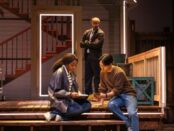
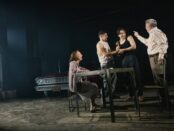
There might be some advantages to a stripped-down version of a William Shakespeare play with fewer characters for small theater companies on a tight budget but Eric Tucker’s Bedlam production of "Othello" hasn’t found it. Reduced to four actors playing all the roles, this effort reaches its limit when in the last scene after Susannah Hoffman’s Desdemona and Susannah Millonzi’s Emilia lie dead, they have to stand up and become Michael Cassio, formerly lieutenant and now general of the Venetian Army in Cyprus, and Lodovico, emissary from the Venetian court, respectively, as there are no other actors to play these parts. It is also unconvincing watching Ryan Quinn’s Othello dropping his blue button-down shirt to his shoulders as a shawl and playing Bianca, Cassio’s Cyprus girlfriend, when we have just seen him as the hero of Shakespeare’s tragedy. This production demonstrates that Shakespeare’s "Othello" might be played with six or eight actors, but not four. [more]

The Rocky Horror Show

May 6, 2026

As Frank-N-Furter, Luke Evans amply fills the towering platform heels of Tim Curry, who originated the role on stage and, much more indelibly, that supreme silver screen. To put it as delicately as possible, Evans owns a distinct advantage in bodily charms over a 1970s Curry, which costume designer David I. Reynoso maximally emphasizes. But the sizable difference between the two fellas doesn't make Evans any less emotionally vulnerable in the later numbers "I'm Going Home" and "Floorshow/Rose Tint My World." Despite Frank-N-Furter's deeply problematic take on love, Evans sentimentally honors his character's need for a very peculiar and lonely form of it. [more]

The Balusters

May 4, 2026

Following in the footsteps of Joshua Spector’s "Eureka Day" and Tracy Letts’ "The Minutes," also stories of local community service groups, David Lindsay-Abaire’s hilarious satire "The Balusters" is simply the best new play of the 2025-26 season. Set at a series of meetings of the Vernon Point Neighborhood Association in a landmarked enclave of an East Coast city, the pointed dialogue skewers liberals who really want to maintain the status quo as well as their white privilege. Hypocrisies abound as the nine members discuss local issues that stir up a great deal of heated debate as well as revealing their personal biases, while little change actually gets voted on. Director Kenny Leon’s terrific ensemble cast is led by Tony Award-winner Anika Noni Rose and Emmy Award-winner Richard Thomas, and the play also reunites the author with Marylouise Burke who has created roles in his "Fuddy Meers," "Wonder of the World" and "Kimberly Akimbo." [more]

The Door Slams, A Glass Trembles

May 4, 2026

Inspired in part by "he Magic Mountain," Thomas Mann’s 1924 meditation on illness and temporality, Zimet’s play borrows not its plot but its sensibility: the peculiar dilation and contraction of time as it is lived, remembered, and imagined. Like Mann’s sanatorium-bound protagonist, Zimet’s characters find themselves suspended in a liminal zone where past, present, and future bleed into one another with disorienting grace. The result is not mere homage but a vivid reanimation of Mann’s central insight—that time, far from being fixed, is a profoundly subjective medium. [more]

Proof

May 3, 2026

Thomas Kail’s elegant and polished production now at the Booth Theatre (probably the best Broadway venues for dramas) has recast the family as African American and it works just as well – if not better - than the original production in which the family was white. Two stars from the world of film and television – Ayo Edebiri (Chef Sydney on "The Bear") and Don Cheadle ("Devil in a Blue Dress," "Crash," "Hotel Rwanda," "Traffic," etc.) – make their Broadway debuts and take to it like a duck to water. In addition, the remarkable Kara Young, nominated for the Tony Award the last four years and winning two in the last two years in a row, plays the supporting role of the sister with the assurance we have seen in her previously. [more]

Beauty Freak

May 2, 2026

What lingers, long after the final moments—which are, indeed, superb—is not a tidy judgment but a series of disquieting questions. Clements refuses the comfort of easy condemnation, even as he lays bare the cost of moral evasion. Riefenstahl emerges neither exonerated nor simplified, but as a figure whose brilliance and blindness are inseparable. The play does not ask us to forgive her; it asks us to understand how such a figure could exist, and, more provocatively, what it means that she did. [more]

The Bad Daters

May 2, 2026

Derek Murphy’s "The Bad Daters" arrives Off Broadway from Ireland and the United Kingdom with the unassuming air of a chamber piece and the stealthy force of something far more piercing: a romantic comedy that has the good sense to distrust romance, and the better sense to proceed anyway. Murphy, an Ireland-born New Yorker with an ear for the bruised lyricism of everyday speech, has fashioned from the well-trod terrain of app-based courtship a work of surprising delicacy and cumulative emotional power. Under Colm Summers’ exquisitely modulated direction, and animated by two performances of uncommon acuity from Kate Arrington and Shane McNaughton, the production unfolds with a patience that feels almost radical, allowing its jagged edges to soften—though never quite smooth—into something like grace. [more]

The Lost Boys

May 1, 2026

Despite the revisions—1980s’ Republicans become a dull running joke—"The Lost Boys" is, like its source, a banal, comic‑book‑level depiction of family dysfunction and B‑movie vampire‑thriller shallowness. Amped up to supersonic levels with loud, uninspired rock music by The Rescues, whose lyrics are often indecipherable, it seems even more inane in its new guise. Even the ballads can’t resist morphing into tear‑the‑house‑down anthems, no matter their underlying emotional simplicity, as in Lucy’s paean to her son, “Michael.” [more]

Love Story

May 1, 2026

Where past and present commingle—as they so insistently do in a play like "Love Story"—the burden falls squarely on the director to furnish the audience with a legible temporal grammar. Without such guidance, fragmentation risks reading not as intentional lyricism but as simple confusion. Here, despite the production’s many sensitivities, that grammar is not always clearly articulated. Judging by the palpable hesitations in audience response—the delayed laughter, the uncertain silences—it takes an inordinate number of transitions before one fully apprehends a crucial fact: that Maria is already dead at the top of the play. This is not, in itself, a flaw; dramatic revelation can be a powerful tool. But the production does not so much reveal this reality as obscure it, leaving spectators to assemble the timeline retroactively, often at the expense of emotional continuity. [more]

Dreamcats!

April 30, 2026

Fans of feminist science fiction and revisionist fairy tales will find much to recognize in playwright Charlotte Lily Gaspard's new work. Set on a planet ruled by intelligent and mighty creatures called "Dreamcats," the play features a rebellious feline princess played with gusto by Gaspard herself. Intellectually courageous, the Princess has a secret plan to challenge the belief that her planet is the best of all possible worlds--a sacrosanct tenet that no Dreamcat has dared to investigate, still less to refute. Her project envisions comparing all the planets, but how can this be done when hardly any data on them is available? (The one map of the galaxy she has found was under wraps.) [more]

Kenrex

April 30, 2026

There are evenings in the theatre when the air seems to tighten, as though the room itself has drawn a breath it cannot quite release. Such is the case with "Kenrex," a work of unnerving command and cumulative force, written by Jack Holden and Ed Stambollouian, and directed by the latter with a vigilance that borders on the prosecutorial. What begins as a seemingly familiar excursion into the annals of American true crime—its outlines recognizable, its destination foreknown—steadily transforms into something far more disquieting: a communal autopsy, conducted in real time, of a place where the mechanisms of justice have not merely failed but quietly abdicated. [more]

The New York Pops 43rd Birthday Gala: “Changed for Good: A Celebration of Stephen Schwartz”

April 29, 2026

The New York Pops’ 43rd Birthday Gala honoring Stephen Schwartz did not present itself as a ceremonial evening. It moved with purpose, cleanly built, with no drag between numbers and no need to overstate its significance. Under music director Steven Reineke, the orchestra kept a steady line—bright brass, controlled strings, and arrangements that stayed responsive to the singers rather than imposing weight on them. The result was a program that trusted the material and let the performers meet it directly. What distinguishes this gala is not only the caliber of performance but the structure surrounding it. This is the Pops’ largest fundraiser of the year, and the proceeds are not abstract. They feed directly into PopsEd, the orchestra’s long-running music education arm, which provides in-school instruction, performance opportunities, and access across New York City. That mission was not explained from the stage. It was visible in the room. [more]

Titaníque

April 26, 2026

Some shows are better Off Broadway either because the smaller theater helps the ambiance or the smaller budget inspires greater imagination or there is a “let’s put on a show” vibe that enhances the fun. "Titaníque," the Off Broadway hit musical which has traveled from The Asylum NYC to the Daryl Roth Theatre to ultimately Broadway’s St. James Theatre, is one of those shows. Not that is it not still an entertaining musical, but the feeling of spontaneity with props that looked like found objects is now missing. The cast is mainly the same but for some superstar additions particularly Emmy Award-winner Jim Parsons as a mugging Ruth DeWitt Bukater and Grammy Award winner Deborah Cox as the unsinkable Molly Brown. [more]

Rheology

April 25, 2026

"Rheology" previously seen at Brooklyn’s Bushwick Starr in the spring of 2025 has reopened at Playwrights Horizons and proves to be a unique meta-theatrical experience with both performers, a real mother and son, theoretical physicists Bulbul Chakraborty and writer/director Shayok Misha Chowdhury (Pulitzer Prize finalist for "Public Obscenities"), appearing as themselves. Written and directed by Chowdhury in association with Chakraborty, Rheology begins as a physics TED talk on sand as “capricious matter” (Bulbul’s field) then switches to a demonstration of stage directing (Misha’s field), and finally becomes a metaphysical discussion on life and death tying the two together. This is an unusual theatrical presentation, one you will ponder for a long time to come. [more]

The Adding Machine

April 24, 2026

Among Bradshaw’s revisions are the use of a narrator, reducing the original cast list from 25 to four, adding an intermission, updating some of the slang to contemporary speech, and having its protagonist Mr. Zero played by a woman instead of a man. The effect of all of these changes is that the play now runs longer than it used to, and the long monologues are still in evidence and become rather tedious. The new version still includes some of the protagonist’s racist rant in the trial scene. Few of these changes make the play any better or more relevant today. [more]

Fallen Angels

April 23, 2026

It’s therefore a delight to see two such skilled actresses as Byrne and O’Hara, both using ultra-posh accents, willing to play against their striking beauty to get laughs, demonstrating both physical dexterity and perfect timing. At first, it seems as if everyone, the stars included, is trying express some stereotypical notion of what being in a Coward comedy requires, from the ultra-sophisticated speech, mannerisms, and elevated tone, and it takes a few minutes to begin seeing through the self-consciously lacquered veneer to the characters inside. Although Coward now and then comes through with a bon mot matching his reputation, much of the laughter is generated by throwaway comments and responses, gestures, facial expressions, and bodily reactions. Ellis creates amusing business with props, like long cigarette holders, and food, like strawberries. What Byrne does with a slinky green gown and veil, using her elegant slimness to visually hysterical advantage, will long remain in my memory, just as will the image of the glamorously blonde O’Hara, flopped upside down over a club chair as she ever so slowly slides down it to the floor. [more]
The Fear of 13

April 22, 2026

Renowned theatrical spoilsport Bertolt Brecht decried the stupefying effect of catharsis. By contrast, the new Broadway offering The Fear of 13 revels in it. Adapting liberally from British filmmaker David Sington's 2015 documentary of the same name, playwright Lindsey Ferrentino turns the true story of Nick Yarris--a Pennsylvania man who served an unjust 22-year death row sentence for rape and murder--into something that feels decidedly less true. Admittedly, Ferrentino adheres to the basic facts of Nick's brutal mistreatment, but, with the masterful assistance of director David Cromer, packages them into an easily digested and forgettable form. [more]

Lost in Del Valle

April 21, 2026

Van Zandt is a cyclone that tears through the intimate confines of SoHo Playhouse’s Huron Club, detonating with the force of lived experience refined into art. What might, in lesser hands, resemble a familiar confessional is here transformed into something far more volatile and exacting: a darkly comic, genre-defying work that refuses containment even as it unfolds within a single body onstage. Van Zandt’s performance achieves the rare feat of appearing both recklessly spontaneous and meticulously controlled. He moves through the evening with a muscular precision, shifting registers and emotional temperatures with such fluency that the boundaries between character, narrator, and witness begin to dissolve. It is acting of a high order—technically exacting, yet fueled by something that feels perilously close to exposure. [more]
Death of a Salesman

April 20, 2026

As you may have read, a lot of critics are saying that “attention must be paid” to the sixth Broadway revival of "Death of a Salesman," Arthur Miller’s 1949 “tragedy of the common man,” innovatively directed by Joe Mantello at the Winter Garden. Indeed, it is an attention‑getting, nearly three-hour mounting, led by sterling performances from Nathan Lane and Laurie Metcalf as Willy and Linda Loman, and Christopher Abbott and Ben Ahlers as their sons, Biff and Happy. My companion was so moved when it ended she could barely speak. I was impressed but with tearless results. [more]

Flo

April 16, 2026

The show’s titular character, Flo Weinberg, is a wheelchair-bound Upper West Side resident who decides to make a deal with Satan – in exchange for her soul, she can have fame, wealth, and happiness. The final part, happiness, proves to be a difficult sticking point, and the two bicker over what happiness exactly means and how one achieves it. Toby Armour’s ("Freedom Summer," "Meltdown") script is wickedly clever, full of recurring jokes and fascinating religious themes. There’s an undercurrent of gnosticism to the play’s narrative, one that works impressively well with the show’s tone. "Flo" is a comedy at heart, but one that engages seriously with larger ideas even as it commits to being quite wacky. [more]

Titus Andronicus

April 14, 2026

While 'Titus Andronicus" is not for the squeamish, it has definite importance in Shakespeare’s canon showing us where he started, how he was influenced by his contemporaries, and how he developed later. Jesse Berger’s exciting and swiftly moving production is riveting at all times, not only keeping the energy up but keeping the play surprising as it develops. As we suspected from Patrick Page’s one-man Shakespeare play, he is an asset to any Elizabethan production and leads a compelling cast. This may not be your cup of tea but you will not be bored for a second, even though you may be startled or shocked. [more]

How My Grandparents Fell in Love

April 13, 2026

Playwright Cary Gitter and composer Neil Berg’s "How My Grandparents Fell in Love," their follow-up musical to "The Sabbath Girl" also seen at 59E59 Theaters, is a charming old school two-character musical about how Gitter’s grandparents got together in 1933. While not particularly new in content or style, it has its own appeal and a prepossessing plot and quirky characters that hold your interest. Set in Rovno, Poland in the 1930s, it also brings back to life a civilization that is gone with the wind dramatizing pre-World War II Europe. Harris Milgrim and Becca Suskauer are an engaging couple as the author’s grandparents who initially don’t like each other when they first meet just like Jane Austen’s iconic couple in Pride and Prejudice, possibly the archetype for all major rom-coms. [more]
REMEMBERING KEN PEPLOWSKI

April 13, 2026

Ken Peplowski was not just the greatest clarinet player of his generation; he was a friend I admired for some 46 years—beginning well before he became famous. Oh, he did a bit of work outside of jazz on his way to the top. (He told me he witnessed far more hijinks of every sort when he did the musical “Annie” than he ever witnessed in the supposedly dissolute world of jazz.) But jazz was his first love. I found his unflagging zest for life inspiring. [more]
The Pushover

April 12, 2026

Di Zou as Pearl and Rebecca De Mornay as Evelyn in a scene from John Patrick Shanley’s “The [more]

Nicole Travolta Is Doing Alright

April 12, 2026

Nicole Travolta, a member of the famous Hollywood family, has turned her life into a one-woman show that is introducing her to the New York stage. "Nicole Travolta is Doing Alright" is an entertaining and humorous tale of a girl who grew up in Los Angeles and then found herself as a teenager in Florida when her parents moved there. Co-written with Paula Christensen, it is also a cautionary tale about how not to grow up when on your own. Travolta is an animated, vivacious performer in telling her life story up until now. She recounts her adventures with credit card debt, divorce by age 30 and becoming a spray tan artiste which eventually straightened out her finances. Now at age 40, she has finally learned the error of her ways. [more]

Scorched Earth

April 12, 2026

In Luke Murphy’s astonishing "Scorched Earth," a vitality is rendered with a ferocity that feels at once ancient and bracingly new. Murphy, working under the banner of his multidisciplinary company Attic Projects, has fashioned a work that does not so much adapt John B. Keane’s play "The Field" (which went on to great acclaim in the landmark film starring Richard Harris) as detonate it—scattering its themes across a landscape of dance, film, sound, and theatrical invention, and then reassembling them into something hypnotic and wholly its own. [more]

Becky Shaw

April 10, 2026

Gionfriddo’s play, which runs nearly two and a half hours, is directed with finely calibrated control by Trip Cullman. It’s a tart, unsettling, and often wickedly funny examination of the emotional minefields that define modern intimacy. At its center is the seemingly innocuous act of a blind date, but as in so many comedies of manners, what begins as social ritual quickly metastasizes into something darker, probing the uneasy intersections of manipulation, vulnerability, and power. [more]

Public Charge

April 8, 2026

If you ever wondered what it is really like to work in the corridors of power, "Public Charge" based on the political career of Julissa Reynoso, an idealistic diplomat who was Deputy Assistant Secretary of State for the Western Hemisphere under Secretary of State Hilary Clinton and Ambassador to Uruguay during President Obama’s second term, will give you an excellent idea. Written with playwright Michael J. Chepiga, the world premiere production of "Public Charge" now at The Public Theater is a fascinating account of attempting to make change in a bureaucracy whose very policies keep anything from happening. Told by someone who lived it, it is all true as far as we know. Under Doug Hughes’ robust and forceful direction, the play is never didactic or too dense, making us feel we are living the events as Julissa encountered them. [more]

Desi SNL

April 8, 2026

For all its incremental gestures toward inclusivity, "Saturday Night Live"—now improbably in its 51st season—has remained curiously bereft of a regular South Asian cast member, a lacuna that feels less like oversight than inertia. Desi SNL, an ensemble-driven sketch revue, cheekily appropriating the familiar architecture of "Saturday Night Live"—the opening monologue, the mock-news desk, the parade of quick-change characters—and refitting it with a distinctly South Asian sensibility, performed by an entirely South Asian ensemble, arrives not so much to fill that absence as to gleefully upend it, at once affectionate and insurgent. What emerges is not mere pastiche but a lively act of cultural translation: a show that gleefully inhabits the grammar of American late-night comedy while infusing it with the textures, tensions, and tonalities of diaspora life. [more]

No Singing in the Navy

April 7, 2026

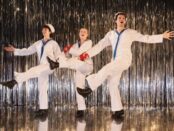
"School Pictures," Milo Cramer’s last New York show, a solo musical, was wildly inventive, hilarious funny, and extremely insightful about the New York education system, based on his own experiences as a tutor. Unfortunately, his new musical show again premiering at Playwrights Horizons seems to be out of his comfort zone though he has been a fan of musicals for years. "No Singing in the Navy" is a three-character revue which purports to be a tribute to Golden Age musicals, but its format is a series of very slight skits, à la 'Saturday Night Live," all with the same three sailors. It does use the premise from "On the Town": three sailors on leave for 24 hours before shipping out to the war, also used in a series of original Hollywood musicals, usually about sailors who become involved in putting on a show in either New York or on the coast. This show claims to have parodies of songs from "The Music Man," 'Peter Pan" and "The Sound of Music" but most theatergoers will not recognize them. A charming idea, but "No Singing in the Navy" is too thin and simplistic to make us think of those golden age musicals that still get revived on stage and reaired in their film versions. [more]

Uncle Vanya, scenes from country life

April 7, 2026

The narrative architecture of "Vanya"—its languors, its longings—is assumed, even beside the point. In its essence, this distilled adaptation unfolds less as a conventional staging than as a kind of theatrical mixtape, an assemblage both deliberate and mischievous, in which the familiar architecture of this oft-performed play is artfully dismantled and recomposed. Scenes arrive out of their expected sequence, as though guided by emotional rather than narrative logic, while character motivations are subjected to a searching reconsideration—some gently refracted, others boldly reconfigured—yielding a work that feels at once recognizably rooted and thrillingly unmoored. What Dmitry Krymov has fashioned instead is a kind of theatrical palimpsest, a dream-logic fantasia in which the gravitational center is unmistakably Yelena, that luminous and unwitting axis of desire (much to the dismay of Vanya). One might, without doing violence to the enterprise, retitle Krymov’s audacious, dreamlike reimagining of Chekhov’s inexhaustible classic evening: "All Roads Lead to Yelena." [more]

The Last Audition

April 7, 2026

There is, in "The Last Audition," something almost defiantly modest—a chamber piece of sorrow that refuses the grandiloquence of tragedy even as it circles one. The play, a solo vehicle of hushed ambitions, written by and starring Paul Shearman, sensitively directed by David St John, unfolds like a fading echo in an empty theater, its emotional register pitched not to catharsis but to the quieter, more unsettling key of recognition. It is, at heart, a drama about diminishment—of memory, of stature, of self—and yet it proceeds with a delicacy that feels, in its way, like a form of grace. [more]

THE EXPLOSIVE GROWTH OF FILM AND TV PRODUCTION FACILITIES IN THE NEW YORK / NEW JERSEY AREA

April 2, 2026

The unprecedented, ongoing expansion of television and film production facilities in the New York-New Jersey area should be a boon for New York's whole entertainment community. New York-based actors, directors, writers, and designers will have more incentives to stay in New York rather than move to L.A. The size and scale of the new sudios being developed will make New York/New Jersey far more competive with L.A. than ever before. [more]

Gotta Dance!

April 1, 2026

It must be mentioned that this excellent cast has an incredible charge put before it, to recreate some of the most legendary dances from Broadway and Hollywood, all of which were performed by some very famous actors and dancers. It is no small feat to channel these original works and make them their own, a task they take on with relish and at which they completely succeed. The cast seems to dance without effort and to sing without being winded. By the time the company performs its last number, “One” from "A Chorus Line," the audience is completely enamored with every performer, and as they each tip their hat the cheers of love are unmistakable. The entire production makes for an excellent primer on the history of dance in both stage and film. It is fantastically executed and is not to be missed. [more]

Jesa

March 31, 2026

The dominant form of American theater since Edward Albee’s "Who’s Afraid of Virigina Woolf?" has been the dysfunctional family drama of which there have been countless such plays. The newest one, Jeena Yi’s debut play "Jesa" presented by Ma Yi Theater Company in residence at The Public Theater, adds a new wrinkle. This time the family is Korean American and the cast is all women, four sisters to be exact who meet to perform their parents’ jesa. Jesa is a Korean ceremony honoring the dead on the anniversary of their passing that includes food, ritual and requesting their blessings. It is this ceremony that brings together the four estranged for the first time in a long time, the first time they are honoring their mother who died a year ago. [more]

Monte Cristo

March 30, 2026

Adam Jacobs in a scene from the York Theatre’s world premiere production of the musical “Monte [more]

The Unknown

March 30, 2026

Hayes proves wholly persuasive, gliding among a gallery of supporting figures (Hayes delineates 11 distinct characters with astonishing lucidity, his transitions so fluid they seem almost instinctive, even as the narrative around them grows increasingly clouded and labyrinthine.) with a lightness that never calls attention to its own virtuosity. As Elliott, he is coolly, almost disquietingly composed, revealing only the briefest fissures beneath a meticulously maintained façade—a man who seems able to exist only in the telling of stories, never quite as himself. [more]

Antigone (This Play I Read in High School)

March 30, 2026

The world premiere of Anna Ziegler’s new play, "Antigone (This Play I Read in High School)" now at The Public Theater, is one of four ambitious attempts to update Sophocles’ tragedy playing in New York this spring. However, Ziegler overburdens her version with three separate stories which vie for our attention: a contemporary woman who read the play in high school and has admired its heroine ever since, Sophocles’ version of the Greek myth, and the one that takes up the most time in this play, a modern Antigone who has a different beef with the state. What Ziegler is really after is a Post-Roe v. Wade story about a woman who goes against the new abortion laws of her country. Unfortunately, Sophocles’ original plot as a sequel to "Oedipus Rex" and "Oedipus at Colonus" doesn’t really work with this contemporary social context. Tyne Rafaeli’s direction suggests that at any moment one of the scenes will catch fire but, unfortunately, they never do. [more]

Antigone in Analysis

March 30, 2026

Yet the production proves curiously reluctant to pursue the implications of its own provocations. The philosophers, rather than evolving into distinct and dynamically opposed sensibilities, settle into the dramatic equivalent of bullet points. Kierkegaard cleaves to divine absolutism; Hegel dismisses women with a glib reductionism; Lacan invokes madness as a universal solvent; Irigaray insists upon feminine multiplicity; Butler reiterates the performativity of gender. These positions are announced, then reiterated, but seldom interrogated or transformed. What might have been a dialectic becomes a recitation. [more]

Bughouse

March 29, 2026

John Kelly in a scene from Martha Clarke and Beth Henley’s “Bughouse” at the Vineyard Theatre [more]

The Paparazzi

March 28, 2026

Ryan Howell’s Art Deco unit set with the outline of the Chrysler Building gives the story a midtown feel but does not make clear when all this is happening. The costumes by Cathy Small are credible casual wear but are rather too bland to define the characters except for high-powered Betty. John Burkland’s lighting creates various moods for the unchanging set. With no references to the internet or social media, "The Paparazzi" seems like it is taking place several decades ago but the program insists that this is all happening now in 2026. [more]

Giant

March 27, 2026

It doesn’t matter that this debate never took place because, aside from an overly contrived moment regarding Jessie’s copy of Dahl's review, it’s plausible enough to believe in, and it makes for a memorably dramatic, politically hot stage confrontation. In the second act, things cool down dramatically as Dahl, perhaps showing self-doubt, begins to question even the serving girl and the old retainer on what to do; perhaps we’re meant to feel a sliver of sympathy for him. [more]

Ivanov

March 26, 2026

New American Ensemble may be young, but this production announces a company of rare precision and ambition. Every element—the mulch underfoot, the bar at your shoulder, the dead tree overhead—feels deliberate, considered, necessary. In a theatrical landscape often defined by haste, such care is not merely admirable. This true theatre company in every sense of the word is most welcome and we look forward to productions in their future. [more]

Blood/Love

March 25, 2026

"Blood/Love," the Vampire Pop Opera, may just have the most energy of any musical in town. Dynamic, obsessive and seductive this rock opera is the kind they don’t seem to write any more. This is also a sound and light show that creates its own dazzling environment and does not let you look away from the stage for a moment. Even the lobby and the theater have been redecorated to look like a nightclub in black and red, along with suitable mixed drinks at the bar. Written and composed by two-time Grammy nominee Dru DeCaro and Carey Renee Sharpe who also plays the leading role of Valerie Bloodlove, this has a powerhouse score that submerges you in its sound and catches you in its web. [more]

Touch

March 24, 2026

In "Touch," a work of disarming modesty and unnerving emotional precision, a life that has been carefully tamped down begins, almost imperceptibly, to leak. The play, written by Kenny Finkle, sensitively directed by Jonathan Silverstein, and performed with aching lucidity by Anthony Rapp, takes as its subject a man whose disappointments have calcified into habit, and whose sense of self—once animated by artistic ambition—has settled into something quieter, if no less fraught. There is, at first glance, something almost perversely austere about Touch:  Rapp, seated for 90 uninterrupted minutes, inhabiting the brittle interiority of a middle-aged gay man whose emotional register oscillates between panic, irritation, and quiet devastation. And yet the experience proves not merely engaging, but quietly transfixing. Its modesty is its method, its intimacy, its force. [more]

The Silent Serenade

March 24, 2026

Mannes Opera’s production of "The Silent Serenade" now seems retro with its lilting score, a combination of Johann Strauss II and Jerome Kern who was working in Hollywood during Korngold’s tenure. This may be why the frivolous plot seems like that of a Fred Astaire/Ginger Rogers movie. (Ironically, Korngold’s romantic operas sound Puccini-esque and his orchestral film scores found influenced by Wagner.) While the libretto for the operetta is set in 1820s Naples, its anachronisms like a fashion house with models, tabloid newspapers looking for gossip, and references to Hollywood actresses make the updating to the 1950s (suggested by Teresa Wadden’s beautiful costumes, literally a fashion show in itself) much more believable. Although Korngold was used to huge orchestras both for his operas ("Die Tote Stadt," "Violanta," etc.) and at Warner Brothers, he scored his operetta for ten instruments and Mannes music director Cris Frisco gave it an excellent reading. He may have been hoping that its small scale might make it more attractive to theater impresarios. [more]

The Wild Party (New York City Center Encores!)

March 23, 2026

In the hands of Michael John LaChiusa (music, lyrics and book) and George C. Wolfe (book), the feral, syncopated verse of Joseph Moncure March’s Prohibition-era poem is not so much adapted as reforged—heated, hammered, and hurled forward as a kind of theatrical locomotive. Their "Wild Party" arrives like a runaway train of jazz, gin, and envy, its momentum at once intoxicating and annihilating. It careens down the rails with a velocity that promises, even as it seduces, an inevitable and exquisitely catastrophic derailment. [more]

Every Brilliant Thing

March 22, 2026

In persistently hopeful defiance of its heavy subject matter, the show strives for lightness. That's largely achieved thanks to Radcliffe's affability, which also swiftly inoculates the audience against his celebrity and lessens the chance for the type of slack-jawed fawning that might grind the proceedings to a halt. But Radcliffe isn't permitted to completely shed his fame, because, in lieu of a fully fledged character, "Every Brilliant Thing" desperately needs it as the engaging force to both form and conduct the "choir." That means, to some unknowable extent, Radcliffe must remain Radcliffe. [more]

Burnout Paradise

March 22, 2026

"Burnout Paradise" is the most unique show in New York right now and enormous fun. A sort of athletic performance piece, it is also an interactive circus competition. Four members from the Australian theater collective Pony Cam perform on treadmills in four sets of 12-minute sessions each while performing set tasks and have to beat their own previous record while completing all the tasks. Genial hostess Ava Campbell explains the rules, keeps time, sells merchandise and serves Gatorade to lucky theatergoers. If the performers do not beat their previous record, audience members can request their money back. However, the show is so much fun that you will have had your money’s worth by the end no matter what the final score. In any case, the performers do collectively run about 17 miles before the evening is over. [more]

Chasing Grace

March 20, 2026

"Chasing Grace" is an original musical by writer/composer Elizabeth Addison ("In Between…," "This Is Treatment") that excellently combines compelling drama and biting satire. The narrative follows Grace, a Black woman who checks herself into a recovery program for alcoholism. In the second act, however, the show flips and suddenly becomes a satire about the theater industry and its shallow view of Black existence, especially Black pain. Addison’s script is razor-sharp – emotionally compelling and hilarious in equal measure. [more]

Entangled: 12 Scenes in a Circle K off the I-40 in New Mexico

March 20, 2026

In "Entangled:12 Scenes in a Circle K off the I-40 in New Mexico," the beguiling and philosophically mischievous collaboration between Mona Mansour and Emily Zemba, the American desert becomes less a landscape than a condition of thought—a place where the ordinary laws governing time, consequence, and human attachment appear to have loosened their grip. Set in the fluorescent limbo of a Circle K somewhere in the New Mexico expanse—30 miles from the nearest outpost of civilization, and perilously close to both an atomic testing site and a nuclear laboratory—the play hums with a low-grade metaphysical dread that it wears, with admirable restraint, as comedy. [more]

Trash

March 19, 2026

James Caverly and Andew Morrill’s Trash is a provocative play about two late 20s deaf roommates who have nothing in common except sharing an apartment. However, what is most intriguing about Trash is that it told in multiple ways. As the main characters are both deaf, they use American Sign Language to communicate. As a concession to hearing audiences, some of the dialogue is projected on three walls facing the audience. Still more unusual, there is a jukebox on stage (played by Chris Ogren) which, when fed with dollar bills, translates the ASL into spoken speech. When the lead characters really want us to know what is being said they use this method. However, this is only used partially. Much of the play is told only in ASL but Caverly and Morrill are so adept (and so dramatic) at it that we often feel like we know exactly what they are saying. They also use white boards which they hold up for all to see for simple statements or questions to the audience which sometimes require answers. [more]

The New York Pops: “United in Sound: America at 250”

March 17, 2026

There was something inherently ambitious—perhaps even unwieldy—about The New York Pops’ season finale, “United in Sound: America at 250.” Spanning two and a half centuries of American music in a single evening, the program, curated and conducted by Steven Reineke, attempted nothing less than a musical biography of the nation. That ambition was both the concert’s greatest strength and, at times, its limiting constraint. [more]

Bigfoot! A New Musical

March 17, 2026

The latest show about intolerance and social outcasts is the delightful "Bigfoot! A New Musical," now at New York City Center Stage I. Similar in plot to "Bat Boy: The Musical" but with a happy ending, if the book written by Amber Ruffin and Kevin Sciretta has much in common with sketchy comedy, it is most certainly because its writers come from that genre. The game cast is led by charming and cuddy Grey Henson as the hirsute seven foot title character with the rest of the hard-working cast playing many roles in the course of 90 minutes. [more]

Spare Parts

March 14, 2026

What begins as a satirical clash between corporate swagger and academic idealism gradually deepens into a more unsettling inquiry. The play’s true subject, it turns out, is not merely the arrogance of billionaires but the universal temptation to trespass upon the limits of the body. Humanity, after all, has always been drawn toward transgression—whether through cosmetic surgery, pharmaceutical enhancement, or the relentless drive to improve the species one experiment at a time. [more]

Zack

March 14, 2026

While not the classic that "Hobson’s Choice" has become, Harold Brighouse’s follow-up play "Zack" proves to be a charming Edwardian comedy drama in the Mint Theater Company’s production which may be the first full New York production since 1916. Ironically, Zack has a great many things in common with "Hobson’s Choice" probably best known from the awarding-winning 1954 Sir David Lean film with Charles Laughton, John Mills, Brenda da Banzie and Prunella Scales. Britt Berke’s production glosses over the play’s deficiencies by keeping this middle-class comedy of manners going at quite a clip. While "Zack" shares many elements with "Hobson’s Choice," the two plays are very different, variations on a theme: a strong woman who saves the hero from his weaknesses, siblings who are against seeing the strength of an unambitious person, a parent who is both dominating and dogmatic, and a happy ending for the leading characters. However, both are based on the theme of the “worm turning.” [more]

Dear John

March 13, 2026

Elliott’s staging is often quite clever, making use of the space in interesting ways. The use of actual letters Lin received adds a degree of authenticity to an already very personal piece, but having audience members come on stage to pick up the letters themselves is a strong choice of direction. It keeps the letters feeling fresh every time – and also provides an opportunity for Lin to change costumes. The projections onscreen (handled by designer Ein Kim) and roving spotlights (lighting designer Yang Yu) evokes images of a game show, making each letter-picking section feel like a miniature intermission – something that breaks up the play quite nicely. [more]

Our House

March 10, 2026

Billed as a “comedy in two acts” on its title page, it is not funny nor does it deal with comic material, though the direction tries to emphasize its bitchier moments. Its plot involves homophobia, gay bashing and racism which goes a long way to explain why The Other Side of Silence (TOSOS), the oldest and longest producing LGBTQ+ theater company, would be interested in staging it. However, half of the actors emote shamefully and the other three give too restrained performances to make much impression, both of which damage the credibility of the play. [more]
1 2 3 4 5 … 68