
Dirty Books
The Warden grills random patrons for character names and book titles, turning the evening into a gloriously anxious, faintly smutty game of Mad Libs.
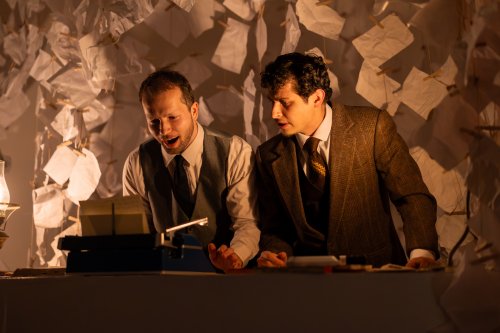
Grayson Willenbacher and Sammy Rivas in a scene from Mara Lieberman’s “Dirty Books” at Bated Breath Theatre (Photo credit: Bjorn Bolinder)
For most of its running time, Dirty Books—a slyly seductive immersive production written and directed by Mara Lieberman for Bated Breath Theatre Company—behaves less like a play than like a forbidden object one has discovered hidden in a filing cabinet marked “Moral Decay.” The audience enters a narrow white-walled performance space on West 14th Street that has been transformed into a miniature museum of American censorship: stacks of banned books, clothespinned documents, timelines of obscenity law, View-Masters displaying coyly erotic photographs, typewriters waiting for confessions. Before a word of drama has officially begun, the production has already implicated us in its central question: who gets to decide what stories may be told, what desires may be spoken aloud, and what forms of intimacy are permitted to exist in public?
Lieberman, whose company has long specialized in intimate and site-specific work, understands that immersion succeeds not through spectacle but through complicity. Dirty Books begins as an exhibit devoted to Anthony Comstock, the nineteenth-century anti-vice crusader who persuaded Congress to grant him astonishing authority over the American mail system and whose infamous Comstock Act criminalized the distribution of anything deemed “obscene, lewd, or lascivious.” In one of the evening’s many inspired touches, audience members are invited to compose their own fragments of forbidden language before the action begins: a love letter to a banned author, a memory of a cruel word once weaponized against them, a line of imagined seduction typed onto yellowing paper beneath a photograph of two women staring at one another with dangerous tenderness.
Then the exhibit ruptures. A stern guide known as the Warden—commandingly played by Elisa Grace Davis (in a rotating cast)—accuses a visitor of theft, only for the “visitor” to reveal herself as part of the drama. The transition from museum installation to theatrical narrative is delightfully disorienting. What follows is a gently comic tale involving two men in the nineteen-sixties who churn out disposable lesbian pulp novels while remaining hilariously oblivious to the fact that their own wives are falling in love in the next room.
The premise has the buoyant absurdity of a forgotten underground farce, but Lieberman wisely refuses to play it merely for camp. The husbands, portrayed with vaudevillian desperation by Camilo Zuqui and Grayson Willenbacher, sweat over purple prose and looming deadlines, concocting fantasies about madams and maids while fearing arrest under obscenity statutes. Meanwhile, the emotional center of the evening quietly migrates toward the women, played with aching delicacy by Alaina Bozarth and Claire Hampsey. Their flirtation emerges not as a lurid spectacle but as something infinitely more subversive: authentic feeling. When the men are arrested and detained, the wives discover the nature of their husbands’ collaboration and rewrite the latest manuscript from a woman’s point of view. Dirty Books gradually proposes that the true threat to moral gatekeepers has never been pornography itself, but intimacy that escapes prescribed social arrangements.
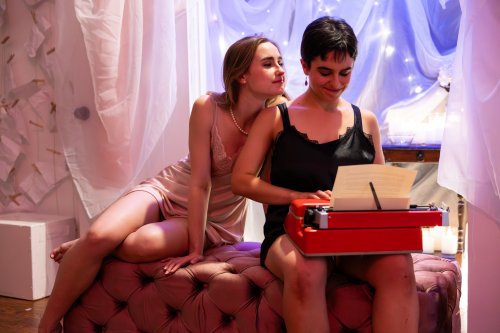
Alexis Pratt and Melina Rabin in a scene from Mara Lieberman’s “Dirty Books” at Bated Breath Theatre (Photo credit: Bjorn Bolinder)
The production’s immersive mechanics are unusually deft. Audience participation, often the death rattle of otherwise insecure theater, becomes here a source of communal playfulness. Names for the characters are solicited from spectators; snippets typed before the show are folded into scenes; rotary telephones hidden inside ottomans suddenly ring, demanding emotional testimony from unsuspecting attendees. Lieberman has created not the aggressive immersion of contemporary endurance theater, but a softer, more conversational form of participation, one that invites rather than coerces.
What lingers most powerfully is the production’s tactile sense of space. The design team performs minor miracles inside the cramped venue. Yung-Hung Sung’s set and lighting design transform an ordinary office floor into a maze of hidden chambers, boudoirs, and archival corners; Stephanie Lopez’s costumes evoke Eisenhower-era domesticity without caricature; Tojo Rasedoara’s sound design drifts through the evening like static from an illicit radio station broadcasting after midnight. Particularly memorable is a dinner-table scene staged with nothing more than fabric and gesture, the performers manipulating cloth into a shifting architecture of repression and longing. The effect is both playful and strangely moving, like watching desire materialize out of household objects.
Lieberman’s script, devised in collaboration with the ensemble, occasionally wanders down intriguing side corridors it never fully explores. References to historical figures such as Ida C. Craddock (a nineteenth-century advocate for free speech and women’s rights, she wrote candidly about female sexuality at a time when such expression was routinely criminalized; her work led to obscenity convictions and imprisonment, and, facing further prosecution after her release, she died by suicide in 1902) and Margaret Sanger (the American nurse, writer, and birth-control activist, became one of the twentieth century’s most controversial advocates for reproductive freedom; after opening the nation’s first birth-control clinic and distributing information that violated federal obscenity laws, she was repeatedly arrested and prosecuted.
Sanger’s activism eventually helped pave the way for the legalization of contraception and the development of the first birth-control pill, as well as the founding of what would become Planned Parenthood) flicker at the edges of the narrative, reminders that America’s battles over obscenity were never really about obscenity at all, but about power: who controls bodies, who controls language, who controls access to pleasure and knowledge. Yet even when the evening threatens to become diffuse, its looseness feels oddly appropriate to its subject. Dirty Books is fascinated by fragments, by marginalia, by the unfinished and improvised nature of human desire itself.
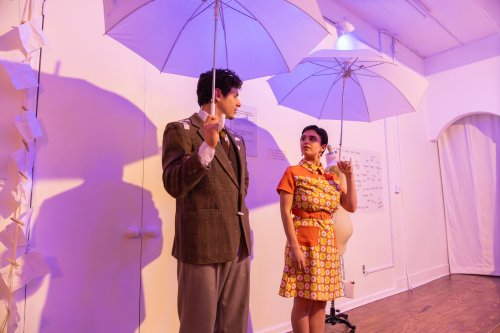
Sammy Rivas and Melina Rabin in a scene from Mara Lieberman’s “Dirty Books” at Bated Breath Theatre (Photo credit: Bjorn Bolinder)
And beneath all the theatrical gamesmanship runs a current of genuine political urgency. The Comstock Act remains technically active law, periodically resurrected by contemporary activists seeking to regulate reproductive rights and sexual information. Schools continue banning books at alarming rates. The production wisely avoids heavy-handed sermonizing, but its historical echoes reverberate unmistakably into the present. Dirty Books understands that censorship rarely announces itself as tyranny; it arrives disguised as public virtue, family values, civic hygiene. Anthony Comstock may seem like a relic from a sepia-toned America, yet his spiritual descendants continue to patrol libraries, classrooms, and legislatures with unnerving vigor.
Still, Dirty Books is never dour. It is too mischievous for that, too enamored of flirtation, theatricality, and collective laughter. The cast navigates the evening’s constant shifts between scripted scenes and improvisation with remarkable ease, maintaining emotional truth even when audience members offer absurd suggestions or freeze in panic beneath the Warden’s flashlight. What emerges is less a conventional play than a communal experiment in vulnerability—part salon, part history lesson, part romantic comedy, part constitutional argument conducted in whispers.
By the end, one realizes that Dirty Books is not really interested in obscenity at all. Its true subject is permission: permission to speak, to write, to desire, to imagine oneself beyond the roles assigned by state, spouse, or society. Lieberman has fashioned an evening that is untidy, ambitious, funny, and unexpectedly tender. Like the contraband literature it celebrates, it insists that private longing is never merely private. To love freely, it suggests, is already a political act.
Dirty Books (through June 27, 2026)
Bated Breath Theatre Company
Bated Breath Theater, 39 West 14th Street, suite 301, in Manhattan
For tickets, visit http://www.dirtybooksplay.com
Running time: 90 minutes without an intermission


Leave a comment