
Vanessa (Heartbeat Opera)
A stripped down, updated version of the 1958 Samuel Barber/Gian Carlo Menotti opera using seven musicians rather than the original 63 courtesy of Heartbeat Opera.
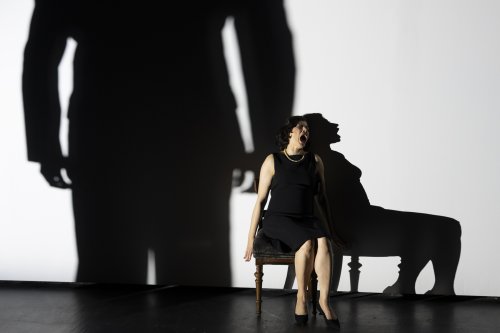
Inna Dukach as Vanessa and the shadow of Freddie Ballentine as Anatol in a scene from Heartbeat Opera’s production of Samuel Barber’s “Vanessa” at Baruch Performing Arts Center (Photo credit: Russ Rowland)
Heartbeat Opera has become famous creating “incisive adaptations and revelatory arrangements of classics.” Its latest is a stripped down, updated version of the 1958 Samuel Barber/Gian Carlo Menotti opera using seven musicians rather than the original 63 and several fewer characters with elimination of Nicholas, the Major-Domo, and The Footman in the new 100-minute Jacob Ashworth adaptation. Set in 1905 in a Northern European country, the Heartbeat production is performed in modern dress. Purists will find that this spare chamber version of what was originally a grand opera commissioned by the Metropolitan Opera waters down Barber’s lush neo-romantic score. However, as the major opera houses are not programming it in recent years, this version is more likely to be staged by smaller companies who must be budget conscieous.
Although the Met production was hugely acclaimed and won Barber his first Pulitzer Prize for Music, its subsequent European premiere was poorly received and began the opera’s decline in popularity. The Met offered a revised version in 1965 shortened from four acts to three which was poorly attended and it has never staged it again. However, it has not been forgotten and long had its admirers: it was been staged at the Spoleto Festival USA in 1978 (available on YouTube in the Menotti production) and again in 2023, twice at the Washington National Opera in both 1995 and 2002 with Dame Kiri Te Kanawa, and at the San Deigo Opera in both 2005 and 2016. Julliard School’s American Opera Center performed it in 1991.
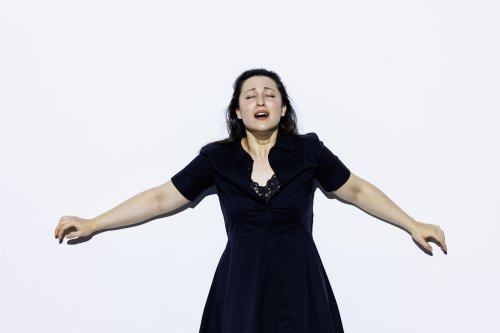
Kelsey Lauritano as Erika in in a scene from Heartbeat Opera’s production of Samuel Barber’s “Vanessa” at Baruch Performing Arts Center (Photo credit: Maria Baranova)
The New York City Opera staged the 50th Anniversary revival in 2007 at Lincoln Center with Lauren Flanigan in the title role. In recent years it was acclaimed in its first United Kingdom production held at Glyndebourne in 2018, and has surfaced in the U.S. in concert productions at the National Symphony Orchestra in Washington, D.C. in 2025 with Renée Fleming and in Boston in January 2026. The current Heartbeat Opera version started at the Williamstown Festival last summer as its first opera production and had its New York opening night on May 14, 2026 before a three-week run at the Baruch Performing Arts Center.
Menotti’s libretto was rumored to have been inspired by Isak Dinesen’s Seven Gothic Tales but as none of them tell the same story, it is assumed that Menotti meant the atmosphere found those tales. Set in 1905 in a Northern country, the story concerns the title character who has waited 20 years for her love Anatol to return to the country house where they had an affair in their youth. Romantic Vanessa has lived as a recluse with the mirrors and paintings covered. Her only companion has been her niece Erika and her mother, the Old Baroness who won’t speak to her. Now in the present she is awaiting a visit from Anatol, only to discover that he has died and it is his son also named Anatol has come to visit.
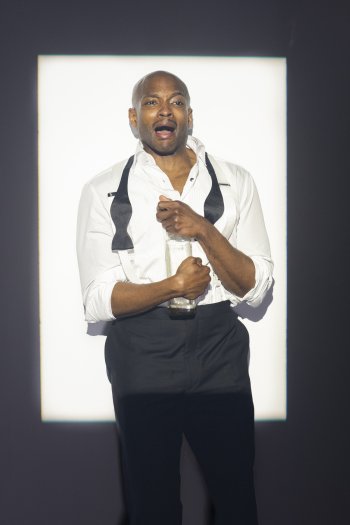
Freddie Ballentine as Anatol in a scene from Heartbeat Opera’s production of Samuel Barber’s “Vanessa” at Baruch Performing Arts Center (Photo credit: Russ Rowland)
The manipulative and gold-digging Anatol seduces Erika on the day he arrives and then romances the aunt who is smitten with her memories of his father. When Erika discovers she is pregnant and doesn’t trust Anatol’s love for her, she wanders out into a storm on the night of Vanessa’s first ball in 20 years. She is found and brought back, having caused the miscarriage she wanted. Vanessa and Anatol marry and leave for Paris. Erika then has the mirrors and paintings covered and takes Vanessa’s place waiting for Anatol’s return, with the Baroness no longer speaking to her. The only other major character is the old doctor who had an affair with the Baroness in their youth and still pines for her. Vanessa never guesses that Erika has been in love with this Anatol who lies when asked explicitly.
Directed by R.B. Schlather, the Heartbeat Opera production is in modern dress with all-black costumes by Terese Wadden except for Erika wearing a white nightgown in her second act outing and Anatol and the Doctor wear white shirts with their tuxedos for the second act New Year’s eve ball.) The bare set by Jiaying Zhang (based on an original design by Schlather) is simply an all-white wall on which huge shadows and silhouettes in Yuki Nakase Link’s lighting design are cast on it. The only furniture are basic wooden chairs which turn up when needed. The production is strongest on atmosphere, with film noir lighting rather than the Gothic elements of the original production.
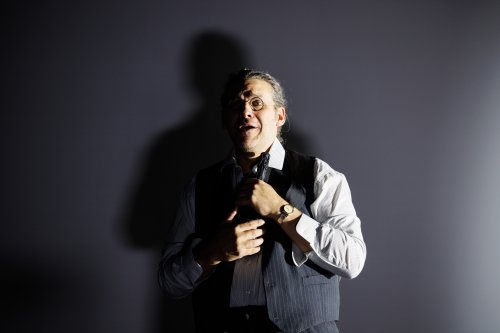
Joshua Jeremiah as the Doctor in a scene from Heartbeat Opera’s production of Samuel Barber’s “Vanessa” at Baruch Performing Arts Center (Photo credit: Maria Baranova)
In Schlather’s production each singer has one trait obvious above all others. In the title role, soprano Inna Dukach puts her high tessitura to good use as all of Vanessa’s music requires it. She acquits herself well with Vanessa’s most famous aria, “He has come, he has come!” and “Do not utter a word, Anatol.” Dukach’s Vanessa seems a very shallow woman who lives only for love, which is just the way Joanna Meier played the role in the 1978 Spoleto production under Menotti’s direction. In the deeper role of Erika (which Maria Callas guessed when offered the title role which she turned down), mezzo-soprano Kelsey Lauritano impressed with her more layered performance. She made the oft-sung aria, “Must winter come so soon” in the first act her own. She demonstrated a wide range of emotions in the course of the opera. In the small role of the Baroness, contralto Mary Phillips made one wish she had more to sing.
Tenor Freddie Ballentine gave a swaggering ironic performance as the young Anatol, insincere, disingenuous and hypocritical, usually smiling out of one side of his mouth. He made a meal of his first act aria, “Outside the house the world has changed,” and gave a sensitive reading of this third act aria, “On the path to the lake she was hidden in a small ravine.” Dukach and Ballentine are fine in their extended duet to “Love has a bitter core” in the second act. As the Doctor, baritone Joshua Jeremiah was best in his drunken scene in Act Two which begins with his “What an evening! What women, what champagne!” Some of the excised lines of the Major Domo are assigned to others.
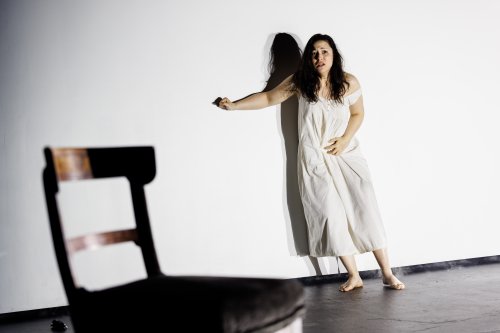
Kelsey Lauritano as Erika in a scene from Heartbeat Opera’s production of Samuel Barber’s “Vanessa” at Baruch Performing Arts Center (Photo credit: Maria Baranova)
Those who want to see a lavish Vanessa like the original designs of Cecil Beaton will be disappointed with this minimalist and cut-down version. Those who like their opera pure so that they can concentrate on music and text may be delighted with Heartbeat Opera’s version. In any event, this new version does resurrect and update an opera that was nearly consigned to the scrap heap without just cause.
Vanessa (May 12 – 31, 2026)
Heartbeat Opera
Baruch Performing Arts Center, 55 Lexington Avenue at 25th Street, in Manhattan
For tickets, visit http://www.heartbeatopera.org/Vanessa
Running time: one hour and 55 minutes without an intermission


Leave a comment