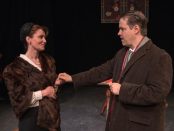
Whether you see one or both of Gurney’s "Two Class Acts," these are provocative plays of ideas on topics of the day. The playwright continues to demonstrate that he has a wise and discerning view of the human condition. Director Stafford Arima has done a beautiful job of obtaining all of the nuances and humor out of the two sharp and intelligent situations. The casting for both plays could not be improved as the actors make their roles their own. The Flea Theater leaves White Street on a high note with two entertaining and superior productions that will close the space with honor and distinction. [more]
British actor Richard Armitage making his New York stage debut and Tony and Academy Award nominee Amy Ryan work hard to make Kenneth and Sandra three-dimensional, likeable people, but, as written by Mr. Bartlett, their crassness is the fatal flaw in "Love, Love, Love." Why should we enjoy spending so much time with two people who so adroitly care only for themselves? [more]
Healy’s treatment is faithful to the novel with a good deal of it being Clegg’s narration addressed to the audience. There are lengthy conversations between Miranda and Clegg, and her escape attempts are depicted. No matter how skillful Healy’s stage version is, it’s still two hours of often-philosophical talk between two characters in an unpleasant situation. [more]
Founded in 1991, the National Asian American Theater Company’s mission is to present theater with all Asian-American casts. This is accomplished by producing classics of European and American works of dramatic literature, or adaptations of these works by Asian-American playwrights or new plays written by non-Asian Americans, not for or about Asian Americans. That last precept is the case of this East coast premiere of "Sagittarius Ponderosa." [more]
Benjamin Stuber’s puppetry designs are a disappointment and should be more thoughtful and complementary to the play. Ghoulish puppets that are meant to disturb seem make-shift and thrown together. There is only one disturbing and appropriately quirky puppet effect – the appearance of a huge eye, set into a collage background of assorted textiles. [more]
In his Broadway productions, David Leveaux has often used a strong directorial concept such as his Chekhovian 'Fiddler on the Roof" and his interracial "Romeo and Juliet" which did not work for all theatergoers. Here he seems to have decided that Susan finds life in Britain gray on her return and all of the sets by Mike Britton other than the final one (ironically suggesting the hope of the post-war generation) are made up of gray walls. As a result, none of them have any atmosphere aside from all resembling each other. It is left to the costumes by Jess Goldstein to give clues to the year of each scene which they sometimes do, and sometimes not. [more]
Company XIV has applied its inimitable Baroque-Burlesque style to the Greek myth of the Judgement of Paris for the second time and come up with Paris, an exotic and erotic adults-only entertainment that is like nothing else you will see this year. Conceived, directed and choreographed from the fevered imagination of Austin McCormick, Paris combines the arts of dance, opera, circus, theater, storytelling and high fashion to tell its story of the competition between the goddesses Athena, Juno and Venus for the Golden Apple. As you may know, the future outcome was eventually The Trojan War. [more]
The play is both satiric and trenchant. The conversations of the men are laced with profanity much like David Mamet’s real estate men in Glengarry Glen Ross. Eliza is called everything in the book (arrogant, aggressive, disrespectful, impatient, a loose cannon) as well as names you can’t print in a family newspaper. Eventually it rubs off on Eliza and Janice and they are cursing as crudely as the men: if you can’t beat them at their own game, then join them. The men’s fear of the women getting ahead would be pathetic if it weren’t so typical and true. Rebeck dramatizes office politics as each member of the staff worries about his or her own skin, either with lies, evasions or manipulation, and the circle keeps widening, until Eliza beats them at their own game. [more]
Pierce coolly addresses the audience while delivering this mundane litany. His superb comic timing, long evident on the television situation comedy "Frasier," is on glorious display here. That quality combined with his dramatic depth and soothingly funny delivery makes this opening sequence mesmerizing. [more]
Directed by high profile new British director Simon Godwin, associate director of the U.K.’s National Theatre, making his New York debut, this "Cherry Orchard" seems to have no interpretation or explanation for a new staging. Stephen Karam, the author of last season’s acclaimed "The Humans," has written a new version which seems to be heavy on American ideas in this Russian play, while both the sets and costume designs get in the way of coherence and understanding. All in all this is a great disappointment considering the talent involved. [more]
British author Stephen Sharkey’s new translation is faithful to Brecht, but the Phoenix Theatre Ensemble has fashioned the presentation as an old-time radio show. Brecht was known for his self-conscious style of distancing and alienation, where the audience is made aware that they are watching a play but this additional device is a distraction and not as funny as intended. [more]
While S. N. Behrman was one of the leading Broadway playwrights from the twenties through the early sixties, he went into an eclipse after his death in 1973. Since 2000, however, there have been New York revivals of his major comedies "The Second Man," "Biography," "No Time for Comedy" and "Rain from Heaven." Set in the living room of a summer cottage on an estate in Northern Maine where the rich Frothinghams go to get away from the problems of the world, circa 1936, End of Summer resembles Chekhov’s "The Cherry Orchard" in that they both concern wealthy people refusing to recognize the changing social order. However, S. N. Behrman’s play is very much a comedy with its cool, urbane witticisms and very American in its outlook and content. [more]
Simon Stephens, whose Tony Award winning "The Curious Incident of the Dog in the Night-Time" recently amazed audiences with its razor-sharp take on the inner workings of an autistic boy, is back with "Heisenberg," a two-hander that examines the relationship between a forty-something woman and a seventy-something man, written with the same consummate insight into the foibles of human beings, minus that play’s technical wizardry, here replaced by a sharp ear and eye for the nuances of neediness. [more]
In the guise of two old Upper West Side bachelor geezers, Kroll as failed actor, Gil Faizon, and Mulaney as failed writer, George St. Geegland, wander about Pask’s brilliant combination apartment/beauty salon/TV studio/street set, musing out loud about their lives, wearing dreadful wigs (credit Leah Loukas) and speaking in a bizarre accent which, for example, turns “Broadway” into “broodway,” “an” into “en” and “homage” into “home page.” [more]
Visual artist and puppeteer Jessica Scott navigates through a satiric and fascinating new media “seascape” with a dysfunctional ship’s crew, albeit all women. Scott’s "Ship of Fools" uses nightmare structure, intentionally drawing from Book VI of Plato’s "Republic" (from whence its title came), Bosch imagery and other surreal allegories, depicting the fine line between heroines and madness. [more]
In "The God Projekt," the “Divine He” repeatedly tries to make reparations for his past destructive deeds, but to no avail. God is wrestling with dementia and in a time loop. Yet, he is determined to correct, well, his god-awful mistakes -- one of which is not only acknowledging the “Divine She” in his heavenly order, but atoning for a heinous crime against her. [more]
Obie award-winning playwright José Rivera is an Oscar nominee for his adapted screenplay for "The Motorcycle Diaries." For this adaptation, he has set "The Maids" (which premiered in Paris in 1947) in Vieques Island in Puerto Rico in 1941. This was a politically tumultuous era with native factions resisting the U.S. presence there. Mr. Rivera’s script reflects this situation and locale and is filled with cultural references to sugar cane, bustellos and revolutionaries. [more]
The scenic design by Brett Banakis is a functional, minimalist configuration of a slightly raised wooden performance platform surrounded by a wooden frame dotted with small antlers suggesting the pub. There’s an assemblage of vintage furniture, potted plants, screens and vines that are shifted about to designate the various locations. This all contributes to a deficit of visual grandeur that the production is understandably striving for on a limited budget but doesn’t achieve. These design flaws could be superseded by an abundance of bravura performances, but there aren’t. [more]
Ibsen’s "An Enemy of the People" is a classic of modern drama but at times it can seem musty in a poor translation. David Harrower’s "Public Enemy" is not only a shrewd, accessible adaptation, it also makes clear the contemporary relevance of the dangers of the herd instinct in a seemingly just society. The Pearl Theatre Company production is a must-see for all good citizens, particularly in these perilous times. [more]
Playwright Helen Edmundson whose stage plays have been mostly adaptations of famous literature ("The Mill on the Floss," "War and Peace," "Anna Karenina," as well as "Coram Boy" and "Thérèse Raquin" both seen on Broadway) tells her story in the leisurely way one might write a novel. While the material is both shocking and surprising, director Pamela Moller Kareman has undercut the inherent tension in the play by the choices she has made. [more]
The gregarious Matt Koplik plays Donald Moscowitz who constantly bears the brunt of his parents’ overbearing natures. He is instantly likable, charming, and relatable as any young person can identify with in trying to maintain his independence while also respecting his parents. Kate Katcher and Tony Rossi play Donald’s parents and make quite the electric pair as they are nothing short of domineering. With his close friends, Levi and Henrietta, by his side, Donald is able to concoct an elaborate story that he hopes will make his parents happy and one that he will be able to pull off without hurting anybody’s feelings. [more]
Grand highlights of Mr. Horton’s dynamic work includes an analysis of "Animal Farm" while he erases the novel’s seven animal commandments that are written on a blackboard as they are overturned one by one, by the pig Napoleon who represents Josef Stalin. There’s also a dramatic demonstration of American versus British rationing during W.W. II as Orwell produces bountiful American foodstuffs comparing them to the meager provisions allowed in Great Britain. [more]
Sheppard recollected that in the Underground Railroad game his fifth grade classmates were designated to be either Union or Confederate soldiers. The Yankees (Union) tried to covertly run slaves (portrayed as “black dolls”) from a classroom “safe house” to another classroom “safe house.” The Rebels (Confederates) endeavored to prevent the Yanks from accomplishing their mission. The end goal was to secret slaves or dolls to Canada (a school lobby glass case filled with memorabilia served as Canada). [more]
Gentili and Davis riotously appear together in a confrontational scene that’s similar in style to one of Tennessee Williams’ outlandish later works written during his 1960’s drug fueled “Stoned Age.” It culminates in an outrageous catfight right out of the campy 1960’s 'Batman" television series. [more]
Cirque du Soleil's "Kurios: Cabinet of Curiosities" has a wonderful premise and an eye-filling mise en scène. However, without the needed narration or program notes, the idea remains still in embryo. The problem one supposes is how to narrate a show that is intended for international audiences. [more]
Trial is stacked against Bush from the get-go. The torrent of facts alone convicts him. The director, Stephen Eich, the author and probably the actor, Mr. Carlin, seem to have decided to make Bush weak-voiced, full of twitches, nervous eye movements and religious fervor. Had Bush been portrayed as a stronger man who truly believed in what he did, the play might have had a dramatic spine. The very fact that after being convicted by a jury of audience members Bush’s last word is a tearful outcry (“Laura”) serves to induce not empathy, but pity. [more]
The problem with Peter Dobbins’ productions is not the quaint spiritual underpinnings of the plays but the fact that they are directed too leisurely and consequently do not generate any laughs, fatal for comedies. Several of the actors are innocuous where they should be more incisive. The rhythms of both plays seem much more formal and genteel than they need to be. The short, curtain raiser plays like an extended anecdote, while the longer, more famous play is a comedy of manners play that seems rather thin for its length. The stilted, old-fashioned translations from the French also do not help. [more]
Headsets are on the backs of the audience’s seats when they arrive and which they are asked to wear throughout the show. The stage is set with a desk, several microphones and many water bottles. The back wall is adorned with foam sound proofing panels. The overall look is that of a cavernous sound studio. [more]
The live action elements of the show are performed on various platforms and screens on which are projected Deco Dawson’s designs which give the dramatization a 3-D look. In addition to 2 -D minatures, Miller manipulates tiny action figures (the scientists, etc.) and puppets (the Giant Squid, etc.) which are projected life size. Other moments take place in the audience. The audience is also asked to put their smart phones on mute to await developments. Among the magical moments are the walk on the bottom of the sea and the school of jelly fish. Aside from the marvelous visuals, the creators seem to want to have it both ways: although we are transported to a Victorian world, smart phones and computer monitors seem to work – although the younger members of the audience will most likely not notice the anachronisms. [more]
The playwright sets the action in Turner’s jail cell where he’s chained up, visited by Gray, and overseen by a guard, the night before his execution. Mr. Davis states that this situation is a fabrication inspired by the book. A possibly unreliable account is the source material for this even more fanciful dramatization. Davis even expresses through the mercenary Gray the possibility that his chronicle will be sensationally tailored in order to sell more books. [more]
"All the Ways to Say I Love You" is refreshingly free of this formula. The incidents are straightforwardly depicted and the circular conclusion is simple. LaBute palatably sets up the situation by establishing that the male student is a senior who has had to repeat a year of school, so he is clearly a young adult. It is implied that he is African-American and it is stated that Mrs. Johnson’s emotionally distant husband is of mixed race. Despite these intriguing elements, the play narratively peaks halfway through and then grinds on. [more]
Writer and director Peter Darney’s script is based on and intertwines over 50 hours of interviews with gay men contacted through the gay social media site Grindr. From this real life material, Mr. Darney has skillfully fashioned an engaging five-person, unflinching character study. There’s no plot and no resolution but it is still a compelling take on this phenomenon. [more]
The single disadvantage of director Patricia McGregor’s approach is that in cutting so much text, the events of the play seem to occur one on top of each other, making the play a bit melodramatic, and a good deal of character development is sacrificed by the way. However, with dangerous-looking fight direction by Lisa Kopitsky and intriguing movement by Paloma McGregor, this is a "Hamlet" that lives up to its mission to be accessible and entertaining to all, those who know the play well and those seeing it for the first time. [more]
Director Austin Pendleton made some choices which don’t help the now creaky play. Although Peter is described as ten years younger than Helen, Pendleton has cast the ever reliable Bradford Cover who unaccountably looks to be Helen’s age or older. This changes the dynamic of the play as with a younger man it would be obvious why Helen doesn’t think she has much hold over him. While the apartment is described as dirty with junk all over it, Harry Feiner’s set is spotlessly clean. This changes the environment a good deal and makes Jo’s life much less intolerable than described. In addition to the on-stage jazz combo which was also part of the original 1958 London production, Pendleton has several of the characters occasionally speak directly to the audience which makes this play more surreal than the kitchen sink milieu would imply. All of this makes the revival much less affecting than it might have been. [more]
"Safe" is crammed with so much dysfunction and adolescent angst that if its adult language were excised it would make a perfect "ABC Afterschool Special," if those were still being produced. Instead, it’s an earnest but flat social drama. [more]
Like his "Apple Family Plays," Nelson’s "The Gabriel" cycle all take place in a kitchen on a specific day in almost real time using the same six actors to play the family members. These are occasional plays which define a moment in time, as well as being chamber plays, small cast plays set in one place. Not much happens but much gets said and discussed. Described as “Chekhovian” by Oskar Eustis, artistic director of the Public, "What Did You Expect?" is less so as there really is no dramatic event as in such Chekov plays as "The Cherry Orchard" or "The Sea Gull." However, leisurely told and extremely detailed, "What Did You Expect?" offers its own rewards but may not be for all theatergoers. It is an evening of excellent talk which defines a family of have nots in our own time. [more]
Playwright Ana Nogueira has a facility for often arch dialogue but not much else. The play’s potentially promising sci-fi premise is undermined by its bizarre vagueness. Not only do the leading characters not have names, there is no biographical data about them imparted. Their professions and life details are never described. Most crucially HIM’s thesis is mentioned several times but what the subject of it was is not stated. Ms. Nogueira basically presents two ciphers that are difficult to truly care about. Ultimately, it’s all a hollow and smug exercise. [more]
While proud of how she is portrayed in the press, as a woman who couldn’t be broken, McPhee delves beneath the surface to illustrate how Shanley really felt once she returned to an empty apartment at the end of the day -- with her beloved dog as her only real company. Like everyone else, she experiences confusion, loneliness, and pain and only can hope that her good choices and desire to help mankind outweigh the mistakes that she has made. [more]
During the three and a half hours of "Phaedra(s)," Huppert masturbates, menstruates, throws up, fellates several versions of Hippolytus, flails about with masochistic glee, and screams so loudly and continuously as to cause fears for her vocal health, all in the service of getting to the core of the title character as imagined by Sarah Kane, Wajdi Mouawad and J.M. Coetzee (with dramaturgy by Piotr Gruszczynski.) Director Krzysztof Warlikowski did little more than keep the over-the-top emoting and sexuality from exploding out to Fulton Street. [more]
Unlike the original short story which was set on a rural farm in Cornwall, England, and the film which was reset in Bodega Bay, California, the play takes place entirely in the main room of an isolated house in New England. Stefan Dzeparoski’s production which puts the audience in the same room with the characters has its strengths and weaknesses making this an evening of mixed success. [more]
Felder’s play begins with a video of the actual Leonard Bernstein delivering a colorful, yet entertaining, illustrated lecture on music. When Felder sashays down the aisle, a cigarette in one hand and a drink in the other, the lack of resemblance is, at first, bothersome. But, somehow, sitting at a piano—which he plays impeccably—his monologue pulls you into Bernstein’s tumultuous life story. [more]
This comedy revival of Leslye Headland’s 2010 play, that was adapted for the 2012 film of the same name, "Bachelorette," is as caustic and outrageous as ever. While looking ahead to a wedding day is supposed to generate feelings of excitement and bliss as women band together to stand by their girlfriend as she prepares to say “I Do,” this is often times not the case with several different personalities in the same room. It can be a very stressful time as emotions heighten and feelings get hurt, and "Bachelorette" humorously and dramatically represents this experience as three girls meet up to celebrate the night before their friend’s wedding in a swanky hotel suite. [more]
Playwright Julia Cho has crafted an engaging and universal work that unevenly blends reality with mysticism. The characters are all very well delineated and the dialogue is flavorful and realistic. It’s structured as a series of short scenes that include monologues, flashbacks and fantasies. The play’s two-act form diminishes its momentum, running two hours and fifteen minutes with an intermission. Repetitiveness and a preoccupation with profundity sidetrack its effectiveness at times. [more]
Director Kira Simring’s superior staging theatrically presents the play’s complicated situations with clarity and surrealistic flourishes. Characters often enter and exit through unlikely places such as through the audience or from a side door. Though the play lasts only 75 minutes, Ms. Simring’s physical realization of it makes it seem lengthier with the depth she has brought to it. Her results with the cast, some of who play dual roles is superb. [more]
Following "Bachelorette" and "Assistance," Leslye Headland’s latest play, The Layover, is a taut psychological thriller told in an updated film noir style. Trip Cullman, who has directed all of her New York productions, has made the play a tour de force of tension and unease. As acted by Annie Parisse, Adam Rothenberg, Amelia Workman, John Procaccino and Quincy Dunn-Baker, the tone is marvelously sustained. The only fly in the ointment is the ending which will take you entirely by surprise and may feel unmotivated. [more]
To call "About Clarence and Me" simply a play is misleading, as the project features an entirely original score by co-writer Scott Hiltzik. A classical musician, Hiltzik’s music is technically striking but carries a modern flare. In additional to their finely tuned performances, both DeMone and Roll impress as musicians as well. Roll proves himself to be quite the accomplished classical pianist, demonstrating mastery of the keys by way of precision and constraint. DeMone, ever his opposite, produces from the piano a sound descendent of a ragtime piano roll, at times accompanied by the veteran singer’s sonorous growl. Directed by Hiltzik’s co-writer Jones, the duo’s intimacy with the material is plain to see in the final product. Full of nuanced moments both thematically and in performance, the writing team’s hands-on approach is responsible for this well-rounded and solid production. [more]
Written in 415 B.C. as a criticism of the Athenian capture of Melos and the subjugation of its population earlier that year, "The Trojan Women" has remained relevant throughout the last 2,500 years due to mankind’s penchant for war. Although Ellen McLaughlin’s new adaptation makes some changes to the Euripides original, it retains its power pertinent for our own time in the wake of the refugee crisis. While at times callow, Anne Cecelia Haney’s production for The Bats is persuasive, potent and poignant. It also provides an excellent introduction to the plays that make up Greek tragedy for those who have not experienced them on stage. [more]
Besides achieving sensitive and strong performances from the cast, director David Drake masterfully fulfills the playwright’s intentions with his lively and brisk staging. The collaborative group UnkleDave's Fight-House’s fight direction is thrillingly realistic for several physical conflicts. [more]
The beauty of Chen’s technique lies in engaging the audience in a guessing game that they don’t immediately know they are a part of – presenting them with certain messages that appear to be true, but challenge them to think about it from a different perception. One of the main themes is examining the different viewpoints between the Chinese and American cultures and how perceptions can be skewed. The result is a clever and eye-opening puzzle that teaches important lessons around the human experience in a shocking way by offering extremes. [more]
Now that we have been through all the angry play movements, literate writers like N.C. Hunter and Terence Rattigan are once again ripe for revival. While in his own time, Hunter was criticized for being too much like Chekhov that now seems a plus in the days of sloppy craftsmanship and plays that are really movie scenarios staged in the theater. "A Picture of Autumn" was obviously a post-war British variation on Chekhov’s "The Cherry Orchard," while Waters of the Moon resembles "The Sea Gull." "A Day by the Sea" owes a great deal to Chekhov’s "Uncle Vanya" and includes the same basic cast of characters. [more]
Toni Press-Coffman’s "Touch" is a rather challenging play both in that a great deal of it is narrated in recollection and also that it deals with much naked emotion. The cast led by Peter McElligott who is onstage almost throughout the evening could not be bettered. Director Nathaniel Shaw has made this under-dramatized play into a more theatrical experience. While Touch will not be for everyone, it is an impressive document of the workings of the human heart. [more]
"To Protect the Poets" shows how readily lines can be crossed when “street justice” is employed, instead of the judicial system. This first-rate, timely and intelligent play is a just representation of how two people who love each other deal with violent crimes against women and police brutality. [more]
While "LUNT AND FONTANNE: The Celestials of Broadway" is a fine and concise review of their careers for people who have never heard of them, Murphy and Lang make them seem more superficial than necessary. It is true that Fontanne was born in England, but Murphy and Lang play both of them as very English and exceedingly refined and proper, not backed up by their performances as themselves in "Stage Door Canteen." The Lunts’ famous use of overlapping dialogue which was years ahead of its time can be seen in the video of their film of "The Guardsman." Murphy and Lang often use it to talk over each other’s lines making them unintelligible, while the Lunts came in on the last syllable of their cues which is much more realistic. The Lunts may have appeared in many light drawing room comedies, but to portray them as delivering their lines on the same level all time would not have made them as famous as they were. [more]
Laden with jokes, sight gags and flamboyant characters, Mr. Free’s well-constructed and startling work combines the outrageous sensibilities of John Waters’ films with the social consciousness of Norman Lear’s television sitcoms. Free’s giddily convoluted scenario is dense with flashbacks, fantasies and surprises. Just when a thread is exhausted he is seamlessly on to another. The classic horror film "Night of the Living Dead" is emulated for the deadly serious dénouement. [more]
Directed by Leni Mendez, "Implications of Cohabitation" is a smooth running machine, albeit some undeveloped moments in the script. The staging is fluid and the story is clear, but some exchanges between characters are borderline inauthentic. The set design by Anna Grigo is effective, but slightly repetitive. The main set piece is an empty apartment, and the decorum of the apartment is changed to reflect the change in location. Unfortunately, these changes are minimal and don’t do much to enhance or differentiate one scene from the next. [more]
Richard Alfredo’s 'The Dark Clothes of Night," a brilliant parody/homage to film noir and hardboiled fiction, the third play of Summer Shorts – Series B, is so good it alone is worth the price of admission. The other two plays which precede it in this year’s 10th Festival of New American Short Plays have interesting but undeveloped premises. But "The Dark Clothes of Night" is an instant classic, a humorous satire that is also a brilliantly theatrical study in paranoia, fear and evil and the elements that made film noir irresistible. Directed by playwright Alexander Dinelaris, the three actors in this memorable short work play multiple roles with assurance and aplomb. [more]
Writer Gustavo Pace is the handsome, youthful and animated performer of this autobiographical exploration. He loudly rattles on in Portuguese and English while adequately portraying himself and several characters. These include his father, brother, a female therapist working on turning him straight, and various others he encounters. It’s an amiable and passable performance that’s heavy on volume and shaky on intelligibility. [more]
While "Troilus and Cressida" is rarely staged, Daniel Sullivan’s production full of bombs and smoke suggests that in our time of endless wars it speaks to us again, and the play’s cynicism also seems to capture the current zeitgeist. It also features memorable performances from John Glover, John Douglas Thompson, Max Casella, Sanjit de Silva, and Alex Breaux, among others. [more]
The August Strindberg Repertory Theatre presents this production. Since 2012, they have produced a number of the author’s works in New York City and for this one it was decided to condense and update it in order bring out its humor. The result is pretty much laugh-free. [more]
"Alice in Black and White" is a play-within-a-play. Two parallel stories are told: one of Austen’s life and relationship with Gertrude Tate, her companion for over 40 years; and one in the early 1950’s involving a Staten Island Historical Society receptionist and journalist Oliver Jensen, who later published "The Revolt of the American Woman" (which included Austen photographs) and a Life magazine article on Austen. [more]