Plays
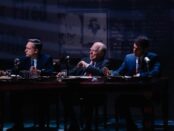
Following in the footsteps of Joshua Spector’s "Eureka Day" and Tracy Letts’ "The Minutes," also stories of local community service groups, David Lindsay-Abaire’s hilarious satire "The Balusters" is simply the best new play of the 2025-26 season. Set at a series of meetings of the Vernon Point Neighborhood Association in a landmarked enclave of an East Coast city, the pointed dialogue skewers liberals who really want to maintain the status quo as well as their white privilege. Hypocrisies abound as the nine members discuss local issues that stir up a great deal of heated debate as well as revealing their personal biases, while little change actually gets voted on. Director Kenny Leon’s terrific ensemble cast is led by Tony Award-winner Anika Noni Rose and Emmy Award-winner Richard Thomas, and the play also reunites the author with Marylouise Burke who has created roles in his "Fuddy Meers," "Wonder of the World" and "Kimberly Akimbo." [more]
The Door Slams, A Glass Trembles
Inspired in part by "he Magic Mountain," Thomas Mann’s 1924 meditation on illness and temporality, Zimet’s play borrows not its plot but its sensibility: the peculiar dilation and contraction of time as it is lived, remembered, and imagined. Like Mann’s sanatorium-bound protagonist, Zimet’s characters find themselves suspended in a liminal zone where past, present, and future bleed into one another with disorienting grace. The result is not mere homage but a vivid reanimation of Mann’s central insight—that time, far from being fixed, is a profoundly subjective medium. [more]
Proof
Thomas Kail’s elegant and polished production now at the Booth Theatre (probably the best Broadway venues for dramas) has recast the family as African American and it works just as well – if not better - than the original production in which the family was white. Two stars from the world of film and television – Ayo Edebiri (Chef Sydney on "The Bear") and Don Cheadle ("Devil in a Blue Dress," "Crash," "Hotel Rwanda," "Traffic," etc.) – make their Broadway debuts and take to it like a duck to water. In addition, the remarkable Kara Young, nominated for the Tony Award the last four years and winning two in the last two years in a row, plays the supporting role of the sister with the assurance we have seen in her previously. [more]
Beauty Freak
What lingers, long after the final moments—which are, indeed, superb—is not a tidy judgment but a series of disquieting questions. Clements refuses the comfort of easy condemnation, even as he lays bare the cost of moral evasion. Riefenstahl emerges neither exonerated nor simplified, but as a figure whose brilliance and blindness are inseparable. The play does not ask us to forgive her; it asks us to understand how such a figure could exist, and, more provocatively, what it means that she did. [more]
The Bad Daters
Derek Murphy’s "The Bad Daters" arrives Off Broadway from Ireland and the United Kingdom with the unassuming air of a chamber piece and the stealthy force of something far more piercing: a romantic comedy that has the good sense to distrust romance, and the better sense to proceed anyway. Murphy, an Ireland-born New Yorker with an ear for the bruised lyricism of everyday speech, has fashioned from the well-trod terrain of app-based courtship a work of surprising delicacy and cumulative emotional power. Under Colm Summers’ exquisitely modulated direction, and animated by two performances of uncommon acuity from Kate Arrington and Shane McNaughton, the production unfolds with a patience that feels almost radical, allowing its jagged edges to soften—though never quite smooth—into something like grace. [more]
Love Story
Where past and present commingle—as they so insistently do in a play like "Love Story"—the burden falls squarely on the director to furnish the audience with a legible temporal grammar. Without such guidance, fragmentation risks reading not as intentional lyricism but as simple confusion. Here, despite the production’s many sensitivities, that grammar is not always clearly articulated. Judging by the palpable hesitations in audience response—the delayed laughter, the uncertain silences—it takes an inordinate number of transitions before one fully apprehends a crucial fact: that Maria is already dead at the top of the play. This is not, in itself, a flaw; dramatic revelation can be a powerful tool. But the production does not so much reveal this reality as obscure it, leaving spectators to assemble the timeline retroactively, often at the expense of emotional continuity. [more]
Dreamcats!
Fans of feminist science fiction and revisionist fairy tales will find much to recognize in playwright Charlotte Lily Gaspard's new work. Set on a planet ruled by intelligent and mighty creatures called "Dreamcats," the play features a rebellious feline princess played with gusto by Gaspard herself. Intellectually courageous, the Princess has a secret plan to challenge the belief that her planet is the best of all possible worlds--a sacrosanct tenet that no Dreamcat has dared to investigate, still less to refute. Her project envisions comparing all the planets, but how can this be done when hardly any data on them is available? (The one map of the galaxy she has found was under wraps.) [more]
Kenrex
There are evenings in the theatre when the air seems to tighten, as though the room itself has drawn a breath it cannot quite release. Such is the case with "Kenrex," a work of unnerving command and cumulative force, written by Jack Holden and Ed Stambollouian, and directed by the latter with a vigilance that borders on the prosecutorial. What begins as a seemingly familiar excursion into the annals of American true crime—its outlines recognizable, its destination foreknown—steadily transforms into something far more disquieting: a communal autopsy, conducted in real time, of a place where the mechanisms of justice have not merely failed but quietly abdicated. [more]
Rheology
"Rheology" previously seen at Brooklyn’s Bushwick Starr in the spring of 2025 has reopened at Playwrights Horizons and proves to be a unique meta-theatrical experience with both performers, a real mother and son, theoretical physicists Bulbul Chakraborty and writer/director Shayok Misha Chowdhury (Pulitzer Prize finalist for "Public Obscenities"), appearing as themselves. Written and directed by Chowdhury in association with Chakraborty, Rheology begins as a physics TED talk on sand as “capricious matter” (Bulbul’s field) then switches to a demonstration of stage directing (Misha’s field), and finally becomes a metaphysical discussion on life and death tying the two together. This is an unusual theatrical presentation, one you will ponder for a long time to come. [more]
The Adding Machine
Among Bradshaw’s revisions are the use of a narrator, reducing the original cast list from 25 to four, adding an intermission, updating some of the slang to contemporary speech, and having its protagonist Mr. Zero played by a woman instead of a man. The effect of all of these changes is that the play now runs longer than it used to, and the long monologues are still in evidence and become rather tedious. The new version still includes some of the protagonist’s racist rant in the trial scene. Few of these changes make the play any better or more relevant today. [more]
Fallen Angels
It’s therefore a delight to see two such skilled actresses as Byrne and O’Hara, both using ultra-posh accents, willing to play against their striking beauty to get laughs, demonstrating both physical dexterity and perfect timing. At first, it seems as if everyone, the stars included, is trying express some stereotypical notion of what being in a Coward comedy requires, from the ultra-sophisticated speech, mannerisms, and elevated tone, and it takes a few minutes to begin seeing through the self-consciously lacquered veneer to the characters inside. Although Coward now and then comes through with a bon mot matching his reputation, much of the laughter is generated by throwaway comments and responses, gestures, facial expressions, and bodily reactions. Ellis creates amusing business with props, like long cigarette holders, and food, like strawberries. What Byrne does with a slinky green gown and veil, using her elegant slimness to visually hysterical advantage, will long remain in my memory, just as will the image of the glamorously blonde O’Hara, flopped upside down over a club chair as she ever so slowly slides down it to the floor. [more]
The Fear of 13
Renowned theatrical spoilsport Bertolt Brecht decried the stupefying effect of catharsis. By contrast, the new Broadway offering The Fear of 13 revels in it. Adapting liberally from British filmmaker David Sington's 2015 documentary of the same name, playwright Lindsey Ferrentino turns the true story of Nick Yarris--a Pennsylvania man who served an unjust 22-year death row sentence for rape and murder--into something that feels decidedly less true. Admittedly, Ferrentino adheres to the basic facts of Nick's brutal mistreatment, but, with the masterful assistance of director David Cromer, packages them into an easily digested and forgettable form. [more]
Lost in Del Valle
Van Zandt is a cyclone that tears through the intimate confines of SoHo Playhouse’s Huron Club, detonating with the force of lived experience refined into art. What might, in lesser hands, resemble a familiar confessional is here transformed into something far more volatile and exacting: a darkly comic, genre-defying work that refuses containment even as it unfolds within a single body onstage. Van Zandt’s performance achieves the rare feat of appearing both recklessly spontaneous and meticulously controlled. He moves through the evening with a muscular precision, shifting registers and emotional temperatures with such fluency that the boundaries between character, narrator, and witness begin to dissolve. It is acting of a high order—technically exacting, yet fueled by something that feels perilously close to exposure. [more]
Death of a Salesman
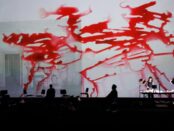
As you may have read, a lot of critics are saying that “attention must be paid” to the sixth Broadway revival of "Death of a Salesman," Arthur Miller’s 1949 “tragedy of the common man,” innovatively directed by Joe Mantello at the Winter Garden. Indeed, it is an attention‑getting, nearly three-hour mounting, led by sterling performances from Nathan Lane and Laurie Metcalf as Willy and Linda Loman, and Christopher Abbott and Ben Ahlers as their sons, Biff and Happy. My companion was so moved when it ended she could barely speak. I was impressed but with tearless results. [more]
Flo
The show’s titular character, Flo Weinberg, is a wheelchair-bound Upper West Side resident who decides to make a deal with Satan – in exchange for her soul, she can have fame, wealth, and happiness. The final part, happiness, proves to be a difficult sticking point, and the two bicker over what happiness exactly means and how one achieves it. Toby Armour’s ("Freedom Summer," "Meltdown") script is wickedly clever, full of recurring jokes and fascinating religious themes. There’s an undercurrent of gnosticism to the play’s narrative, one that works impressively well with the show’s tone. "Flo" is a comedy at heart, but one that engages seriously with larger ideas even as it commits to being quite wacky. [more]
Titus Andronicus
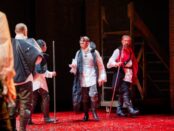
While 'Titus Andronicus" is not for the squeamish, it has definite importance in Shakespeare’s canon showing us where he started, how he was influenced by his contemporaries, and how he developed later. Jesse Berger’s exciting and swiftly moving production is riveting at all times, not only keeping the energy up but keeping the play surprising as it develops. As we suspected from Patrick Page’s one-man Shakespeare play, he is an asset to any Elizabethan production and leads a compelling cast. This may not be your cup of tea but you will not be bored for a second, even though you may be startled or shocked. [more]
The Pushover
Di Zou as Pearl and Rebecca De Mornay as Evelyn in a scene from John Patrick Shanley’s “The [more]
Nicole Travolta Is Doing Alright
Nicole Travolta, a member of the famous Hollywood family, has turned her life into a one-woman show that is introducing her to the New York stage. "Nicole Travolta is Doing Alright" is an entertaining and humorous tale of a girl who grew up in Los Angeles and then found herself as a teenager in Florida when her parents moved there. Co-written with Paula Christensen, it is also a cautionary tale about how not to grow up when on your own. Travolta is an animated, vivacious performer in telling her life story up until now. She recounts her adventures with credit card debt, divorce by age 30 and becoming a spray tan artiste which eventually straightened out her finances. Now at age 40, she has finally learned the error of her ways. [more]
Scorched Earth
In Luke Murphy’s astonishing "Scorched Earth," a vitality is rendered with a ferocity that feels at once ancient and bracingly new. Murphy, working under the banner of his multidisciplinary company Attic Projects, has fashioned a work that does not so much adapt John B. Keane’s play "The Field" (which went on to great acclaim in the landmark film starring Richard Harris) as detonate it—scattering its themes across a landscape of dance, film, sound, and theatrical invention, and then reassembling them into something hypnotic and wholly its own. [more]
Becky Shaw
Gionfriddo’s play, which runs nearly two and a half hours, is directed with finely calibrated control by Trip Cullman. It’s a tart, unsettling, and often wickedly funny examination of the emotional minefields that define modern intimacy. At its center is the seemingly innocuous act of a blind date, but as in so many comedies of manners, what begins as social ritual quickly metastasizes into something darker, probing the uneasy intersections of manipulation, vulnerability, and power. [more]
Public Charge
If you ever wondered what it is really like to work in the corridors of power, "Public Charge" based on the political career of Julissa Reynoso, an idealistic diplomat who was Deputy Assistant Secretary of State for the Western Hemisphere under Secretary of State Hilary Clinton and Ambassador to Uruguay during President Obama’s second term, will give you an excellent idea. Written with playwright Michael J. Chepiga, the world premiere production of "Public Charge" now at The Public Theater is a fascinating account of attempting to make change in a bureaucracy whose very policies keep anything from happening. Told by someone who lived it, it is all true as far as we know. Under Doug Hughes’ robust and forceful direction, the play is never didactic or too dense, making us feel we are living the events as Julissa encountered them. [more]
Desi SNL
For all its incremental gestures toward inclusivity, "Saturday Night Live"—now improbably in its 51st season—has remained curiously bereft of a regular South Asian cast member, a lacuna that feels less like oversight than inertia. Desi SNL, an ensemble-driven sketch revue, cheekily appropriating the familiar architecture of "Saturday Night Live"—the opening monologue, the mock-news desk, the parade of quick-change characters—and refitting it with a distinctly South Asian sensibility, performed by an entirely South Asian ensemble, arrives not so much to fill that absence as to gleefully upend it, at once affectionate and insurgent. What emerges is not mere pastiche but a lively act of cultural translation: a show that gleefully inhabits the grammar of American late-night comedy while infusing it with the textures, tensions, and tonalities of diaspora life. [more]
Uncle Vanya, scenes from country life
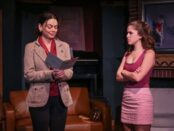
The narrative architecture of "Vanya"—its languors, its longings—is assumed, even beside the point. In its essence, this distilled adaptation unfolds less as a conventional staging than as a kind of theatrical mixtape, an assemblage both deliberate and mischievous, in which the familiar architecture of this oft-performed play is artfully dismantled and recomposed. Scenes arrive out of their expected sequence, as though guided by emotional rather than narrative logic, while character motivations are subjected to a searching reconsideration—some gently refracted, others boldly reconfigured—yielding a work that feels at once recognizably rooted and thrillingly unmoored. What Dmitry Krymov has fashioned instead is a kind of theatrical palimpsest, a dream-logic fantasia in which the gravitational center is unmistakably Yelena, that luminous and unwitting axis of desire (much to the dismay of Vanya). One might, without doing violence to the enterprise, retitle Krymov’s audacious, dreamlike reimagining of Chekhov’s inexhaustible classic evening: "All Roads Lead to Yelena." [more]
The Last Audition
There is, in "The Last Audition," something almost defiantly modest—a chamber piece of sorrow that refuses the grandiloquence of tragedy even as it circles one. The play, a solo vehicle of hushed ambitions, written by and starring Paul Shearman, sensitively directed by David St John, unfolds like a fading echo in an empty theater, its emotional register pitched not to catharsis but to the quieter, more unsettling key of recognition. It is, at heart, a drama about diminishment—of memory, of stature, of self—and yet it proceeds with a delicacy that feels, in its way, like a form of grace. [more]
Jesa
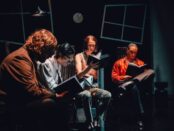
The dominant form of American theater since Edward Albee’s "Who’s Afraid of Virigina Woolf?" has been the dysfunctional family drama of which there have been countless such plays. The newest one, Jeena Yi’s debut play "Jesa" presented by Ma Yi Theater Company in residence at The Public Theater, adds a new wrinkle. This time the family is Korean American and the cast is all women, four sisters to be exact who meet to perform their parents’ jesa. Jesa is a Korean ceremony honoring the dead on the anniversary of their passing that includes food, ritual and requesting their blessings. It is this ceremony that brings together the four estranged for the first time in a long time, the first time they are honoring their mother who died a year ago. [more]
The Unknown
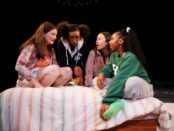
Hayes proves wholly persuasive, gliding among a gallery of supporting figures (Hayes delineates 11 distinct characters with astonishing lucidity, his transitions so fluid they seem almost instinctive, even as the narrative around them grows increasingly clouded and labyrinthine.) with a lightness that never calls attention to its own virtuosity. As Elliott, he is coolly, almost disquietingly composed, revealing only the briefest fissures beneath a meticulously maintained façade—a man who seems able to exist only in the telling of stories, never quite as himself. [more]
Antigone (This Play I Read in High School)
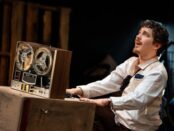
The world premiere of Anna Ziegler’s new play, "Antigone (This Play I Read in High School)" now at The Public Theater, is one of four ambitious attempts to update Sophocles’ tragedy playing in New York this spring. However, Ziegler overburdens her version with three separate stories which vie for our attention: a contemporary woman who read the play in high school and has admired its heroine ever since, Sophocles’ version of the Greek myth, and the one that takes up the most time in this play, a modern Antigone who has a different beef with the state. What Ziegler is really after is a Post-Roe v. Wade story about a woman who goes against the new abortion laws of her country. Unfortunately, Sophocles’ original plot as a sequel to "Oedipus Rex" and "Oedipus at Colonus" doesn’t really work with this contemporary social context. Tyne Rafaeli’s direction suggests that at any moment one of the scenes will catch fire but, unfortunately, they never do. [more]

Antigone in Analysis
Yet the production proves curiously reluctant to pursue the implications of its own provocations. The philosophers, rather than evolving into distinct and dynamically opposed sensibilities, settle into the dramatic equivalent of bullet points. Kierkegaard cleaves to divine absolutism; Hegel dismisses women with a glib reductionism; Lacan invokes madness as a universal solvent; Irigaray insists upon feminine multiplicity; Butler reiterates the performativity of gender. These positions are announced, then reiterated, but seldom interrogated or transformed. What might have been a dialectic becomes a recitation. [more]
Giant
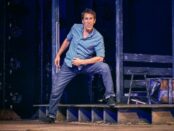
It doesn’t matter that this debate never took place because, aside from an overly contrived moment regarding Jessie’s copy of Dahl's review, it’s plausible enough to believe in, and it makes for a memorably dramatic, politically hot stage confrontation. In the second act, things cool down dramatically as Dahl, perhaps showing self-doubt, begins to question even the serving girl and the old retainer on what to do; perhaps we’re meant to feel a sliver of sympathy for him. [more]
Ivanov
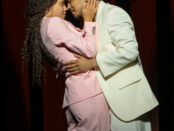
New American Ensemble may be young, but this production announces a company of rare precision and ambition. Every element—the mulch underfoot, the bar at your shoulder, the dead tree overhead—feels deliberate, considered, necessary. In a theatrical landscape often defined by haste, such care is not merely admirable. This true theatre company in every sense of the word is most welcome and we look forward to productions in their future. [more]
Touch
In "Touch," a work of disarming modesty and unnerving emotional precision, a life that has been carefully tamped down begins, almost imperceptibly, to leak. The play, written by Kenny Finkle, sensitively directed by Jonathan Silverstein, and performed with aching lucidity by Anthony Rapp, takes as its subject a man whose disappointments have calcified into habit, and whose sense of self—once animated by artistic ambition—has settled into something quieter, if no less fraught. There is, at first glance, something almost perversely austere about Touch: Rapp, seated for 90 uninterrupted minutes, inhabiting the brittle interiority of a middle-aged gay man whose emotional register oscillates between panic, irritation, and quiet devastation. And yet the experience proves not merely engaging, but quietly transfixing. Its modesty is its method, its intimacy, its force. [more]
Every Brilliant Thing
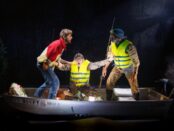
In persistently hopeful defiance of its heavy subject matter, the show strives for lightness. That's largely achieved thanks to Radcliffe's affability, which also swiftly inoculates the audience against his celebrity and lessens the chance for the type of slack-jawed fawning that might grind the proceedings to a halt. But Radcliffe isn't permitted to completely shed his fame, because, in lieu of a fully fledged character, "Every Brilliant Thing" desperately needs it as the engaging force to both form and conduct the "choir." That means, to some unknowable extent, Radcliffe must remain Radcliffe. [more]
Burnout Paradise
"Burnout Paradise" is the most unique show in New York right now and enormous fun. A sort of athletic performance piece, it is also an interactive circus competition. Four members from the Australian theater collective Pony Cam perform on treadmills in four sets of 12-minute sessions each while performing set tasks and have to beat their own previous record while completing all the tasks. Genial hostess Ava Campbell explains the rules, keeps time, sells merchandise and serves Gatorade to lucky theatergoers. If the performers do not beat their previous record, audience members can request their money back. However, the show is so much fun that you will have had your money’s worth by the end no matter what the final score. In any case, the performers do collectively run about 17 miles before the evening is over. [more]
Entangled: 12 Scenes in a Circle K off the I-40 in New Mexico
In "Entangled:12 Scenes in a Circle K off the I-40 in New Mexico," the beguiling and philosophically mischievous collaboration between Mona Mansour and Emily Zemba, the American desert becomes less a landscape than a condition of thought—a place where the ordinary laws governing time, consequence, and human attachment appear to have loosened their grip. Set in the fluorescent limbo of a Circle K somewhere in the New Mexico expanse—30 miles from the nearest outpost of civilization, and perilously close to both an atomic testing site and a nuclear laboratory—the play hums with a low-grade metaphysical dread that it wears, with admirable restraint, as comedy. [more]
Trash
James Caverly and Andew Morrill’s Trash is a provocative play about two late 20s deaf roommates who have nothing in common except sharing an apartment. However, what is most intriguing about Trash is that it told in multiple ways. As the main characters are both deaf, they use American Sign Language to communicate. As a concession to hearing audiences, some of the dialogue is projected on three walls facing the audience. Still more unusual, there is a jukebox on stage (played by Chris Ogren) which, when fed with dollar bills, translates the ASL into spoken speech. When the lead characters really want us to know what is being said they use this method. However, this is only used partially. Much of the play is told only in ASL but Caverly and Morrill are so adept (and so dramatic) at it that we often feel like we know exactly what they are saying. They also use white boards which they hold up for all to see for simple statements or questions to the audience which sometimes require answers.
[more]
Spare Parts
What begins as a satirical clash between corporate swagger and academic idealism gradually deepens into a more unsettling inquiry. The play’s true subject, it turns out, is not merely the arrogance of billionaires but the universal temptation to trespass upon the limits of the body. Humanity, after all, has always been drawn toward transgression—whether through cosmetic surgery, pharmaceutical enhancement, or the relentless drive to improve the species one experiment at a time. [more]
Zack
While not the classic that "Hobson’s Choice" has become, Harold Brighouse’s follow-up play "Zack" proves to be a charming Edwardian comedy drama in the Mint Theater Company’s production which may be the first full New York production since 1916. Ironically, Zack has a great many things in common with "Hobson’s Choice" probably best known from the awarding-winning 1954 Sir David Lean film with Charles Laughton, John Mills, Brenda da Banzie and Prunella Scales. Britt Berke’s production glosses over the play’s deficiencies by keeping this middle-class comedy of manners going at quite a clip. While "Zack" shares many elements with "Hobson’s Choice," the two plays are very different, variations on a theme: a strong woman who saves the hero from his weaknesses, siblings who are against seeing the strength of an unambitious person, a parent who is both dominating and dogmatic, and a happy ending for the leading characters. However, both are based on the theme of the “worm turning.” [more]
Dear John
Elliott’s staging is often quite clever, making use of the space in interesting ways. The use of actual letters Lin received adds a degree of authenticity to an already very personal piece, but having audience members come on stage to pick up the letters themselves is a strong choice of direction. It keeps the letters feeling fresh every time – and also provides an opportunity for Lin to change costumes. The projections onscreen (handled by designer Ein Kim) and roving spotlights (lighting designer Yang Yu) evokes images of a game show, making each letter-picking section feel like a miniature intermission – something that breaks up the play quite nicely. [more]
Our House
Billed as a “comedy in two acts” on its title page, it is not funny nor does it deal with comic material, though the direction tries to emphasize its bitchier moments. Its plot involves homophobia, gay bashing and racism which goes a long way to explain why The Other Side of Silence (TOSOS), the oldest and longest producing LGBTQ+ theater company, would be interested in staging it. However, half of the actors emote shamefully and the other three give too restrained performances to make much impression, both of which damage the credibility of the play. [more]
Body Count
If the show’s point of view occasionally feels one-sided, that imbalance ultimately serves its chief purpose: entertainment. 'Body Count' may not function as a comprehensive treatise on contemporary sexual politics, but it is undeniably electric as a performance vehicle. Knowles’ Pollie is charismatic to the point of hypnosis—funny, sharp, wounded, and persuasive enough to feel utterly real. Her barbs may sometimes be a shade too neat, a shade too gleefully cruel, but they land with a sting that lingers. Long after the laughter subsides, one finds oneself turning the lines over again, wondering what uncomfortable truths might be hidden inside the joke. [more]
Chinese Republicans
Unlike "Glengarry Glen Ross" which also begins at luncheon meetings in a Chinese restaurant but then took us to the office in its second act, "Chinese Republicans" is mostly set at the monthly luncheons with one flashback to Ellen’s first interview with Phyllis years before and a dream sequence. Each scene reveals new pieces of information but the play seems too schematic finding no other way to reveal what we need to know. The title needs to be taken on faith as very little is made of their all being Republicans (probably to fit in at the office.) Nevertheless, the language of the play is raw, the insults cutting and the humor biting. The play covers many women’s issues found in other fields: sexual harassment, corporate culture, prejudice and racism against Asians, generation gap, social justice, and the treatment of women in the business world. "Chinese Republicans" is a tight expose of how women particularly Asian American women are treated in the work place in the 21st century. [more]
The Mall The Mall The Mall
"The Mall The Mall The Mall" is a magical realist comedy about three teenagers traversing a suburban mall in search of stolen fandom merchandise. Along the way, they encounter a coterie of increasingly strange antagonists and have some surprisingly sincere moments of self-discovery. The script, from writer Philip Kenner ("BOYSTUFF," "Stand & Repent"), is quite sharp. The directing from James Wyrwicz ("Is This a Theater Of Love?," "I Love You Jesus Christ!") is wickedly funny, with blocking that brings out the humor of the script while letting the emotional beats still land as they should. Kurt Cruz’ sound design adds quite a lot of comedy as well. [more]
The Reservoir
Alcoholism and Alzheimer’s wouldn’t seem to have much in common. However, Jake Brasch cleverly links the two in his comedy drama "The Reservoir," the story of a recovering drunk on leave from college who goes home to discover his grandparents are sinking into old age, which he never noticed before. Rising star Noah Galvin who replaced Ben Platt in "Dear Evan Hansen" and then co-wrote and starred in the film "Theater Camp" has the role of a lifetime as Josh who never leaves the stage throughout the play and who experiences the year after he dropped out of NYU. Surrounded by some of the most well-known and experienced theater pros around (Heidi Armbruster, Peter Maloney, Mary Beth Peil, Matthew Saldívar and Chip Zien) he holds the stage even as his character relapses and regresses at the worse possible moment. [more]
Marcel on the Train
Slater’s performance is a revelation of synthesis. Known for his buoyant athleticism in Broadway’s "SpongeBob SquarePants" and his chilling portrayal of the Balladeer and Lee Harvey Oswald in Classic Stage’s brilliant "Assassins," he here channels that dexterity into something at once lighter yet more harrowing. His Marceau moves with balletic precision: fingers unfurl like petals; wrists trace invisible architecture; the torso leans into unseen walls. Butterflies tremble from his cupped hands, a flower blossoms and droops along the line of his arm. Guided by movement consultant Lorenzo Pisoni, Slater achieves an embodiment so exacting it appears to suspend the laws of bone and gravity. [more]
Hold on to Your Butts
Actors Kerry Ipema and Natalie Rich, joined by the live Foley artist Kelly Robinson, proceed to conjure Spielberg’s dinosaur epic. They marshal an arsenal of materials so defiantly homespun it borders on subversive: cardboard cutouts standing in for apex predators, skeletal wooden frames sketching out jeeps and laboratories, pocket flashlights pressed into service as cinematic chiaroscuro, and a scattering of objects manipulated with priestly concentration, shot for shot—all deployed with an almost ascetic economy of means that make the absence of machinery feel not like deprivation but like principle. [more]
Mother Russia
In Lauren Yee’s exuberant and stealthily devastating new comedy, "Mother Russia," history arrives not with a bang but with an order of fast food. Two young men, perched at the lip of a new world order, cradle their first-ever Filet-O-Fish sandwich from McDonald's as though it were a sacred relic. They tear into it with the devotional hunger of converts, pausing only to roll their eyes heavenward and lick tartar sauce from their fingers with an abandon that feels both comic and liturgical. Capitalism, Yee suggests, is best introduced as a condiment. [more]
The Waterfall
Not only does Phanésia Pharel’s "The Waterfall" have a great deal to say, it is also very revealing of immigrant views on the American Dream. A tour de force for two actresses, Taylor Reynolds’ production takes hold of you and never lets up for a moment. This captivating play says much about mother-daughter relationships as well as Haitian-American values. See it for Patrice Johnson Chevannes and Natalie Paul’s thrilling performances which fill the stage. [more]
The Monsters
Written and directed by Ngozi Anyanwu, author of "The Last of the Love Letters" (Atlantic Theater Company) and "Good Grief" (Vineyard Theatre), 'The Monsters" is a tour de force for two actors who have the chops for this very physical outing both emotionally and literally and luckily Aigner Mizzelle and Okieriete Onaodowan have what it takes. Aided by the choreography of Rickey Tripp, the fight direction of Gerry Rodriguez, and the work of MMA consultant Sijara Eubanks, the realistic fights mainly pantomimed with only one participant (except for Lil’s training sessions which include Big) make us believe we are seeing two people fighting. [more]
Hate Radio
The premise—a radio broadcast—might seem theatrically inert, yet Rau ingeniously implicates the audience by issuing each spectator a set of headphones. We are not merely watching propaganda; we are tuning in. If we need to gauge our own humanity while we watch the hideous display, all we need to do is look straight ahead - on the other side of where the actors play sits the other half of the St. Ann’s Warehouse audience. The isolation produced by the earphones intensifies the intimacy of the rhetoric. One hears the laughter, the rhythm, the coded exhortations as if they were meant for one’s own ear. The imaginative leap—who would listen to this? who would believe it?—collapses. The seduction of format, the familiarity of tone, do much of the ideological work. [more]
The Dinosaurs
Like Beth Wohl’s Liberation, Jacob Perkins’ "The Dinosaurs" follows a group of women who meet weekly to discuss a problem that interests them, in this case alcoholic addiction. Covering many years, the play gives six women with different stories a chance to talk candidly about their lives and travails. Beautifully written, the play, however, feels thin and repetitious and doesn’t seem to get anywhere. Directed by Les Waters, the six actresses led by Off Broadway stalwarts Kathleen Chalfant and Elizabeth Marvel create very different portraits, though at a brief 70 minutes we don’t learn that much about each one. [more]
The Tragedy of Coriolanus (Theatre for a New Audience)
Tata’s staging is also problematic making almost every scene look like every other. The mob scenes have been reduced to five actors (other than the lead characters) which does not suggest any threat whatever. Afsoon Pajoufar’s unit set is an attempt to create a Roman building and then put scaffolding around it to suggest modern renovations. However, using it for almost every scene which is just under three hours becomes monotonous and uninspired. The acting doesn’t help much with each actor seemingly having chosen one single character trait so that all are one-note in this blank-verse drama. Only Roslyn Ruff as Volumnia, the title character’s mother, shows any variety or range. (Volumnia has always been the best role in the play.) [more]
The Other Place
Going along with leaving much unsaid, Zeldin in his direction has kept things rather slow and leisurely so that the play’s 80 minutes seems much longer. Also much of the backstory is missing: what does Chris do for a living as we are told he is very rich? As his friend Terry is described as his contractor, does that make him a builder or has Terry only been hired to do the renovation on the house? The house incidentally has been made unrecognizable with walls removed to let in the light - though the view outside is still in darkness until the trees are torn down, including the tree from which Adam hanged himself. How has Annie been living since leaving the hospital? She has refused to take Chris’ money so that is not an explanation. And is his offer of money an expiation for some unnamed guilt? [more]
Ai Yah Goy Vey! – Adventures of a Dim Sun in Search of His Wanton Father
Chang is an agile performer, and his quick shifts among characters recall the early solo work of urban shapeshifters who built entire neighborhoods out of voice and posture. Yet here the gallery of types is unevenly realized. Too often, figures arrive as the sketch of a stereotype rather than the surprise of a person. When Chang draws on the stylization of Chinese opera—particularly in the rendering of Jackie’s diva-like mother—the show briefly discovers a richer theatrical language, one in which Eastern and Western performance traditions spar and flirt on equal terms. Such moments hint at a more adventurous piece than the one that predominates. [more]
The First Line of Dante’s Inferno
The opening gesture of Dante Alighieri’s "Inferno"—that immortal confession of midlife disorientation in which a wanderer finds himself astray from the “straight road” and deposited in a “dark wood”—has rarely felt as theatrically apt as it does in "The First Line of Dante’s Inferno," Kirk Lynn’s sly, searching, and disarmingly funny new experiment in staged storytelling. Lynn, a polymath of the American theater—playwright, novelist, screenwriter, educator, and guiding spirit of the Austin collective Rude Mechs—treats Dante’s premise less as a theological map than as a psychological condition. His forest is not an allegorical afterlife but a contemporary wilderness in which several souls, one quite literally at midlife, appear to have misplaced the coordinates of their former selves. [more]
Hans Litten: The Jew Who Cross-Examined Hitler
Despite the admirable commitment to historical accuracy, Lackey’s script is littered with flimsy side characters, muddled messages, and awkward dialogue. The result is a thematically incoherent mess that feels unaware of its own central tragedy. Hans says in Act 1 that he wants to force Hitler onto the witness stand in order to stop the Nazis from coming to power. The play seems unwilling to address that this did not work – that no amount of clever rhetoric would have been enough to stop the tide of Fascism. It would be wildly unfair to blame Hans Litten for failing to stop the Nazis, but it is a grievous omission for a play about him to explicitly frame the story that way and then refuse to grapple with the implications of him failing to do so, both for him as a character and for the ideas he is meant to represent and martyr himself for. Indeed, the play revels in the grace of Hans’ martyrdom. [more]
An Ideal Husband
After a several year hiatus, The Storm Theatre, one of the last classical theater companies left in New York, is back with an elegant and polished production of Oscar Wilde’s rarely seen comedy-drama "An Ideal Husband" staged by artistic director Peter Dobbins. While Wilde’s "The Importance of Being Earnest" is well known to theatergoers, "An Ideal Husband," last since on Broadway in 1985, is not but ought to be better known. This play of political corruption and moral turpitude seems more relevant than ever with the number of government scandals in our news daily. As witty as Wilde’s most famous play, An Ideal Husband also has an involving plot and colorful characters. [more]
Anonymous
Spit & Vigor Theatre Company has an interesting approach to stagecraft at least with its return engagement of Nick Thomas’ Anonymous, now at their new home at the Tiny Baby Black Box Theatre. The play which takes place at a weekly meeting of an addiction support group has the audience sit in a circle and then embeds the actors in the circle without acknowledging the rest of us. This gives the play an immediacy it might not have had otherwise. The audience feels like they are part of the monthly group even though we are not seen by the actors. On the other hand, Sara Fellini’s direction is so broad that the actors all seem like they are overacting considering that the audience is only feet away. The play would be much more convincing if they all took it down a few notches. Some of the actors seem to be hamming it up – unless it is simply that we are sitting next to them or across from them that their performances seem to be too big for the tiny venue. [more]
Blackout Songs
Joe White’s "Blackout Songs" direct from London with its original cast is a tour de force for two actors. It is also a challenge for the audience both because its single topic is addiction and as intentionally written by the author we never know what is real and what is imagined. Rising film stars American actor Owen Teague ("Unspeakable: The Murder of JonBenet Ramsey," Stephen King’s "The Stand') and Australian actress Abbey Lee ("Mad Max: Fury Road," "Black Rabbit") both making their New York stage debuts give bravura performances, though Lee’s English accent is often difficult to understand as is the British slang that they often toss off. However, director Rory McGregor’s use of a single set to present a turbulent relationship over ten years and many locales is quite remarkable. [more]