However, as the title implies it is also a very verbose, long-winded affair giving an excellent cast made up of such veterans as Matthew Broderick, John Epperson (a.ka.a Lypsinka), Jill Eikenberry, Larry Pine, Claudia Shear and Michael Tucker not much to do. Shawn has written the best role for himself but that is not saying much. While the play may be meant as a cautionary tale, it is also over-written and self-indulgent. Long before you realize where the play is going you may have lost interest due to all the explanations. [more]
In "Kunstler," playwright Jeffrey Sweet recounts the defense attorney’s life and career in his well-written, comprehensively researched, and affectionate treatment. The conceit is that Kunstler is to address an audience of law school students at a university. Kerry is a young woman who is the vice-chair of the program committee attends him to him and becomes his foil, and is the play’s secondary character. This construction allows for a free wheeling manner of imparting the chronological details. It’s a solid take that could have certainly been at least a routine biographical exploration, but is undone here by the odd casting. [more]
Birney seems to have cornered the market on sensitive, ordinary guys and his performance is similar to his awarding-winning “Erik” in The Humans. However, here he is extremely sympathetic and heartbreaking while in the earlier play he was revealed to be complicit in criminal behavior. Birney’s work is so subtle and low-key that he suggests worlds of unspoken feelings, which is quite a remarkable feat. O’Toole, who recently appeared on the New York stage in "Hamlet in Bed" in 2015 and "Southern Comfort" in 2016, just keeps getting better and better, and her emotional collapse as Nancy is extremely well delineated. As their daughter Ashley, Boras beautifully captures the whiney demands of the adult child with a black and white view of the world who has never seen her parents as separate people with needs of their own. [more]
Each character is conveniently a different, representative type of oppressed nationality. Though Tirado goes overboard in detailing these culturally diverse, downtrodden characters’ backstories with sociological overtones, and despite numerous tangents, there are very compelling portions, and the roles are rich opportunities for the talented cast. [more]
Presented by the acclaimed Broken Box Mime Theater, "See Reverse" consists of ten short pieces with some even shorter vignettes sometimes in between. Lasting close to two hours with an intermission, it’s a lot of mime. [more]
The evening is narrated by Saki (played by an appealing and suave David Paisley) talking to us from the trenches of France, in 1916. His five soldiers (played by Phoebe Frances Brown, Ellen Francis, Tom Lambert, Tom Machell and Caitlin Thorburn) all like stories and he obliges. As he tells his eight tales, the cast enact them, using slight costuming added to their uniforms and occasionally use puppets to represent animals and children. [more]
Although "Ring Twice" is filled to the brim with socio-political symbolism, it’s not likely that the author was trying for any direct reference to the current maddening political scene since gestation periods for plays are notoriously long. Clearly this play was written well before the 2016 election, so any vague commentary appears to be inadvertent. This is not to say that the metaphors and symbols Hruska uses aren’t intriguing in their own way. [more]
The playwrights have a keen understanding of this place and time, helped by the simple, but telling scenery of Stephen C. Jones, who also lit the small performing space to give the illusion of multiple settings. Molly R. Seidel’s costumes also hit the nail on the head as far as period and character are concerned. The glamorous dress Mária creates for Irma is in direct contrast to her own dreary housedresses, and Robert’s fancy western style suit makes Robi even more eager to leave Romania. [more]
With slicked back hair, a melodiously rough voice and a smooth physical presence, Timothy Simonson offers an accurate impression of Powell that captures his swagger. Mr. Simonson’s appealing performance forcefully recounts Powell’s rise and fall with histrionic relish. Simonson is particularly stirring when describing the hardscrabble life of Powell’s father from poverty in Virginia to prominence and wealth as a minister in New York City. [more]
Illusionist/actor Geoff Sobelle’s show is a combination of happening, art installation, and a meditation on the role objects have in our lives. Using audience participation, objects both hidden and seen, and magical illusion, Sobelle forces us to examine out relationship to the objects in our lives as well as how they ultimately define us when seen altogether as the detritus of a life. Performed in 11 segments with no intermission, "The Object Lesson" is not for everyone, but for those willing to go with the flow and give themselves up to Sobelle’s droll reflection, self-examination and visual theatrics, the evening is fascinating and rewarding. [more]
While the play is at times Pinteresque, it is talky in a way Pinter never is, explaining everything over and over, covering the same ground again and again. Nothing much happens other than that the men become more confiding and reveal more of their personal pasts. The play implies that Jonah is menacing, but under Hughes’ direction, he never seems much of a threat. The pace is slow and methodical, too slow for its own good. Sean Gormley’s Otto and Rupert Simonian’s Jonah are well-rounded characters but the acting style is too refined, too genteel to make much impression. [more]
Rounding out the cast are Alexis Bronkovic as Ruth--Penny’s best friend--and Bill Tatum, who plays Ray’s boss. Once again, the driving motivation behind nearly every character is nowhere to be found. It seems that simply for the sake of creating a play about fake news, Brukenfeld opted to fill his script with lifeless characters that don’t question anything and are content to believe that Ray is dead. The performances across the board are unsympathetic and played mind-bogglingly straightforward. For what it’s worth, the actors do all that they can with the material at hand, turning in acceptable performances given the circumstances. [more]
This volatile quartet battle over the personal and the political during a Scotch-fueled weekend at Ira’s Fire Island house. There’s not much in the way of plot, but secrets are revealed, scores are settled and life goes on with new insights. It’s reminiscent of a Terrence McNally play but lacking in polish. [more]
The only real high-tech exchanges take place only three times during the run of the show. At the performances of February 6, 9 and 17, one of the roles in "Camera Obscura" will be performed telematically from Seoul Institute for the Arts in Korea and directed by Il Kyu Park. "Hi-Fi | Wi-Fi | Sci-Fi" which uses a great many sound specialists for little effect is an interesting idea but doesn’t go far enough either dramatically or in terms of modern technology to have much impact. As a cautionary tale, time has caught up with these plays and passed them by. [more]
Playwright James Lecesne has been acclaimed for his solo performance works, most recently "The Absolute Brightness of Leonard Pelkey." Here, he has written a traditional play employing theatrical devices that’s a mélange of David Sedaris, Charles Busch and Modern Family. There are one-liners galore, wacky situations and a decidedly campy sensibility. It’s a bunch of superficial antics that never really meaningfully connect. [more]
However, it is Ives’ joy in language that is the most infectious. The rhymed couplets keep coming and surprising us over and over again (bitter/twitter; prize/rhapsodize, jocular/interlocutor, kiss/dentrifice, carbuncle/uncle). He has also created remarkably agile, felicitous and contemporary turns of phrase: meet-and-greet/ bittersweet; Chanel perfume/key to my room; perfect ten/tragic flaw again; chance to laugh/some dumb gaffe; believe this boy/pure trompe l’oeil. Considering the nature of lying, the anachronisms like contact lens, superglue, outed me, Kid Dorante, party clown, pants on fire, etc., seem like natural hyperbole for these poseurs who take themselves all too seriously. So too Kahn’s clever direction is highly in tune with this style: Dorante and Alcippe’s duel is fought without swords in pantomime and Cliton appears with a modern paper coffee cup. [more]
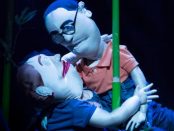
The ensuing journey is a bizarre and sometimes hilarious exploration of China and the culture within, even if it doesn’t always make the most sense. "Made in China" makes the most of the liberties that puppetry allows, and features some very impressive techniques and performances from the actors behind the scenes. Though the two main characters are both interesting, they are both made all the more entertaining by their canine companions. The two dogs, Lily and Yo-Yo (Dorothy James and Andy Manjuck among others) are completely lovable, and every single scene they are a part of is instantly heartwarming. [more]
Periodically the cast calls for a “Family Meeting.” The theme from Jeopardy is played on a kazoo and three audience members are picked to come up. The one who is wearing the funniest nametag that relates to dialogue from the play is the winner, receiving a free vodka shot. Drinking games also take place. All of these festive tangents never sidetrack the plot of the play. Ms. Hudson is also the director, and her giddy, all-over-the-place staging in this large living room, enhances the exuberance of the piece. Improbably and cleverly, Chekov’s tone and intentions survive the mayhem. [more]
There are many questions that the author fails to answer. Although the boys have not attended school in years and Bobbie has been diagnosed as ADHD and should be in the British equivalent of special education, no social worker seems to have visited to check up. Who is paying the rent or the electricity? Is the mother on welfare and are these items paid automatically? There is no explanation of how the boys are eating and how Taliban stays alive if they have not been feeding it for days or even weeks. While the neighbors are aware of Bobbie’s stealing, he seems to be getting away with it. The dog’s continual barking from his locked room can be heard on the street but no complaints have been filed. Is all this a metaphor or a slice of life drama? [more]
Behind the theme of war," Incident at Hidden Temple" is a thriller of sorts. Sisters Ava (Ying Ying Li) and Lucy (Briana Sakamoto), first seen in China travelling on a train littered with American soldiers, are separated when a disturbing road block forces their train to a halt. With some time to kill, the sisters exit the train and are introduced to a mysterious stranger--Dinh James Doan as a blind man with a penchant for speaking in riddles--who tells them about a Hidden Temple located just a short ways away. The temple, the blind man cryptically tells them, is filled with lost treasures but will only be revealed to those of pure heart. [more]
What truly distinguishes the show is Dixon’s fearless psychological focus on Rose and himself. The predominant theme is of hero worship and its bruising disappointments. It also attempts to explore the issue of the often-dark contrast between the on-stage and off-stage lives of great entertainers. In examining their involvement, Dixon doesn’t spare Rose or himself from honest scrutiny. [more]
One problem is that the play (unlike Noel Coward’s "Design for Living" or Somerset Maugham’s "The Constant Wife" which cover similar territory) is neither witty not clever, and none of the lines are particularly sparkling or original. While the play may delineate liberated sexual behavior, its drawing room comedy format is too conventional and refined. All five performers always seem to be acting as their style is too arch to be truly believable. [more]
Mr. Refael’s simple but well-crafted scenario takes place in a contemporary apartment in Israel, and has the elderly Salvado looking back at his past. This is theatrically achieved by having him directly addressing the audience. His best friend and fellow survivor is to be honored at the Holocaust memorial center Yad Vashem during a ceremony where he will light a torch. When he becomes incapacitated, that task falls to Salvado. This situation instigates a flood of painful reminiscences that explore his guilt at having survived. [more]
Essentially it’s a glorified and arch 90-minute, scripted, sketch comedy show. The conceit is that it’s inspired by audience suggestions. The composition of the program changes from performance to performance. Throughout the show, slides are projected of printed extracts from online surveys of people’s theatrical preferences with the dates that they responded. These have been collected over a period of many months. The cast then performs a scene based on these answers. [more]
On the one hand, it is a punch in the gut dramatizing the cold hard facts of disintegrating with this disease; on the other, the non-linear time scheme is difficult to follow, offering more questions than it answers. What "Orange Julius" really is could be described more accurately as a screenplay or a teleplay with cuts and fades. There is a powerful work hiding in this material but it still remains unshaped. Under Dustin Wills’ fast-paced direction, Jess Barbagallo, Ruy Iskandar, Irene Sofia Lucio, Stephen Payne and Mary Testa give fine performances despite the fact that the play seems to wander around trying to find its center. [more]
What Evett delivers—using ample quotes from the poem and robust contributions from himself and Spangler—is a terrifying inside look of the Mariner’s experiences, beginning with being hijacked by a friend at a pub. He breathlessly illuminates what the day-to-day life was like with lurid descriptions of illnesses and exciting second-by-second reports of battles with other ships. [more]
Reading David Foster Wallace’s Infinite Jest while lying on a couch is Jay, a slacker-looking type in his 30’s. Sitting in the living room nearby is his 60ish mother who enjoys watching Dr. Phil on television and complaining about her ailments. Gabe McKinley’s Homebody is an enthralling black comedy with shades of Grey Gardens. Mother and son bicker, rehash recriminations and share their joy over the possibility of Jay’s novel being published. In 35 minutes, Mr. McKinley delivers a very well written, plotted and satisfying one-act play. It’s so pleasurable that a full-length version would be most welcome. [more]
As Paul Harold, a 60ish artist, Pendleton has a leading role that wonderfully showcases his idiosyncratic and considerable talents. With his unruly white hair, limber physicality and distinctive vocal twang, he mines all of the humor and depth of this fascinating character. Sharing the memory of when he met Pablo Picasso in his youth is a vivid moment. [more]
O'Connell’s script is a well-structured series of confessional anecdotes interwoven with the lore of the movies. His performance is a riveting blend of stand-up comedy and grand stage acting with Shakespearean flourishes. The audience is on three sides of the very small theater. This intimate space at times feels too constrained for the unbridled emotionalism on display. [more]
In "DannyKrisDonnaVeronica," playwright Lawrence Dial bitingly delves into the lives of two Brooklyn couples each with two small children. Through his precise, often humorous and realistic dialogue, Mr. Dial has his very well-drawn characters who all in their mid 30’s eloquently express their conflicted feelings and despair. Short on actual plot, the play is rich in incident and is a wistful character study. [more]
The stories included are equal parts humorous, stirring or sobering but always meaningful and intimately personal. Deblinger is a natural storyteller, and every tale is polished and fully developed, and--more importantly--consistent with the show’s overall theme. Further, Deblinger is a fantastic impressionist, and the show contains no less than 15-20 fully realized character impersonations. The versatility he displays is a testament to both his natural abilities as well as his dedication to his craft. [more]
Set in The Afterlife, a crossroad between Heaven and Hell, the play presupposes a trial of Luther on the grounds of being guilty of “the unforgiveable sin.” The prosecuting attorney is The Devil and the defending attorney is Katie von Bora, also known as Mrs. Martin Luther, with Saint Peter acting as judge. The witnesses called are Hitler on Luther’s anti-Semitism in his later years, Dr. King on Luther’s stance on civil rights, Dr. Freud on Luther’s Oedipus complex, and the current Pope on the Catholic Church’s stance on Luther’s objections today. Along the way, the play also dramatized scenes from Luther’s life. Ultimately, it ends with a recreation of Luther’s trial before the Diet of Worms officiated over by the Holy Roman Emperor in 1521. [more]
Playwright Beth Hyland’s very effective conceit is that we’re watching the dress rehearsal of Annie Lambert’s memorial celebration in an auditorium of the State University of New York at Onondaga. There, students act out Ms. Lambert’s story in the manner of a Greek chorus often directly addressing the audience. “What would Annie have wanted?” [more]
While Harms has a fine ear for dialogue, the play moves by revelation and incident. Consequently, it plays like a sophisticated soap opera as every scene brings a new wrinkle not previously suggested. Drew Foster’s direction is smooth and polished but he can’t prevent the play’s plot from having too many incidents that aren’t foreshadowed. Steven Hauck, Elizabeth Rich and Amy Bodnar are charming in a worldly, cultivated way. However, we learn so little about each of them other than how events affect them that they seem one-dimensional. Important facts are left out: what is the rooming situation, are Julian and Agnes married, etc.? The sexual tension is clearly defined: dancing seems to be foreplay to sex. But one can’t live on love alone. [more]
Surprisingly, Eleanor Reissa’s production for New Yiddish Rep has made some debatable choices which damage the power of the play. First of all and most obviously, although not a word has been updated, the characters wear contemporary clothing and use modern objects like headphones, a plastic umbrella and platform shoes. Since there are references to opening a horse stable and the sexual mores of 1907 have changed considerably, this is both distracting and confusing. (The word “roubles” has been eliminated for the more innocuous bucks and coins.) [more]
Director and choreographer Jessica Burr has created a number of dazzling moments with her precise unison of expressive staging, movement and dance. With only a few vintage trunks and a door, all on wheels, Ms. Burr achieves many vivid stage pictures. Walking up a flight of imaginary stairs is a thrilling display of mime. Burr’s work with the ensemble, most of whom play several roles is excellent with their colorful characterizations as evidence. [more]
Two ways to invigorate Shakespeare in our time is to either cast actors not identified with classical roles or to reset the play in some unfamiliar setting. Sam Gold’s magnificent production of "Othello" at the New York Theatre Workshop has done both. [more]
Aaron Port (Josh Radnor), a down on his luck writer, is reduced to teaching Adult Ed classes in middle class/middle brow 1960’s Levittown, Long Island. Richard Greenberg ("Take Me Out," "Our Mother’s Brief Affair") in his new play, "The Babylon Line" at the Mitzi E. Newhouse, has Port frequently speak directly to the audience, doling out information and setting the scene, from the vantage point of 2015. Although it’s an awkward device it does come in handy, particularly at the end when a number of plot strands come together. Port’s frustration with his career is exacerbated by having a successful friend, Jay, confront him en route to his teaching assignment. [more]
Seven musicians of Egypt’s Alexandria Ceremonial Police Orchestra have been sent to Israel to open the new Arab cultural center at Petah Tivah. Due to a mix up at the border, they end up in the dead-end desert town of Bet Hatikva which has no hotel, no culture, and no bus until the morning. However, their visit is the most interesting thing to happen in Bet Hatikva in years as these unlikely visitors represent something different from the outside world. Restaurant owner Dina (Lenk) once a dancer in a big city, now resigned to her boring fate, takes pity on them, feeds them and arranges for them to stay the night in three places including her home. She takes dour, formal conductor Tewfiq (Shalhoub) and young ladies’ man, Haled (Ari’el Stachel). Although the visit is only one night, none of them will ever be the same again. [more]
Raucous highlights include a jive reinterpretation of A Christmas Carol, “by Chazzie D, about a cat called Scrooge...who lives in Scrooge Tower.” There’s also Buckley’s irreverent take on The Gettysburg Address, “I’m a Lincoln cat.” Intertwined are Broder’s cool renditions of “On The Sunny Side of The Street” and “Georgia On My Mind.” He also demonstrates excellent saxophone and tambourine playing. [more]
The audience sits on either side of the large runway stage that set designer Laura Jellinek has arrestingly fashioned into an indoor soccer field. It’s a green vista of Astro Turf that gives the sense “…that the field goes on forever,” writes playwright Sarah DeLappe in her stage directions. [more]
LeFranc’s dialogue is a marvelous blend of the realistic and mundane. The well-delineated main characters all express themselves with true to life simplicity. Plot developments are the combination of subtle details that gradually do build to a satisfying resolution. It all has the sense of John Cheever’s suburban short stories where the darkness behind bonhomie is revealed. Swimming pools are mentioned in passing. [more]
"The Big Uncut Flick is a 1953 live, mid-day movie program broadcast on the Dumont network. The audience is addressed as if they were the studio audience. The stereotypical hosts are a married couple. Jack Sheldon is a hyper announcer type and Arlene Lewis is a grand dame. During commercial breaks they extoll dog food, cigarettes, frozen dinners and laxatives. There’s a quiz show portion as well. References to Sen. Joseph R. McCarthy and the Red Scare are also tossed in. [more]
"This Day Forward" shows much tighter control than many of Nicky Silver’s early anarchic plays. However, aside from offering a few wonderful characters in Malka and the older Irene, the play is disappointing as it sets up expectations which don’t play out. When "This Day Forward" is over, it leaves a feeling of something missing that has failed to take place. It can’t simply be saying that the sins of the parents are visited on the children – or could it? [more]
There is no plot, just a series of verbal jousts played out on Riccardo Hernandez’ sleek, two-tier set with just the image of trees looming over the actors wearing Montana Blanco’s colorfully exaggerated costumes. From the childlike Prunes and Prisms of Ms. Sithole to the angrily twisted Bigger (a reference to Richard Wright) of Mr. Piniella, the actors recite the difficult lines, goaded to do their finest by director Lileana Blain-Cruz who totally understands the work. [more]
The real life Internet hacktivist and Reddit developer Aaron Swartz contrives to have his fictional childhood friend Billy, who is a theater teacher of prisoners, to collaborate on a play about Bradley Manning in order to galvanize public opinion in favor of his clemency. During the moving climax, they act out the roles of Manning confronting President Barack Obama. [more]
The framework is a fictional fiftieth anniversary party given in a New York art gallery by collaborating media/visual/performing artists Malik “Mk Ultra” (Christopher Livingston) and Jimmy “Primo” (William Ruiz a.k.a. Ninja) to commemorate the creation of both the Black Panther Party and the Young Lords. Their interest is familial: Jimmy is the nephew of Tito (Jesse J. Perez), a former Young Lords Party member still involved with union organizing, and Primo is a “Panther Cub” as he is the son of a Panther member now in prison. They want to pay homage as well as reveal unspoken truths. Malik and Primo have created a video of the many former party members that they have interviewed that they plan on debuting at the event. The party with people who have not spoken for years will be a charged reunion. The troubled legacy of the two organizations is thoroughly explored in the course of "Party People." [more]
It isn’t until the second act of Dan Gordon’s stage adaptation of "Terms of Endearment," based on both the Larry McMurtry novel as well as the Academy Award-winning screenplay by James L. Brooks, that the play takes off. Featuring the now grown-up film star Molly Ringwald in the role of Aurora Greenway that won Shirley MacLaine the 1984 Oscar for Best Actress, the first act jumps around, skipping huge chunks of time as you can in movie cutting, but seems like something is has been left out on stage. [more]
Watching these three actors is an incredible experience. As Willie, the slower, funnier tea room worker, Sahr Ngaujah, often the butt of the jokes, never loses his humanity. Noah Robbins finds all the complexity in the adolescent Harold, and Leon Addison Brown makes dignity palpable and believable as Sam. [more]
Besides guiding these engaging performances, director Christopher Martin has meticulously staged the action on the arresting minimalist set that he designed. The floor and brick walls are white. There is a small black rug on the floor near the two plush black cube chairs. Red leaves are strewn about and there’s a pile of them as well. In view are the theater’s windows, an air conditioner and a shelf with a coffee service and drinks. [more]
"Man in Snow" begins and ends in tragedy. In between there is an insightful, sometimes banal, study of a middle-aged man, David (an awesomely complex Will Lyman), his bumpy relationship with his wise wife, Franny (Sandra Shipley, whose even-handed façade hides deep emotions), his daughter Emily (lovely, bright Ashley Risteen) who harbors grudges that pore out at the most unfortunate times and his beloved son Joey whose death in a car accident opens the play. [more]
Mr. Irving has an amazing singing voice that soars from octave to octave. His witty songs include a funny one about texting. He tells an epic story about his parents meeting. His musicianship is tremendous as he plays banjo, bouzouki, shruti box, mbira, jew's harps, whirly tube, scacciapensieri, and the ocean harp during the show. He does a wild dance to America’s “A Horse With No Name.” [more]
That sequence is just one of the highlights of John Doyle’s commanding direction. Best known for his vibrant minimalist approach to musicals, Mr. Doyle brings that precise and visually expressive focus to this play. The cast of ten is expertly placed and moved around the relatively bare and spacious stage creating tension, excitement and striking tableaus that all connect to the story. There are also many presentational flourishes. [more]
Though the premise is an interesting device for dissecting the friendship between two men--for surely many men are curious how they are perceived by their better halves (self included), the play doesn’t aim to say much otherwise. Acting choices, pacing and thematics are all appropriate thanks to Lee Sunday Evans' seamless direction, but it’s the script itself which is the production’s biggest hurdle. Though there are some interesting and engaging ideas presented regarding the mind of the male, the untidy and nondescript ending make no attempt to make any significant statement about any of it, ultimately shrouding the entire production in a veil of murky, middle-ground mediocrity. [more]
“He” and “She” are a 40ish upper middle class couple who divorced ten years earlier following the traumatic death of their young son who was hit by a car. Due to toxic waste from a nearby gas factory, 200 graves, including their son’s will have to be dug up and the remains reinterred elsewhere. This unpleasant circumstance instigates this reunion after a long estrangement at a cemetery in Holland. [more]
The actors make the characterless space come alive. Elizabeth Van Dyke (Zora Neale Hurston) shrouds Zora with the same purity and authority that she conveyed in the 1998 production. Zora never pandered to convention -- Harlem Renaissance beliefs (Langston Hughes or Richard Wright) or white America politics. Zora walked her own path and was unwaveringly true to who she was and her ideas about art, politics, men and women, academia, and Black culture. Van Dyke towering performance is one that depicts Zora's all these character traits, as well as having a vulnerability and zest for life.
[more]
Told in real time from five to seven PM on Election Day, November 8, 2016, not much happens in the play but as the Gabriel women talk, they reveal their hopes, their fears, their desires and their memories. By the end of the play, we know everything there is to know about them. Under Nelson’s direction, his cast of six who now have played these people in three plays since February 27 (first "Hungry" and then "What Did You Expect?" which began previews on Sept. 19) are not so much acting these characters as living them. [more]
Shrouded by clear shower curtains, the actors enter the stage and bring out furniture, including a gramophone, and chat with each other. There is newsreel footage proclaiming the end of W.W. II in Great Britain. Half-baked anachronisms pile up during the next two hours and half hours. These include the intermission shtick of old-time drive-in movie announcements, “The show will start in five minutes…visit the snack bar… for buttered popcorn.” [more]
"Sweat," which won the 2016 Susan Smith Blackburn Prize, is reputed inspired by interviews conducted by playwright Nottage and director Kate Whoriskey in Reading, Pennsylvania, named the poorest city in America in 2011. By 2007, Reading had seen its factories and mills closing as NAFTA and globalization made it cheaper to produce goods in Mexico or China, without offering its residents anything but unemployment insurance. The play could probably have taken place in one of a dozen places in the Rust Belt. "Sweat"’s main characters are all eventually affected by this downward trend in a community that has few opportunities. [more]
Just as Ulysses S. Grant and Dwight D. Eisenhower did centuries later, Coriolanus, urged on by his powerful mother, Volumnia (a startling, stinging Lisa Harrow), uses his military success as a springboard for a high political office, Consul, which he easily wins with help of two Tribunes of Rome, Sicinius Velutus (a wily Stephen Spinella) and Junius Brutus (Merritt Janson, playing cross gender to perfection) and a friend, Menenius Agrippa (Patrick Page, using his weighty voice and commanding eyes brilliantly). [more]