
Antigone (This Play I Read in High School)
Modern update on the Sophocles tragedy substituting abortion for the political conflict in the original play.
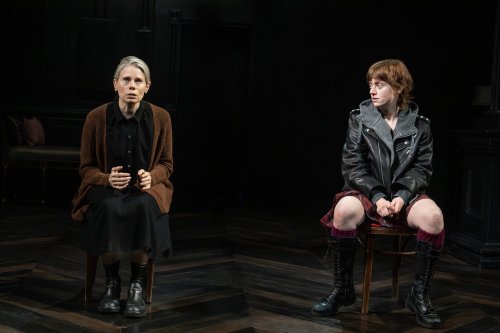
Celia Keenan-Bolger and Susannah Perkins in a scene from Anna Ziegler’s “Antigone (This Play I Read in High School)” at The Public Theater (Photo credit: Joan Marcus)
The world premiere of Anna Ziegler’s new play, Antigone (This Play I Read in High School) now at The Public Theater, is one of four ambitious attempts to update Sophocles’ tragedy playing in New York this spring. However, Ziegler overburdens her version with three separate stories which vie for our attention: a contemporary woman who read the play in high school and has admired its heroine ever since, Sophocles’ version of the Greek myth, and the one that takes up the most time in this play, a modern Antigone who has a different beef with the state. What Ziegler is really after is a Post-Roe v. Wade story about a woman who goes against the new abortion laws of her country. Unfortunately, Sophocles’ original plot as a sequel to Oedipus Rex and Oedipus at Colonus doesn’t really work with this contemporary social context. Tyne Rafaeli’s direction suggests that at any moment one of the scenes will catch fire but, unfortunately, they never do.
The play begins with a single Chorus member (later her name is revealed as Dicey) flying in a plane over Pittsburgh. She recalls reading the play Antigone in high school and not understanding it. Since then, as a timid woman who doesn’t take chances, she has become obsessed with it. She tells us the plot of Sophocles’ play: after the death of King Oedipus of Thebes, his sons Eteocles and Polynices fight each other for the throne, and end up killing each other. Creon, Oedipus’ bother-in-law, now king, decrees that one shall be considered a hero and given a state funeral, while the other will be declared a traitor and given no honorable burial. This does not sit well with their sister Antigone, the older of Oedipus’ two daughters, who continually tries to give Polynices the rites of burial. Unfortunately, as king Creon cannot have people flouting his laws even if they are relatives. Since neither will give an inch, this leads to tragedy for most of the royal family.
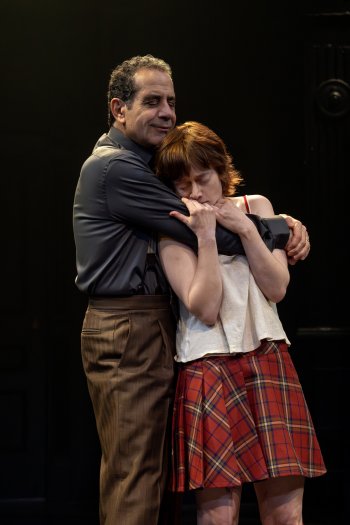
Tony Shalhoub and Susannah Perkins in a scene from Anna Ziegler’s “Antigone (This Play I Read in High School)” at The Public Theater (Photo credit: Joan Marcus)
Across the aisle from our Chorus on her plane to her hometown, a teenager is reading Sophocles’ Antigone and when asked what she thinks of it, she complains that “Is it even about her? It seems like it’s all about her brother’s body. A man’s body.” Dicey offers to tell her another version about Antigone’s body and her own which gives us the third tale in this complex play. In this version, Antigone, daughter of Oedipus, is pregnant by her boyfriend and fiancé Haemon, Creon’s son, and chooses to get an outlawed abortion. (Creon, just crowned king has made abortion illegal as one of his first decrees.) However, we are never told why Antigone wants an abortion as she is marrying Haemon very soon and appears to love him. Ziegler’s play becomes a pro-abortion story from then on. While many New Yorkers will admire her stance, the story of Antigone, a political tragedy, does not allow for this reading nor do we ever find out her reasons.
We also find out that Dicey, our Chorus, is pregnant, and is considering an abortion, circa 1985 when it is still legal in the United States: her pregnancy was a surprise and unplanned. Her reasons for an abortion as a single parent would be quite different from Antigone’s though she does not go into them. The play is also uneven in tone shifting from drama to comedy to tragedy and back. The three guards for Creon are played as Keystone Kops, while Haemon, Antigone’s fiancé, is described as fey. The proprietor of the underground abortion clinic is a hoot though she also seems entirely extraneous to the play, an example of comic relief? The jokes about characters with the names Achilles and Eurydice though not those seem also out of place in this context.

Susannah Perkins and Calvin Leon Smith in a scene from Anna Ziegler’s “Antigone (This Play I Read in High School)” at The Public Theater (Photo credit: Joan Marcus)
Celia Keenan-Bolger, seemingly the author’s stand-in as narrator, does her best with a very underwritten role: there are too many holes in her biography for us to know who she is. She does not fulfill the traditional role of the Greek Chorus who comment on the action of the play we are watching, not some alternate story. As the modern Antigone, Susannah Perkins is feisty and rebellious but never generates enough heat for us to get totally involved with her story. Ironically, as her younger sister Ismene, Haley Wong demonstrates more passion and rage. As King Creon, Tony Shalhoub is more convincing than Antigone, conflicted by his official role but wanting to save his niece at the same time. Calvin Leon Smith’s Haemon is adequately confused as a young man who has not yet found himself in a new world he has been thrust into. As the cops and other characters, Katie Kreisler, Dave Quay and Ethan Dubin are amusing but seem to have stepped out from another absurdist play, not this one.
The visual production does not get in the way of the story line or the telling. David Zinn’s minimal set design allows for instant transitions from scene to scene. The contemporary costumes by Enver Chakartash help with the updating, making the story a 21st century tale. Jen Schriever’s subtle lighting design makes the scene changes crystal clear while Daniel Kluger’s sound design helps to create the off-stage ambiance from crowds, to planes to mobs.
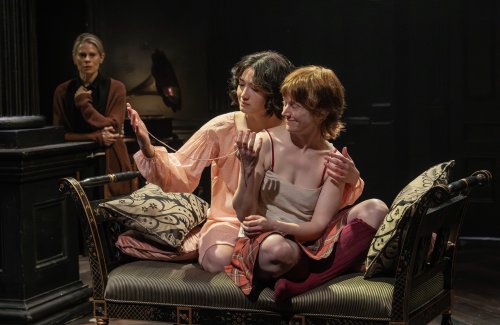
Celia Keenan-Bolger, Haley Wong and Susannah Perkins in a scene from Anna Ziegler’s “Antigone (This Play I Read in High School)” at The Public Theater (Photo credit: Joan Marcus)
While one admires Anna Ziegler’s thesis and her intention in Antigone (This Play I Read in High School), her own busy play sabotages its effectiveness. The telling of three parallel but unrelated stories only muddies her pro-abortion stance. Even her title gets in the way as this is not the play we read in high school. There definitely needs to be a Post-Roe v Wade tragedy for our stages but this is not it.
Antigone (This Play I Read in High School) (extended through April 12, 2026)
The Public Theater
Barbaralee Theater, 425 Lafayette Street, in Manhattan
For tickets, visit http://www.publictheater.org
Running time: two hours and 15 minutes including an intermission


Leave a comment