
Antigone in Analysis
Peculiar Works Project offers Barbara Barclay’s bold feminist reinterpretation of a Sophocles touchstone, rich in ideas, uneven in execution.
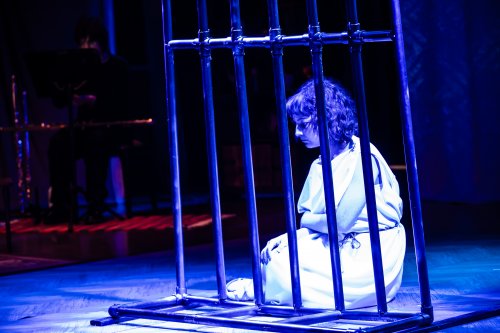
Alessandra Lopez as Antigone in a scene from Barbara Barclay’s “Antigone in Analysis” (Photo credit: Marina Livitskaya)
In Antigone in Analysis, the playwright Barbara Barclay announces her ambitions with a kind of intellectual audacity that is difficult not to admire, even as it proves dramatically precarious. To invoke Antigone is to summon a text whose moral architecture has endured centuries of scrutiny; to subtitle it “in Analysis” is to suggest not merely reinterpretation, but dissection. Barclay, taking this premise at its most literal, replaces the traditional Greek chorus with a panel of thinkers who observe, interrupt, and theorize the action as it unfolds. The result is less a metaphorical framing than an explicit dramaturgical conceit: tragedy as seminar, catharsis as case study.
Under the direction of Ralph Lewis, the production announces its aesthetic ambitions the moment one crosses the threshold. Set and projection designer Evan Frank conjures an elegantly appointed parlor, at once inviting and faintly uncanny, its most arresting feature a dead tree, stark and skeletal, improbably installed as though it were just another piece of furniture. The walls, adorned with reproductions evocative of Miró, Kandinsky, and Klee, gesture toward a lineage of abstraction—suggesting, perhaps too neatly, the tumult of the intellectual disputation to follow.
David Castaneda’s lighting design proves another of the production’s more finely attuned elements, responsive to both the chromatic palette of the environment and the shifting emotional weather of the debate. With a measured subtlety, it modulates the space as arguments gather heat or recede into abstraction, lending a definite tonal coherence. The costume design by Grace Martin sketches the philosophers in a visual shorthand that spans eras and ideologies. The effect is deliberately eclectic, a sartorial collage that gestures toward the porous boundaries between historical period and contemporary thought.
Before a word is spoken, the atmosphere is further shaped by the presence of flutist Samantha Kochis, performing Alana Asha Amram’s gently undulating score. The music, at once soothing and faintly hypnotic, lends the space a contemplative hush.
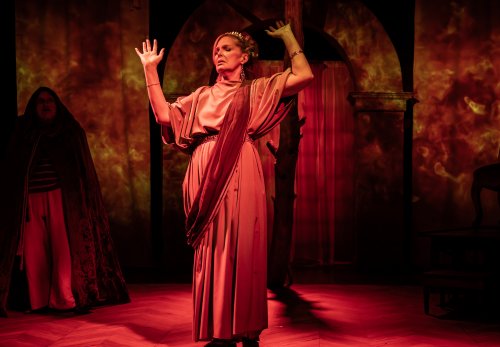
Bianca Leigh as Jocasta in a scene from Barbara Barclay’s “Antigone in Analysis” (Photo credit: Marina Livitskaya)
There is, at least on paper, a perverse allure to Antigone in Analysis: the prospect of summoning Georg Wilhelm Friedrich Hegel, Søren Kierkegaard, Jacques Lacan, Judith Butler, and Luce Irigaray into a shared parlor to anatomize Antigone. One imagines an evening of combustible intellect—a clash of systems, a thrilling collision between metaphysics, psychoanalysis, and feminist critique, all refracted through one of the most inexhaustible tragedies in the canon. It is, in other words, the sort of dinner party one would cross continents to attend. That it does not yield equally compelling theater is the central disappointment of this earnest but curiously airless production.
Yet even this conspicuous intervention is eclipsed by a more radical narrative revision. In Barclay’s rendering, Jocasta—mother, wife, and unwitting participant in one of mythology’s most notorious familial entanglements—does not meet her customary end. Rather than succumbing to the horror of her revelations, she survives, and in surviving, ascends. The throne that, in Antigone, belongs to Creon is here occupied by a figure whose authority is freighted with an altogether different psychic and symbolic weight.
This reconfiguration of lineage and power is, in theory, a thrilling provocation. By allowing Jocasta to outlive the catastrophe that defines her in the Oedipus Rex mythos, Barclay disrupts the fatalistic closure that traditionally seals her fate. The civil war between Eteocles and Polynices—itself the aftershock of Oedipus’ abdication and exile—becomes not merely a dynastic struggle but a crucible from which a new, and deeply compromised, sovereign emerges. Jocasta’s rule, shadowed by incest, grief, and political collapse, promises a reframing of authority not as inherited order but as psychic residue.
The conceit is disarmingly simple. Five thinkers, embodied with spirited commitment by Mick Hilgers, Simon Henriques, Sammy Rivas, Nomi Tichman, and Linnea Scott, gather in the warmly appointed salon to debate, reenact, and ultimately revise Sophocles’ drama. Their principal intervention—installing Jocasta as sovereign in place of Creon—gestures toward a fertile reexamination of gendered power. Indeed, when Jocasta in a brisk assertion of authority, reproduces Creon’s edict by condemning the burial of Polynices, the play briefly flickers with intellectual voltage. The moment tacitly rebukes Butler’s and Irigaray’s suppositions of a feminine mode of governance, raising tantalizing questions about whether power, once seized, inevitably reproduces the structures it claims to resist.
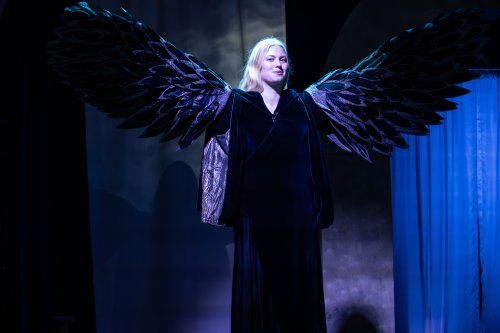
Freja Højland Høj in a scene from Barbara Barclay’s “Antigone in Analysis” (Photo credit: Marina Livitskaya)
Yet the production proves curiously reluctant to pursue the implications of its own provocations. The philosophers, rather than evolving into distinct and dynamically opposed sensibilities, settle into the dramatic equivalent of bullet points. Kierkegaard cleaves to divine absolutism; Hegel dismisses women with a glib reductionism; Lacan invokes madness as a universal solvent; Irigaray insists upon feminine multiplicity; Butler reiterates the performativity of gender. These positions are announced, then reiterated, but seldom interrogated or transformed. What might have been a dialectic becomes a recitation.
With much of Barclay’s enterprise, the boldness of the premise is not always matched by its execution. The transformation of the chorus into philosophers risks overdetermining the play’s interpretive frame, while Jocasta’s survival—so rich with tragic and theoretical implications—often feels more asserted than explored. What might have been a searching inquiry into the afterlives of trauma, gendered power, and the persistence of taboo instead hovers at the level of conceit, its most provocative ideas insufficiently pressed into dramatic consequence.
The difficulty is not merely one of compression—though corralling such formidable bodies of thought into a single evening is no small task—but of dramatic imagination. The play does not so much stage an argument as gesture toward one. Its engagement with Antigone feels curiously ornamental, as though the ancient text were a pretext rather than a partner. Theory, instead of illuminating the drama, settles over it like gauze, diffusing its urgency and obscuring its stakes.
When tempers flare and the philosophers descend into physical confrontation, the escalation feels unearned, a theatrical punctuation mark in search of a sentence. Without the slow accrual of intellectual and emotional pressure, the eruption registers less as inevitable combustion than as imposed effect.
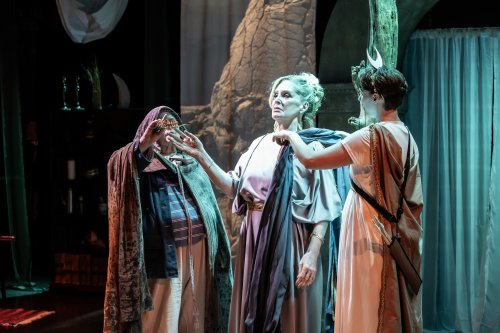
Nomi Tichman, Bianca Leigh and Linnea Scott in a scene from Barbara Barclay’s “Antigone in Analysis” (Photo credit: Marina Livitskaya)
And yet, intermittently, the production remembers the theater it might have been. Alessandra Lopez’s Antigone and Bianca Leigh’s Jocasta lend the mythic figures a welcome specificity, grounding the abstractions in human impulse and contradiction. The two actresses, working from Barclay’s adapted Antigone text, acquit themselves with admirable rigor, carving out moments of genuine dramatic vitality amid the production’s more overdetermined conceits; their performances, alert to the emotional stakes too often submerged elsewhere, supply some of the evening’s most compelling and fully realized passages.
Most striking is a brief, incandescent intervention by Freja Højland Høj, whose operatic invocation of death arrives like a tear in the fabric of the play—sudden, arresting, and gone too quickly. In these moments, one glimpses the synthesis the production never quite achieves: thought made flesh, philosophy given voice and consequence.
Instead, the evening concludes in a curious equivocation. The assembled minds, having circled questions of incest, authority, and moral transgression, arrive at a muddled consensus that feels less like resolution than fatigue. Neither the Theban court nor the philosophical salon yields a satisfying denouement. For a work so preoccupied with systems of meaning, the absence of a coherent end point is particularly enervating.
One senses, throughout, the labor of considerable research and genuine intellectual curiosity. What is missing is the confidence to follow that inquiry to its most discomfiting conclusions—to trust that an audience might not only endure but relish the vertigo of deeper philosophical descent. As it stands, Antigone in Analysis remains stranded on the surface of the very ideas it invokes, a symposium that promises profundity but delivers, at best, an elegantly staged seminar where none of the students bother to take notes.
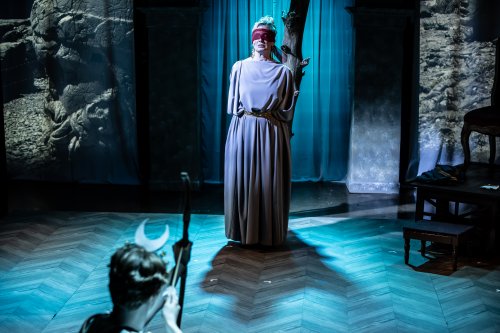
Linnea Scott and Bianca Leigh in a scene from Barbara Barclay’s “Antigone in Analysis” (Photo credit: Marina Livitskaya)
Still, one cannot deny the bracing quality of Barclay’s departures. If they do not fully cohere, they at least disturb the sediment of a too-familiar text, reminding us that even the most canonical tragedies remain susceptible to reinvention—if not always to revelation.
Antigone in Analysis (through April 5, 2026)
Peculiar Works Project
The Downstairs Theatre at La MaMa Experimental Theatre Club, 66 East 4th Street, in Manhattan
For tickets, visit www.lamama.org
Running time: 75 minutes without an intermission


Leave a comment