
Bughouse
Henry Darger's elusive life and art mostly remain that way in a new Off Broadway play.

John Kelly in a scene from Martha Clarke and Beth Henley’s “Bughouse” at the Vineyard Theatre (Photo credit: Carol Rosegg)
Chicagoans Nathan and Kiyoko Lerner shared an inspired life: she trained as a classical pianist, and he was a photographer whose work took a huge cultural turn after visiting Japan, his wife’s home country. A student of The New Bauhaus and protégé of its founder, László Moholy-Nagy, Nathan, who died in 1997, was also a prolific industrial designer (he may or may not deserve credit for the iconic bear-shaped honey bottle). But the Lerners’ most astounding contribution to artistic posterity hasn’t come from their expressed talents; rather, it’s the by-product of owning an apartment building. That’s where one of their tenants spent his days inventing a fantastical alternate reality he kept to himself.
The Lerners knew Henry Darger well enough to realize that, after his death in 1973, they hadn’t known him at all. A recluse schooled in pre-Vatican II Catholicism, Darger paid his rent from menial labor while spending his visible free time compulsively attending mass at nearby St. Vincent de Paul Church. When his health deteriorated, the Lerners helped Darger move to a charity nursing home. Darger, in turn, left the Lerners with simple instructions for his worldly and jumbled possessions: “throw it all away.”
The Lerners did not comply, because, in Darger’s tiny, cloistered apartment, they uncovered an artist’s soul. Buried beneath the hoarded clutter, it bloomed through a collection of beautiful drawings, collages, and watercolors, many of them illustrations of a 15,000-plus-page, single-spaced novel with a fittingly epic title, The Story of the Vivian Girls, in What Is Known as the Realms of the Unreal, of the Glandeco-Angelinian War Storm, Caused by the Child Slave Rebellion. The Lerners couldn’t immediately fathom that their stunning discovery had, in fact, begun the canonization process for the eventual patron saint of outsider art.
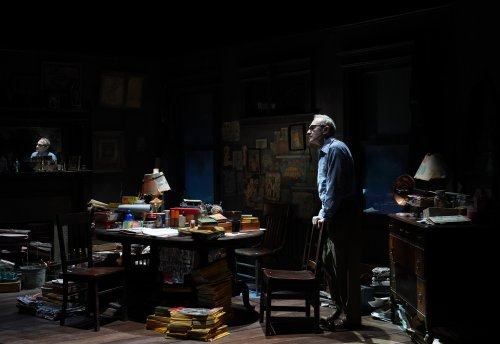
John Kelly in a scene from Martha Clarke and Beth Henley’s “Bughouse” at the Vineyard Theatre (Photo credit: Carol Rosegg)
Whether Darger would have welcomed this posthumous honor is debatable, though not in the squat play Bughouse, which makes lots of room for Darger’s imagination and decidedly little for anything else. Conceived and directed by Martha Clarke, sans the morally ambiguous question about remembrance, the solo show ostensibly depicts Darger through Darger, as Clarke and her collaborators attempt to grasp an achingly solitary man from his own point of view, which they’ve substantially curated. It’s not necessarily the wrong dramatic choice, but it probably is.
Playwright Beth Henley (Crimes of the Heart) pulls from a smidgen of Darger’s writings, including an autobiography, to fashion a stream-of-consciousness script that, in a very Joycean way, requires significant external knowledge about Darger’s life to make sense. Even then, Bughouse is idiosyncratic to a fault, with Henley piecing together not so much a story as an impression of one. To say the least, Henley is fortunate to have an exceptional cadre of theater professionals supporting both her work and our attention.
Summoning Darger, the versatile performance artist John Kelly cocoons himself within an all-consuming creativity that is simultaneously captivating and distancing. The latter would be especially true for Darger neophytes, who should be forgiven for not knowing what the hell is happening. Spun from obvious personal trauma, Darger’s monumental novel tells a good-versus-evil story about a Christian child-slave rebellion that emerges against the Glandelinians, an empire of Satanic adults. Annie Aronburg, modeled on the photograph of a murdered 5-year-old from a 1911 newspaper clipping, leads the noble fight. When she is struck down, her Joan-of-Arc-style martyrdom serves as a catalyst for the androgynous Vivian girls–royal warrior angels–to unleash their full fury on the Glandelinians, which, for some reason, they do while naked.

John Kelly in a scene from Martha Clarke and Beth Henley’s “Bughouse” at the Vineyard Theatre (Photo credit: Carol Rosegg)
Atomizing the novel’s narrative arc, Henley, with whatever encouragement from Clarke, leans into intermittent poetic revelation rather than blasé comprehension. Though, admittedly, other aspects of Bughouse achieve a closer balance between the two, particularly the scenic shaping from production designer Neil Patel and set decorator Faye Armon-Troncoso, who vividly conjure Darger’s circumscribed outer life in his Chicago confines. Meanwhile, projection designer John Narun and animator Ruth Lingford do the same for Darger’s inner one, which was, as the evidence suggests, forever expanding within his capacious mind. To be sure, Bughouse erects, at most, a permeable barrier to separate Darger’s troubling memories, like being sent to an asylum for feeble-minded children, from his artfully eschatological reflection of them.
Despite the remarkably seamless and saturating vivacity of Narun and Lingford’s images, they can’t lessen the belief that the audience is looking through a glass darkly at Darger. Lighting and sound design (Christopher Akerlind and Arthur Solari respectively) maximize the play’s evocativeness but aren’t equipped to illuminate its mysteries. As for Henley’s script, it merely lengthens an arduously opaque echo chamber by having Darger, either in human or child-avatar form, frequently lose himself in repetitive, circular voiceovers. Yet, at least all is not meaningfully lost: what remains absolutely intelligible is Darger’s overwhelming vulnerability and, as he kneels in prayer, both the seriousness of his faith and the pained frustration that it elicits no responses.
Bughouse (through April 5, 2026)
Vineyard Theatre, 108 East 15th Street, in Manhattan
For tickets, call 212-353-0303 or visit http://www.vineyardtheatre.org
Running time: one hour without an intermission


Leave a comment