
Henry VI: A Trilogy in Two Parts
Ambitious and epic production which combines Shakespeare's history of the Wars of Roses into two plays instead of three.
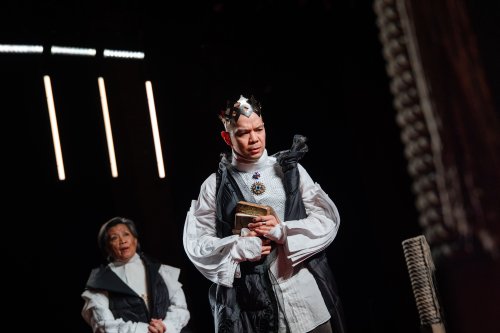
Mia Katigbak as the Duke of Gloucester and Jon Norman Schneider as King Henry IV in a scene from the NAATCO production of William Shakespeare’s “Henry VI: A Trilogy in Two Parts” at The Public Theater (Photo credit: HanJie Chow)
Shakespeare’s Henry VI is rarely produced both because it was his first attempt at historical playwriting, but also because it is a trilogy to be performed over three evenings. NAATCO (National Asian American Theatre Company) has returned with a revised version of its ambitious 2018 two-part production (subtitled “A Trilogy in Two Parts”) which solves some of the problems of this unwieldy epic but make others more difficult. However, this is a rare chance to see these early Shakespeare plays.
Directed with an all-Asian cast and adapted by Stephen Brown-Fried, the two parts are now known as “Foreign Wars” and “Civil Strife.” Brown-Fried is reputed to have rearranged the text to get the scenes in this order. Covering 50 years of history and covering the entire War of the Roses, the two evenings start with the funeral of King Henry V in 1422 and continues until the murder of Henry VI in 1471. (Although Henry VI was eight months old when his father died, Shakespeare skips this detail.)
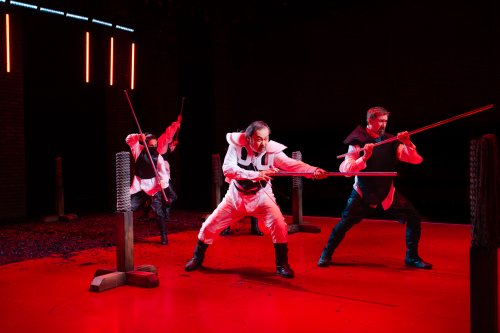
Kimiye Corwin as the Duke of Somerset, David Shih as the Duke of Burgundy and John D. Haggerty as Lord Talbot in a scene from the NAATCO production of William Shakespeare’s “Henry VI: A Trilogy in Two Parts” at The Public Theater (Photo credit: HanJie Chow)
The first play takes place mainly in France where the Dauphin Charles with the help of Joan of Arc attempts to take back the territory lost to England under Henry V at the end of the Hundred Years War. In the meantime, the devious Earl of Suffolk convinces the weak King Henry VI to marry Margaret of Anjou, a French Princess whom he has captured, while the Duke of Gloucester, the king’s uncle and chief adviser, disapproves of this dowry-less marriage. Little does Henry know that they are lovers and Suffolk expects to control him through Margaret.
Henry’s other uncle and advier, the Bishop of Winchester, adversary to Gloucester attempts to bring him down through his wife and gets her exiled. When Suffolk arranges Gloucester’s murder, henry banishes him enraged his wife Margaret. A feud breaks out between Richard Plantagenet, Duke of York, who chooses a white rose as his symbol, and the Duke of Somerset who chooses a red rose as his symbol. Unaware of action, Henry chooses a red rose and loses Richard as a friend.
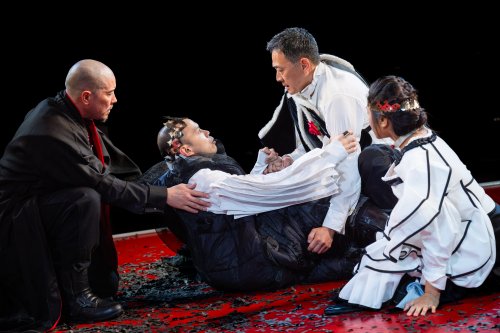
James Yaegashi as the Bishop of Winchester, Jon Norman Schneider as Henry VI, Paul Juhn as the Duke of Suffolk and Teresa Avia Lim as Queen Margaret in a scene from the NAATCO production of William Shakespeare’s “Henry VI: A Trilogy in Two Parts” at The Public Theater (Photo credit: HanJie Chow)
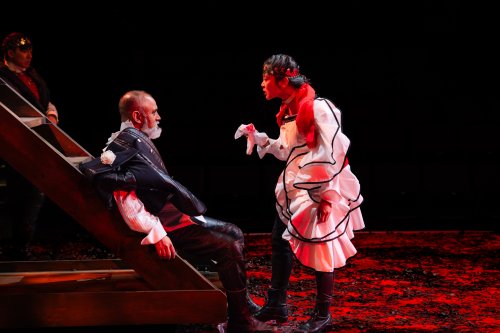
Rajesh Bose as Richard Plantagenet, the Duke of York, and Teresa Avia Lim as Queen Margaret in a scene from the NAATCO production of William Shakespeare’s “Henry VI: A Trilogy in Two Parts” at The Public Theater (Photo credit: HanJie Chow)
Although the three plays have been reduced to two and many of the actors appeared previously in the 2018 production, Henry VI is still challenging for audiences unfamiliar with the Hundred Years War or the War of the Roses. Even with an ensemble of 16, the actors play between three and nine characters each so that you are never entirely sure who anyone is when they appear. With women playing men (mostly to add a few female characters to the play), it is not only often confusing but makes the wrong statement like the Duke of Gloucester played by a female and then his wife being a major character later in the play. Even with 16 cast members some of the court and battle scenes look underpopulated on the large stage.
The costuming, a combination of modern and medieval by the collective threeASFour which resembles outfits by Comme des Garçons, does not entirely help even though the English wear black and white in Part I and the French wear black. Due to the number of dukes and earls, it would have been helpful if they wore defining outfits that set them apart from each other. In Part II, the Yorkists wear a white signifier while the Lancastrians wear red but this still does not make it easy to recognize particular characters.
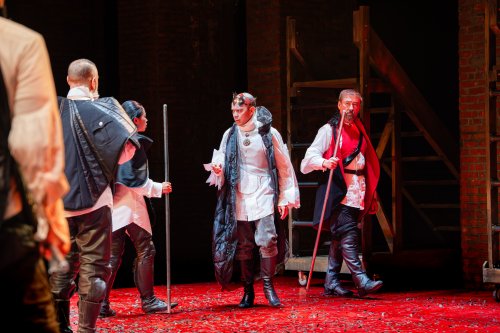
Jon Norman Schneider as King Henry VI and the cast of the NAATCO production of William Shakespeare’s “Henry VI: A Trilogy in Two Parts” at The Public Theater (Photo credit: HanJie Chow)
The set by the collective dots is minimal in the extreme allowing for quick transitions between scenes but little atmosphere or sense of place. With the audience sitting on opposite sides facing the playing area, the stage is a red lacquered floor covered on one side by what looks like black gravel or ashes. In the course of the two evenings, this encroaches more and more on the red half of the stage. The only scenery per se are two rolling staircases which are mostly kept against one wall and used only occasionally. A stake for Joan of Arc appears in the first half of the play. The rather distracting lighting design by Mextly Couzin includes hanging LED tubes which occasionally turn red, orange or white. Besides the Japanese-inspired costumes, the weapons used in the battle scenes are also Asian inspired. Soldiers use Samurai poles and small kama-style swords.
Some of the actors are standouts either due to their acting or their roles in the play. Jon Norman Scheinder makes King Henry VI a weak, ineffectual king who like Hamlet thinks too much but like King Richard II makes poor choices. As his eventual Queen Margaret, Teresa Avia Lim is a force of nature, a hot-blooded excitable lady who is better on the battlefield than her husband as well as backroom scheming. As Richard Plantagenet, Duke of York, one of the movers and shakers of the plays, Rajesh Bose is a dour, even-tempered aristocrat scheming to get his due. The Duke of Gloucester, played by Mia Katigbak, Henry VI’s uncle and chief adviser, is a cool, level-headed courtier. Julyana Soelistyo as Richard, later the Duke of Gloucester and eventual King Richard III (in the next play), is an over-the-top psychopathic villain who warns us of his next crimes at the end of Part II. David Lee Huynh is suave and sophisticated as Charles, Dauphin of France, while Myka Cue makes Joan la Pucelle (Joan of Arc) a feisty, gutsy leader.
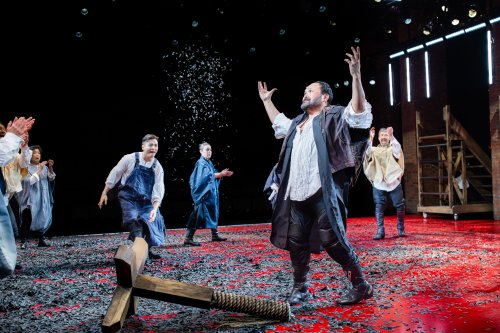
Orville Mendoza as Jack Cade (center) and the cast of the NAATCO production of William Shakespeare’s “Henry VI: A Trilogy in Two Parts” at The Public Theater with in a scene from the NAATCO production of William Shakespeare’s “Henry VI: A Trilogy in Two Parts” at The Public Theater (Photo credit: HanJie Chow)
Stephen Brown-Fried’s staging of Shakespeare’s Henry VI is an ambitious epic presentation that takes some stamina both from the actors and audience at just under six hours running time. While following the plot and the characters is a challenge, the story with its scandals and betrayals proves to be very modern and may remind you of modern politics. Visually sweeping, the play takes a lot of concentrating to keep up with the 50-year history of England from 1422-1477.
Henry VI: A Trilogy in Two Parts (through July 19, 2026)
NAATCO (National Asian American Theatre Company)
The Newman Theater at The Public Theater, 425 Lafayette Street, in Manhattan
For tickets, visit http://www.publictheater.org
Running time: Part I – three hours including one intermission
Part II – two hours and 40 minutes including one intermission


Leave a comment