News Ticker

Kimiye Corwin

Henry VI: A Trilogy in Two Parts
July 15, 2026

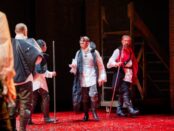
Although the three plays have been reduced to two and many of the actors appeared previously in the 2018 production, Henry VI is still challenging for audiences unfamiliar with the Hundred Years War or the War of the Roses. Even with an ensemble of 16, the actors play between three and nine characters each so that you are never entirely sure who anyone is when they appear. With women playing men (mostly to add a few female characters to the play), it is not only often confusing but makes the wrong statement like the Duke of Gloucester played by a female and then his wife being a major character later in the play. Even with 16 cast members some of the court and battle scenes look underpopulated on the large stage. The costuming, a combination of modern and medieval by the collective threeASFour which resembles outfits by Comme des Garçons, does not entirely help even though the English wear black and white in Part I and the French wear black. Due to the number of dukes and earls, it would have been helpful if they wore defining outfits that set them apart from each other. In Part II, the Yorkists wear a white signifier while the Lancastrians wear red but this still does not make it easy to recognize particular characters. [more]
[Veil Widow Conspiracy]

June 21, 2019

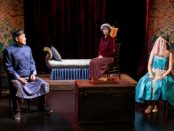
The set designer (Yu-Hsuan Chen) and lighting designer (Reza Behjat) have obviously worked collaboratively to create some effective—and often beautiful—stage pictures. Loops of light are a striking visual leitmotif throughout the show. Costume designer Mariko Ohigashi was given a particularly challenging assignment: imagining garments for three distinctly different worlds. She has delivered the period costumes of the original story (with help from Makoto Osada), the T-shirts with production titles that are worn on the film set, and the simple windbreakers that appear in the futuristic scenes—and she’s done it all with both nuance and flair. [more]

Fruiting Bodies

May 1, 2019

With "Bodies," playwright Sam Chanse attempts to explore the realities of Japanese-American culture in the 21st century, but gets lost in the process. Bodies is at its core an exploration of familial ties and meaningful human connections, as is made clear by the time it reaches its multiple emotional climaxes. Its monologues about mushrooms and self-worth suggest a more ambitious artistic treatise, but ultimately weaken those other core themes. [more]

Henry VI (NAATCO)

August 22, 2018

Presented by NAATCO (National Asian American Theatre Company), it has a virtually all-Asian excellent cast of sixteen, several of whom play roles of opposite genders. Creatively conceived by Stephen Brown-Fried and superbly directed by him, his Orson Welles-like vision transcends the difficult material. This sterling production is also an inspired example of Americans succeeding at Shakespeare. [more]

The Changeling

January 13, 2016

The interpretations are also open to question. Although she should be demure before her sexual awakening, Sara Topham plays Beatrice as experienced and sophisticated which allows her nowhere to take her character. While the beauty and the beast theme is much in evidence, Manoel Felciano’s make-up as the ugly De Flores fails to make him the monstrous embodiment of the play’s description. Christian Coulson’s Alsemero is described by his friend Jasperino as asexual and he seems to have taken this as the basis for his character. As a result he is extremely bland, as is John Skelley’s Alonzo, so that we never see what Beatrice is supposed to see in these men. [more]