
The Tempest (Teatro Grattacielo)
World premiere opera of Shakespeare's play by Joseph Summer performed by Teatro Grattacielo at the Ellen Stewart Theater of La MaMa.
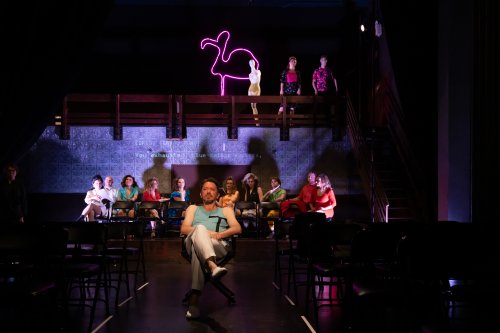
Daniel Klein as Prospero (foreground); Sara Kennedy as Miranda and Omar Najmi as Ferdinand (on balcony) with chorus seated below in a scene from Teatro Grattacielo’s production of Joseph Summer’s opera “The Tempest” adapted from the play by William Shakespeare at the Ellen Stewart Theater at La MaMa (Photo credit: Jennifer Katzman)
Don’t attend the world premiere of Joseph Summer’s new opera version of William Shakespeare’s The Tempest expecting to recognize the text or the characters. Both the libretto by Eve Summer and staging by Teatro Grattacielo’s artistic director Stefanos Koroneos have done their own thing with the original. If you don’t read the program notes before the performance you may be rather confused as to the approach.
According to the statement from Koroneos in the program, he imagines Prospero, normally the deposed Duke of Milan, as a film director inside a crumbling 1980s film studio. The enchanted island is filled with inflatable tropical plants, cheap plastic pink flamingos and plastic vines, with a cameraman quietly recording it all. Prospero, previously a magician in thrall to his books, is here seen at an old-fashioned typewriter turning out pages to what one assumes is his latest screenplay. However, if you have not read the notes none of this will be obvious. You may find yourself confused by the typewriter.
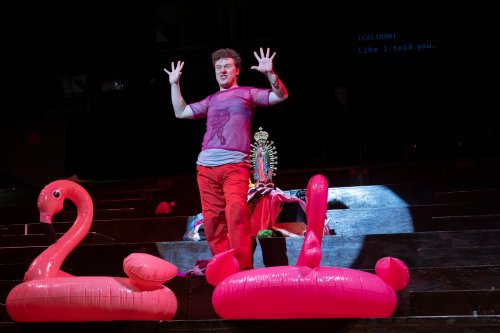
Benjamin Sieverding as Caliban in a scene from Teatro Grattacielo’s production of Joseph Summer’s opera “The Tempest” adapted from the play by William Shakespeare at the Ellen Stewart Theater at La MaMa (Photo credit: Jennifer Katzman)
Koroneos has staged the first act on the risers where the audience usually sits in the Ellen Stewart Theater of La MaMa as a mountain vista with his cave in the center, plus some scenes in the center aisle or on the balcony at the back of the theater. (This requires the audience to periodically turn around to watch the back.) However, during the second act the audience is requested to either move to the back of the theater or turn their chairs around as most of the concluding scenes will take place on the rear stage and the balcony. There a group of singers gather, first walking down the center aisle from the stage to the back, one by one as in on a fashion runway, many of whom have not been identified previously.
Prospero then takes a seat in the aisle in front of the rear stage and according to the supertitles “auditions” the goddesses Iris, Ceres and Juno for a masque for the marriage of his daughter Miranda and her fiancé Ferdinand (shipwrecked by the tempest at the beginning of the story). Unfortunately, the singers return to the front for this musical interlude which means the audience must swivel their heads back to front in order not to miss anything. The chorus members appear to rignore the singing as they chat among themselves.
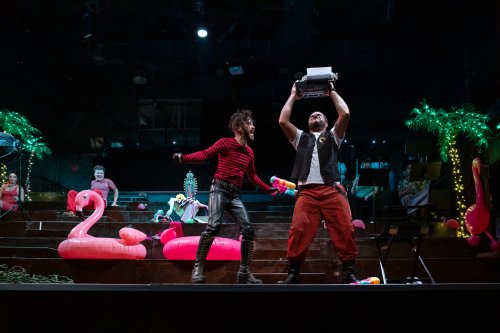
Benjamin Sieverding as Caliban, Jordan Rutter-Covatto as Trinculo and Eliam Ramos as Stephano in a scene from Teatro Grattacielo’s production of Joseph Summer’s opera “The Tempest” adapted from the play by William Shakespeare at the Ellen Stewart Theater at La MaMa (Photo credit: Jennifer Katzman)
The libretto by Eve Summer (the composer’s daughter) shortens the expected speeches and business of the main characters and instead interposes verses for the spirits Iris (Greek goddess of the rainbow), Ceres (Roman goddess of agriculture) and Juno (Roman goddess of marriage), plus adding the Greek gods and goddesses Calypso, Nereus, Ligeia and Echo (listed in the program) whom are never identified in the libretto but appear as members of the chorus. All of this seems to shortchange the shipwrecked main characters: Antonio, Prospero’s brother and the usurping Duke of Milan, Alonso, King of Naples, and his brother Sebastian who wishes to unseat him. Miranda usually played as a teenager and Ferdinand, a young man in his twenties, are here played much older though the libretto never makes clear how long Prospero and his daughter have been in exile on their island.
Summer’s music in the first act appears to have been inspired by Benjamin Britten’s sea interludes in Peter Grimes initially, and the music turns dissonant and atonal later on. The most sustained singing is the aria for Iris, Ceres and Juno in the second act which is very Straussian as sung impressively by soprano Maggie Finnegan, mezzo-soprano Chantelle Grant and soprano Sarah Johnson in a high tessitura. On the other hand, the king’s jester Trinculo is sung by Jordan Rutter-Covatto in a weak countertenor which sounds more like falsetto, while soprano Sara Kennedy as Miranda is often drowned out by the orchestra as is mezzo-soprano Kayla Viviana as Prospero’s helper the spirit Ariel. Though you might have expected Prospero to get the lion’s share of the vocal music, bass-baritone Daniel Klein is given repetitive, humdrum arias which all sound the same. The rest of the cast acquit themselves well though they have little to do: bass Benjamin Sieverding as the monster Caliban, bass-baritone Eliam Ramos as the king’s butler Stephano, tenor David Gordon as Sebastian (the king’s brother), and baritone Justin Ryan as Prospero’s brother Antonio and DeAndre Simmons as King Alonso.
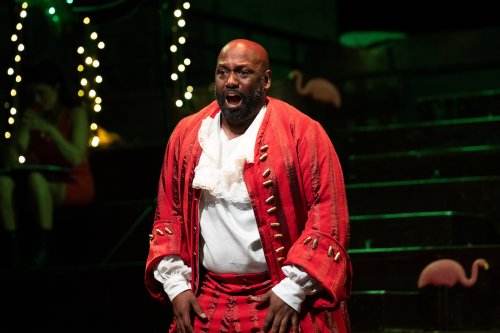
DeAndre Simmons as Alonso in a scene from Teatro Grattacielo’s production of Joseph Summer’s opera “The Tempest” adapted from the play by William Shakespeare at the Ellen Stewart Theater at La MaMa (Photo credit: Jennifer Katzman)
While Oscar Escobedo has appropriately created an enchanted island, it is Anabel Simotas’ costumes that impress the most. The women are all dressed in monochromatic modern dresses so that together they make up a rainbow effect. The men are in various outfits appropriate to their characters: Prospero in his working clothes of blue tank top and white pants, Stephano in red pants, black vest and white shirt, Trinculo in black leather pants and red and black striped long-sleeved shirt, and Caliban in red pants and a see-through purple shirt which appears to have a monster in a leather outfit on it.
Gregory Pernicone, Jr. is responsible for the amusing props which dot the stage. The work of choreographer Hala Shah is not very obvious. The placement of conductor Enrico Fagone is a problem as his raised podium blocks a good deal of the action on the stage due to where the singers are placed. The strangest part of the evening were the supertitles which were either lagging behind the singers or something other than what they were singing as though someone had paraphrased the libretto. This became distracting and meaningless as it had less and less to do with what was being sung.
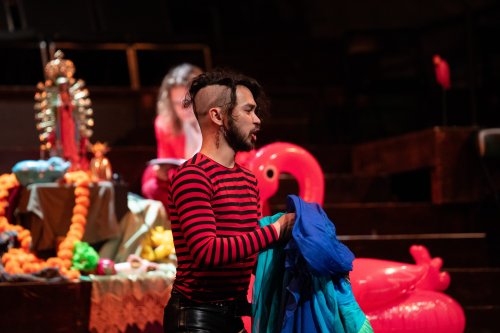
Jordan Rutter-Covatto as Trinculo in a scene from Teatro Grattacielo’s production of Joseph Summer’s opera “The Tempest” adapted from the play by William Shakespeare at the Ellen Stewart Theater at La MaMa (Photo credit: Jennifer Katzman)
Joseph Summer’s opera is probably better than this production allowed. The busy, intrusive direction not only did not help but split the listeners’ ability to follow the score and the text. Why no one noticed that dividing the action between the front and back of the theater would be a problem remains a mystery. Obviously, the Ellen Stewart Theater was not the right venue for this undertaking.
The Tempest (July 16 and 18, 2026)
Teatro Grattacielo
Ellen Stewart Theater at La MaMa, 66 East 4th Street, in Manhattan
For tickets, visit http://www.grattacielo.org
Running time: two hours and 50 minutes including one intermission


Leave a comment