
Hungry Women
Intriguing sci-fi socio-political drama: what would the world be like if there were no men?
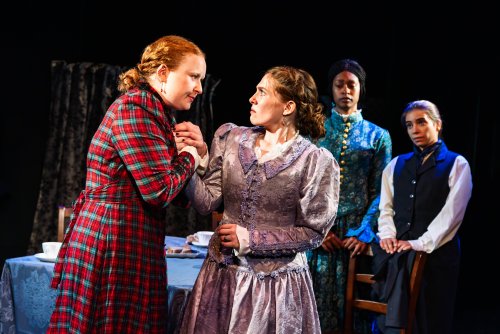
Julia Lester, Zoe Dean, Mariyea, and Sophie Zmorrod in a scene from Melissa Maney’s “Hungry Women” at SoHo Playhouse (Photo credit: Rebecca J Michelson)
Melissa Maney’s Hungry Women has a fascinating premise: what would the world be like if there were no men? Obviously, things would be different, but would they be any better? However, the play attempts to be too many things: a critique of Victorian marriage, a sci-fi play set in the future, a socio-political drama, a totalitarian power play. Divided in three parts (“Hungry Women,” “Curious Women” and “Scared Women”), the play seems to be three different one acts as the styles and tones change in each. Daniella Caggiano’s direction is superb except for a great deal of shouting in the third and last scene. However, she does not help unify the play into a coherent whole.
The play is about women’s empowerment and how women have been treated over the centuries by men. The title refers to literal hunger as the food chain is broken in this depiction of a fictional 1891. However, it also refers to women’s hunger for freedom, rights and knowledge. Each scene takes place 100 years after the previous one: a Massachusetts tea party in 1891, a high school classroom in 1991, a World Council meeting in 2091. Led by rising star Julia Lester (Into the Woods, I Can Get It for You Wholesale, Queens, All Nighter), the quartet of actresses appear in all three sections, each playing a similar woman whose name starts with the same letter, referred to as R Track, M Track, E Track and V Track.
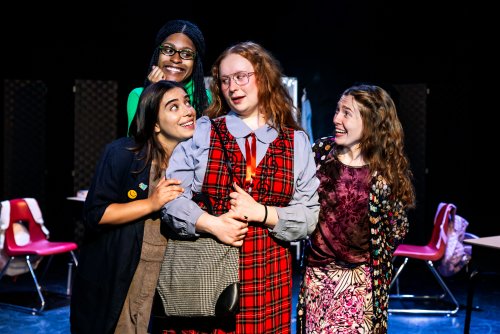
Sophie Zmorrod, Mariyea, Julia Lester and Zoe Dean in a scene from Melissa Maney’s “Hungry Women” at SoHo Playhouse (Photo credit: Rebecca J Michelson)
In Part One, we are at a Massachusetts tea party in which traditional, conventional Ruth (played by Lester), her sister Mary (Zoe Dean) (a follower but curious about things she hasn’t tried), and intellectual Eden (Mariyea) await their hostess Victoria (Sophie Zmorrod) who now wants to be called Vic. There has been an “incident” in which all of the men and boys have died without explanation. The women are hungry as no one is providing any food. When Vic appears, she is in her husband’s clothing which she says doesn’t make her feel closer to him but feel closer to herself. Vic brings a plate of sandwiches but as there is no food the other women are skeptical. She points out that something has to be done with all the dead bodies and she has taken upon herself to make that decision. At first the women are revolted but then their hunger gets the best of them. Throughout this scene all the women have two monologues in which they address the audience directly while the others freeze.
The second scene called “Curious Women” which takes place 100 years later is set in a high school classroom. Rebecca (Lester) is the substitute teacher (with traditional views) for “AP Herstory” and her students are Valerie (Zmorrod), Melanie (Dean) and Elizabeth (Mariyea). They discuss The Great Fires (1891 to 1893) in which the women burned away the old world: statues, paintings, novels, financial centers, military bases, halls of law and politics, churches and the Vatican. This was to be able to create a world “free of war, a land without borders, and a society that sees us as human, not our gender.” They mention that reproduction without men was made possible. The world is made up of mothers (who don’t get to go to college) and working women who finish their education, a choice made at age 18.
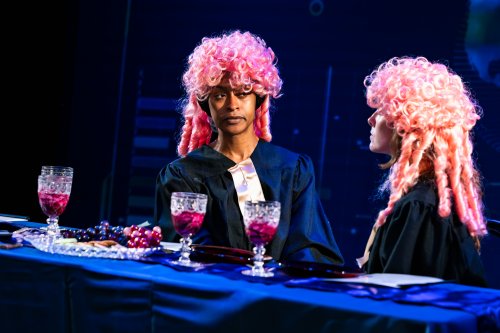
Mariyea and Zoe Dean in a scene from Melissa Maney’s “Hungry Women” at SoHo Playhouse (Photo credit: Rebecca J Michelson)
Valerie, the rebel, just like Victoria was in the first scene, wants to learn something not in the textbooks, and wants to know why they went out of their way to destroy the men’s existence when they’ve done so much for them. She suggests that they get in touch with the men through a séance to find out their side of the story. When Rebecca starts for the door, the girls insist they will go ahead without her, and she decides to be part of the experiment. At first the ghosts of the four men who answer their call are shocked by this new world which has tried to erase them. Then one by one they declare 19th century opinions as to women being incapable, unqualified, unfit. The classroom bell puts an end to this confrontation.
Part Three takes place at a World Council Meeting in 2091. The conservative Regina (Lester) appears to be in charge, while Eleanor (Mariyea) and Miranda (Dean) are subservient to her. They are all dressed as “Founding Mothers” in long black robes and powdered pink wigs. The Housewives are revolting as they want a greater purpose in life, having chosen their path at age 18. According to Regina there are “two types of women: those who lead and those who follow.” It transpires that Eleanor and Miranda as well as the missing Violet (Zmorrod) are housewives for Regina who lords it over them.
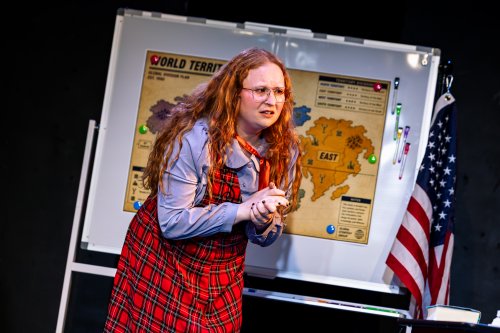
Julia Lester in a scene from Melissa Maney’s “Hungry Women” at SoHo Playhouse (Photo credit: Rebecca J Michelson)
When Violet arrives, she has invented the Global Surveillance System which can keep track of everyone wherever they are – except that as of now there is only one such device. Regina wants many of them in order to keep track of everyone. However, Valerie points out that this is not possible as it doesn’t account for what may come in the future. And then Violet reveals that she is pregnant and the child might be a boy – but he might not be like men in the past. Consternation breaks out as to what is the best thing to do.
Besides being a feminist statement Hungry Women also suggests Charlotte Perkins Gilman’s Herland, George Orwell’s 1984 and Margaret Atwood’s The Handmaid’s Tale. The shifts in style from one part to the other are disconcerting and jarring without really taking into account the preceding scene. Nevertheless, Hungry Women is provocative and engrossing though in the end rule by women seems to be no better than the previous rule by men. Winner of last year’s SoHo Playhouse Lighthouse Series, it is an intriguing play which has some dramatic issues it needs to sort out.
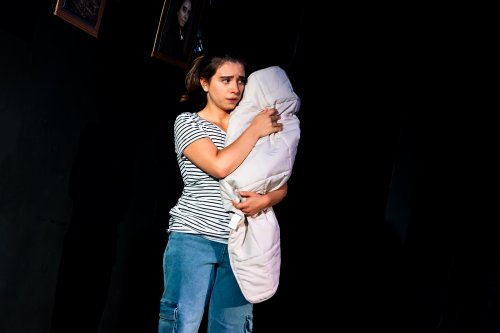
Sophie Zmorrod in a scene from Melissa Maney’s “Hungry Women” at SoHo Playhouse (Photo credit: Rebecca J Michelson)
The quartet of actresses are astute at playing different characters 100 years apart who are descendants of the earlier characters. Playing women who are all conservative and have traditional beliefs about women’s roles, Lester makes all three of her characters quite separate. Following the V track, Zmorrod is most interesting as the rebel among them, asking questions that cause various problems. As the timid one who is still curious, Dean’s three women are amusing due to their naïveté. More reticent than the others, Mariyea is memorable as the voice of reason and understanding.
The all-female production team is definitely on the same page as the playwright and director. Qingan Zhang’s scenic design for the small stage at SoHo Playhouse is excellent for the first two scenes as are the sophisticated projections for the third. Olivia Vaughn Hern’s color-coordinated costumes putting each actress in a similar color scheme to her ancestor is clever while the Founding Mother costumes are very satiric. The lighting by Annie Garrett-Larsen is suitable for each succeeding scene, creating different environments. Only the sound design by Chris Verde has problems as the recorded men’s voices in the séance scene are very difficult to understand.
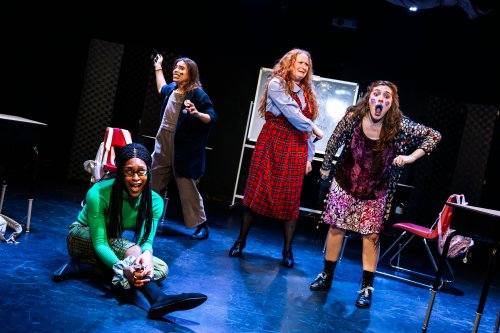
Mariyea, Sophie Zmorrod, Julia Lester and Zoe Dean in a scene from Melissa Maney’s “Hungry Women” at SoHo Playhouse (Photo credit: Rebecca J Michelson)
Melissa Maney’s Hungry Women is an absorbing play that follows its premise all the way to its conclusion. The storytelling is engrossing though to some extent the ending is predicable. The play’s problem is that the three parts are written in different styles and feel like three different plays. Nevertheless, the performances by Julia Lester, Zoe Dean, Mariyea and Sophie Zmorrod are riveting enough to supersede this dramaturgical problem.
Hungry Women (through August 30, 2026)
Black Watch Theatre
Soho Playhouse, 15 Vandam Street, off Sixth Avenue, in Manhattan
For tickets, call 212-691-1555 or visit http://www.sohoplayhouse.com
Running time: 90 minutes without an intermission


Leave a comment