
ON THE TOWN WITH CHIP DEFFAA…. AT “A WALK ON THE MOON”
Pamela Gray--an insightful writer with a terrific ear for dialogue--has turned her 1999 motion picture, "A Walk on the Moon," into a new musical with a knockout cast. The score is uneven, but the show is so abundantly filled with life--and such strong performers--I want to see it again.

Logo for the new musical “A Walk on the Moon” at the Laura Pels Theatre
There’s much to love in the new Off-Broadway musical “A Walk on the Moon”—an adaptation of the 1999 motion picture of the same name that’s just opened at the Laura Pels Theatre.
The original film, set in the Catskills in 1969, has long been a favorite of mine. It was so brilliantly written by Pamela Gray and directed by Tony Goldwyn, and featured such a strong cast, that I was skeptical when I first heard reports that Gray was developing a musical-theater adaptation. The film seemed almost perfect to me in its own way; I just didn’t see the need for a theatrical version.
But, boy, was I wrong! This musical, warm, and honest, and very human, not only held me from beginning to end—I actually wish it were a bit longer. (And that’s very rare.) Its current running time, including the intermission, is two hours and fifteen minutes. I would have gladly welcomed adding ten or fifteen more minutes of dialogue, to develop some underwritten characters a bit more and to create greater tension in the second act before releasing that tension for the happy ending.
But I’m very glad I caught this show. I attended a press performance, the night before the show’s original opening. And the show has resonated with me since seeing it. I’d like to see it again. Oh, there are some things that I think could be better, as I’ll explain in a bit. But this show’s strengths far outweigh its imperfections.
There’s a solid book by Pamela Gray. (And good musical-theater book writers are in short supply these days.) The show is well acted, well cast (by the TRC Company, Merri Sugarman, CSA), well directed (by Sheryl Kaller), well designed (by Tal Yarden). It has a big cast for an Off-Broadway show—13 actors. And there is one exceptionally vibrant performance that I’ll tell you about in a bit.
The score (by AnnMarie Milazzo, with additional lyrics by Gray) is uneven. There are moments when a not-so-great song, alas, is sold too hard; but there are some really rewarding songs. I hope they make a cast album; I’d enjoy it. And this strong cast’s work ought to be memorialized on disc. (A cast album will also help the show get more productions.)
* * *
The show takes place in the summer of 1969. The Kantrowitz family—Pearl, the mother (Talia Suskauer); Marty, the father (Max Chernin); their children, 15-year-old Alison (Sophie Pollono) and young son Danny (Leo Caravano); and the paternal grandmother, Lillian (Andrea Burns)—are doing what so many Jewish families in New York did back then. They’re spending the summer “in the mountains.” It’s a tradition—long-gone now—that they thought would go on forever. The only “big event” that anyone was anticipating that summer was that astronauts would be going to the moon.
But times are changing. Women’s liberation is in the air. And not far from the little resort in the Catskills (“Dr. Fogler’s Bungalow Colony”) where the Kantrowitz family is staying, hundreds of thousands of young people will be gathering this summer for the Woodstock Festival. And the voices of the younger generation will definitely be heard.
The show captures very well the feeling of the time (which I certainly recall clearly; like playwright Pamela Gray, I was coming of age in 1969). Gray has a terrific ear for dialogue. And she treats each major character with respect. There are no villains here. We see each character’s point of view. And all seem sympathetic; we feel for them, from the hapless, put-upon father, to his wife who so badly wants more out of life than she’s found thus far; to the impassioned daughter, who’s glad she’s on “the right side” of the Generation Gap.
The mother, the children, the grandmother are spending the whole summer in the Catskills. The hard-pressed father, a TV-repairman slaving away at a job he doesn’t like, can only join the others on weekends—and not even on all weekends; he has to stay back in the city to make a living.
Pearl (the mother) has lots of time on her hands this summer to reflect upon how unfulfilling her life feels. She falls for a dashing, free-spirited fellow named Walker Jerome (“the blouse man,” played by Sam Gravitte)—a man who goes from resort to resort selling clothes to women.
She winds up having an affair with “the blouse man”; he tells her she should leave her boring, constricting old life behind, and run away with him to California. To her, he seems to be living life much more fully than the people she knows.
In the second act, she gets to sing—with tremendous impact–a wonderful song with an absolutely dreadful title: “Ba Ba Ba Dah (Fine).” In this song she gets to express—for better than she could via mere dialogue—the elation her affair is bringing her. Her lover has opened her up to seeing so many more possibilities in life. It’s a peak moment in the show, and I’d buy a cast album, if they ever make one, just to hear once againTalia Suskauer sing that song (which really deserves a better title)..
At the same time that the mother is finding fulfillment in her affair, her 15-year-old daughter, Sophie, is falling in love for the first time—with a 16-year-old she’s met at the resort, Ross (played by Oscar Williams).
And then Ross persuades Sophie to sneak off with him to Woodstock.
And then Walker Jerome (“the blouse man”) persuades Pearl to sneak off with him to Woodstock.
Sophie winds up seeing her mother with the blouse man at Woodstock, and realizes that her mother is cheating on her father. At about the same time, the father is learning of his wife’s affair—and Pearl suddenly feels like everything is falling apart.
It’s a very well-constructed story, and the actors bring it to life with great flair.
* * *
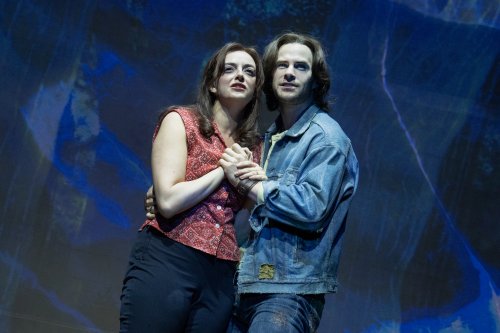
Talia Suskauer as Pearl and Sam Gravitte as Walker in a scene from the new musical “A Walk on the Moon” at the Laura Pels Theatre (Photo credit: Joan Marcus)
It fascinated me to see the ways Pamela Gray has changed the story, in the process of turning the motion picture into a stage musical. There are some things I liked better in the movie, other things I like better in the current stage musical. And there are ways, I think, that the stage musical production could be made even better.
Both the film and stage versions have been well cast. In the movie, Diane Lane played the mother (Pearl); Liev Schreiber played her husband (Marty); Viggo Mortensenplayed her lover (Walker Jerome, “the blouse man”); Tovuh Feldshuh played the grandmother (Lillian); Anna Paquin played the daughter (Sophie); and Joseph Perrino played Ross.
The film felt very much like the mother’s story; the other characters felt to me rather like adjuncts, like supporting players in Pearl’s story.
The performances that registered most deeply with me, when I originally watched the film, were those by Tovuh Feldshuh (unforgettable as matriarch of the family, the grandmother with steel in her spine, fiercely determined to hold the family together) and Diane Lane playing Pearl (whose desires to find herself–to fully realize who she could be, besides being defined as someone’s wife or someone’s mother—were what drove the whole story).
But the changes come at a price. If the daughter (Allison) and her boyfriend (Ross) now feel more substantive, if their characters are now more fully fleshed out, some of the other characters, like the grandmother and the husband, now feel less substantive (leaving two fine actors—Andréa Burns and Max Chernin–with less to work with than they should have). And the young son, Danny, is now almost like an “extra.”
I wish a way could be found to restore some moments from the film that have been dropped here—like the grandmother trying to deal with an emergency with young Danny (stung by a swarm of wasps), while the mother is off with her lover; and Walker Jerome getting to meet members of Pearl’s family, and grasping the extent of her ties to them, before his affair with Pearl becomes public knowledge. He sees how much she loves her family, and that running away with him would not be as simple as he’d imagined.
Those scenes not only added emotional richness to the story, they helped heighten the tension we felt as we wondered what the consequences of Pearl’s affair would be. We saw—more fully in the film than in the stage production—how Pearl’s affair could affect others.
The tension is relieved too quickly in the stage musical, compared to the film. Maintaining the tension longer before finding a happy ending would pay off much better, dramatically.
* * *
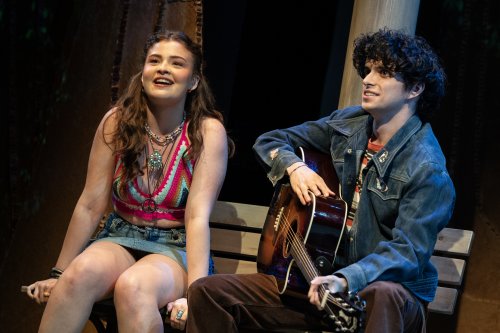
Sophie Pollono as Alison and Oscar Williams as Ross in a scene from the new musical “A Walk on the Moon” at the Laura Pels Theatre (Photo credit: Joan Marcus)
I mentioned that although the film was filled with strong actors, the performances I personally found most memorable were those by Tovuh Feldshuh (who, incidentally, gets to make a cameo voiceover contribution to the current stage musical—a most welcome touch) and Diane Lane.
In the current stage musical, I might note, the performances I personally found most memorable were those by Oscar Williams (playing the daughter’s boyfriend, Ross—a part that barely existed in the film but has been significantly expanded now), Sophie Pollone (playing the daughter, Allison), and Sam Gravitte (playing Walker Jerome, “the blouse man”).
I’ve long appreciated Gravitte’s work, although I felt bad for him because for a while he couldn’t seem to catch a break. I first took notice of him when he was a student at Princeton University (I’m a loyal Princeton alumnus), where he was active in both theater and arch-singing (not to mention lacrosse). He got to take over an important role (“Fiyero”) in Wicked on Broadway, but then the pandemic shut down all theater in NYC. And although he got to play the role for a couple of years in Wicked once the pandemic was over, most reviewers don’t ever see cast replacements in long-running shows. So he didn’t get the recognition he deserved. (I went back to see Wicked again, specifically to see him.) But originating a role in this New York production of A Walk on the Moon should bring him well-deserved greater attention. He has an unusually lovely voice, an engaging manner, and an easy grace; he’s never pushing. And he makes his character most appealing. The chemistry between him and Talia Suskauer is great; you sure believe in their affair.
Newcomer Sophie Pollono plays the 15-year-old daughter, Allison, with aplomb, finding more in the role than Anna Paquin did in the film (which is saying plenty). Whether she’s “up” in one scene or “down” in another, she’s aways believable. She’s stridently idealistic—her generation will fix everything!—in a way that captures the era well. And it is touching when she tells her mother she is not sure but thinks she may be falling in love; all she knows for sure is that Ross has made her feel “more awake” than ever before. (Aptly said!) The mother cannot, of course, respond that she’s experiencing her own sexual awakening via her covert affair with Walker Jerome; all she can tell her daughter is that that’s the way she felt when she first fell in love with her husband—Sophie’s father—about 16 years before. The sexual attraction between Pearl and her husband may have faded since then, but she still remembers how he once made her feel.
Pollano gets to display a considerable range of emotions well, from the elation of first-love to her horror of discovering—at Woodstock—that her mother is cheating on her father. (Incidentally that discovery scene was handled more boldly and more effectively by the film’s director, Tony Goldwyn, than by this musical’s director, Sheryl Kaller. In the film, the daughter does not merely see that her mother is present at Woodstock with the blouse man–the mother appears to be high, and she’s exposed; there’s partial nudity. And when we–and the daughter–see a glimpse of the mother’s exposed breast, it hits us like a slap. The daughter is shocked. And will later tell her mother she was disgusted. Director Sheryl Kaller makes a more prudish choice in staging this scene; we don’t witness that moment of partial nudity, and it lessens the scene’s impact.)
But Pollano was a delight throughout. And well-matched with Oscar Williams, playing the boyfriend Ross.
Williams’ exceptionally vibrant performance is one I won’t soon forget. He lit up that stage from start to finish. As I’ve noted before in these pages in past years, I’ve relished his work in “Fun Home,” “The Secret Garden,” and “The Last Five Years,” as well as performing in cabaret. And his work keeps getting better. He’s a musical-theater natural, with vivid presence on stage. He’s got charisma, which is rare and indefinable, but a wondrous gift to have. It didn’t feel like he was acting; he WAS that character. He’s actually 22, but he was convincingly 16 throughout. And he was giving 100%, all night.
When Sophie first discovers Ross, he is singing confidently how he sees himself as “a Jewish Jimi Hendrix.” (If they make a cast album, I’ll play that track a lot, too.) He’s funny and he’s exuberant, and there’s a light in his eyes that makes the whole performance seem to shine.
He’s also present and engaged in every scene, whether he’s speaking, singing, or merely listening (and realistically reacting) to what others on stage are saying. There’s a scene in which Sophie is blurting out to her mother and father (and everyone within earshot) how Ross, on their first date, got to “second base” with her. (And Ross, with an endearing smile, gives Sophie’s father a look that seems to say “I’m sorry I took advantage of your daughter, but please don’t hold it against me.”)
I’m going to encourage some of the younger actors I work with to go see this musical, and study the way Williams makes every moment he has onstage count. And even moments when he’s not yet onstage, for that matter. He makes his entrance for one scene by bounding down the aisle from the back of the house and then jumping up onto the stage! Unforgettable!
Gray has a keen feel for dialogue. The characters, for me, felt like old friends. The characters—both young and old—felt like people I grew up with. And Gray captures a whole milieu well, from the chatter of the mothers playing mahjong, to the fathers competitively comparing how quickly they’d managed the long drive up from NYC to the Catskills.
And I felt for the father, aware that he was a man some would call a square, or consider uptight; and he’s uncertain if he could change to be the sort of man his wife seems to want. The uncertainties and ambiguities are real. I wanted the play to explore those issues a bit longer.
But I liked this musical play. I hope the author continues to develop it further. And I hope I get to see it again.
–CHIP DEFFAA


Leave a comment