
The Unknown
In a tour de force for Sean Hayes, David Cale’s thriller plays masterfully from moment to moment with an audience’s expectations.
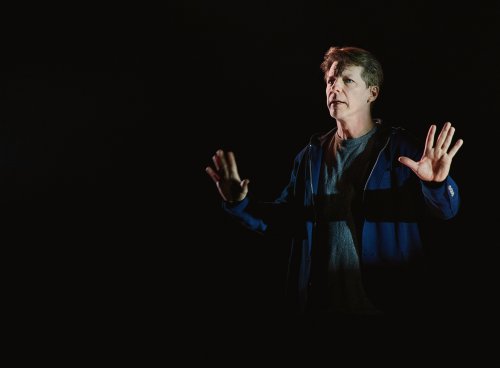
Sean Hayes in a scene from David Cale’s “The Unknown” at Studio Seaview (Photo credit: Emilio Madrid)
In The Unknown, a diabolically elegant chamber piece of self-invention and psychic unraveling, Sean Hayes delivers a performance of unnerving finesse, navigating David Cale’s labyrinthine text with a suppleness that makes its many sleights of hand feel less like virtuoso display than like the natural byproduct of a mind in crisis. What begins as a seemingly straightforward artist’s retreat—Elliott, a blocked playwright-composer, decamping to a borrowed house in the wooded isolation of upstate New York—quickly curdles into something far more gothic and disquieting, as a disembodied voice in the night begins to sing as if conjured from the recesses of his own thwarted longing. More unsettling still, the unseen man is singing a song of Elliott’s own composition—“I Wish You’d Wanted Me”—a title that, in its plaintive specificity, feels less like ornament than omen. The disturbance derives its power not from volume but from proximity: his own melody, once an expression of private feeling, returns to him as a form of violation.
Under the direction of Leigh Silverman, the production accrues a slow, insinuating dread. The design elements—Cha See’s shadowy, suggestive lighting, Caroline Eng’s eerily dislocated soundscape (she conjures an immersive aural landscape: a disembodied singer seems to circle the upstate house in real time, his presence mapped in sound—the faint crunch of leaves underfoot, the shifting proximity of his voice—until the space itself feels porous, breached from all sides), and Isobel Waller-Bridge’s taut, nerve-pricking score—conspire to turn the stage into a kind of psychic echo chamber, where identity itself seems to reverberate and fracture. The austere black box devised by Studio Bent keeps the eye trained squarely on Hayes, while Sarah Laux’s unassuming street clothes—anchored in a telling wash of gray—quietly underscore the character’s studied neutrality, as if Elliott himself were trying to fade into the margins of his own story.
Cale, who might easily have inhabited the role himself, ultimately pulls the rug out from beneath both Elliott and the audience, nudging the piece into a sly meta-theatrical register that interrogates authorship, performance, and the porous boundary between invention and confession. Cale’s script toys deliciously with the grammar of the thriller, edging toward the cinematic—one can easily imagine a nervy adaptation under the cool, prurient eye of Brian De Palma—while never relinquishing the intimate contract of the solo performance. Hayes, fresh from his bravura Tony Award-winning turn in Good Night, Oscar, proves an uncommonly dexterous guide through Elliott’s increasingly baroque descent, slipping among characters and tonal registers with a liquidity that feels almost involuntary.
The song shadows Elliott back to New York, where the atmosphere thickens into something stranger still. The most plausible explanation presents itself—a slighted actor, an “unknown” in every sense, spurned from a workshop of the musical—but Elliott, dulled by creative stagnation, meets the intrusion with curiosity rather than fear. Indeed, he begins to pursue the figure himself, drawn less by self-preservation than by the tantalizing prospect of artistic ignition.
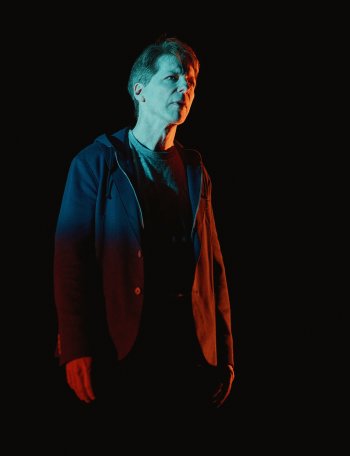
Sean Hayes in a scene from David Cale’s “The Unknown” at Studio Seaview (Photo credit: Emilio Madrid)
His Elliott is wry, self-aware, and faintly unmoored; even as the narrative spirals into a hall of mirrors populated by possible stalkers, dubious acquaintances, and versions of the self that may or may not be fabrications, Hayes anchors the evening with a disarming, almost conspiratorial charm.
Hayes proves wholly persuasive, gliding among a gallery of supporting figures (Hayes delineates 11 distinct characters with astonishing lucidity, his transitions so fluid they seem almost instinctive, even as the narrative around them grows increasingly clouded and labyrinthine.) with a lightness that never calls attention to its own virtuosity. As Elliott, he is coolly, almost disquietingly composed, revealing only the briefest fissures beneath a meticulously maintained façade—a man who seems able to exist only in the telling of stories, never quite as himself.
Yet for all the circumstantial detail with which Elliott unfurls his story, he remains curiously opaque at the center of it—an absence where a self ought to be. The reasons for this evasiveness emerge only gradually, resolving, by the play’s close, into something at once clarifying and quietly devastating. Elliott’s elusiveness is not merely a narrative trick but the key to a more tender and troubling concern: the sorrow of a life half-lived, of a consciousness unable—or unwilling—to cohere into a stable whole. He drifts through his own account like a ghost of himself, a figure in search not simply of a story, but of an identity he can bear to inhabit—a walking unknown.
The play keeps possibilities suspended in a state of tantalizing flux, and for this thrilling ride its grip is undeniable. Cale’s writing is at its most incisive—and slyly, almost offhandedly funny—in the early barroom encounters, and in Elliott’s dawning, discomfiting awareness that he may already be alchemizing his ordeal into material. As the action gathers momentum, the piece takes on a lacquered sheen of dread, its tensions tightening with a quiet, inexorable force.
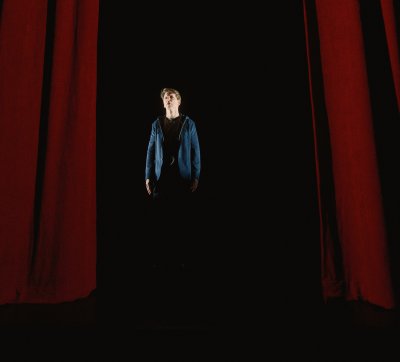
Sean Hayes in a scene from David Cale’s “The Unknown” at Studio Seaview (Photo credit: Emilio Madrid)
If the play’s narrative machinery occasionally threatens to over-elaborate its own enigmas, its pleasures are nonetheless considerable. “In the movies, this is where the music would first come in,” Elliott remarks at one point—a winking acknowledgment of the genre it both invokes and subverts. By the time the final turn arrives, one is less concerned with the precise calibration of its twists than with the uncanny atmosphere it sustains: a shimmering, disquieting meditation on the stories we tell about ourselves, and the strangers we become in the telling.
Hayes is mesmerizing throughout, sustaining our allegiance even as Elliott’s reliability dissolves into something vaporous and suspect. So ingratiating is his presence that we submit to the journey without resistance, following him—almost gratefully—into the gathering shadows of The Unknown, which he navigates with a performer’s instinctive authority and a magician’s quiet command.
In The Unknown, the theatrical artifices—its doublings, its narrative feints, its hall-of-mirrors construction—feel not merely clever but earned, grounded in a scrupulous attention to the inner weather of the mind. Cale has composed something rarer than a tidy psychological puzzle: a meditation on isolation and identity that resists the consolations of clarity. Rather than shepherding the audience toward resolution, he invites us to linger in uncertainty, to dwell within contradiction, and to recognize, perhaps uneasily, how much of the self remains irreducibly unknown.
The Unknown (through April 12, 2026)
Studio Seaview, 305 West 43rd Street, in Manhattan
For tickets, visit www.studioseaview.com
Running time: 65 minutes without an intermission


Leave a comment