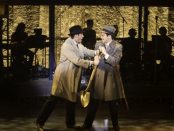
“We'll Take a Glass Together” is an exhilarating production number. Brandon Uranowitz’s animated youthfulness is up to the task of equaling the impact of Michael Jeter’s legendary turn in the original production as the dying bookkeeper enjoying a carefree spree. Mr. Uranowitz’s limber movements are thrilling as he euphorically undulates up and down flanked by a large gold dance barre carried by the terrific ensemble. [more]
Any further comparisons with the Broadway musical "Come From Away" end with the Nova Scotia setting as Chaim and Chaya quickly settle in Montreal where the 19-year-old Chaim marries the 24-year-old Chaya, who lost her husband on the trek from Romania to Russia to escape the pogroms. (Her husband died of typhus, which becomes a recurring theme in the story that unfolds.) To be sure, their tales are “dark” ones, as put together in the play by an apparent descendent Hannah Moscovitch of the real Chaim and Chaya. [more]
It would be a pleasure to say that Musicals Tonight! is going out on a high but that would not be accurate. While the book by Ronald Hanmer and Phil Park based on the play by Charles K. Freeman is very old-fashioned and the original score by Sammy Fain and Paul Francis Webster is quite derivative, the real problem is with the production staged by Devin Vogel making his Off Broadway directing debut. While the Wild West material suggests color and ambiance, this "Calamity Jane" is devoid of those things. [more]
Hilariously impersonating Marlene Dietrich while playing an accordion, singing and trotting about, is one of the grand highlights of performer Phoebe Legere’s "Speed Queen." Spanning from W.W. I to the present, it’s a madcap lesbian historical and musical fantasia about Joe Carstairs, for which Legere has written the book and original score. [more]
"Jerry Springer - The Opera" is not for opera purists nor is for people who are easily offended by four letter words and other bad language of which there is a multitude. However, its irreverence skewers social, religious and political hypocrisy. The New Group’s production directed by John Rando is one of the most exciting musical theater experiences to be currently obtained in New York. It actually seems more relevant in Trump America where this sort of thing is cable-fodder every night of the week. If you are a dedicated theatergoer, miss this show if you dare. [more]
All the good jokes get lost in the onslaught of cast members vying for their moments and looking for the audience’s approval, which admittedly was offered freely. "Bitches" becomes chaotic, crude and in your face, not to mention clichéd, the clichés hiding behind dirty jokes and blatant shtick. Raine clearly can’t rein in the cast’s enthusiasm even though they are portraying animals with animal passions. [more]
They’re friends in the present. Someone picks up yellowed newspaper articles from the past. Then we’re in New York City’s Lower East Side in 1911. We meet the spunky 13-year-old Roselia. She is the daughter of immigrants and her goal is to become a muckraking journalist. An exposé of the local butcher was one of her scoops that have been published. Her older sister is to marry a genial young man. Her parents are very affectionate but due to their hardscrabble circumstances it’s decided that after her impending 14th birthday, Roselia will leave school to join her mother and sister in working in a garment factory to bring in more money to the family. This heartbreaking thread is the most substantive, affective and dramatic of the three tales. The girlish and luminous Lena Hudson makes a great impact as Roselia. Kate Loprest’s practical but maternal characterization of the mother is perfect. “The House on Ludlow Street” is a haunting song that is woven through the narrative. [more]
Thus begins the unique show, "Black Light," which is a concert cum confessional. In her sequenced gowns--and there are five costume changes during the 90-minute performance--and with her red lipstick and frizzy, frazzled, dark hair, Jones sometimes provides a strong, alto voice for her intermittent songs, ranging from ballads (“Crossroads”) to hard rock (“Life is motion”). [more]
"Subways Are for Sleeping" is a valentine to New York and projection designer Lacey Erb has created atmospheric slides and streaming video of such iconic locations as Grand Central Station, Park Avenue, Rockefeller Center and the Metropolitan Museum of Art. Unfortunately, the original problem with the material has not been solved: Tom and Angie are just not very interesting. They have little or no back story and no outstanding characteristics. As was famously true in the original production, the show is stolen by the secondary leads. With their continually inventive schemes to get through each day, slacker Charlie who lives off his former friends and would-be nightclub performer Martha with her Southern accent are a total delight. Unfortunately, they are off stage most of the time. The rest of the many characters are simply walk-ons. [more]
The cast seems to have been mostly chosen for their comic skills rather than their singing skills. Nevertheless, Josh Waldren and Matthew Fairless as the visiting travelers turn “Dear Old Syracuse” into a delightful soft shoe number complete with straw hats and canes, and Walden has a lovely duet with Darrell Morris, Jr. as Luciana to “This Can’t Be Love (Because I Feel So Well).” Shapiro's Luce and Ian Fairlee as Dromio of Ephesus have a big success with the witty, “He and She,” a comic specialty number. However, much of the show has been eroticized and there is a “wink wink” feeling to the overall approach. [more]
"Bar Mitzvah Boy" may not be a top-drawer Jule Styne musical, but Jack Rosenthal’s original story and David Thompson’s new book are excellently observed to have the ring of truth. The family chaos in planning the affair and problems precipitated by the young son’s behavior are sharply and shrewdly detailed enough to be absorbing in a way that all can relate to. Annette Jolles’ production for The York Theatre Company gets a great deal out of the material even in a version without the trappings of a full production. It is also a pleasant surprise to see an unfamiliar musical by major talents which fills in a gap in their careers. [more]
Writer-performer Bob Martin recycles his sweater-clad disaffected “Man in the Chair” character from his 2006 Broadway musical "The Drowsy Chaperone." The conceit is that he’s a disgruntled Encores! subscriber who has been chosen to pick his selections for inclusion. Mr. Martin addresses the audience to offer commentary, often tells inside jokes and interacts with the cast. Depending on one’s sensibilities, this is either an inspired or an insufferable device. However, it doesn’t mar the actual production. [more]
The first act is a faithful and skillful hour-long condensation of "The Seagull." The second act is a clever hour-long vaudeville-style amalgam of "The Cherry Orchard," "Uncle Vanya" and "The Three Sisters" in the detailed manner of one of Mel Brooks’ cinematic parodies. [more]
While the new cut-down version (performed concert style with book in hand) with nine actors instead of the original 36, now covers 100 years, rather than the sixty in the original show, it still remains a shorthand version of the history of the movement as well as the trials and tribulations of African American performers in show business. Originally written with Lena Horne in mind, when she turned it down the starring role of Georgina Franklin went to newcomer Leslie Uggams and was subsequently revised to accommodate her softer, girl-next-door persona. Although her perky, animated performance won her the Tony Award for Best Actress in a Musical, Laurents was never happy with the compromises made to the show. The more tightly written show which now focuses on four main characters still doesn’t solve all the problems inherent in the material, as directed by Gerry McIntyre it does make for fast-paced musical entertainment with a great many unfamiliar songs. [more]
This comedy/drama/fitful musical also suffers from major tonal challenges, as it strains to push all of our emotional buttons. It’s a shame, because the cast gives it their all. Particularly good is Zoe Wilson, as Leni, a severely depressed teenager whose body dysmorphia has led to self-cutting and bouts of suicidal ideation. Wilson is just the right mix of pained and angry. Whenever she speaks, or sings, The Pill feels centered and we’re ready to delve deeper into Leni’s personal struggles. [more]
The main event, however, is the performance of Harris who doesn’t just imitate Baker but uses her own gifts to illuminate the multitalented cult figure. It’s as if Baker has brought out the best in Harris and she returns the favor with her vivid singing, unabashed dancing and direct connection with the audience. The songs include well-known ditties like “I’m Just Wild About Harry,” “Ain’t Misbehavin’,” “Blue Skies,” a particularly moving “And Then I’ll Be Happy,” “Minnie, the Moocher,” the Civil Rights anthem “Strange Fruit,” “The Times They Are A-changing,” and a heartbreaking “La Vie en Rose.” [more]
Another irony is that while Fury is kind of a bore, another character is not. Yeah, you guessed it. Him. When the president (David O. Friedman) appears in Fury’s bedroom like the Ghost of Christmas Present, Attea’s writing finally comes to life. His take on you-know-who isn’t unique, but the situation is wonderfully silly, and Friedman’s impression is a funny profile in petulance. [more]
Yazbek’s songs—ranging from the darkly comic “Welcome to Nowhere” (sung by the town folk) to Dina’s romantically tinged “Omar Sharif” and ending with the upbeat, danceable “Concert” played as a finale by the Band—rise magically from the dialogue, just as Patrick McCollum’s choreography emerges naturally from walking, singing and thinking. [more]
As "Rock of Ages" did for the 1980’s, "Cruel Intentions: The Musical" does for the 1990’s. This is a carefree entertainment accompanied by the revelry incited by a two-item minimum in a nightclub. For many audience members, the Proustian pleasure of experiencing songs that they fondly recall shoehorned into the plot from a minor movie they might remember will suffice. It’s decidedly not an event for musical theater connoisseurs. [more]
Vince Guaraldi’s monumental jazz themes are beautifully rendered by musical director Jenny Shiroma on piano, Laura Hamel on percussion and Billie Sholen on bass. This talented trio also performs marvelous renditions of a number of classic holiday numbers including “The Christmas Song,” Tchaikovsky’s “Dance of the Sugar Plum Fairy” from The Nutcracker, and “Silent Night.” Most crucially they do great justice to Mr. Guaraldi’s wistful “Christmas Time Is Here.” [more]
Moses’ famously crowded and contentious career is glossed over except for his final battle with Jacobs over the Lower Manhattan Expressway. "Bulldozer" doesn’t even give a good summary of his long and length exploits. Although the program lists the time scheme, there is nothing in the show to let us know how much time passes between any of the scenes. The dialogue does a lot of name dropping (Al Smith, Jimmy Walker, Fiorello LaGuardia, Franklin D. Roosevelt, Walter O’Malley) without making any of these people real. Hardly any of the songs forward the plot but instead tell us what we already found out in the preceding dialogue scene. The song lyrics have endlessly repeated refrains and choruses which is typical of rock and pop songs but death in a theatrical presentation in which we expect more information and cleverer wording. [more]
Deffaa’s great achievement is joining the narrative portions with just the right song. An anecdote about encountering Florenz Ziegfeld having an office dalliance with a chorus girl is followed by “A Pretty Girl is Like a Melody.” “I Love a Piano” is preceded by Berlin’s extolling of his beloved piano nicknamed “Buick. ” [more]
Written by The Bengsons and Sarah Gancher, the show presents a stylized take on the couple’s love at first sight meeting, the complications it caused with their partners at the time, their instant romance and quick marriage. It’s a New York story as they lived in Astoria, there’s mention of a memorable walk from Canal Street to The Cloisters, and a trip to Coney Island is pivotal. [more]
Decked out in nerdy regalia of a yellow shirt, red tie and plaid pants with suspenders, Ethan Slater is terrific as SpongeBob. The immensely personable Mr. Slater wonderfully sings, dances and acts with the force of a Broadway titan such as Robert Morse in "How to Succeed in Business Without Really Trying." Using whiny vocal inflections and animated facial expressions, Slater perfectly replicates the essence of the television character. [more]
Director Arden, a 2005 Juilliard graduate, has impressed with his reinvention of the 2015 Forest of Arden/ Deaf West Theatre revival of "Spring Awakening" for which he was nominated for a Tony Award. Among his clever additions to "Once on This Island" are the use of a chorus of eight to play the Storytellers who relate the tale through Ahrens’ book and lyrics, a new sonic palette for Flaherty’s calypso-tinged score with musical instruments made from found objects, and a set which puts us on the shores of the very island where the story takes place with the audience sitting on all four sides of this newly created beach. His young lovers Ti Moune and Daniel seem a good deal younger than before, making the story that much more romantic and ultimately more tragic. [more]
Serving as both narrator and protagonist, Harris portrays Blue, a runaway slave who crossed the Sabine River from Louisiana to Texas in search of his elusive freedom. To tell us everything that came before and after this momentous event, Harris is joined by three other impressive vocalists/performers in a concert-style presentation that has all the charm and verve of an old radio play. [more]
"American Idol" winner Candice Glover, "The Voice"’s Josh Kaufman, "America’s Got Talent"’s Bianca Ryan and the attractive, married couple Peter Hollens and Evynne Hollens, who are popular on YouTube, comprise the youthful cast. They all bulldoze their way through more then 20 classics. The vocal grandstanding is matched with overly expressive gestures and grimaces that invariably crush the meanings of the songs. [more]
Kait Kerrigan and Brian Lowdermilk’s original book is filled with incidents, vignettes, reflections, observations, and flashbacks, but short on actual plot. There is deciding on which college to attend, or not to go to college at all in order to find oneself, and the suspense of passing a driving test. A tragic occurrence is a major event. [more]
In their new rock musical "Billy and the Killers," lyricist/librettist Jim Shankman and composer Peter Stopschinski channel Nicholas Ray, David Lynch, Elvis Presley, and Dashiell Hammett to concoct a muddled tale of teenage rebellion that dead-ends in an even less coherent murder trial. Along the way, there are some well-performed songs whose lyrics seem to be tied to the plot, but it’s often hard to tell, since, as you probably already know, proper enunciation is not what rock ‘n’ roll is all about, man. [more]
Leave it to George S. Kaufman and collaborator Morrie Ryskind (the Marx Brothers’ "The Cocoanuts," "Animal Crackers," "A Night at the Opera" as well as the Gershwins’ "Strike Up the Band"), lyricist Ira and composer George to come up with the first all satirical political musical and be prophetic as well. Led by Tony Award nominees Bryce Pinkham, Denée Benton, Kevin Chamberlin, Brad Oscar and Tony winner Chuck Cooper, this concert adaptation proves that there is still life in the 86-year-old musical. [more]
The score is comprised of Jerry Garcia & Robert Hunter’s Grateful Dead music and lyrics with additional music and lyrics by Phil Lesh, Mickey Hart, Bob Weir, and Bill Kreutzmann. It’s all an engaging patchwork well-realized by Jeff Chimenti’s polished musical supervision and arrangements. Though it’s wonderful experiencing such spirited renditions of Grateful Dead classics such as “Truckin,” “Casey Jones,” “Alabama Getaway” and “A Touch of Grey” by the talented ensemble, "Red Roses, Green Gold" doesn’t really cohere into a satisfying work of musical theater. [more]
During the jam-packed ninety minutes of "This One’s For the Girls," the foursome run through a batch of songs that show the ups and downs of the last one hundred or so years through the eyes of women. Ms. Marcic puts her characters through the romantic, social and professional wringer. Their individual tales are illuminated by songs and clever dialogue, helped by the set design of Josh Iacovelli which includes walls painted with artful pictures of famous ladies and a continuous slide show of portraits and scenes of historic and social importance such as fashions, sheet music, popular literature and family portraits. Mr. Iacovelli also designed the subtle lighting which makes the most of the tiny stage. [more]
Boycott gets to sing a bounty of scintillating songs including “It’s A Perfect Relationship,” “Is It A Crime?,” “I’m Goin’ Back” and her duets with Heuser in “Better Than a Dream” (written for the film version) and “Long Before I Knew You.” Colgan’s choreography includes witty dance numbers to “Independent,” “I Met a Girl”, “Mu-Cha-Cha,” and “The Midas Touch.” Sue and Otto have a hilarious parody of the operetta aria in “Salzburg (By the Sea),” and the singer and girls of the Pyramid Club do a clever take on a cut-rate Busby Berkeley number to “The Midas Touch.” [more]
As the show progresses with intermittent songs, the other musicians/singers (Ryan McCurdy, Matt Park, and Rocky Vega) also strip down to their underwear/lingerie. The sounds they all make are, at times, infectious. And Oh is a natural-born performer, who instantly has us in her thrall. Though the show has been co-directed by Orion Stephanie Johnstone and Oh, it’s hard to imagine anyone reining in its star. And if the “first installation” of Oh’s latest show occurred when she stood on a soap-box in Times Square pontificating in 2014, it’s hard to say how it’s progressed since then. Unless you were there, you just wouldn’t know. [more]
While not all musicals from Shakespeare have worked and updates are particularly risky, "Desperate Measures" avoids all of the pitfalls and is a refreshing and satisfying work in its own right. The catchy score has superb songs in the vein of the Broadway western musical. It is hoped the show has a long life beyond this production, like its young hero, in years to come. [more]
Mr. Njikam offers a witty take on the classic mythology of a hero’s episodic journey with a lively African-American slant. There are a lot of high school and college scenes with wise teachers referring to James Baldwin and W.E.B. Du Bois, combative students, a dying father and an imperious mother. Rhyming battles, love and enlightenment occur along the way. The narrative is so eventful and spread out that it can be difficult taking it all in and its overall impact is diluted. [more]
Part of the problem is the lack of innovation in Ray Roderick’s staging in this show which calls out for invention and clever handling of sets and props. Devin Vogel’s colorless stage design (making use mainly of a ladder in the first and third stories) and Hope Salvan’s equally colorless costumes for most of the show (pale grey and blue tee-shirts and jeans for the first one-act) do not help bring any atmosphere to the three separate stories which span the time scheme from Biblical days up to the present. All three stories are narrated or introduced by The Balladeer who also plays the Snake in the first story. While such songs as the catchy “Forbidden Fruit,” the lovely “What Makes Me Love Him?,” the sultry “I’ve Got What You Want,” and the folk-rock ballad, “You Are Not Real” still impress, the musical staging is lacking in showmanship and pizzazz. [more]
Although the plot has been reset in Loveless, Texas and New Orleans, Louisiana, circa 1929, it is an improvement over the original story as a romantic comedy: Shakespeare’s version ends with a death and four pairs of lovers departing and agreeing to meet in a year’s time. Loveless, Texas puts the funeral at the end of the first act, and brings all four couples, plus two more, together by the final curtain, which is much more satisfying. (No spoiler this as it is obvious what will happen – just not so obvious how they will get there.) [more]
Projected titles indicate place and year—beginning with Arles, 1888 and progressing until van Gogh’s suicide—which we hear as an offstage gunshot—in July of 1890. The audience is treated to Vincent’s thoughts on his painting technique, his poverty, his mental health, his fellow artists, stars, sunflowers, all interrupted by chamber music by Debussy, Fauré, Chausson and Franck played—in various combinations—by Henry Wang (violin), Yuval Herz (violin), Chich-Fan Yiu (viola), Timotheos Petrin (cello), Max Barros (piano) and Renana Gutman (piano). [more]
But Cohen the composer is another matter entirely--his jazz-inflected songs make "Come Light My Cigarette" a gem of a chamber musical. As more and more of the songs are revealed, time and again one is reminded of "Trouble in Tahiti." And like that classic Leonard Bernstein opera, "Come Light My Cigarette" appears to be set in the 1950’s, which the music evokes. So do the busy but impressive set and costumes, both designed by Craig Napoliello. [more]
The songs never come up to the title song made famous by Marlene Dietrich who’s mentioned several times during the play. Antin’s attempt at playful seduction, “Take Me Home Tonight,” sung by the half-dressed cabaret girls and his German-style drinking song, “Fill My Stein with Beer” are pleasant pastiche, but “How Can Germany Survive?” (sung by the beleaguered Willi) and “Time to Stand Up” (sung by Josef) are heavy-handed and obvious. The lyrics throughout, even in the love songs are of the “moon-June” variety, but, as mentioned, are sung with great feeling. [more]
The revival at the York is being seen in yet a new version of the show that began as a cabaret in 1981 and went to Broadway in 1985. Created by director Larry Alford, choreographer Wayne Alford and composer Herman, the original show included new songs written especially for the show, only one of which remains in the revival. However, as directed by Pamela Hunt ("The Musical of Musicals"), this version of "Jerry’s Girls" organizes the songs more faithfully by around each show and includes the greatest hits from "Hello, Dolly!," "Mack and Mabel," "Milk and Honey," "Mame," two numbers from "Dear World," and ending with a medley from "La Cage aux Folles." Along the way are also two unfamiliar numbers from Herman’s 1960’s revue "Parade." [more]
While the dialogue offers some stabs at humor and Opel--a first-rate comedienne of the old school--usually excels at comic timing, much of it falls flat here. Most of the 90-minute, intermission-less piece focuses, naturally enough, on Bobby’s attempts to create a new life for herself, ultimately meaning a new relationship. It’s during her second visit with the shrink that he says, “I’m making getting laid a medical directive”-- to which Bobby replies, “Can you do that?” effectively ending the scene. [more]
Book writers West Hyler and Matt Schatz have taken these facts and woven a charming piece of Americana that explores idealism coming up against cynicism. It’s very well structured, amusing and thoughtful. There are a few zingers that could be interpreted as referring to President Trump. Their chief conceit is having Banvard’s early associate Taylor, later become Barnum, and their rivalry becomes a focal point of the show. [more]
Matthew McElligott, Larry Tuxbury and Brian Sheldon’s book is a witty, smart and sharp take on pirate lore laced with a child’s sense of individuality, tolerance and inclusivity. It’s adapted from Mr. McElligott’s acclaimed series of children’s books. McElligott, Mr. Tuxbury and Michael Musial’s lyrics are quite accomplished and chock of full of crafty rhymes such as scarf with barf. Mr. Musial’s euphorically tuneful music completes the marvelous score, that’s perfectly rendered by Barbara Musial’s skillful music direction. [more]
The genial Ralph Byers’ performance as Franklin is heroic as he is onstage for virtually the entire length of the show. Mr. Byers marvelously sings, dances and cracks wise, while channeling the familiar Franklin persona with his wry vocal delivery. Byers exudes dignity, serenity and focus despite the deficient material. [more]
Mora works as a mermaid in a tank at the sideshow owned by the crusty, old Captain Murdock who rescued and raised her. As her romance with Johnny blossoms, there are complications. Her previous two boyfriends died under mysterious circumstances. An ominous woman in black mills about and there’s a fortuneteller looming over the action, as the plot builds to a tragic finale. There is also the possibility that Mora is a real mermaid. [more]
Vamping and slinking around in a bright, red tunic laden with rhinestones and wearing black tights, the vivacious Lesli Margherita steals and salvages the show as Mephistopheles. With the physical allure of the young Gina Gershon and the musical comedy talents of the young Donna Murphy, and her own quirky persona, Ms. Margherita is commanding. It’s a proverbial case of “I couldn’t take my eyes off her,” and “everything she said and did got a laugh.” [more]
Conveying the premature decrepitness of Errol Flynn with flair is Jonathan Stewart. His hair styled and with a thin mustache, the charming Mr. Stewart resembles Flynn and channels his dissolute persona and good humor with a melodious, slight Australian accent. The bearded and youthful George Psomas totally captures the look and essence of the early Fidel Castro with his edgy bearing. Combining sensuality, a lush singing voice and superior comic timing, Mr. Psomas is delightful. He and Stewart’s scenes together energize the show, particularly their clash near the end. [more]
Physically lean, with gaunt but animated features, the immensely charming David M. Lutken plays the narrator and sings many of the numbers. Mr. Lutken magnificently captures the essence of Guthrie with his wry twang, beaming smile and dramatic presence. This dimension is complete when he puts on a blue cap like Guthrie’s iconic one. That image is on display onstage, with a cigarette dangling from the side of Guthrie’s mouth. [more]
Bastard Jones is surprisingly accessible for a contemporary musical based on a long and episodic 18th century novel. Sophisticated and off-color, naughty but nice, it proves to be a sharp and irreverent entertainment. With a terrific cast and a star making performance by Evan Ruggiero, witty and clever, Bastard Jones is both a delightful 18th century and 21st century evening in the theater. [more]
The animated and charismatic Mr. Spitaletta is the standout of the cast, vibrantly appearing in numerous roles. Highlights of his portrayals are a commanding Russian agent spoofing Danny Kaye’s tongue-twisting patter number "Tschaikowsky (and Other Russians)" from Kurt Weil’s "Lady in The Dark," and a rollicking caricature of Richard Nixon. Mr. Spitaletta is an ever-present delight. [more]
Featuring an energetic, game cast headed by bigger-than-life Ashley D. Kelley as the title character, "Bella" follows this “big booty Tupelo girl,” as she travels (under an assumed last name) to meet her staid fiancé, Buffalo Soldier Aloysius T. Honeycutt (handsome, sweet voiced Britton Smith) and to escape the law. She meets a slew of fascinating characters—some who really existed and some fictitious—and finds her life taking a surprising turn in her bumpy road to marital bliss. [more]
Lazarus’ score is an entertaining blend of rock, pop and show tunes. None of Elvis Presley’s actual songs are heard, but there are a number of clever takeoffs such as “Viva Milwaukee!” and “Spread the Word of Hound Dog.” His good-natured book is a shambles. The serious, campy and satirical elements don’t connect. The plot is crammed and wayward. It recalls the 1960’s "Batman" television show as well as counterculture fantasies such as the 1968 film "Wild in The Streets" and Brian De Palma’s movie, "The Phantom of The Paradise." [more]
"Sweetee" is an admirable attempt to depict determination in the face of prejudice in the Deep South 80 years ago. While the cast appears to be older than their characters, they make a valiant attempt to make more out of the material than the show has going for it. Unfortunately, "Sweetee" seems rather thin considering the possibilities inherent in the story line. The score is pleasant but innocuous and unmemorable, always a deal breaker in a musical. Ironically, the most effective musical numbers are the actual interpolated hymns: "Amazing Grace," "This Little Light of Mine," and "Joyful, Joyful." [more]
It is set in present-day rural Afghanistan. Several years earlier, Paiman as a child was sold by his father to the well to do Jahandar. The two have an intense emotional and physical involvement that must soon cease, as Paiman is soon to marry because he is approaching manhood. Feda, Zemar, the dancing boy of Zemar, Jahandar’s droll, and mean cousin, is also aging out. Paiman and Feda fall in love and that instigates several conflicts. [more]
The playing space designed by Doyle is a narrow white runway with a stool at one end and at the other, an archway created by continuing the flooring into the air on which Japanese writing appears as on a banner. The audience sits in stadium-type seating on either side of the playing space. Eschewing pageantry, the production puts the cast in very bland outfits of black, grey, white, blue or beige (costumes by Ann Hould-Ward), adding fabric or robes when absolutely necessary. The lighting by Jane Cox occasionally bathes the stage in either red or blue mood lights. [more]
On the fourth anniversary of the Stonewall uprising in 1973, an arsonist set fire to a gay bar in New Orleans, killing 32 people. This tragic yet forgotten episode in gay history is not only part of a Harvey Fierstein monologue in "Gently Down the Stream"—currently playing at the Public Theater--but also the subject of "The View UpStairs," a new Off Broadway musical that has a lot of spark, but ultimately not enough fire. [more]