Dance
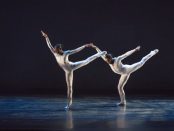
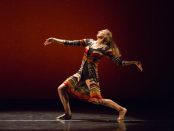
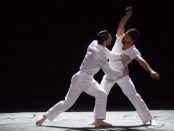
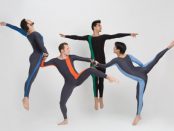
All four works—particularly the first three—had a certain offhanded similarity, a lack of formal movement ideas and construction, but all four choreographers are clearly students of the school of Jiři Kylián, the most famous director of the NDT whose incredibly musical, minutely detailed choreography has influenced many both in Europe and here in the United States. Kylián’s works have a touching humanity to them, while these four works tended more to movement for its own sake and arbitrary expression of emotions. [more]
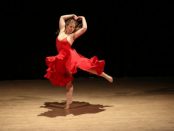
Aileen Passloff, Stepping Forward: One Foot (in front of the other)
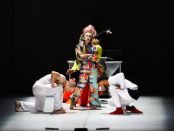
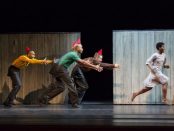
Of Passloff’s eight works, the newest, “Frolic,” (2018) to music by Erik Satlie (“Trois morceau en la forme de poire”) came closest in spirit to her classical ballet origins, utilizing whimsical characters to tell a gentle daydream. To the calm music played live by pianists Michael Cherry and Douglas Schultz, a gentle Ballerina (Esmé Boyce), a boisterous, muscular Joker (Aviles), a sassy Horse Trainer (Pam Wess), two cavorting Horses (S. Asher Gelman and Mati Gelman) and a caring Mother (Charlotte Hendrickson)—all costumed in appropriate, colorful outfits—danced solos and duets, finally uniting for what—in minimalist terms—was a grand finale complete with cartwheels, simple ballet steps, horsey prancing, and the entire cast competing for attention from the rapt audience. [more]
Contemporary Dance Festival: Japan + East Asia 2019
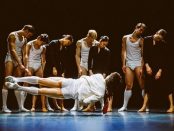
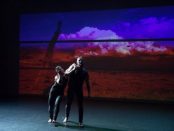
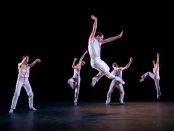
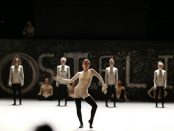
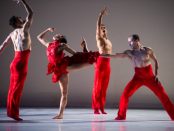
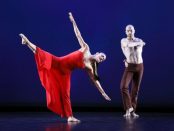
The four choreographers whose three works were represented at the Japan Society’s Contemporary Dance Festival: Japan + East Asia flung themselves headlong into the modern world of dance with only occasional glances over their shoulders at their ancestors-in-art, preferring what often appeared to be an arbitrary approach to choreography uneasily alternating between coy, fey bits of choreographic fluff and sudden primal screams. Only the final work on this occasionally interesting, but flawed program displayed some understanding of this concept of the inexorable march of time and its effects. [more]
The Chase Brock Experience: The Girl with the Alkaline Eyes
Brock’s work once prized effect over substance, but years of choreographing situation and character-based musicals ("Be More Chill," "Spiderman: Turn Off the Dark") have sharpened his artistic vision; or, perhaps, he has matured as he’s gained experience—and years. [more]
ZviDance: Bear’s Ears & Detour
A five-day journey to Bear’s Ears National Monument in Utah in the company of other dancers, choreographers and Native Americans turned Gotheiner’s mind to more serious pursuits resulting in “Bear’s Ears” and “Detour,” two of his best works. Both display some influence of Native American dance forms, but only to focus Gotheiner’s creative energies on the emotional journeys of his dancers. Bear’s Ears is a national monument under attack by this government’s forces which want to open this area to mining and natural gas exploration, completely ignoring the deep spiritual associations with the Native Americans. [more]
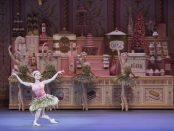
Nut/Cracked
The troupe attracted a wide-ranging audience to The Sam space at The Flea, even a few youngsters there to see their first live dance performance, and, with the exception of one section, “Thumbs,” performed by Nic Petry and Kazin, which might been perceived as naughtily sexual, they were in for many treats: jaunty barefoot tapping (“Top Hats”); a male Sugar Plum Fairy, Dylan Baker, who was so proud of his toe shoe technique that he shined a flashlight on his every foot jiggle (“Flashlight”); and “A Chorus Line” of young dancers from the Dalton School getting their first taste of professional dancing under the lights in front of an audience. [more]
Twyla Tharp: Minamalism and Me
Her quietly wry, gently self-deprecating autobiographical lecture demonstration, “Minimalism and Me,” was the first half of a program devoted to her early works. These works more often than not caused more chin scratching than accolades. From the virtually motionless “Tank Dive” to the giddy, if slight, “Eight Jelly Rolls,” her intellectual processes—including stacks of graph paper jottings that guided her and her dancers on stage (or on gymnasium floors, museum exhibition rooms and outdoor spaces)—were sensible yet challenging to the status quo of the 1960’s when she did her first choreographic experiments with her all-female quintet. [more]
The New York Pops – Song and Dance: The Best of Broadway
The New York Theatre Ballet performed the lovely, all-female, “Come to Me, Bend to Me” from that musical, a sweet look at pre-wedding preparations in the ancient village of Brigadoon. That troupe began with two excerpts from de Mille’s groundbreaking “Dream Ballet” from "Oklahoma!" and her “Hornpipe” from another Rodgers and Hammerstein classic, "Carousel" (1945), its fishermen bouncing about while on the hunt for female companionship. [more]
The Tenant
Whiteside isn’t exactly misused, but rather underused and under coached. No one should have laughed when he began his transformation into his female alterego. Whiteside, used to the broader acting style of ballets on huge stages, can’t seem to find the telling details of his drastic, paranoid morphing into Simone of the death wish, not helped by the steps nor the direction he has (or has not) been given. Whiteside appeared practically emotionless as he stared into a mirror—actually the audience—as he adjusted his very bad wig, applied more lipstick, stripped naked, tucked and put on a Whiteside-sized version of the dress that Simone wore when she flew off the top of Pita’s well-designed, complex set. [more]
Song of the Mermaid
The K-Arts Dance Company from Korea presented two performances of "Song of the Mermaid," an entertaining full-length ballet choreographed by its artistic director, Sunhee Kim. Song of the Mermaid was an extravagant ode to old-style ballet, a tribute to Petipa, if you will, based on the well-known tragic Hans Christian Andersen fairy tale of love gone wrong. [more]
Bill T. Jones/Arnie Zane Company: Analogy Trilogy
Jones has become known for applying his wide-ranging choreography and sharp mind to storylines that take on chunks of history—including some shockingly modern history. He displays his sharp observational abilities in Analogy Trilogy, each part luxuriating in the slow, detailed unraveling of the stories of three interesting people: Dora Amelan, a Belgian Holocaust survivor; Lance, a seventies’ drug, sex and phony fame survivor; and the surreal Ambrose, the Emigrant who accompanies a rich, detached Jew on his odd journeys through America and Europe in the early twentieth century. [more]
The Sarasota Ballet: Summer 2018
The Sarasota Ballet, under the direction of Iain Webb, a former leading dancer with the Royal Ballet, has, to the benefit of the dance world, been collecting works by the British master choreographer, Sir Frederick Ashton. Even Ashton’s artistic home base rarely performs his work, despite the fact that that troupe’s elevation from Sadler Wells Ballet to Royal Ballet was largely due to Ashton’s efforts. (The troupe’s repertory also includes works by Ashton’s contemporaries, such as Antony Tudor, Dame Ninette de Valois, Agnes de Mille and Michel Fokine.) [more]
MOMIX: 2018 Season
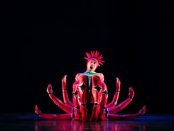
It’s easy to see why MOMIX is one of the most popular dance troupes in the world. Beauty, strength, ingenuity combine in often ingenious choreography. A generous program of short works that range from raunchy to sensual to dreamy is pulling in audiences at the Joyce Theater where MOMIX regularly plies its colorful wares. The repertoire this season was handpicked from a smorgasbord of several previous programs, but also included a impressive new work called “Paper Trails.” [more]
Batsheva – The Young Ensemble: “Naharin’s Virus”
Naharin is known for having “invented” a movement language called Gaga. Frankly, I’ve never been able to distinguish Gaga from any other movement palette. If Gaga means disconnected bits of movement utilizing hints of modern, ballet, hip-hop, mime and even ethnic movements, then it’s not particularly original. All these movement vocabularies were on display in “Naharin’s Virus” whose sixteen-member cast was put through their paces for an overlong hour. (The work could easily have been edited down by at least twenty minutes and been more effective, particularly by eliminating a long monologue about a self-abusing young lady.) [more]
Sean Dorsey Dance 2018
Sean Dorsey is a transgender and queer choreographer whose movement palette in “The Missing Generation” is a gentle, swirling combination of twisty, floor-bound, organic movements with a rich gesture vocabulary. Where the revealing series of speeches about gay life previous to, during and after the Epidemic provided the facts, Dorsey’s movements provided the emotions that even the depressing stories couldn’t. A look, a touch, a quick lift, all turned this cast of mature dancers—Dorsey, Brian Fisher, ArVejon Jones and Will Woodward—into a fount of emotion, sometimes too intense to take in. [more]
Women/Create! A Festival of Dance 2018
Jennifer Muller, of Jennifer Muller/The Works, whose artistic history includes a long association with José Limon, provided “Shock Wave,” a world premiere to a cello-heavy score by Gordon Withers. “Shock Wave,” with its suggestive title, showed how darkness and loneliness can pervade a microcosmic set of people—The Works’ members—as they are stopped in their paths by a loud explosion and have to cooperate to re-group and go on. [more]
Philadanco! (The Philadelphia Dance Company)
The theme running through the four works presented, three of them New York premieres, was of sadness and anger. Even “Folded Prism” by Thang Dao, an abstract dance work, had an unsettled ambiance. The cast of nine, dressed in Natasha Guruleva’s pale, form-fitting costumes, were initially found in a tight group, occasionally breaking up into quick solos and duets, but always returning to the cluster of performers. The work ended when one recalcitrant young lady is carried back into the fold. The ever-changing, but quiet score of John Levis and the somber lighting of Nick Kolin helped sustain the mood. [more]
The Beast in the Jungle
While "The Beast in the Jungle" is a musical for our time it contains a message that was dear to the heart of writer Henry James, that of the unlived life. Ultimately very moving when the story reaches its conclusion, the exquisite Vineyard Theatre production is for elite tastes but all dedicated theatergoers, not the casual entertainment seekers, should see it. It may well start a new trend in theatre musicals, one in which the emotional sections are danced rather than sung. [more]
Parsons Dance Company 2018
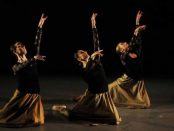
The new work, “Microburst,” was a quartet performed to classical Indian music composed and played live by Avirodh Sharma. Brilliant and audacious, “Microburst” took the four dancers, all wearing black, fringed outfits—by Barbara Erin Delo— through complex rhythmic patterns that magically fit together as if the four were having a hyperkinetic conversation with their feet. The agility of the four dancers—Geena Pacareu, Eoghan Dillon, Zoey Anderson and Justus Whitfield—was breathtaking and entertaining. [more]
The Alice-in-Wonderland Follies
Inspired by Lewis Carroll’s two Alice books and cleverly choreographed by Keith Michael, the "Follies" was preceded by Byer’s usual pre-show, uplifting audience-participation talk on the wonderful world of movement. She got the many kids in the audience—well over half the attendees were seven and under—to get up and copy the postures and movements of some of the talented students from the New York Theatre Ballet School, all of whom had impeccable stage deportment. [more]
Martha Graham Dance Company: Spring Season 2018
"Ekstasis,” danced by PeiJu Chien-Pott, her hair loose, her costume a tight tube of form-fitting jersey (designed by Graham, herself), stood still as eerie clacking percussion and quiet woodwind music passed through her body, eventually causing her hips to jut from side to side and her bent arms to move in increasingly large circles. “Ekstasis” is clearly a remnant from Graham’s days with the Denishawn company which specialized in soft-focused versions of ethnic dance forms from all over the world, using them for their decorative effect rather than expression of deep emotions. Ms. Chien-Pott was terrific, unabashedly decorative, yet adding emotional depth through her personal style and commitment. [more]
Ballet Hispánico: Spring Season 2018
The dancers displayed a new depth of expression, particularly in the world premiere “Espiritus Gemelos,” a sensitive, beautifully acted duet about a brief same sex encounter performed by Chris Bloom and Omar Román De Jesús. Choreographer Gustavo Ramírez Sansano was inspired by the real-life relationship between the doomed writer, Federico García Lorca and the surrealist painter, Salvador Dalí, two famous Spaniards. He used dim, but colorful music by Manuel de Falla and Jacinto Guerrero to accompany his movements and tell his emotionally rich story. [more]
Malpaso Dance Company: 2018 Season
The first work on the program was “Indomitable Waltz” (2016) choreographed by Aszure Barton to dark hued music by the Balanescu Quartet and Nils Frahm. Barton achieved a graceful, yet dramatic flow for these dancers dressed in Fritz Masten’s black and grey costumes. Barton knows how to spread her dancers about the stage like a single organism continually splitting apart and coming together again. They danced warily about each other, performed leans and sensual embraces that faded as the dancers melted to the floor. The work ended on a contemplative note as Dunia Acosta moved with careful steps and twisting hips, in a journey across the stage. Although the emotions of “Indomitable Waltz” ranged from dark to sensual to giddily physical, it ended up as a head scratcher, beautifully performed by the Malpaso dancers. The intriguingly moody lighting was by Nicole Pearce. [more]
Works & Process at the Guggenheim: “One of Sixty-Five Thousand Gestures”/”NEW BODIES”
“NEW BODIES” (2016) choreographed by Melnick was initiated by Sara Mearns in a summer workshop at Jacob’s Pillow Dance Festival. Skilled classical ballet dancers who were interested in expanding their understanding of movement beyond the strict formalities of ballet choreography joined Mearns and Melnick to experiment with just how movements emerge into choreography. The result is not an earth-shattering rethinking of the art of dance, but a loose web of crossing paths where touching and light partnering follow from soft collisions. [more]
Pillowtalk
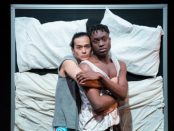
Kyoung H. Park's "Pillowtalk" mixes the mysteries of passionate, but flawed, love with the realities of racism in today’s society, specifically, Brooklyn, New York, where Sam (Basit Shittu), a hunky African American and former Olympic swimmer is married to Buck (JP Moraga), a sleek Asian American journalist. Both are in a constant battle with the White-dominated society which constantly undermines the lives of people of color. Park’s direction of his play is straightforward and “in your face” giving this rarely seen corner of society some needed exposure. [more]
Soaring Wings
The famous Chinese ability to subsume themselves in crowds was evident in the flowing choreography for the mass “flight” of the Ibis across the stage. The precision of the corps de ballet did not, however, lessen regarding each dancer as an individual as they flew past in ever-changing patterns. The creators of "Ibis" also gave life to the inhabitants of the small town and the young modern urbanites who show up at a museum to learn about the birds with which they had peacefully co-existed. [more]
Mary Shelley’s Frankenstein
Fairchild speaks well and communicates much with his physique, but his choreography is repetitive and uninventive. Here was a chance to breathe new life into a too familiar character. All Fairchild could come up with is lurching movements and awkward falls to the floor. He takes the obvious path to create his character with movement when he had a chance to illuminate the Monster’s inner emotions. [more]
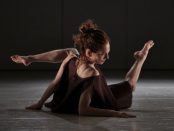
Alvin Ailey American Dance Theater – Winter 2017 Season
The middle work, “Walking Mad,” choreographed by the Swede, Johan Inger, has inadvertently taken on an urgency and timeliness. Always a surreal study of off-handed violence, the current tidal wave of sexual harassment revelations has given “Walking Mad”’s series of violent episodes against women an added shock value. [more]
Mimi Garrard and Friends
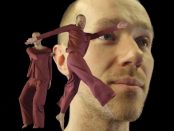
In “Lines,” the videos were straightforward representations of Mr. Selden, clad in a loose-fitting red outfit, pausing his image in dramatic moments while in the second work, “Untranslatable,” directed by Ms. Garrard and choreographed by her and the very solid dancer, Ms. Hopkins-Greene (formerly of the Alvin Ailey troupe), the visual elements—produced by Ms. Garrard—were far more abstract, chaining together tiny images of the dancer in fantastical patterns like giant letters, globes, maps, etc., as the dancer, clad in a chic two-piece purple outfit designed by Mindy Nelson bounded about. Snatches of poetry by Walt Whitman were cut and shifted about to provide an aural accompaniment to the steps which were vigorous with lots of quick direction changes. Images of Ms. Hopkins-Greene floated about the screen making it seem as if she were dancing with clones, all equally talented. [more]
ZviDance: Like
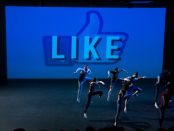
This time Gotheiner put his dancers through a faux competition that fell in mood somewhere between "Dancing with the Stars' and "Shark Tank," combining eager striving with off-handed sadism. Electronic gadgetry virtually turned the beautiful dancers into products that viewers in the NYLA Theater were inadvertently bidding on. [more]
Big Dance Theater: 17c
Big Dance Theater, conceived and directed by Annie-B Parson, presented "17c" at the BAM Harvey Theater. The work somehow combined the diary of Englishman, Samuel Pepys, the works of Margaret Cavendish (whose play-within-the-show—contemporary with Pepys—displayed proto-feminist ideals), classical theater (Euripides), modern writings on gender inequality (Jill Johnston who promoted a Lesbian world without men) with high production standards and a keen sense of storytelling all held together by a cast of great actor/dancers. [more]
The Red Shoes
Hanging over this presentation is, as indicated, the film which divides the audience into those who did not see it and must take or leave Bourne’s clever version and those who saw it and compare each of the film’s campy, colorful moments to the dramatically dull Bourne version in which characters seem to fall in love after barely meeting. Characters who are boldly drawn in the film could not be inhabited by Bourne’s young cast, particularly Nicole Kabera as an unstylish Lady Neston who introduces the main character, her niece Vicki Page (a saucy, plush Ashley Shaw) to ballet owner and Diaghilev surrogate, Boris Lermontov. This rich character was played by a much too young Sam Archer whose charisma is totally absent. It’s difficult to stage a story at whose heart is a tragic love triangle when at least one angle had no magnetism and was, in fact, a mass of outrageous eccentricities compared to the seething elegance of Anton Walbrook in the film. [more]
Fall for Dance – Program E
The highlight of the program was watching the world-renowned premier danseur David Hallberg perform a work specially commissioned for him by Fall for Dance. Mark Morris, the equally famous and respected choreographer, chose Benjamin Britten’s “Twelve Variations for Piano” as his score for the coyly humorous “Twelve of ‘Em.” The tone was set by Isaac Mizrahi’s wry costumes for both Mr. Hallberg and the adroit pianist Colin Fowler who was totally in synch with Morris’ tongue-in-cheek sense of humor. Both wore ancient Greek-like flowing tunics over t-shirts and jeans. [more]
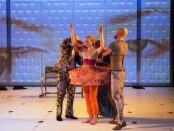
Marc Bamuthi Joseph on His Artistic and Cultural Influences in “/peh-LO-tah/”
I’ve been playing soccer and have been exposed to soccer longer than I have been exposed to dance. Both of these things are part of my kinesthetic and the biography of my body. I can’t really recall a time where I didn’t play soccer and I’ve been dancing since I was at least ten years old. It’s actually not super far-fetched when I watch a soccer game, it looks like choreography to me. I trained for dance in some ways as an athlete would train for sport, I really connect to the similarities more than the dissimilarities. In terms of the literal transfer, our choreographer Stacey Printz did a great job of identifying some tropes that are consistent in both soccer and the kind of cultural universe that we traverse. There are elements of hip-hop, samba, South African gumboot dancing, Haitian folkloric movement – all of these inform the choreography. Moving forward, without being hyper-literal, I think that’s proven to be a really transformative experience for us and also makes it very clear and legible for audiences watching the piece. If our written and spoken language is literal, dance gives us allegory and metaphor and the synthesis of the two - - spoken language and body language -- helps to communicate the ideas in a very powerful way. [more]
Fall for Dance 2017
Michelle Dorrance, this troupe’s director, has become a force in tap dance because she understands both its legacy and its future. She played Pied Piper to a large troupe of very talented dancers who were all given opportunities to shine and create moods that varied from sexy to flirtatious to hilarious and sad. With additional choreographic contributions by Ephrat “Bounce” Asherie and Matthew “Megawatt” West—fine soloists—“Myelination” ebbed and flowed as soloists floated out of groupings of the twelve dancers to express themselves in brilliant bits that combined tap with modern dance, jazz, break dancing and even a touch of ballet. [more]
Mette Ingvartsen: 7 Pleasures
Ingvartsen has a record of intellectualizing her work taking all the juice out of them in the process. "7 Pleasures"—a misnomer if there ever was one—takes her dry, over thinking to the extreme in a work that somehow made the nudity and sexual activities of her twenty-something cast members boring and ugly. (There’s something unappealing about a stage-full of performers jingling all their various body parts as they did in one extended section of 7 Pleasures, no matter how it related to “that other crucial element [of dance], the body,” or “political, sexual, desiring, linguistic, historical, racialized, gendered, and agential flesh matter.”) [more]
Twyla Tharp Dance: 2017 Season
Twyla Tharp (Photo credit: Robert Whitman) [avatar user=”Joel Benjamin” [more]
Faustin Linyekula: In Search of Dinozord
"In Search of Dinozord" is Linyekula’s futile, naive attempt to turn the devastating history of his homeland into art. There was choreography—simple, spasmodic, realistic, but ultimately falling short of expressing anything but physical tension. There was a wonderfully minimal stage setting—by Studios Kabako/Virginie Dupray—that turned the well-equipped NYU Skirball Center for the Performing Arts stage into a sleek black box, with colored lines intersecting, a large red vertical structure and a back wall consisting of joined sheets of wood that served as a screen. Costumes—not specifically credited—were worn-looking casual street wear in faded colors. Lighting was exquisitely expressive. [more]
One Night Only (running as long as we can)
Barnes’ choreography is a delightful blend of ballet, modern dance and stylized movement. She and Bass are highly skilled and have a great chemistry together that recalls that of an accomplished comedy team with flashes of dramatic depth. [more]
Ariel Rivka Dance: 10th Anniversary Season
Ms. Grossman tended toward overuse repetition of movements and arm gestures. Emotional states were supported by little else than the titles and her husband’s gemlike scores. “No Words,” to a score composed and played by Mr. Homan, opened the program. His music sounded like an anguished string quartet to which she made an honest stab at using gesture and arrangement of the eight dancers to express the anger and loss in a poem, “Fury: In Praise of Stone,” by Janet R. Kirchheimer and Jaclyn Piudik, which was printed in the program. [more]
Works & Process Rotunda Project: “Falls the Shadow”
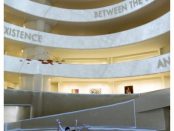
The title comes from T.S. Eliot’s "The Hollow Men," the one that famously includes the line: “This is the way the world ends/Not with a bang but a whimper” - which is exactly how Falls the Shadow ended, the dancers swirling off to the borders of the Rotunda performing space after a series of meetings and partings that too often found them lying in geometric patterns on the floor, their arms spread out in cross forms or moving their limbs in unison to produce a Busby Berkeley effect. (The audience stood above the action on the ramps, looking down.) The two couples rarely mixed and matched, but did occasionally form lineups that wound up dragging the unlucky fourth dancer who was face down on the stage. The actual movement palette was limited to walking, soft arabesques, rolling on the floor and some hip-level lifts, all repeated too many times. [more]
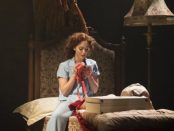
Jewels (Lincoln Center Festival)
The three-part ballet is considered Balanchine’s tribute to the three major artistic influences in his professional life: the French school, the Russian school and, of course, his own American style of classical ballet as taught in his School of American Ballet in Lincoln Center. Therefore, it was not just logical, but inspired, that the Paris Opera troupe would dance the dreamy “Emeralds” to Gabriel Fauré, the New York City Ballet, the fresh and jazzy “Rubies” to Igor Stravinsky, and the Russian troupe the very classical “Diamonds” to Piotr Ilyich Tchaikovsky. [more]
American Ballet Theatre: Whipped Cream
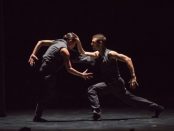
Richard Strauss’ surprisingly lighthearted score was first staged as a ballet in 1924 to a libretto he also wrote. Strauss is, of course, best known for his serious, dark operas ("Salome," "Elektra," "Der Rosenkavalier," "Die Frau ohne Schatten"). This work, originally "Schlagobers" in German, appears to be a whimsical musical detour that, happily, has landed in the hands (feet?) of the very much in demand Ratmansky who, with the superior creative support of Mark Ryden (sets and costumes), Brad Fields (lighting) and, of course, the talented dancers of the American Ballet Theatre produced a candy-colored entertainment that might just serve as its new Nutcracker, a ballet that appeals to both children and adults. [more]
Momix: Opus Cactus
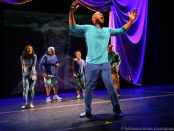
In eighteen short sections, Pendleton and his dancers evoke images of the western deserts of the U.S., using whatever means necessary, be it skateboards, puppetry, classical Indian dance, acrobatics, technological gimmickry or a truckload of imaginative costumes. [more]
Lydia Johnson Dance 2017 Season
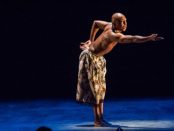
Johnson’s choreographic ethic borders on the minimalistic, repeating some basic movements, particularly certain arm gestures, in all of the works. In two of the three ballets, it works, in one it fails terribly, and in the fourth, it merely comes up short. [more]
The Reception
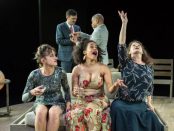
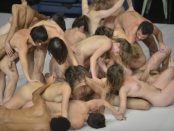
Soon little rends in the fabric of normalcy became apparent. Bits of dialogue are repeated senselessly and the five revelers keep returning to the same positions (three on a couch, one alone at the border of the space and one behind the bar). Attempts at dancing get more and more inelegant, even leading to a bit of physical sparring. Even worse, there is an intermittent ominous, crackling sound emanating from deep in the floor, as if the house were about to collapse. [more]
Martita Goshen’s Earthworks: “Sanctuary”
Martita Goshen’s love of horses, one in particular, and nature in general, is a driving force in “Sanctuary,” her gentle and genteel dance recently performed by her troupe, Earthworks at the Paul Taylor Dance Studio. “Sanctuary” is the final section of a three-part work dedicated to the memory of the famous equine, Barbaro, who died tragically after an injury. [more]

Jody Sperling/Time Lapse Dance: “Book of Clouds”
The ostensible theme of Sperling’s series of performances at the Baryshnikov Arts Center was climate change. Had spectators not read that in the program they would have come away from Sperling’s performance thinking it was an ode to spring with some cosmic overtones in Huestis’ colorful slide projections of circular forms that evoked the earth, the moon, Mars, stars, subtle earth formations and, of course, clouds. [more]
Janis Brenner & Dancers: Spring 2017 Season
Wearing pale, simple but elegant costumes with small colorful patches around the hips (designed by Sue Julien and Brenner) the dancers in “Soul River/Blues” entered singly at first up a diagonal, almost as if sneaking on. As the dance unfolded they rolled and paused, looking over their shoulders to a score by Ry Cooder and V.M. Bhatt which was a hybrid of Indian classical and bluesy American guitar styles. One man (Aaron Selissen) and four women (Kara Chan, Ruth Howard, Sumaya Jackson and Kristi Ann Schopfer) interacted in slow lifts and groupings that became ever more complex in their angles and internal relationships. [more]
Parsons Dance – Spring Season 2017
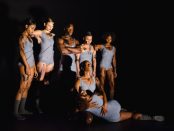
Company member, Omar Román De Jesús choreographed the third world premiere, “Daniel,” to a multiple-sourced score. He took his eight dancers through a dramatic visit to those on the autism behavior spectrum, finding beauty, sadness and even some humor. The emphasis was definitely on the darker elements with angular knee and elbow jutting movements repeated over and over again. Unlike his mentor, David Parsons, De Jesús dared to end his work with two sections that each used two dancers. [more]
Ellen Cornfield/Cornfield Dance: “Close-Up” (2017)
There was a mysterious coolness about “Close-Up” which, according to a program note by Ms. Cornfield, was meant to delve into the personalities of her five dancers, doing this by assigning very particular gestures—touching the face with a finger, holding a palm to the forehead, quivering hands, mimed pouring, nods—and facial expressions like appearing to laugh or shout to each dancer. She called these intimate, non-dance details, “zoom close-ups.” These quirky bits were additions to sleek, catlike movements that included lunges, low leg circling and the kind of balletic movements that were the centerpiece of Cunningham’s choreographic output. [more]
The Deborah Zall Project: “In the Company of Women” 2017
All but one of Zall’s works were solos and all were based on famous literary figures: “George Sand” (ruminating on her lost love, Chopin), “Mary Tyrone” (from "Long Day’s Journey Into Night" fighting her addiction while remembering her childhood), “Sonnet” (to an Edna St. Vincent Millay sonnet about obsessing over a lost love), “Amanda” (the mother in "A Glass Menagerie" sadly musing over her ball gown) and “Shadow of Her Sister” (two sisters from "The House of Bernarda Alba" battle to the death with dark Catholic imagery overlaying the internecine war). [more]
Battery Dance – Spring 2017 Season
The final work, “On Foot” was choreographed by Hollander and seven company members. It featured a Middle East-tinged score by Kinan Azmeh and Anouar Brahem and sensational visual art, mostly created on the spot, by Kevork Mourad whose ancestors fled the Armenian genocide. Mourad created both beautiful and horrifying projections on the back screen of the stage and also sat at a computer projector producing fluidly morphing images on a scrim: people floated about; ancient buildings melted; and complex landscapes passed by capturing the mood of the choreography. [more]
Limón Dance Company: Spring 2017 Season
“Corvidae,” Colin Connor’s contribution to the program, was staged to the relentless first movement of a Philip Glass Violin Concerto. The title refers to the scientific name of the family of crows and ravens. The six dancers, stylishly dressed in all black outfits by Connor and Keiko Voltaire and moodily lit by DK Kroth, wandered about stylishly, but aimlessly, suddenly bursting into movement, softly leaping, arms held in wing-like positions. The heads of stationary dancers were held high in ornithological awareness as the rest of the cast softly cut through the air in balletic, sweeping steps. The overall mood was dark and sexy. [more]
Titicut Follies
The original film is brazen in its guerilla-style filmmaking, a good deal of which was surreptitiously produced right under the noses of the Institution’s officials. To anyone who knows or watched the original 1967 film, James Sewell’s choreographic rendition would seem tame, certainly lacking the shocking visions of naked men abused and humiliated by sadistic guards, ridiculously backward psychologists and a nutritional staff intent on starving the patients. (Images abound of skeletal men wandering aimlessly.) The film begins with the eponymous follies, the men singing and dancing to a bizarre version of “Strike Up the Band” and showing off their other talents, only to quickly descend into a vision of hell on earth. [more]
Ballet Hispanico – Spring 2017
The company is in great shape. It’s a difficult task to combine ethnic themes with ballet and modern dance, but somehow Eduardo Vilaro has been succeeding terrifically. His troupe entertains, titillates and even educates (if that isn’t a dirty word). [more]
Doug Varone and Dancers: Spring 2017 Season
Varone employs movements loosely flung out from the body’s core; sudden, inexplicable pauses; (painful looking) drops to the floor (usually onto a knee!); contrasting chaotic activities with stillness, high with low and slow with fast. There is a sense—clearly mistaken—that the choreography is improvised which makes for unfocused and nervous stage pictures. The fact that his dancers, a diverse bunch, wear his movement style like a second skin adds an excitement to his ballets. They seem born to his particular style and give it an offhanded grace, looking more like people moving rather than dancers. [more]
Paul Taylor American Modern Dance: Spring Season 2017
Now named Paul Taylor American Modern Dance, Taylor has included ballets by other choreographers which allows for some healthy comparisons and a hope for the future of this legendary company. The four non-Taylor works, all but one danced by the Taylor dancers, made fascinating comparison with his work: particularly Martha Graham’s “Diversion of Angels,” her ode to romantic and sexual love, choreographed in 1948 to music by Norman Dello Joio, one of the few works in which Graham, herself, did not appear. [more]
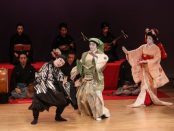
Nihon Buyo Dance by Geimaruza
Three musical pieces displayed the instruments on which the music is made. “Nagare (Flow)” was played on two shamisen (stringed instruments) by Touon Minamidani Mai and Touon Sakata Maiko, completing in ever faster, improvised sounding, themes, all based on traditional melodies (kind of like a gentler version of “Dueling Banjos” from Deliverance). “Toki (Japanese Crested Ibis)” featured a long fue (flute) solo by Tosha Suiho, whose passionate musicianship was overwhelming. The third work, “Shishi (Lion)” combined all the different percussion instruments and the flute to great dramatic effect. [more]
Complexions Contemporary Ballet 2017 at the Joyce
“Star Dust,” Rhoden’s tribute to rock original David Bowie forced Rhoden to study and use each of the nine chosen songs as vignettes to comment on Bowie’s magic, the superb quirkiness of his dancers and display subtlety in his use of steps sometimes missing from his wham-bang, jet engine choreography. Rotating lights and disco balls beamed mood-changing pools of light on the stage (designed by the hard-working Mr. Korsch with psychedelically colorful costumes and makeup by Ms. Darch which exposed a lot of skin.) [more]