
The Invention of Love
A rare revival turns scholarship, longing, and mortality into exquisite theater, anchored by David Greenspan’s vivid performance and Zachary Elkind’s agile staging.
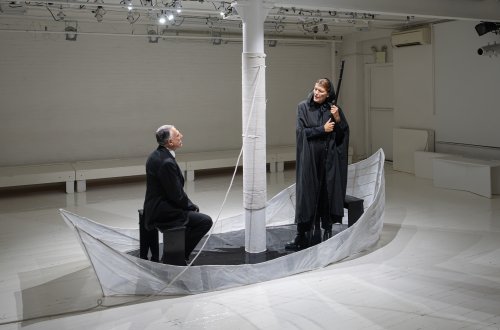
David Greenspan and Annabel Capper in a scene from the Map Theater’s production of Tom Stoppard’s “The Invention of Love” at the Theaterlab (Photo credit: Paul Lutvak)
There are plays that ask you to follow a story, plays that ask you to admire an actor, and plays that seem to have been written by a man who, having been told that a theatrical evening should contain a little Greek, a little Latin, some Victorian gossip, several varieties of unrequited love, a handful of dead literary celebrities, a dispute over textual punctuation, the River Styx, Oscar Wilde, and a joke about patent offices, replied, “Yes, but why stop there?” Tom Stoppard’s The Invention of Love is one of those plays. In the rare revival now being presented by The Map Theater at Theaterlab, Zachary Elkind and a remarkably agile company take on this three-hour intellectual marathon and discover, beneath its layers of scholarship and historical ornament, something almost embarrassingly simple: a man who loved someone he could not have, lived in a time when saying so could be dangerous, and spent much of the rest of his life converting the ache into scholarship. That the man, A. E. Housman, the celebrated poet and classical scholar, is historically significant; that he was also, rather inconveniently for his own peace of mind, human, is theatrically decisive.
Elkind’s production begins where Housman’s life ends, which is a very Stoppardian way of refusing to behave. The newly dead poet arrives at the River Styx and boards the boat of Charon, played by the excellent Annabel Capper, who treats the business of ferrying the deceased to Hades with the brisk professionalism of someone who has seen an endless line of literary types and has learned not to be impressed. The boat sits in the middle of Theaterlab’s nearly blinding white box, where the audience occupies two sides and the entire production seems to have been constructed from the proposition that if you remove enough scenery, the actors will have no choice but to become the scenery. Bridget Lindsay’s spare set makes a virtue of necessity, incorporating the room’s central support pole into the boat’s mast, while Paige Seber’s lighting periodically washes the white space in soft blues, purples, and yellows. Alyssa Korol’s Victorian costumes complete the illusion, although the production’s decision to leave the men from Housman’s past barefoot has the delightful side effect of making 19th century Oxford look as if it has briefly been invaded by a particularly well-read cult.
At the center of this improbable vessel is David Greenspan, who gives one of those performances that make the phrase “command of language” sound insufficiently imposing. As the elderly Housman—identified in the play as AEH—Greenspan enters in a close-fitting three-piece academic suit, immaculate facial hair, and the deliberate gait of a man whose body has finally been persuaded to move at the same speed as his thoughts. He speaks Stoppard’s enormous sentences with an old-fashioned, almost declamatory musicality, and although the Theaterlab acoustics occasionally swallow a softened syllable, the overall effect is extraordinary. Greenspan does not seem to be delivering Stoppard’s prose so much as discovering it. Latin, Greek, textual criticism, literary gossip, manuscript variants, etymology, metaphysics, and the occasional barb emerge as if they were all part of the same nervous system. What could, in another actor’s hands, become an endurance test in the history of Western thought becomes something closer to chamber music. Greenspan makes Housman funny without making him cute, sorrowful without making him sentimental, and formidable without ever asking us to admire his cleverness. He simply inhabits it. Watching him negotiate this verbal Himalaya is itself worth the price of admission.
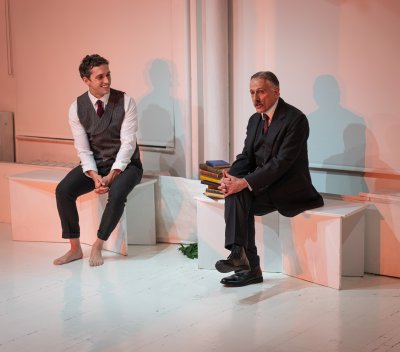
Yaron Lotan and David Greenspan in a scene from the Map Theater’s production of Tom Stoppard’s “The Invention of Love” at the Theaterlab (Photo credit: Paul Lutvak)
Yaron Lotan, as the young Housman, gives us the man before the armor has hardened. Lotan’s Housman arrives at Oxford with the dangerous optimism of someone who has not yet learned that the things one wants most are not necessarily the things one is permitted to have. He is intoxicated by books, argument, friendship, athletics, and the discovery that other people can be as interesting as ideas. Lotan brings a lovely openness to him, particularly in his scenes with fellow student Moses John Jackson, and there are moments when his face seems to contain the astonishingly pure expression of a young man who is one second away from tears, laughter, or an embrace. The older Housman’s reserve is consequently not presented as a fixed personality trait but as something acquired, piece by piece, by a person who has discovered the uses of self-protection. When Greenspan’s AEH encounters Lotan’s young Housman, the scene has the peculiar poignancy of a man meeting the version of himself who still believes that the future is a country to which he has been invited.
José Espinosa, as Moses John Jackson, supplies the production with its necessary oxygen. Jackson is athletic, handsome, warm, curious, and gloriously comfortable in his own body—the sort of person who can enter a room without first consulting his conscience about whether he has earned the right to be there. Espinosa makes him more than the object of Housman’s longing; he gives Jackson a buoyant humanity that explains why Housman falls for him in the first place. Their friendship has the ease of young male companionship, full of arguments about literature and philosophy, physical exuberance, teasing, and the unspoken assumption that tomorrow will contain more of the same. For Housman, however, the friendship is becoming something else. Espinosa understands the exquisite cruelty of not needing to be cruel: Jackson does not have to reject Housman viciously because he does not experience the relationship in the same emotional register. The tragedy lies precisely in the mismatch. Housman can spend a lifetime trying to articulate what Jackson can simply live without articulating. In Lotan and Espinosa’s scenes together, the distance between those two conditions becomes almost visible.
The intellectual architecture around this emotional triangle is enormous, and Stoppard builds it with the cheerful excess of a man who has never encountered a historical footnote he did not want to invite to dinner. Housman’s Oxford circle includes A. W. Pollard, played by Daniel Liu with a wonderfully authoritative baritone, along with an assortment of professors, poets, critics, journalists, scholars, and institutional grandees. Abrar Haque, Spencer Lutvak, Sam Bolen and Leland Fowler are particularly nimble in the production’s frequent doubling, changing characters with the precision of people changing hats at a particularly manic academic conference. The conversations range from Plato, Homer, Aeschylus, Sophocles, Propertius, Catullus, Dante, and Horace to the finer points of textual authenticity and translation. There are arguments about commas. There are arguments about scholars arguing about commas. There are people arguing about what other people meant when they argued about commas. One begins to understand that Stoppard considers punctuation not merely grammar but a branch of metaphysics. Yet beneath the jokes is a serious and rather beautiful idea: scholarship is an act of attention, and attention is one of the few forms of love that can survive death.
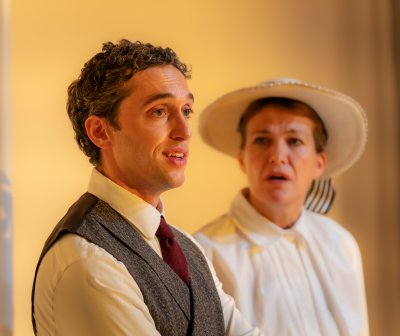
Yaron Lotan and Annabel Capper in a scene from the Map Theater’s production of Tom Stoppard’s “The Invention of Love” at the Theaterlab (Photo credit: Paul Lutvak)
This is where The Invention of Love becomes considerably more than an Oxford fantasia. Housman’s scholarly obsession with recovering the exact meaning of ancient texts parallels his inability to recover the life he might have lived. He can interrogate a manuscript for the smallest discrepancy; he can spend years determining whether a line belongs to one author or another; he can make an academic career out of uncertainty. But the central uncertainty of his own existence—what might have happened had he been able to speak openly about Jackson—cannot be settled by textual criticism. The knowledge that “knowledge is good just by being knowledge” becomes both his credo and his refuge. He accumulates facts partly because facts are safer than feelings. The scholar becomes a detective of the dead while remaining an evasive witness to himself. And the more one watches Greenspan’s Housman, the more one senses that the scholarship is not an escape from emotion at all. It is emotion translated into a language he can survive.
Oscar Wilde enters this psychological equation like a man arriving at a funeral in evening clothes and asking whether there is a bar. Sam Bolen gives him precisely the necessary combination of flamboyance, wit, sensuality, and danger. Historically, Wilde and Housman apparently never met; dramatically, their encounter is irresistible because Wilde embodies the life Housman could not imagine permitting himself. Wilde is visible where Housman is concealed, theatrical where Housman is private, openly sensual where Housman has converted desire into silence. His prosecution and imprisonment for “gross indecency” make the contrast more than temperamental. The danger is real. Housman knows it. Wilde pays the price publicly; Housman pays his privately. Their meeting therefore crystallizes the play’s larger question: what happens to a person when the society around him declares a fundamental part of his nature unspeakable? Stoppard is not interested in turning Housman into a tidy modern hero. He gives us instead a man who survived by becoming exceptionally good at being the person society would permit him to be, and then asks what survival costs.
Elkind is especially impressive in the way he prevents all this talk from becoming merely talk. His staging is stylized without being precious and economical without ever looking impoverished. The central boat becomes the production’s theatrical Swiss Army knife: Styx, Thames, memory, metaphor, vehicle, waiting room, racetrack, and occasionally a floating Oxford seminar. Actors emerge from the white space and disappear back into it, carrying whole eras with them. The barefoot figures from Housman’s memory move almost silently, giving the past a ghostly physicality. A track meet, an Oxford common room, a newspaper office, a club, and the halls of academia can all materialize without the production pretending that Theaterlab is suddenly the West End. This is precisely the kind of staging that understands that theatrical imagination is not a substitute for resources; it is a resource. Elkind trusts the audience to participate, and the audience does.
Y
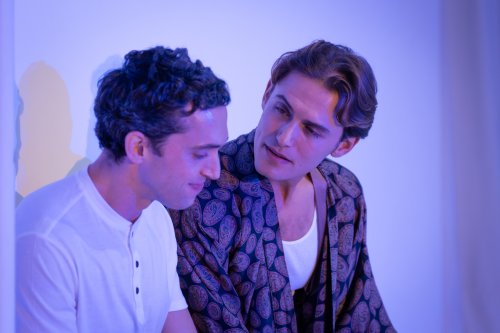
aron Lotan and José Espinosa in a scene from the Map Theater’s production of Tom Stoppard’s “The Invention of Love” at the Theaterlab (Photo credit: Paul Lutvak)
The company’s collective achievement is considerable because Stoppard’s play is populated by enough intellectual personalities to stock a small university. Liu’s Pollard gives the young Oxford scenes a vigorous argumentative center; Haque, Fowler, Lutvak, Bolen and Capper navigate their multiple roles with admirable clarity; and the ensemble maintains the production’s velocity through a text that can change subjects with the alarming speed of a professor who has just remembered three additional things he would like his students to know. The danger in such a piece is that the characters become merely delivery systems for information. This cast largely avoids that fate. They make the intellectual world social. People disagree because they care, compete because they are ambitious, gossip because they are alive, and argue about literature because, to them, literature is not an elective but a way of understanding existence.
What finally makes this Invention of Love so moving is the collision between the enormity of the intellectual apparatus and the simplicity of the wound underneath it. A man loved another man. He could not have the life he wanted. He lived in a society that gave him compelling reasons to conceal that desire. He turned toward scholarship, poetry, and the exacting preservation of language. He became famous. He became old. He died. And then, in Stoppard’s marvelous theatrical afterlife, he gets to board a boat and look backward. The play’s scholarship may occasionally threaten to consume its own subject—Stoppard has never been accused of mistaking a stopping point for an opportunity to stop—but Elkind’s production and, above all, Greenspan’s performance keep bringing us back to the human being inside the intellectual monument. When Greenspan extends an arm toward the past without quite touching it, “Jackson, I would have died for you,” the entire elaborate machinery of the play suddenly seems to have been constructed to arrive at that gesture.
That is the peculiar pleasure of this production: it gives us Stoppard at his most extravagantly cerebral while allowing us to feel why the cerebral matters. The ancient poets, the disputed manuscripts, the commas, the Oxford dons, the newspapers, the scholars, Wilde, the River Styx, the athletic young men, the patent offices, the ambitions, the evasions—all of it circles the same elemental human desire to make something endure. Housman tried to make words endure. Stoppard tries to make Housman endure. And Elkind, Greenspan, Lotan, Espinosa, and this unusually accomplished company have now given the whole enterprise a body, a voice, and a theatrical life. In an era when a production of a demanding Stoppard play can seem almost as improbable as an Oxford don voluntarily admitting that he has misplaced a manuscript, The Map has managed something rather wonderful: it has made an intimidating work feel intimate, made scholarship feel sensual, and made a dead poet’s inability to say what he wanted to say feel, after all these years, like something we can hear.
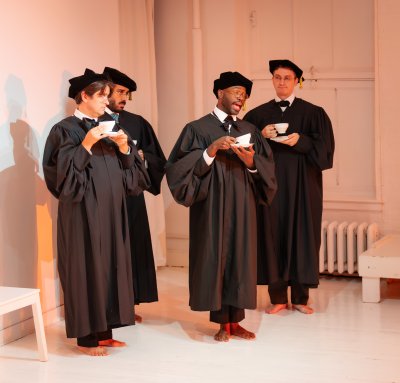
Sam Bolen, Abrar Haque, Leland Fowler and Spencer Lutvak in a scene from the Map Theater’s production of Tom Stoppard’s “The Invention of Love” at the Theaterlab (Photo credit: Paul Lutvak)
The Invention of Love (through October 3, 2026)
The Map Theater presents TLAB SHARES
Theaterlab, 357 West 36th Street, in Manhattan
For tickets, visit www.theaterlabnyc.com
Running time: three hours including one intermission


Leave a comment