
America, Who Hurt You?
A dazzling solo performance in which Sarah Jones becomes a chorus of voices, turning history, humor, and empathy into an electrifying theatrical encounter.

Sarah Jones in a scene from her one-woman show “America, Who Hurt You?” at the Polonsky Shakespeare Center of Theatre for a New Audience (Photo credit: HanJie Chow)
Sarah Jones has spent two decades turning the one-person show into an exercise in theatrical multiplication. In America, Who Hurt You?, she fills the Polonsky Shakespeare Center with a sprawling collection of personalities who seem to have wandered in from different corners of the country, different generations, and, occasionally, different centuries. There are relatives, immigrants, elders, skeptics, patriots, malcontents, and people simply trying to figure out what happened to the country they inhabit. Directed by Eric Ting, the production is at once comic, intimate, intellectually restless, and unmistakably built around Jones’ extraordinary ability to make a single body feel inhabited by many.
Jones, who received a Special Tony Award for Bridge & Tunnel 20 years ago, has developed an acting technique that is less about impersonation than about instantaneous reorientation. A change in vocal register, a slight alteration of posture, a tightened mouth, a different rhythm of speech, and suddenly the performer we were watching a moment ago has receded. Lorraine, an elderly Jewish woman, carries the physical history of another generation in her hands and shoulders; Nereida, Jones’ half-Dominican, half-Puerto Rican relative, barrels forward with comic impatience; Rashid, a Black man with a vocabulary influenced by the language of artificial intelligence, arrives ready to “enter the chat”; and Hank, a white Christian man from Georgia, gradually reveals an emotional life beneath his bluster. Jones does not caricature these people. She gives each of them a particular interior temperature.
She begins by pretending to be someone else entirely. Dressed in Toni-Leslie James’ elegant pale-gray pinstriped suit, Jones walks out speaking in an almost absurdly refined British accent, immediately establishing both the comedy and the theatrical contract of the evening. She eventually drops the accent and returns to herself, explaining the personal and communal sources of many of the characters. A photograph of Jones with her white Jewish mother and Black Caribbean father places the performance inside a family history that is itself a lesson in the complicated interweaving of American identities. The characters are not presented as specimens in a sociological display; they feel like people Jones has spent years listening to.
Several of them have appeared before, particularly in the podcast that gave the stage work its title, but the live performance allows them to develop relationships with one another that are more theatrical than a succession of comic character sketches. They interrupt, argue, linger, and occasionally seem to carry on without Jones’ permission. At one point, the characters discover that their creator has apparently disappeared, and their reaction to her absence is both funny and oddly poignant. The joke contains the larger achievement of Jones’ technique: for a few seconds, these figures seem capable of existing beyond the performer who summoned them.
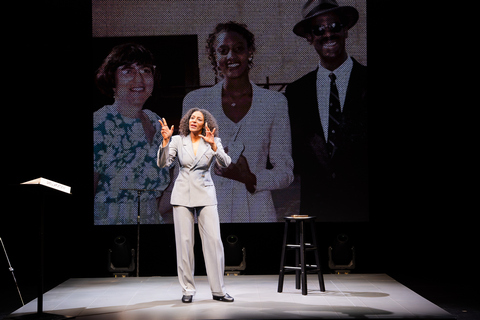
Sarah Jones in a scene from her one-woman show “America, Who Hurt You?” at the Polonsky Shakespeare Center of Theatre for a New Audience (Photo credit: HanJie Chow)
The evening’s governing idea emerges when Jones introduces Britain and America as characters. Britain, older and considerably more composed, becomes something between an experienced relative and a reluctant caretaker; America is the younger relation, phone in hand, emotionally volatile, defensive, and chronically worried about what everyone else thinks. The conceit is comic enough to sustain Jones’ lighter touch, but it also provides the evening with its dramatic architecture. Britain’s task is to persuade America to examine its past in something closer to its entirety, rather than treating history as a collection of flattering national photographs.
That framework gives Jones the opportunity to bring forward a series of voices whose experiences complicate any simple account of American identity. The stories range across generations and communities: people shaped by migration, racial violence, incarceration, religious persecution, war, family trauma and the pressures of assimilation. Some of these portraits are brief, almost flashes of testimony, but Jones’ concentration makes them feel sharply etched. In the strongest passages, she seems to disappear altogether. What remains is a succession of human beings speaking with such specificity that the virtuosity required to create them becomes almost beside the point.
The visual language of the production is equally economical and effective. Stefania Bulbarella’s video design makes particularly strong use of Jones in close-up, turning the screen behind her into a second performance space in which a series of faces and identities can appear with startling immediacy. Jiyoun Chang’s scenic and lighting design keeps the physical environment spare while giving the stage considerable visual flexibility, and Palmer Hefferan’s sound design quietly reshapes the acoustic space around Jones. Toni-Leslie James’ suit, meanwhile, is more than an attractive piece of tailoring: its restrained neutrality gives Jones an ideal visual constant against which all those transformations can register. The entire production has the clean, transportable quality of theater designed to put the performer first.
Jones’ most affecting quality, however, is her generosity toward the people she plays. She does not reserve empathy for characters whose experiences fit neatly into a predetermined moral framework. Hank, in particular, is allowed a vulnerability that complicates the easy assumptions one might make about him: the violence of an alcoholic father, a son’s struggle with addiction, and an uncertain future become part of his story. Lorraine, Nereida, Rashid, and the many historical figures who pass through the performance likewise carry their own forms of injury. Jones is fascinated by the ways pain can migrate across generations, becoming part of family behavior, public memory and national mythology.
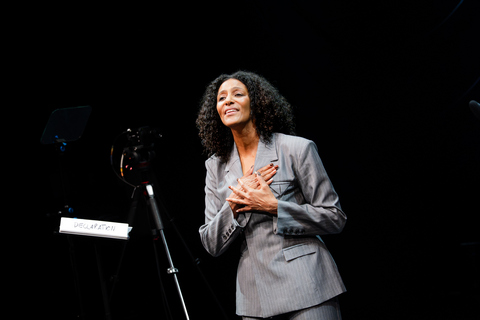
Sarah Jones in a scene from her one-woman show “America, Who Hurt You?” at the Polonsky Shakespeare Center of Theatre for a New Audience (Photo credit: Hanjie Chow)
That interest in inheritance explains why listening becomes the show’s deepest recurring theme. Jones speaks of hearing her father recite the Declaration of Independence repeatedly and of absorbing the voices of relatives, neighbors, and elders. The Declaration thus functions less as a sacred artifact than as a piece of language that can be reopened and reconsidered. America, Who Hurt You? is not interested in pretending that the country possesses a single, coherent story; its theatrical method is to place many stories beside one another and allow their contradictions to remain audible.
There is an appealing urgency to Jones’ enterprise. The work originated as a podcast during the 2024 election and has evolved into a live performance concerned with what happens when people retreat into informational and emotional enclaves, consuming only the voices that confirm what they already believe. Jones answers that fragmentation with theatrical abundance. She gives the audience too many people to dismiss, too many histories to flatten, and too many conflicting experiences to reduce to a single slogan. Her comedy is crucial here. A joke gets the audience to relax; a character gets us to recognize someone; then the history underneath the joke begins to register.
The final movement turns toward the audience itself. Jones invites everyone to place a hand over the heart and consider the possibility of an unfinished personal and collective transformation. Outside the theater, another, quieter conversation has already begun: audience members have been invited to write down something they find beautiful about America, with their responses displayed on wicker chairs. The contrast is striking. The performance has spent the evening confronting painful histories, while the lobby acknowledges that affection, attachment, community, landscape, memory, and shared experience also belong to the national story. Neither impulse cancels the other.
Jones calls the production a “work in progress written by a work in progress,” a line that neatly captures both its provisional quality and its considerable vitality. After 20 years of making solo theater, she has arrived at a form in which her greatest technical gift—the ability to become somebody else almost before we realize she has changed—serves a larger theatrical purpose. She makes multiplicity visible. She turns a bare platform, a camera, a screen, and her own remarkably responsive body into a gathering place for people who would rarely occupy the same room, much less speak to one another. America, Who Hurt You? ultimately asks its audience to do what Jones has spent her career doing: pay attention, listen closely, and remain open long enough for another person’s voice to become impossible to ignore.
America, Who Hurt You? (through October 4, 2026)
National Black Theatre & Theatre for a New Audience in association with Foment Productions, Cinereach & Jayson Jackson
Theatre for a New Audience
Samuel H. Scripps Mainstage, Polonsky Shakespeare Center, 262 Ashland Place, in Brooklyn
For tickets, visit www.tfana.org
Running time: 90 minutes without an intermission


Leave a comment