
And Then the Rodeo Burned Down
Three-time winners of Edinburgh Fringe Festival’s Fringe First Award for writing offer an immersive outing of the show that began the Xhloe and Natasha lovefest.
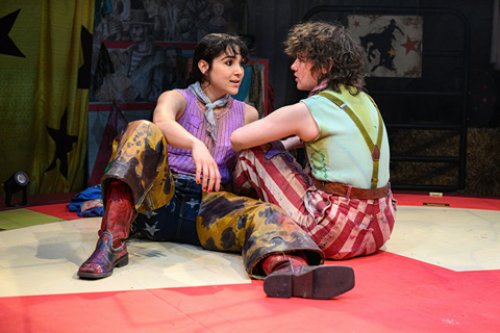
Natasha Roland and Xhloe Rice in a scene from their “And Then the Rodeo Burned Down” at Ars Nova (Photo credit: Ben Arons)
For the past several years, the theatrical duo known as Xhloe and Natasha—Xhloe Rice and Natasha Roland—have been building a reputation that borders on legend within the increasingly vibrant world of contemporary clowning. Their ascent, marked by three consecutive Fringe First Awards at the Edinburgh Festival Fringe, has felt less like the emergence of promising young artists than the steady unveiling of a wholly original theatrical language. With And Then the Rodeo Burned Down, now galloping triumphantly into Ars Nova for its Off-Broadway debut, they confirm what devotees have long suspected: they are among the most inventive and exhilarating theater-makers working today.
At first glance, the premise sounds delightfully ridiculous. Dale, a rodeo clown played by Rice with a mixture of wide-eyed sincerity and aching vulnerability, dreams of becoming a real cowboy. His constant companion is Dilly Dally, a mischievous shadow brought to life by Roland, who mirrors Dale’s movements, challenges his assumptions, and quietly exposes the cracks beneath his relentlessly cheerful façade. Together they inhabit a world of greasepaint, hay bales, cigarettes, livestock, and impossible aspirations—a landscape that feels simultaneously borrowed from American mythology and completely invented anew.
What distinguishes Xhloe and Natasha from many contemporary absurdists is their ability to make nonsense feel emotionally precise. Their clowning is virtuosic, but never merely decorative. Every pratfall, synchronized gesture, acrobatic flourish, and perfectly timed physical gag serves character and theme. The pair move with such uncanny synchronicity that they often appear less like two performers than two halves of a single theatrical consciousness. Whether shoveling manure in elaborately choreographed routines, dancing through dreamlike musical interludes, or engaging in rapid-fire comic exchanges, they generate a kinetic electricity that keeps the audience in a state of delighted anticipation.
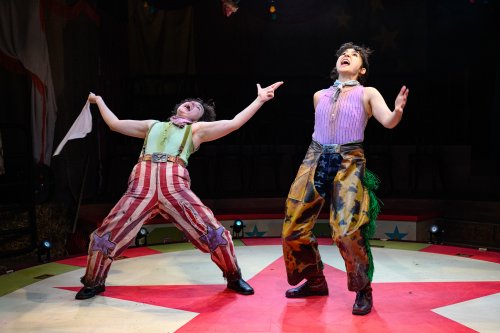
Xhloe Rice and Natasha Roland in a scene from their “And Then the Rodeo Burned Down” at Ars Nova (Photo credit: Ben Arons)
The duo and co-director Tom Costello make magnificent use of the expanded resources afforded by the Off-Broadway production. Emmie Finckel’s richly detailed scenic design transforms Ars Nova into a fully realized rodeo dreamscape, a gloriously gaudy rodeo arena, part circus ring, part fever dream, part Americana shrine, immersing the audience in a world of hay bales, bright banners, greasepaint, an imaginative use of colorful bandannas, and Western mythology. The cowboy costumes, created by Rice, Roland, and Christopher E. Ford, amplify the show’s playful theatricality, while Angelo Sagnelli’s lighting design shifts seamlessly between exuberant spectacle and moments of startling intimacy. (The only design blemish, but a decidedly offensive one at that, is the inclusion of Carrie Underwood, now a vocal MAGA sympathizer, in co-sound designer Carsen Joenk’s pre-show mixtape.)
The first half unfolds as an increasingly sharp examination of ambition, masculinity, and self-delusion. Dale insists repeatedly that the rodeo is “the best place in the world,” yet every interaction suggests otherwise. Barnaby the Cowboy—also played by Roland with a hilarious touch of rhinestone diva swagger—embodies the hollow promise of success. Arnold the Bull, perhaps the production’s most unexpectedly moving creation, offers a heartbreaking perspective on confinement and longing beneath layers of comic absurdity. Through these encounters, Xhloe and Natasha gently dismantle cherished American myths while retaining profound empathy for those who still believe in them. What makes their writing so remarkable is its refusal to separate comedy from melancholy. A throwaway joke about rodeo hierarchy suddenly becomes an indictment of exploitative labor. A conversation with a bull evolves into a meditation on freedom. A running gag involving cigarettes falling from the sky acquires existential significance. Few playwrights possess such confidence in their audience’s willingness to leap between registers, and fewer still manage those leaps with such grace.
Then comes the production’s astonishing central rupture. Just as the narrative appears to be settling into familiar rhythms, darkness engulfs the theater. The rodeo vanishes. The characters dissolve. What emerges from the blackout is one of the most exhilarating meta-theatrical pivots in recent memory. Without sacrificing momentum, Xhloe and Natasha transform their clown mystery into a searching inquiry about artistic creation itself—about budgets, ambition, failure, and the seemingly endless struggle to make meaningful work in a culture that rarely values it adequately.
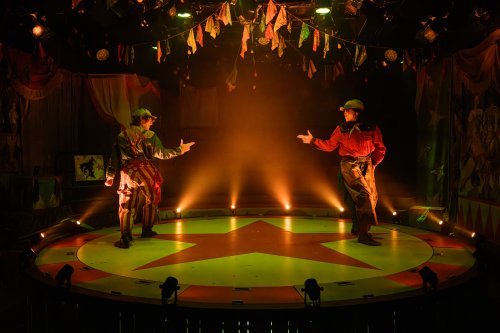
Xhloe Rice and Natasha Roland in a scene from their “And Then the Rodeo Burned Down” at Ars Nova (Photo credit: Ben Arons)
Remarkably, this shift never feels self-indulgent. Instead, it deepens everything that came before. Dale’s desire to become a cowboy suddenly mirrors the artist’s desire to transcend limitations. The rodeo’s precarious ecosystem becomes a reflection of the theater industry itself. The mystery of who burned down the rodeo evolves into something richer and stranger—a question not merely about plot, but about authorship, aspiration, and the cost of chasing impossible dreams. The result is both intellectually playful and emotionally resonant.
Throughout, Rice and Roland demonstrate extraordinary command of tone. They move effortlessly from slapstick to philosophical inquiry, from broad clowning to moments of startling vulnerability. Their dialogue crackles with wit, but it is their physical storytelling that leaves the deepest impression. Every gesture feels considered. Every movement carries meaning. The years of collaboration between these artists are visible in every second of stage time, producing a level of trust and precision rarely encountered even among the most accomplished theatrical partnerships.
The show’s recurring use of Dolly Parton’s “9 to 5” becomes increasingly poignant as the evening unfolds. What begins as an amusing musical motif gradually reveals itself as the production’s thematic backbone. Beneath the rodeo makeup and absurdist hijinks lies a deeply felt exploration of labor: the work required to become who we wish to be, the compromises demanded by institutions, and the stubborn persistence required to continue creating despite uncertainty. It is a theme that resonates far beyond the theater industry, touching anyone who has ever sacrificed comfort in pursuit of purpose.
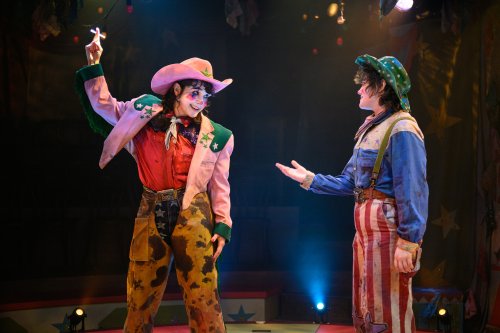
Natasha Roland and Xhloe Rice in a scene from their “And Then the Rodeo Burned Down” at Ars Nova (Photo credit: Ben Arons)
In a cultural moment when clowning has begun to edge from the margins toward the mainstream, Xhloe and Natasha stand unmistakably at the forefront of the movement. Yet labels such as clown, absurdist, or physical theater artist seem increasingly insufficient to describe what they accomplish. And Then the Rodeo Burned Down is funny, moving, bewildering, politically astute, formally adventurous, and unexpectedly tender. It asks large questions without insisting upon tidy answers. It embraces chaos while revealing profound emotional truths.
Most of all, it leaves one exhilarated by the possibilities of live performance. The cigarettes may be fake, but the fire is undeniably real. With And Then the Rodeo Burned Down, Xhloe and Natasha have created a work of rare imagination and startling originality—a dazzling act of theatrical reinvention that confirms their status not merely as rising stars, but as essential artists shaping the future of the American stage.
And Then The Rodeo Burned Down (extended through July 10, 2026)
Ars Nova, 511 West 54th Street, in Manhattan
For tickets, visit www.arsnovanyc.com
Running time: 70 minutes without an intermission


Leave a comment