
oh, Honey
Playwright Scotti excavates how suffering shields and distorts, revealing pain as spectacle—our delusions projected outward as yet another shimmering screen.
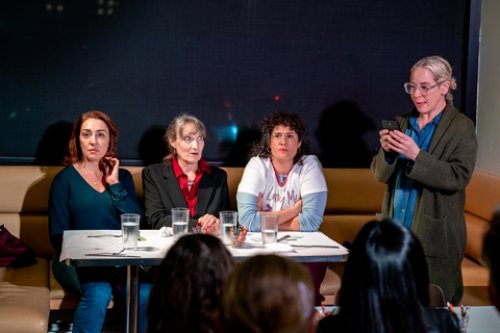
Jamie Ragusa, Dee Pelletier, Maia Karo and Mara Stephens in a scene from Jeana Scotti’s “oh, Honey” at Little Egg in Brooklyn (Photo credit: Krystal Pagán)
Walking up to Little Egg, the charming borderline Crown Heights/Prospect Heights breakfast nook, one does not expect to be met with a content warning and a mug of tomato soup. The house special, for the moment, is not avocado toast but theater — specifically, oh, Honey, a revival of the production of Ugly Face, a recent theatre collective founded by playwright Jeana Scotti, actor Maia Karo and producer Amelie Lyons. What’s on offer is not brunch but reckoning: the play comes seasoned with mentions of sexual assault and addiction.
In a room that seats a mere 27 souls, one does not so much attend a performance as intrude upon it. The space is intimate to the point of confession; the air, heavy with the scent of soup and subtext, seems to vibrate with secrets not meant for public airing. You find yourself less an audience member than an accidental voyeur, a neighboring diner who’s suddenly realized that the conversation drifting from the next table is not light brunch chatter but something dense, uncomfortable, and quietly devastating. Go ahead and listen — you won’t be able to help yourself — but know that what you’re overhearing is not easily digested.
For oh, Honey begins, quite literally, in this diner: four suburban mothers convene for their regular “girls’ lunch,” tended to by a server so expertly repressed she could win a medal for subjugating her inner life. Their orders are petty symphonies of particularity — salad dressing on the side, monkfruit sweetener, iced tea “with half lemon juice and a little sugar” (decidedly not an Arnold Palmer). If these women sound unbearable, hold your judgment; the point, as Ugly Face declares, is to celebrate flaws and reclaim what was once shameful.
The restaurant, we learn, has been selected with almost surgical precision — not for its menu or ambiance, but for its distance, its blessed anonymity. It sits well beyond the women’s suburban comfort zones, a neutral ground where recognition is unlikely and reputations can momentarily exhale. Here, amid clinking cutlery and the hum of strangers’ small talk, they can convene in the safety of obscurity — a self-imposed exile where no familiar face will glance up from the next booth and connect them to the shame that shadows their sons’ names.
Under Carsen Joenk’s clean, clever direction, Scotti’s writing finds a delicate equilibrium — biting, funny, and deeply humane. The quartet of women are precisely dressed by designer Iliana Paris — Lu (played with steely authority and a glint of battle-worn wisdom by Dee Pelletier), Bianca (played as a confection — all sugar, charm, and the gentle fizz of conviviality — yet beneath that polished surface something acrid brews, by Jamie Ragusa), Vicki (Karo, radiating a pitch-perfect, Aquarius-inflected, “healing crystal” chaos), and Sarah (Mara Stephens) — are not friends, as Lu icily reminds us. “We can’t talk to real friends about this crap,” she declares. “They already talk enough shit about us behind our backs.” This crap, we soon learn, is the devastating, unshareable truth they orbit: each has a son accused of sexual assault.
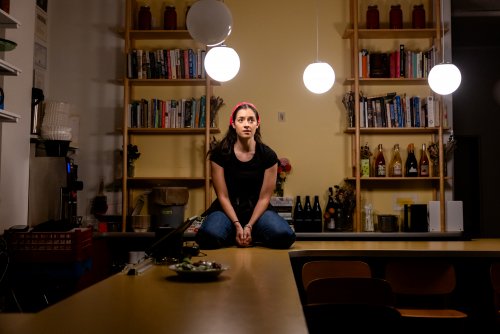
Carmen Berkeley in a scene from Jeana Scotti’s “oh, Honey” at Little Egg in Brooklyn (Photo credit: Krystal Pagán)
Under Carsen Joenk’s clean, clever direction, Scotti’s writing finds a delicate equilibrium — biting, funny, and deeply humane. The quartet of women are precisely dressed by designer Iliana Paris — Lu (played with steely authority and a glint of battle-worn wisdom by Dee Pelletier), Bianca (played as a confection — all sugar, charm, and the gentle fizz of conviviality — yet beneath that polished surface something acrid brews, by Jamie Ragusa), Vicki (Karo, radiating a pitch-perfect, Aquarius-inflected, “healing crystal” chaos), and Sarah (Mara Stephens) — are not friends, as Lu icily reminds us. “We can’t talk to real friends about this crap,” she declares. “They already talk enough shit about us behind our backs.” This crap, we soon learn, is the devastating, unshareable truth they orbit: each has a son accused of sexual assault.
The play draws inspiration from a 2017 New York Times article about real mothers in similar circumstances — women who met in a suburban diner to “share notes and commiserate.” The material is chilling, a psychological buffet of denial, moral inversion, and the human instinct to rationalize horror into something livable. “In my generation,” one mother says, “what these girls are going through was never considered assault. It was considered, ‘I was stupid and I got embarrassed.’” Scotti transforms this material into an acerbic chamber piece, a kind of suburban Greek tragedy served with coffee refills.
The title, oh, Honey, refers to that saccharine expression of condescending sympathy these women deploy like perfume — to soothe, to deflect, to disguise. Sarah, the hostess of the group and the most unravelled among them, assembled the others via an online support forum with the chillingly sanitized acronym FACE — “Families Advocating for Campus Equality.” From this linguistic doublespeak, Scotti spins a series of taut, deliciously awkward dances: activist jargon tangled with politeness, empathy colliding with self-preservation. These are women forever on the brink of exposure — their conversations teetering between solidarity and subtle warfare, each mother silently calculating whose son, and whose reputation, might yet be saved.
Stephens’ Sarah is the group’s tremulous heart, fluttering between neediness and fury. Her Sarah, embodied with weary precision, seems to carry a low, unshakable weather system about her person, and is invariably the first to arrive. Her early presence feels less like punctuality than compulsion, as though she needs the extra minutes to reassemble herself before the others descend. This habitual earliness affords her a small ritual of control: the chance to gently, almost apologetically, remind the beleaguered server of her preference for agave as sweetener. Such dietary particularities, repeated and reasserted, become a kind of social armor throughout the play — the polite neuroses of women who cling to the manageability of menu choices even as their emotional lives slip irretrievably beyond regulation.
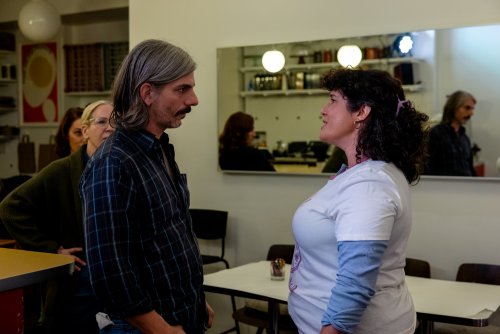
Lucas Papaelias and Maia Karo in a scene from Jeana Scotti’s “oh, Honey” at Little Egg in Brooklyn (Photo credit: Krystal Pagán)
Her attempts to recast her accused son as the innocent boy from old Facebook photos feel both pitiful and profoundly human. When she hisses about a rival mother — “Jillian, with her perfect daughter Chelsea, her valedictorian hair!” — we glimpse a woman combusting under the weight of envy, guilt, and thwarted maternal love. Her breakdowns are as funny as they are harrowing, and in the show’s most lacerating moment, her pain becomes spectacle — the others mocking her as if she were a character on The Real Housewives of Suburbia.
If Scotti is willing to concede that the notion of unshakable sisterly solidarity is, at best, a well-meaning feminist fable, then she does not stop there. She presses further, exposing with sharp, unflinching precision the myriad ways in which women can, and do, wound one another. Oh, Honey renders these dynamics with unsettling clarity: not merely in the mothers’ reflexive lapses into gossip — those petty cruelties disguised as concern — but in the subtler, more insidious hierarchies that unfold between generations. Here, the older, comfortably moneyed women, swaddled in privilege and Pilates-toned moral certitude, preside over the lone younger woman onstage, whose economic precarity and emotional transparency mark her as Other. The result is a tableau of gendered power turned inward — a portrait of oppression not imposed from above but circulating, venomously, within the very ranks of those who claim to resist it.
Naturally, this self-styled coven of suburban priestesses would prefer to imagine their collective power as benevolent — a protective force marshaled, however imperfectly, in defense of women like Mari. When a dubious male patron wanders into their midst, they spring into action with the righteous choreography of amateur avengers, their moral vigilance briefly lending them purpose. (Here, Lucas Papaelias as the Diner Guy, wide-eyed and twitching in a perfect tableau of startled masculinity, supplies a moment of sly comic grace.) Yet the performance of the ladies’ solidarity rings ever so slightly hollow.
Hovering on this periphery is Mari (Carmen Berkeley), the server whose silence conceals an artist’s ache. In a startling, crimson-lit monologue, Mari literally crawling atop the serving counter smears herself in salad dressing — a grotesque baptism of creative frustration — confessing that her secret, “selfish” labor is the act of writing itself. It’s a sequence that reframes the entire production: the women at the table, so sure they are the protagonists of their own misery, are in fact being observed, absorbed, and perhaps rewritten by the person bringing them their tea.
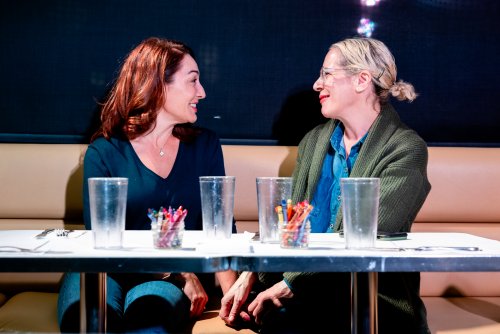
Jamie Ragusa and Mara Stephens in a scene from Jeana Scotti’s “oh, Honey” at Little Egg in Brooklyn (Photo credit: Krystal Pagán)
Scotti’s dramaturgy is both compassionate and cruelly perceptive. She offers her characters enough interiority to earn our empathy, yet keeps them at a cool observational distance — as though we, too, were Mari, jotting field notes on the performance of privilege. Even the haughty Lu is eventually revealed to be trembling atop her own quicksand of guilt. And for all its thematic heaviness, oh, Honey is buoyed by moments of theatrical wit — particularly the surreal interludes in which “the girls” parody themselves, wielding forks as microphones, channeling their inner Netflix stars.
There are moments when the production, having established its firm footing in the recognizable textures of realism — the clatter of dishes, the practiced smiles, the brittle cadences of polite conversation — suddenly tilts, almost imperceptibly, into another realm entirely. Designer Attilio Rigotti’s subtlest modulation of light and the faint, uncanny glow of a soup bowl transfigures into something near-mystical, and the diner becomes a threshold: a passageway into the characters’ interior landscapes, those trembling, unspoken places where trauma and denial quietly roost. At first, these departures can feel jarring — a breach in the play’s naturalistic spell, as though we’ve stepped momentarily off the map. Yet, as the evening unfolds, one comes to understand their purpose: these spectral interludes do not abandon the world of the play so much as deepen it, peeling back the veneer to reveal the raw, psychic undercurrent thrumming beneath. What once felt disorienting soon emerges as essential, expanding our understanding of these women beyond dialogue and gesture, allowing their buried griefs to shimmer briefly into view.
In the end, oh, Honey lands a sharp meta-theatrical punch: “Because, Sarah,” Bianca tells her, “you’re entertainment for her. You’re her Real Housewives.” It’s a line that detonates the play’s central conceit — the notion that suffering, in our mediated age, can so easily become another form of content.
Ugly Face’s debut is a bracing success: a play that interrogates complicity without moralizing, that wades into the swamp of maternal devotion and denial with both tenderness and teeth. To sit in Little Egg, sipping soup while women spill secrets across the table, is to experience theater not as distant spectacle but as intimate indictment — one that lingers long after the check is paid.
oh, Honey (through November 7, 2025)
Ugly Face Theatre
Little Egg, 657 Washington Avenue, in Brooklyn
For tickets, visit http://www.uglyfacetheatre.com
Running time: 90 minutes without an intermission


Leave a comment