
ON THE TOWN WITH CHIP DEFFAA AT “THE PEOPLE VERSUS LENNY BRUCE”
World premiere production of "The People Versus Lenny Bruce" based on the case of legendary lawyer Martin Garbus comes to Theatre Row.
ON THE TOWN WITH CHIP DEFFAA AT “THE PEOPLE VERSUS LENNY BRUCE”
Logo and program for “The People Versus Lenny Bruce”
On Sunday, May 12th, I attended a press performance of the world premiere production of “The People Versus Lenny Bruce,” which officially opened on Theatre Row (410 W. 42nd St., NYC) on May 14th. Now, a press performance is different from an ordinary preview. It is a performance to which reviewers are specifically invited to attend, to watch a play that the producers feel is ready to be reviewed.
But the production I witnessed felt unwieldy, unfocused, and under-rehearsed—more like a workshop of a work-in-progress than something wise producers would want reviewers to see. And that’s a pity, because there were some very good actors on that stage, and some moments—but not enough moments–that really worked as theater. With proper pruning, reshaping, and rewriting, “The People Versus Lenny Bruce” could be really interesting. I hope they’ll do the needed work. But the play has a long way to go.
I might add that I was really looking forward to “The People Versus Lenny Bruce.” I’m pretty much like an ideal audience member for this play. I very much enjoyed Lenny Bruce’s work as a comic and social critic. In the early 1960s, he was a leader in the emerging counter-cultural movement that brought welcome—and much-needed–new energy to America. His conviction on obscenity charges—for uttering in his club act the sort of words that our current President now tosses about so freely—always struck me as obscene, an obvious violation of Bruce’s First Amendment rights. My sympathies have always been more with artists who are striving to express themselves, than with censors. Bruce helped open doors for many comics and social critics to speak more freely. And for all of that and more, I’m grateful.
Lenny Bruce’s life was rich with drama; a good play about him would be engrossing, meaningful, and resonant. Plenty of people are still trying to censor what others can say or write; they strive to keep books they dislike out of the library, and talk-show hosts they dislike off the air. You may not often hear the name “Lenny Bruce” anymore, but his fight against the censors is still, alas, all too relevant. His story deserves telling, and re-telling. I was definitely rooting for this new play.
However, “The People Versus Lenny Bruce,” written by Susan Charlotte and directed by Anthony Marsellis—two seasoned stage/screen/television pros with solid track records–had surprisingly little dramatic impact. And from the very start, things felt slightly “off.”
I invited a guest who’d never heard of Lenny Bruce and was eager to learn his story. We entered the theater and a woman serving as an usher looked at our tickets and directed us to our seats. We had terrific seats. We couldn’t wait for the play to begin.
But then, to our surprise, the same woman who’d directed us to our seats a moment ago, whom I’d taken to be an usher, stepped up on stage, and proceeded to try to warm up the audience. She did not identify herself. She did not tell us If she was a producer or the playwright, or what her connection with the show was. She told us twice that we looked like a good audience. (I guess she was hoping that we might be a good audience; we hadn’t actually done anything yet except take our seats.) She told an odd story about a play that wasn’t working, it wasn’t going over, and no one was sure what fixes need to be made. They wondered: Should they change the writer, or change the director, or change the actors? Then a suggestion was made: “Change the audience.” What was my takeaway from her telling us that odd story? I thought, “What’s on her mind right now is a play that isn’t working and the question of how of fix it. “ What she was communicating, whether or not it was her intent, was that we were about to see a play that wasn’t working, that needed fixing–and she hoped, somehow, that we’d be a “good audience.”
She told us that in the play we were about to see there were plenty of places for us to laugh, and that we should feel free to laugh. I figured from that remark that the play hadn’t been getting hoped-for laughs at the previous performances, and she hoped that encouraging us to laugh would help. But that’s not really the way things work in New York. Pros don’t give warm-up speeches before press performances of shows. They don’t tell us that a play will be funny; they trust us to find the laughs in the play, if they’re to be found.
And after that odd, awkward, amateurish warm-up bit—which to me felt a bit desperate–the play itself started.
I smiled happily, seeing Stephen Schnetzer—playing famed attorney Martin Garbus—take the stage. I’ve seen him in assorted memorable plays in New York (including “Oslo,” “Wit,” “The Waverly Gallery,” “The Goat, or Who is Sylvia”), and he has many television credits. I was glad to see him up there. And then, alas, he began delivering narration… lots of it, too much of it. This play is weighted down with far too much exposition.
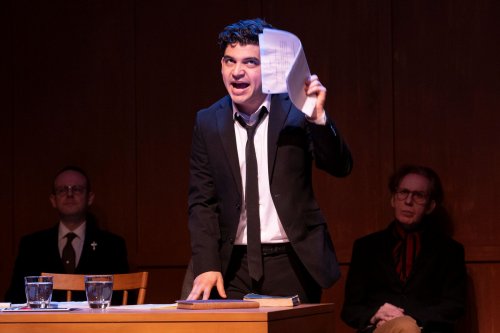
Joseph Anthony as Lenny Bruce in a scene from Susan Charlotte’s “The People Versus Lenny Bruce” (Photo credit: Russ Rowland)
And then he began to look uncomfortable. I know that look; it’s a look you often see in actors in the early stages of rehearsing a play, when they’re still straining hard to remember what lines come next, and thus they can’t yet fully “be” the character they’re playing. And then he stopped, caught like a deer in the headlights. It was clear he was having a brain-freeze and couldn’t remember what he was supposed to say next. He then actually told us in the audience that he was having a freeze. (I don’t think calling attention to such an occurrence is wise.) And then called out “Line!” The prompter, prominently seated in the center of the front row, following the script on his open laptop, called out the line that Schnetzer needed to say next; Schnetzer said the line, and the play continued.
OK, I told myself; that didn’t augur well for the show. But actors are human. Anyone can—on occasion–go up on a line. It’s not the end of the world. But just a short while later, it happened again. Schnetzer again called out “Line,” the prompter called out the forgotten line, Schnetzer repeated it, and the play continued. Then it happened a third time. And then a fourth time. And a fifth time. And then another actor on stage called out “Line!” and once again, we listened to the prompter provide the forgotten line, so that the actor could repeat it and the play could resume.
In more than six decades of avid theater-going, I’ve never seen so many requests made to a prompter for a line. (And this was a press performance!) There’s a standard of professionalism you expect in New York theater. And this production simply was not meeting that standard.
But that was only the start of the problems. Too often, Schnetzer was being asked to tell us things—via overlong passages of narration—that we should have been seeing onstage.
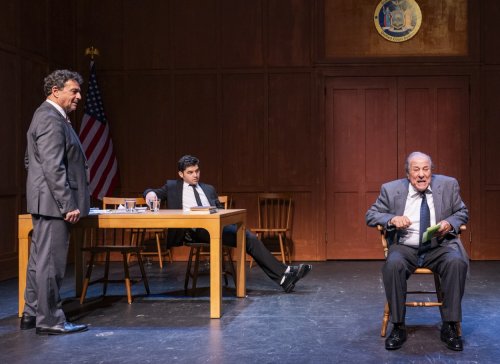
Stephen Schnetzer, Joseph Anthony and Don Grimaldi in a scene from in Susan Charlotte’s “The People Versus Lenny Bruce” (Photo credit: Russ Rowland)
One example. In the script, Schnetzer (as Lenny Bruce’s lawyer, Martin Garbus) tells us—twice—that Bruce wept after he was convicted. But why are we sitting in a theater listening to one character recall that another character wept? (We might as well just listen to an audio-book version of Garbus’ memoir, which was a source for this play, if we want to simply hear Garbus say that Bruce wept.) The scene would have ten times more dramatic clout if we actually saw Bruce break down and weep, rather than hear his attorney tell us that Bruce wept. We don’t go to the theater to have the big, emotional moments simply mentioned to us via narration. We expect to witness them.
Another example. Schnetzer (as Martin Garbus) tells us that, over the course of the trial, Bruce deteriorated both physically and mentally. But if the play were written, directed, and acted right, we would so clearly see that happening that we would not need a narrator to tell us it had happened.
A third example. Schnetzer (as Garbus) is led to believe, by Lenny Bruce, that Bruce pops pills but is steering clear of the hard stuff, heroin. And then, Schnetzer tells us, he visited Bruce’s apartment and to his surprise he saw the needles strewn about; he realized, when saw the needles, that Bruce was a drug addict.
But why is this key information being given to us via narration? The cast includes a very good actor, Johnny Anthony—charming, human, endearing –playing Lenny Bruce. The actor, at present, is woefully under-utilized. His part is much smaller than Schnetzer’s. (It should be the other way around; the audience cares far more about Bruce than they care about his lawyer.) Dramatically, it would work far better if Johnny Anthony (as Lenny Bruce) first charms all of us into believing that he’s not using hard drugs, and then—after we’ve been conned—we actually see him shooting up. Show it, don’t bury the information in endless lines of narration. Let us realize that Lenny Bruce has been lying to us (and to himself) about how serious his drug problem is. If we see he’s a user, it would pay off much better.
The play, the program says, is based on a chapter (“The People Against Lenny Bruce”) in Martin Garbus’ book “Ready for the Defense.” But a playwright should not simply be putting lines from a book directly into a script. The playwright should dramatize events. Take some dramatic liberties, if needed to make a point. But show us what happened; don’t just have an actor keep telling us what happened.
At play’s end—about two long, intermission-less hours after the woman began warming up the crowd—the audience offered polite, perfunctory applause. No standing ovation (which you almost expect these days at a press performance, if only because the audience often includes friends of the cast and crew). My guest commented that it felt more like a documentary–with a narrator simply telling us so much about Lenny Bruce–than a play.
There’s some excellent material here, a story that deserves to be told, and a very good cast. If the playwright is willing to put in the needed work to cut, revise, and restructure the play, it could have a future. But the focus needs to be on Lenny Bruce, not his lawyer. Bruce is a far more interesting character than his attorney, and Bruce has the most at stake here. Some narration can be retained, but generally speaking the play works better when we’re seeing—not being told by a narrator–what is happening. And pruning lines that aren’t essential to Bruce’s story is essential. The play drags at times. (I grew impatient as one character, Forrest Johnson, was telling us that he’s in his 40s not his 50s, he has a daughter but not a granddaughter, etc. I wanted to tell him, “Move it along; we’re here to learn about Bruce, not whether you’re in your 40s or 50s. We see you, we can guess your approximate age without your rambling about it.”)
I liked the fantasy sequences, in which we saw what Bruce wished was happening in the courtroom. I liked the various characters breaking the fourth wall to speak directly to us for a moment.
And I really liked the seven-member cst. The only actor who was new to me was Johnny Anthony, a young Pace University graduate, who caught the essence of Bruce with charm and flair. I swear, he had me the first time he addressed his lawyer, Martin Garbus. Just the way he said the word “Martin,” with a bit of that old-time New York accent we heard so often when I was young and hear so rarely today—was perfect. The play is set in 1964—long before this actor was born. But he said the name just right. And it was like we were there. But we need to see—not just be told by a narrator—the pain this prosecution is inflicting upon Bruce.
My favorite moments in the play—the moments when the play most fully came to life—were in the sequences involving Bruce and the key prosecution witness against him, Herbert Ruhe, played to perfection by Dan Grimaldi (whom many will remember for his portrayals of brothers Patsy and Phil Parisi on “The Sopranos”).
Grimaldi delivers one of the most delicious supporting-role performances I’ve seen in years. He lost himself completely in his character. He was funny, real, exasperating all at once. His struggles to pronounce one Yiddish word (“meshugannuh”) prompt Bruce to go into one of his most famous routines—a discourse on what is Jewish and what is goyish. Johnny Anthony carried it off well. And it was good to hear it again, even in truncated form. (Bruce had many more examples to give, in his diatribes on what was Jewish and what was goyish.)
It was painful for us to hear Ruhe acknowledge to us that Bruce had been selected for prosecution even though Ruhe—successfully testifying against Bruce—did not actually believe Bruce was obscene. That was the one time in the play that I wished the playwright had written more, had helped us understand what made Ruhe tick, what made him want to put in a jail a man he actually thought was innocent.
The play had many flaws, and I was tempted to simply walk out, early on. It feels episodic; it does not build to a strong climax. But I’m glad I stayed; Dan Grimaldi’s performance was one I’ll long remember. And I look forward to seeing more of Johnny Anthony.
I delighted, too, in the performances by Timothy Doyle (as Jules Feiffer) and Roberta Wallach (as Dorothy Kilgallen). They, too, brought their characters to life. And their trial testimony held me. A lot of fine acting on that stage. (If I may offer one small critique…. Dorothy Kilgallen had such a distinctive way of speaking, I wish Wallach had caught some of the essence of it. I’m not asking Wallach to be an impersonator or an impressionist; but watching old clips of Kilgallen on television and evoking a bit of her cadences or inflections would make the characterization more impactful for audience members old enough to recall Kilgallen.)


Leave a comment