
Giant
New British play about author Roald Dahl pits the right to speak one’s mind against the obligation to answer for it, asking whether conviction can ever excuse cruelty—or merely disguises it.
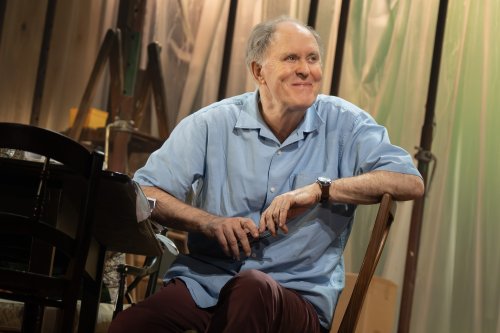
John Lithgow as Roald Dahl in a scene from Mark Rosenblatt’s “Giant” at the Music Box Theatre (Photo credit: Joan Marcus)
Topical political plays are rare on Broadway; ones that spark real argument rarer still. Mark Rosenblatt’s Giant, now at the Music Box, is both. Fresh from a warmly received West End run, it arrives with John Lithgow leading four of the six original cast members as Roald Dahl. A few minor issues aside, Giant provides a magnetic background for a riveting discussion about one of the hottest social and political issues of our times.
Its topic, anti-Semitism, is very familiar on the Great Way, as recent productions of A Prayer for the French Republic and Leopoldstadt demonstrated; in Giant, this topic gains an even sharper edge of currency by its connection to the ongoing debates regarding Israel’s aggressive military reactions to attacks from its neighbors. The background conflict in Giant is that between Israel and Lebanon in 1982. The recent clashes between Israel and Gaza, as well as with Iran, make the play, despite being written before the latter wars, seem freshly ripped from the headlines.
At the heart of the debate in Giant is the question: can one’s moral convictions regarding a political cause excuse—or even coexist with—bigotry against an entire people? In the play, Roald Dahl’s home, Gipsy House, in Great Missenden, England, is visited by Jessie Stone (Aya Cash), an attractive young sales director from Farrar Strauss Giroux (FSG), Dahl’s American publisher. The house is undergoing renovation, and plastic sheets upstage separate the sparse interior, dominated by a dining table, from the outdoors. The great Bob Crowley did the sets, lights, and costumes.
In addition to Dahl and Jessie, we meet interior designer Felicity “Liccy” Crosland (Rachael Stirling), Dahl’s 22-years-younger fiancée, a beautiful, caring helpmeet with whom he had a long-term affair during his now ended marriage to actress Patricia Neal. Then, there’s British editor and publisher, Tom Mascher (Elliot Levey), an assimilated Jew who escaped Nazi Germany as a young child and avers he’s unaffected by it. Hallie (Stella Everett) is a serving girl from New Zealand, who refuses Dahl’s request to comment on what she’s overheard. Wally (David Manis) is the estate’s tweedy old retainer. (Jessie, Hallie, and Wally are all fictional.)
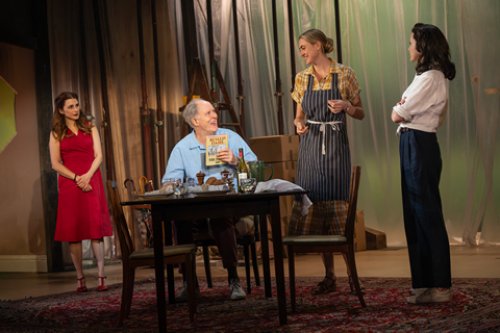
Aya Cash, John Lithgow, Stella Everett and Rachael Stirling in a scene from Mark Rosenblatt’s “Giant” at the Music Box Theatre (Photo credit: Joan Marcus)
Dahl has published a highly commendatory review of an anti-Semitic book, God Cried. In his review he calls the Jews “a race of people” who had “switched so rapidly from victims to barbarous murderers,” among other defamatory grenades. Jessie, claiming to be a Dahl idolater, arrives, her goal being to persuade Dahl to apologize for what he’s written. Tom is in on the plan and tries hard to keep things under control, but slipups occur. Dahl is sensitive to anything with which he might disagree, and, a master of witty derision, is caustically sarcastic and curmudgeonly whenever his buttons are pushed.
Jessie, pressured by Dahl, admits she’s Jewish, and, with Liccy and Tom unable to effect a cease fire, a knives-out argument rages regarding the rights and wrongs in the Israeli-Lebanon conflict. Dahl’s refusal to recant only intensifies as his perfectly honed British rhetoric makes his positions ever clearer. He will not be policed, he insists, declaring he’s telling hard truths, although he won’t acknowledge the line between criticizing the Israeli military and the Jewish people.
Facing him is the argument that his words have consequences, that the book he’s finishing, The Witches, will lose sales, and that an apology is accountability, not censorship. Strong points are made on both sides, which prevents audience complacency. And we are asked to ponder whether great art exempts the artist from moral condemnation.
It doesn’t matter that this debate never took place because, aside from an overly contrived moment regarding Jessie’s copy of the review, it’s plausible enough to believe in, and it makes for a memorably dramatic, politically hot stage confrontation. In the second act, things cool down dramatically as Dahl, perhaps showing self-doubt, begins to question even the serving girl and the old retainer on what to do; perhaps we’re meant to feel a sliver of sympathy for him.
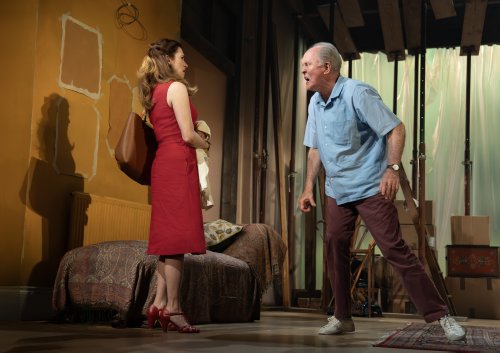
Aya Cash as Jessie Stone and John Lithgow as Roald Dahl in a scene from Mark Rosenblatt’s “Giant” at the Music Box Theatre (Photo credit: Joan Marcus)
He is, obviously, showing signs of age, and he continues to suffer the pain of having lost a seven-year-old daughter many years earlier. But then comes the denouement, a phone conversation with New Statesman writer Michael Coren, during which Dahl gleefully spills words he actually did say, and that would be published, leaving no doubt about where he stood.
Interestingly, despite all the storm and stress about the consequences Dahl might face, even his words to Coren created little more than a temporary dent in his reputation, which served to complicate, not destroy it. Jessie Stone’s arguments on behalf of FSG make for good theatre; the fears they represented, however, were all unfounded. Dahl never took back his words, and continued being a successful writer until his death. In 2020, the Roald Dahl Story Company issued a formal apology, and there, despite belated condemnations, the matter rests, consequences be damned. Meanwhile, the same arguments delivered in the play keep being repeated by newspaper and broadcast pundits, and our politicians and the public clinging to one side or the other.
Lithgow, although his posh accent does sometimes sound more put on than natural, runs the gamut of emotions from arrogance to zealousness, evoking pathos and ridicule as needed, and he’ll surely get award nominations. The accents come easier for native Brits Elliot Levey as the anxious, non-confrontational Tom, with tennis on his mind, and Rachael Stirling as the conciliatory Liccy. Repeating their London performances, both do fine work, but it’s hard not to wonder what this strikingly attractive, voguishly dressed woman sees in this aging, anti-Semitic miscreant.
Aya Cash’s Jessie offers a worthy antagonist for Lithgow’s Dahl, but her executive is a bit too much a well-dressed (red dress and heels), generic executive. It could use a more distinctive New York sharpness and dialect. Both veteran David Manis and newcomer Stella Everett do well in smaller roles, the lanky young actress bringing effective comic energy and timing to her Broadway debut.
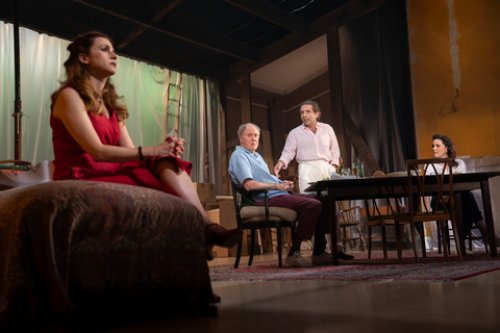
Aya Cash, John Lithgow, Elliot Levey and Rachael Stirling in a scene from Mark Rosenblatt’s “Giant” at the Music Box Theatre (Photo credit: Joan Marcus)
Liccy, in the play, talks to Dahl about the possibility of his being knighted. In reality, he was eventually offered a lesser rank and turned it down because he wanted her to be Lady Dahl. As it turned out, however, in 2024, Felicity Crosland was named Dame Commander of the Order of the British Empire, an even higher honor. Serves him right.
Giant (through June 28, 2026)
The Royal Court Theatre
The Music Box, 239 W. 45th Street, NYC
For tickets, call 212-239-6200 or visit http://www.telecharge.com/giant-tickets
Running time: two hours and 20 minutes including one intermission


Bravo Jack!