
The Porch on Windy Hill: Building a Space That Holds What Isn’t Said
I spoke with set designer Andrew Robinson and writer/director Sherry Stregack Lutken about how the porch came into being—not as an object, but as a way of thinking. What follows is a focused exchange about structure, absence, restraint, and memory: how physical choices do emotional work, how collaboration sharpens intention, and how a space can hold what characters—and audiences—aren’t yet ready to carry inside.
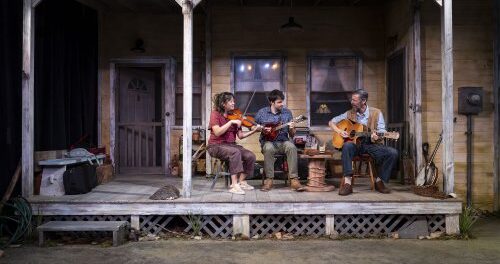
Tora Nogami, Alexander Morgan Morse and David M. Lutken in The Porch on Windy Hill. Photo by Ben Hider
A Conversation with Set Designer Andrew Robinson and Director/Playwright Sherry Stregack Lutken
Interview by: Jack Quinn, Publisher
When I first saw “The Porch on Windy Hill” in October, the set didn’t feel like scenery. It felt present—observant, patient, almost watchful. The porch wasn’t simply where the story happened; it shaped how the story could move, where it could stop, and what it refused to resolve. Note: Theaterscene.net critic Joseph Pisano reviewed the first production.
For this conversation, I spoke with set designer Andrew Robinson and writer/director Sherry Stregack Lutken about how the porch came into being—not as an object, but as a way of thinking. What follows is a focused exchange about structure, absence, restraint, and memory: how physical choices do emotional work, how collaboration sharpens intention, and how a space can hold what characters—and audiences—aren’t yet ready to carry inside.

Tora Nogami Alexander, Morgan Morse and David M. Lutken in a scene from the new musical “The Porch on Windy Hill” at Urban Stages (photo credit: Ben Hider)
Q: When The Porch on Windy Hill first began to take shape, how early did the porch itself enter the conversation—not as scenery, but as a way of thinking? When did it stop being an idea and start being something you could stand on?
Sherry Stregack Lutken:
The porch felt like a character before we ever produced the play. Even at the writing stage, it represented many things at once—the people who aren’t there, the home everyone is looking for, the history the characters are carrying. It needed to be a grounding force in the storytelling, something very real and very present.
When Andrew and I first sat down together, it was already a place I could see clearly. Not abstract. Not symbolic in a loose way. It was always meant to feel like somewhere you could actually stand.
Andrew Robinson:
When I read the script, it immediately brought me back to sitting on my grandmother’s porch when I was a kid. That sense of warmth, family, and memory came up right away. That was my entry point—not scale or structure yet, but feeling.
From the beginning, Sherry and I kept bringing research, memories, and ideas into the room. Each conversation sharpened what that porch needed to be emotionally before we ever finalized what it would be physically.
“Even though the characters could technically leave, it never felt like they really could.” — Andrew Robinson
Q: Looking at the porch now—its height, depth, and how far forward it sits—what structural choices are doing the emotional work? Why this elevation, this depth, this edge relative to the audience?
Andrew Robinson:
A lot of that came from isolation. Even though the characters could technically leave, it never felt like they really could. The porch had to be an anchor—something they were bound to.
The depth and elevation came out of conversations about blocking and movement, but also about emotional containment. This porch is where they always end up. It’s where things get stuck.
And then there was the reality of Urban Stages. It’s an intimate space. Instead of fighting that, we leaned into it—using proximity to heighten the emotional pressure.
Q: Once those physical limits were set, how did they shape where scenes could live—or couldn’t?
Sherry Stregack Lutken:
The instinct of these characters is often to get as far away from each other as possible. In this space, there’s a limit to how far they can go. That meant we had to find other ways to create emotional distance.
There were moments in rehearsal where we’d hit an impasse and have to start the blocking over—not because it was wrong emotionally, but because it couldn’t work physically. That constraint became a creative engine. It forced clarity.

“The porch felt like a character before we ever produced the play.” — Sherry Stregack Lutken
Q: What parts of the house did you intentionally not build—and why was leaving them out more powerful than showing them?
Andrew Robinson:
There was an early sketch that leaned more abstract, but we moved away from that. We realized this story needed realism to carry its emotional weight.
Of course, I’d love to show a full house, a roofline, more detail—but we kept asking whether adding more would dilute the truth of the space. What we built is exactly what the story needs. Anything else would have been decoration.
Q: Did those absences force the text or staging to do different work?
Sherry Stregack Lutken:
Not really. The porch itself had enough room to breathe. Even though it’s compact, it feels alive.
Where things shift is at the edges—the mural, the painted space beyond the porch. That’s where realism starts to loosen and emotion can take over. The world changes shape without losing its grounding.
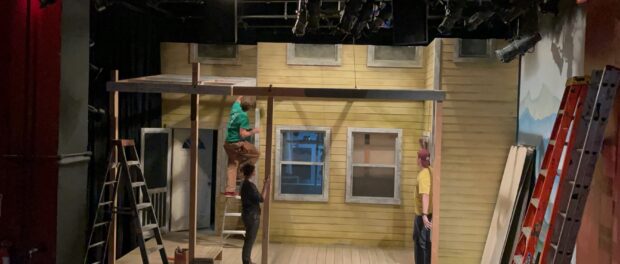
Construction photo — unfinished porch, ladders, exposed siding
Q: Looking at build photos—unfinished siding, exposed structure—what decisions changed because you were physically in the space together?
Andrew Robinson:
The first time, we were lucky enough to build while rehearsals were happening. We could move walls, adjust the ground plan, and really feel where the house needed to live.
By the second build, everything was refined. There were no major changes—just small adjustments made with intention.
Sherry Stregack Lutken:
That time was a gift. We could sit in the space and talk about height, distance, and proportion in real time—balancing function and aesthetics.
Because of that, the set doesn’t feel imposed on the theater. It feels grown inside it.
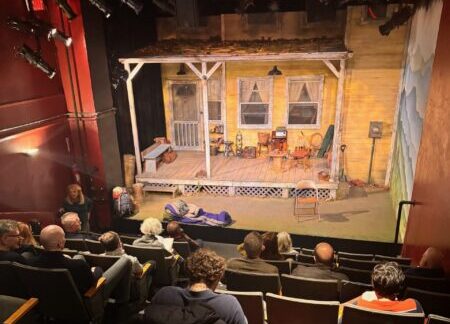
Audience view from the house
Q: From the audience, the porch feels close enough to step into—but not quite. How intentional was that threshold?
Andrew Robinson:
Very intentional. We wanted the audience to feel like they were there—to recognize their own memories of porches, patios, driveways, family spaces.
But we also needed a boundary. Where the mural ends, where the floor treatment changes—that line tells you: this is the stage, and this is where you’re watching from.
Keeping the audience just outside the space makes the invitation stronger.
“If only five people notice a detail, we’ve done our job.” — Andrew Robinson
Sherry Stregack Lutken:
That proximity matters. If the space were farther away, it would change the relationship completely. Being close allows the audience to see themselves in it—to reflect on their own families, their own histories.
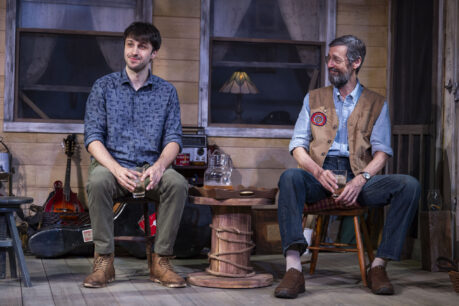
Morgan Morse and David M. Lutken
Q: This porch feels lived-in without feeling busy. How did you decide what objects earned their place?
Andrew Robinson:
It was constant conversation. We’d place things, step back, remove them, try again.
Some choices were practical—height, reach, how actors move—but others were about restraint. If only five people notice a detail, we’ve done our job.
Sherry Stregack Lutken:
Some pieces came from storage, some from our own lives, some through sheer luck—like the bench we found buried in Urban Stages’ basement that turned out to be perfect.
Fate plays a role in theater. You stay open to it.
Q: Did any object become emotionally charged in rehearsal in a way you didn’t expect?
Sherry Stregack Lutken:
The dulcimer. It became the embodiment of Elmira—the missing generation. It carries grief, memory, and ultimately becomes the thing that allows real listening to happen between the characters.
Andrew Robinson:
There’s also a moment where Edgar grabs the gutter during an emotional scene. That sound—that resistance—was never planned, but it changed the scene. The set gave the actor something to push against.
Q: This piece relies on restraint. What did you need from each other to trust those choices?
Sherry Stregack Lutken:
I love collaboration. It doesn’t always make things easier, but it makes them stronger.
From the start, I trusted Andrew—his instincts, his follow-through. That allowed me to let go of certain things and focus elsewhere. I hope I created space for his ideas to push back and deepen the work.
Andrew Robinson:
There was never a sense of “my way or the highway.” Every idea was discussed. Every department was part of the conversation.
It was one of the smoothest processes I’ve been part of—because everyone was listening.
Late in the conversation, both Robinson and Lutken returned to memory—not as nostalgia, but as something active and unfinished. Robinson spoke about how the porch continually brought him back to his grandmother’s home, the warmth of a place that no longer exists but still shapes how he moves through the world. Lutken described the porch as a partner to the music—forward-looking and nostalgic at the same time—a space that acknowledges what’s been lost without pretending it can be recovered intact.
That tension is what gives The Porch on Windy Hill its quiet force. The set doesn’t explain the past or resolve it. It holds it—visibly, patiently—long after the characters leave. When the lights go down and the porch is empty, it still feels inhabited by what came before and what hasn’t yet been spoken. The audience doesn’t step into that space. But they leave carrying it.
The Porch on Windy Hill (Encore engagement: January 25 – February 22, 2026)
Urban Stages, 259 West 30th Street, in Manhattan
For tickets, call 212-421-1380 or visit http://www.urbanstages.org/porch


Leave a comment