
Did You Eat? (밥 먹었니?)
For a Korean child betrayed by every adult meant to protect her, hope emerges as the lone alchemy—fragile yet radiant—capable of lifting her toward flight.

Zoë Kim as she appears in her one-woman show “Did You Eat?” (밥 먹었니?) at The Shiva Theater of The Public Theater (Photo credit: Emma Zordan)
To have emerged from a childhood like Zoë Kim’s—with enough self-awareness, critical distance, and sheer emotional stamina to craft a piece of theater with even a hint of uplift—is in itself an act of tremendous courage. The piece’s very existence is a quiet triumph: a testament to survival, to the insistence of choosing a path of identity in the face of sheer cruelty, and to the reclamation of one’s own narrative. Yet Did You Eat? (밥 먹었니?) accomplishes something beyond testimony. Artistically, it is a layered, deeply felt work that reveals Kim’s aesthetic intelligence and her willingness to experiment with form, language, and the body.
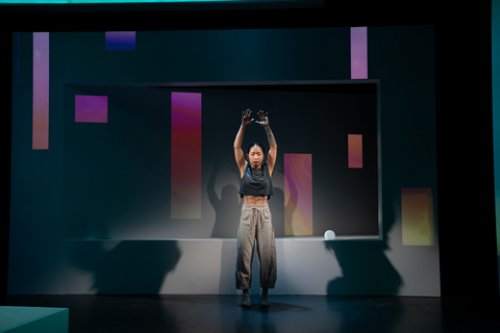
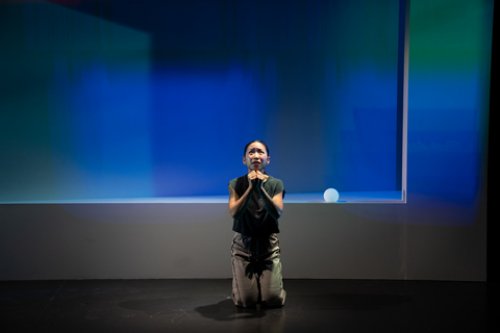
In most solo performances, the performer engages in a familiar ritual: addressing the audience directly, striving to singlehandedly sustain their attention for the duration of the evening through charisma, confession, or sheer force of will. Did You Eat? (밥 먹었니?) disrupts this convention with quiet audacity. Here, Kim’s gaze—and with it, her emotional energy—is directed not toward us, but toward an orb: a small, glowing sphere that pulses with an almost sentient luminosity, functioning as both object and interlocutor. One imagines it to be the invention of either director Chris Yejin or scenic designer Tanya Orellana, though in the script, Kim’s own stage directions refer to the orb simply as “you.” It is, in other words, an entity as much as a prop—a mirror, a memory, perhaps even a ghost.
At first, this delicate sphere becomes her scene partner, her anchor against the inherent narcissism of the solo form. It coaxes her away from the self-regard that so often besets one-person shows and into dialogue with another presence. Yet as the performance progresses, the orb, like so many interlocutors in memory plays, recedes. Kim turns inward, pulled by the gravitational force of recollection. The object remains, glowing faintly in the background, a silent witness to her excavation of the past. Still, its early appearance accomplishes something remarkable: it gently dismantles the isolating architecture of the solo show. By conversing with the orb, Kim signals from the outset that Did You Eat? will not be a monologue, but a dialogue—with the past, with the self, with the luminous fragment of childhood that endures even after every other light has dimmed.
Zoë Kim as she appears in her one-woman show “Did You Eat?” (밥 먹었니?) at The Shiva Theater of The Public Theater (Photo credit: Emma Zordan)
One cannot help but be struck by the physical and linguistic architecture built by Kim, director Yejin, and choreographer Iris McCloughan. Together, they make movement the show’s true scaffolding, and bilingualism its emotional compass. Kim’s interplay of Korean and English—two tongues carrying radically different registers of intimacy, repression, and memory—becomes both a formal device and an emotional dialectic.
The story she tells is almost operatic in its tragedy. Kim was the only child of parents spectacularly ill-suited to raising a child—particularly one as tender and imaginative as she. What they wanted, demanded even, was a dutiful son, the traditional bearer of family honor. In one of the show’s most chilling anecdotes, Kim recounts how her paternal grandfather, her Harabeoji, the first male child after twelve daughters, was lavished with resources while his sisters were starved or froze to death—a parable of gendered cruelty, even murder and neglect, that reverberates down generations.
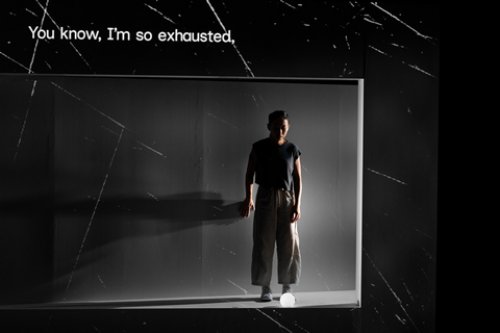
Her mother, forced by her father to abandon her PhD in science and enter a marriage she never desired, wields affection with sadistic precision: love forever snatched away at the moment of trust. In Kim’s world, criticism is not merely a mode of communication; it is the family’s native tongue, the air its members breathe. It emanates from every corner of her childhood home—delivered with surgical exactness by a mother seemingly incapable of affection, and with volcanic fury by a father whose thwarted desire for a son metastasizes into rage. His anger, steeped in the patriarchal dictates of tradition, curdles into both verbal and physical abuse, a cruelty that persists long after young Zoë has been exiled—under the genteel pretense of opportunity—to a boarding school in the United States.
Zoë Kim as she appears in her one-woman show “Did You Eat?” (밥 먹었니?) at The Shiva Theater of The Public Theater (Photo credit: Emma Zordan)
Yet distance offers no deliverance. The narrative descends into something almost Dickensian in its bleakness, a panorama of emotional deprivation rendered all the more chilling for its domestic familiarity. The dutiful daughter, conditioned to absorb pain rather than deflect it, finds her rebellion expressed inwardly. She turns to alcohol, to cigarettes, to the quiet mutilations of self-harm—acts less of defiance than of despair. In a culture and a psyche that equate obedience with love, even fury must find a secret outlet. Kim’s survival, then, feels not merely courageous but miraculous: a fragile persistence of light amid generations of inherited darkness.
From age 16 onward, Kim was self-sufficient. Shipped thousands of miles away to the American boarding school she was ultimately cut off financially. She has since built a life of hard-won stability: a loving marriage, a cherished dog, and a flourishing career nurturing new work at The Public Theater while pursuing her own as writer and performer. So why exhume these ghosts now? Why expose such raw, intimate wounds to an audience of strangers? The answer, one suspects, is that this is not a play about pain, but about love—its distortions, its absences, its quiet endurance.
The story she tells is unflinching, her prose spare and direct, her chronology clear. “You will try to make sense of you and how you love… Why does safety feel like violence?” The framework of “love languages” is what she employs to categorize her relationships—with others as well as herself. In Kim’s searing honest portrayal, when she steps away from linguistic taxonomy and into movement, the piece soars. Under Yejin’s direction and McCloughan’s choreographic guidance, gesture becomes grammar, posture becomes punctuation. Orellana’s set design provides a series of elegantly minimal frames—geometric containers for that spare movement and for Minjoo Kim’s lush lighting of shadow and saturated color imbuing the stage with emotional chiaroscuro, and Yee Eun Nam’s intricate projections.
Zoë Kim as she appears in her one-woman show “Did You Eat?” (밥 먹었니?) at The Shiva Theater of The Public Theater (Photo credit: Emma Zordan)
“I cry in Korean but laugh in English,” Kim tells us—a line that encapsulates the work’s emotional geography. There is little humor in Did You Eat?, but the linguistic bifurcation—English for the actual storytelling, Korean for memory—flows as a kind of dramaturgical logic. English is the voice of survival, the language of forward motion; Korean, the language of inheritance, grief, and ghosts. Each physical phrase carries narrative weight. The body remembers what the voice resists. The formal precision of the movement keeps the storytelling taut, preventing it from devolving into catharsis-for-catharsis’-sake. In a mere 65 minutes, we realize that in choosing to tell this story primarily in English, Kim has chosen life. Did You Eat? (밥 먹었니?) is, in its essence, an act of supreme release—a reclaiming of love from those who weaponized it. It is both an offering to the audience and a benediction for the self who lived to tell it.
The Public Theater presents a Ma-Yi Theater Company production
Did You Eat? (밥 먹었니?) (through November 16, 2025)
The Shiva Theater at The Public Theater, 425 Lafayette Street, in Manhattan
For tickets, visit http://www.publictheater.org
Running time: 65 minutes without an intermission


Leave a comment