
Playing Shylock
the play is not only about anti-Semitism but also cancel culture, freedom of speech, and political correctness.

Saul Rubinek in a scene from Mark Leiren-Young’s “Playing Shylock” at the Polonsky Shakespeare Center at the Theatre for a New Audience (Photo credit: Dahlia Katz)
Mark Leiren-Young’s timely one-man show, Playing Shylock (formerly called simply Shylock), has arrived in New York after its premiere run in Toronto in its new version rewritten around the life and career of veteran film actor Saul Rubinek (The Marvelous Mrs. Maisel, Unforgiven, Frasier) playing himself. Returning to the stage for the first time since 1990, Rubinek plays an actor performing Shylock in a (fictional) production of Shakespeare’s The Merchant of Venice which is shut down by protestors claiming that the play is anti-Semitic and the theater company has caved in to their demands. While the play is fascinating and provocative, it also has some flawed passages but Rubinek is commanding at all times.
Rubinek points out that the last time a play was shut down in New York due to content rather than ticket sales was Orson Welles’ production of The Cradle Will Rock back in 1937. The contention now is that the Merchant is inappropriate at this time due to rising anti-Semitism. Usually Shylock is made inoffensive by directors by not presenting him as Jewish. The most famous Jewish role in all of literature and he is often presented today as Black, indigenous, Palestinian, even by a woman. And this is what happens when finally a Jewish actor gets to play the part, the son of Holocaust survivers and using his grandfather’s accent and dressed (by designer Shawn Kerwin) in his orthodox garb. Ironically, his father, a Polish actor, never got the chance to play Shylock, nor did Rubinek ever expect to be offered the part.
Growing up in Canada, Rubinek tells us he joined Stratford Shakespeare Festival hoping to play the great Shakespearean roles. However, his friend director Martin Kinch, who more recently staged Playing Shylock, talked him into leaving after only one season, warning him that as a Jew he would never get to play those roles. If William Shatner was thought to be too Jewish, what hope did Rubinek have? His parents thought he should get a nose job in order to forward his career but he did not take their advice or change his name the way earlier stars like Tony Curtis, Lauren Bacall and Bob Dylan had.

Saul Rubinek in a scene from Mark Leiren-Young’s “Playing Shylock” at the Polonsky Shakespeare Center at the Theatre for a New Audience (Photo credit: Dahlia Katz)
Invited to defend the play at a Jewish Community Center, Rubinek points out that the very first professional production of Shakespeare in American back in 1751 was The Merchant of Venice. He also reveals that the play and Shylock are based on a real person and a real trial. And this is where Playing Shylock goes off the deep end. According to Rubinek and author Leiren-Young, Shakepeare is not the author of the play but was fronting for Edward DeVere, late Chancellor of England, who had lived in Venice and had witnessed the anti-Semitism rife there at that, a discredited theory for many reasons. It also has no place in the story that Rubinek is telling.
In any case, he insists that “Shylock is the first three-dimensional Jewish character in the history of English literature.” Moreover, the play was probably written as an antidote to Marlowe’s earlier virulent The Jew of Malta which portrayed the Jewish Barabas as a monster. The host at the Jewish Center comments that playing Shylock will only reinforce the stereotype of the Jew as a moneylender, while Rubinek points out that he is playing him as a victim of the anti-Semitism in Venice and England in the 16th century. As an aside, he points out that when he started acting he played a couple of gay parts because his gay friends were afraid to play them. Now they are not afraid to play them but we are living in a world where that is all they may get to play in the future.
As the lights shift, Rubinek shines most when he slips into Shylock’s most famous speeches including “hath not a Jew eyes? Hath not a Jew hands, organs, dimensions, senses, affections, passions. .. If you prick us do we not bleed?” And reenacting the trial scene he quotes Portia playing the judge and slips in a quote from the Jewish law which makes his wanting merchant Antonio’s flesh even more forbidden than in Christian law, one we may not have caught as lines not by Shakespeare. The play ends magnificently with Rubinek saying the same speech about “hath not a Jew eyes” but this time in Yiddish – and we understand exactly what he is saying through his acting even without knowing the language.
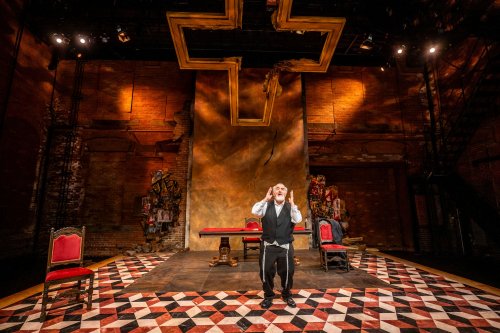
Saul Rubinek in a scene from Mark Leiren-Young’s “Playing Shylock” at the Polonsky Shakespeare Center at the Theatre for a New Audience (Photo credit: Dahlia Katz)
The play is performed on Kerwin’s appropriate set of a Renaissance palace courtroom with a cross hanging overhead and anti-Semitic slurs on its walls. The lighting by Steven Hawkins subtly changes for the speeches from Merchant putting us into the canceled performance of the play and then bringing us back to Rubinek talking to the audience from the stage. Of course, the play is not only about anti-Semitism but also cancel culture, freedom of speech, and what is politically correct. As a result it is very necessary viewing at this time. If nothing else, Playing Shylock is a first rate audition for a production of The Merchant of Venice that some adventurous theater should stage giving Rubinek the role of a lifetime.
Playing Shylock (through December 7, 2025)
Starvox Entertainment
Theatre for a New Audience
Polonsky Shakespeare Center, 262 Ashland Place, in Brooklyn
For tickets, visit http://www.tfana.org
Running time: one hour and 50 minutes without an intermission


Leave a comment