Off-Broadway
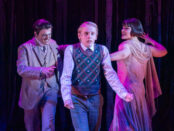
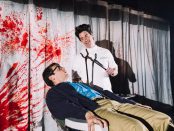
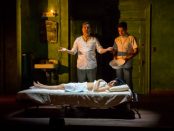
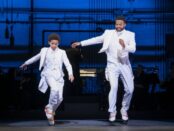
As always in a John Doyle presentation, the production is professional, polished and accomplished. This time around he has not made changes to the script or the score except to include the climactic song “Something Just Broke” which was not in the original Off Broadway production but was added to the first London version in 1992 and has been used ever since. While the actors give excellent performances, the revival lacks emotion and heart which is strange considering the number of characters who die or who are wounded in the course of the show. It is as though they (and we) are numbed by much depiction of killing. Is there a way to fix this in a show which repeatedly has its cast shooting at presidents of the United States, in this case only in a fun house setting? [more]
Trevor: The Musical
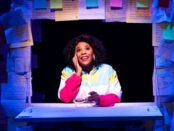
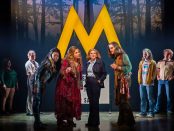
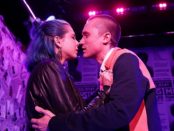
The writers seem afraid to state what the story is all about, the word gay being mentioned exactly once. At two hours and 15 minutes including one intermission, today’s audience is way ahead of the plot, knowing exactly what will happen in advance. While the 1994 movie was 23 minutes, the musical seems padded and dragged out. Davis’ music is pleasant enough, but Collins’ lyrics are pedestrian and repetitious. The songs seem to have a limited vocabulary such as children’s books often do, but 13 year olds have a slang and vernacular that is hardly used. The biggest problem with the score is that the dream Diana Ross (played flamboyantly and spiritedly by Yasmeen Sulieman) gets to sing seven of her most iconic songs (“Do You Know?,” "It’s My Turn,” “Upside Down,” “Ain’t No Mountain High Enough,” “Remember Me,” “Endless Love” and “I’m Coming Out”) which are far superior to any of the new songs, always a mistake in a non-jukebox musical. [more]
A Turtle on a Fence Post
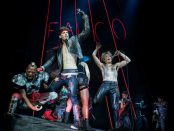
Unfolding from a stand-up comedy routine—“A prisoner walks into a bar…!”—and set in a comedy venue designed with ingenuity and style by Walt Spangler, Turtle veers from hokey to horrible helped by the spiffy routines staged by choreographer Kenny Ingram in over-the-top, sometimes kitschy, routines. Where else can you see dancing prison guards waving their batons as they tap dance in a circle or the flexible actor Josh Marin portraying an ATM and a basketball hoop? [more]
Disney’s Winnie the Pooh: The New Musical Stage Adaptation
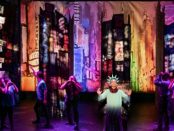
The question arises who is the intended audience. The 60-minute show is too slow for young children and too repetitious for adults. Possibly this is meant for the nostalgia crowd of which there are apparently legions. The thin story line is a watered-down version of the original A.A. Milne stories that inspired the animated films Winnie the Pooh and the Honey Tree, Winnie the Pooh and the Blustery Day as well as a tale of Tigger’s infamous bouncing. All of the famous characters put in an appearance: easily frightened Piglet, gloomy Eeyore, cranky Rabbit, wise Owl, energetic Tigger, maternal Kanga and curious Roo. Christopher Robin (played alternately by Kaydn Kuioka, Max Lamberg, and Cooper Lantz) spends the day at school but is reunited with Winnie the Pooh just before the final curtain. Surprisingly, he does not have a British accent. [more]
Swan Lake Rock Opera
Now there’s "Swan Lake Rock Opera" created by Mirit Shem-Ur (book and lyrics), Tsedi Sarfati (director and dramaturge) and Sharona Pick (music production and additional music). The show uses orchestral themes from the original Tchaikovsky score and clever pop variations to create witty songs and underscoring. The libretto of "Rock Opera" follows the original Swan Lake plot points which tell of Young Prince Siegfried, ordered by his mother the Queen to choose a fiancée from a list of foreign princesses she has assembled. He goes off to hunt to avoid making a decision and meets the Swan/Woman Odette and falls in love only to be deceived by her doppelganger Odile, an agent of the evil Von Rothbart who has cast a spell that turned women into swans. This deception leads to tragedy. [more]
A Commercial Jingle for Regina Comet
While Marshall Pailet’s direction is breezy and fastpaced, the dialogue has too many Borscht belt jokes (“Take my Grandma, for instance. No really take her-,” Camp Rosenblatt, “As my Grandma used to say,” etc.”) and lyrics with too many quotes from much better song writers such as Cole Porter, Stephen Sondheim and Bock and Harnick. References to Barry Manilow and Hanson don’t really land and the show counts on a great many current memes like making Wyse’s neurotic lyricist gay and Fankhauser’s self-effacing composer straight. Unfortunately, they are rather bland when they should be bigger than life in this three-character musical. The fact that they have no names and are referred to in the program as “Man 2” (there is no “Man 1”) and “Other Man” is pretentious rather than endearing. [more]
Yeah, But Not Right Now
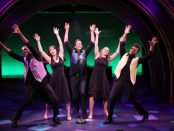
Holmes’ songs include clever lyrics particularly “Facebook,” “I Can Be That Guy” and "Beautiful Girl in the Front Row.” His expert playing on the keyboard allows him to have duets with himself and making it sounds like many instruments. He also accompanies himself on the guitar and a drum. The show is a confessional in which Holmes reveals the worst, most embarrassing parts of himself which seems to be the latest thing with comedians, except this show is partly sung. However, it is bright and upbeat even when telling unlikable characteristics. Craig Bundy’s sound design is usually clear, but occasionally makes it difficult to catch the lyrics. Director Caitlin Cook keeps this one-man show moving swiftly along. [more]
George M. Cohan Tonight!
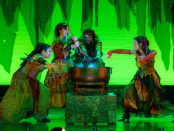
It is definitely worth a gander for both its subject matter and its performer, the disarming and immensely talented Jon Peterson who also adapted the one-man play from Chip Deffaa’s original stage production which Deffaa previously staged. Peterson directed this filmed adaptation and choreographed the scintillating tap routines matched with joyous precision to Cohan’s repertoire of gung-ho Americana. (Think “Over There,” “You’re a Grand Old Flag,” “Give My Regards to Broadway” and “Forty-five Minutes from Broadway.”) The choreographic high point was Peterson’s hip-swinging dance to “The Hinkey Dee.” [more]
Stranger Sings! The Parody Musical
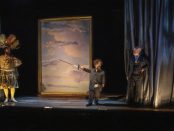
Since it's difficult to make fun of something that was never meant to be taken seriously in the first place, Hogue and director Nick Flatto are often left to spin their wheels by simply rehashing their subject matter's underbaked characters and shamelessly derivative storytelling, which all-too-often turns "Stranger Sings! The Parody Musical' into a glorified clip show. Hogue further hampers himself by largely sticking to the series' first season, as if he only had time to skim the second and third. It's an especially odd choice that leaves Hogue needing to rely on unfunny, if not downright offensive, parodic padding. [more]
Friends! The Musical Parody
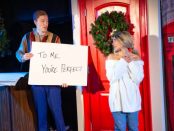
The problem with the show now at The Jerry Orbach Theater is director Tim Drucker’s frenetic, over-the-top staging and the artificially broad presentational style of the acting, similar to - but beyond - what he did in his 2019 production of "Love Actually? The Unauthorized Musical Parody" at the same theater. It is as though he does not trust the material. Matthew Fischer’s sound design for the taped score by composer Assaf Gleizner (to Gleizner’s orchestrations) is overly loud and fast, overpowering the clever lyrics which are well worth hearing for their stinging barbs at the television series. It also makes all of the songs sound the same, except for some short, slower folk ballads set to guitar accompaniment which are mostly oddball numbers for Phoebe to play in her gig as a folksinger. [more]
Charmed Life: From Soul Singing to Opera Star
She gets to sing everything from the Patsy Kline classic “Crazy,” “Respect” (made famous by Aretha Franklin), and “Summertime” from Porgy and Bess to generous, beautifully acted scenes from Bizet’s Carmen, her favorite role and the highlight of the show. The setting, a comfortable, slightly formal room (by Jaime Terrazzino) also includes a convenient grand piano played by John DiPinto (who alternates with Allison Brewster Franzetti), clearly delighting in collaborating with this warm-hearted diva. [more]
Housewives of Secaucus: What a Drag!
The captivating cast of actors who are here drag artistes is comprised of Philip McLeod, Ryan Stutz, Cammerron Baits, Jacob P.S. Lemmenes, and Sam Brackley. While striding around and dancing in high heels, this magnetic quintet all offers animated stereotypical Italian American characterizations while cracking wise. "I'm Every Woman," "Hit Me with Your Best Shot," and, of course, "Total Eclipse of the Heart," are among the classic songs played while showcasing the ensemble’s dynamic lip-synching abilities. [more]
The Unsinkable Molly Brown
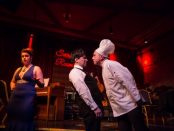
Although director/choreographer Kathleen Marshall has given the Transport Group production staged at The Abroms Arts Center a rousing production, the major problem still exists with the story: Molly goes from tomboy to wife to social activist but always seems to be the same. Basically Malone changes her outfits (costumes by Sky Switser) and becomes more mature and more sophisticated but never really changes from the girl at heart who wants riches and gaudy things. Costar David Aron Damane, with his powerful baritone, who plays J.J. Brown, the miner who strikes it rich and proceeds to give Molly almost everything she wants, helps a good deal but their love story is not made entirely believable, possibly because the stalwart Damane is still made to be a very retiring hero, a man of few words. [more]
Unknown Soldier
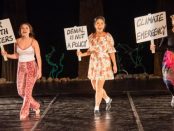
The declarative lyrics are written by Mr. Goldstein and the show’s composer Michael Friedman. Mr. Friedman was a notable musical theater figure who died of HIV-related causes in 2017, at the age of 41. With its derivative melodies echoing Stephen Sondheim, John Kander and William Finn, "Unknown Soldier" is not a posthumous masterpiece. [more]
Tumacho
To review dramatist/lyricist/composer Ethan Lipton's "Tumacho" almost feels like missing the point of this endearingly oddball "play with songs," a comic pastiche of Western and horror tropes that is essentially the theatrical equivalent of an old Hollywood B-movie. Its major goal is to shamelessly please the audience, something it largely achieves through top-notch performances and an abiding strangeness, if not necessarily a consistent quality of jokes or characterizations or plotting. Obviously, all of the latter should matter, but the fact that it doesn't only attests to the show's bizarre charm. [more]
No Strings
Following its opening production of Cy Coleman’s equally rarely seen "Seesaw," J2 Spotlight Musical Theater Company is presenting a fully staged version of "No Strings" as the second production of its inaugural season. While No Strings, set in the Paris world of high fashion and the French watering holes of the very rich, would need a much more lavish staging to do it justice, Deidre Goodwin’s production does have its charms though the show’s book by playwright Samuel Taylor seems particularly thin by today's standards. The songs are melodic and hummable though there is no breakout winner among the 14 musical numbers. [more]
Mack & Mabel
The latest offering in New York City Center Encores! concert series was the Jerry Herman musical, "Mack & Mabel." Originally on Broadway during the 1974 season, it received disappointing reviews and had a mere 66 performances before it closed after nine weeks. This production also has its problems, but it was enormously entertaining and worth seeing, mostly because of the Herman score and the delicious musical numbers. Herman has written the music for some of Broadway’s most iconic shows, like "Hello, Dolly!," "Mame" and "La Cage Aux Folles." Because of his recent death this past December, the show was a tribute to him, with huge, framed photos of him displayed during the entr’acte. [more]
Seesaw
Although J2 Spotlight’s artistic director Robert W. Schneider who staged this show has given it a vigorous production and cast a delightful Gittel in Stephanie Israelson, he is unable to disguise the show’s flaws. He is not helped by the trite, derivative choreography by Caitlin Belcik for a show that is mainly dance and has eight dancers out of a cast of nine. The many production numbers are both busy and familiar, and keep the ensemble composed of Kyle Caress, Chaz Alexander Coffin, Katie Griffith, Caleb Grochalski, Morgan Hecker and Halle Mastroberardino spinning throughout the show. [more]
Bob & Carol & Ted & Alice
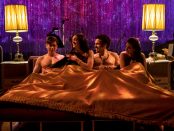
Bookwriter Jonathan Marc Sherman has wisely kept the story in its period. However, his dialogue is almost word for word lifted from the screenplay which is rather old hat for those of us have heard it in the movie. The score with music by Sheik and lyrics by Sheik and Amanda Green makes all the songs sound the same in Sheik’s orchestration played by a combo of four. The lyrics are both pedestrian and trite, telling us only what we already know. The songs which are not listed in the program include a great many reprises. Many of the tableaux and setups recreate exact visual moments from the film. [more]
Emojiland: The Musical
Smiling Faces, Skull, Princess, Pile of Poo and other notable emojis cavorting around might have made for a peppy contained sophisticated children’s show. The creators of "Emojiland: The Musical" however, have opted for a full-length treatment that sputters out by intermission as not much has happened and then we come back for more anemic hijinks. The meager plot involves a software update, a firewall, a virus, betrayals and some romantic complications all taking place in a smartphone fantasyland. [more]
Romeo & Bernadette: A Musical Tale of Verona & Brooklyn
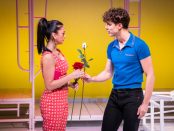
"Romeo & Bernadette," a fresh take on Shakespeare’s oft-adapted tale of love, is an unabashed valentine to inter-era romance. Shakespeare’s Romeo (cutie-pie Nikita Burshteyn, perfectly cast) is magically time-travelled to 1960’s Brooklyn to seek Bernadette (beautiful Anna Kostakis who plays both the foul-mouthed Bernadette and the demure Juliet), a striking doppelganger of his beloved sixteenth century Juliet. There he meets members of two rival Italian mobs who substitute, 1960-style, for the Capulets and Montagues. [more]
Sing Street
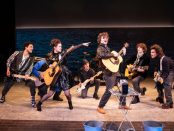
By stripping the story of local color—even the projections show little but an anonymous seascape—the creative team does ill by "Sing Street. " Take away the Irish accents, the 1980’s songs and a quick reference to The Famine, and this story of alienated teens could have taken place in Boise, Idaho, or Buenos Aires, Argentina. Let’s face it, the let’s-put-together-a-band-to-solve-our-problems was even a common theme in MGM films of the forties! (The original "Sing Street" movie, of course, was filmed in Dublin and was filled to the brim with local color and the grimness of economic distress.) [more]
Pockets
Frothiness abounds in "Pockets," an amusing spoof of British musicals that’s presented by the Los Angeles-based comedy troupe Robot Teammate. The rollicking score is a collaboration between the group’s members and lead composer and music director Branson NeJame. The saucy book is a communal effort as well, created with head writer Dave Reynolds. It’s all 70-minutes of good-natured silliness structured as sketch comedy-style scenes and accomplished musical numbers. There are plentiful puns, sight gags and zaniness. [more]
ray gun say0nara
Fabulous technical elements and spirited performances from a large ensemble of actors, singers and dancers cannot overcome the authorial negligence of the musical science fiction pastiche, "ray gun say0nara." It runs over two hours plus an intermission and has some engaging sequences but makes little cumulative impact. [more]
Anything Can Happen in the Theater: The Musical World of Maury Yeston
The York Theatre Company’s new revue, "Anything Can Happen in the Theater: The Musical World of Maury Yeston," reminds us not to take for granted the talents of this vibrant composer/lyricist, best known for such Broadway titles as "Nine" (1982), "Grand Hotel" (1989) and "Titanic" (1997). This one-act show, featuring five abundantly gifted singer-dancers, underscores the wide-ranging nature of the composer’s music. Yeston has successfully adopted diverse musical sounds, from 1920's pop to mid-twentieth-century rock to folky-country contemporary. Mostly though, he’s known for lush, sweeping, timeless melodies that seem at times to bypass listeners’ ears and aim straight for the heart. His lyrics are smart, but not overly clever. [more]
The Sorceress (Di Kishefmakherin)
Goldfaden’s escapist musical fantasy combines bits and pieces from many sources: the Cinderella fairy tale; Gilbert-and-Sullivan-esque rapid-fire, tongue twister songs; old-fashioned (even in 1878!) melodrama; Mozart’s The Abduction from the Seraglio; and—believe it or not—the Seventies’ TV sitcom, “Laverne and Shirley”! (The L & S reference, to be absolutely honest, might be an interjection improvised by the actor—yes actor—playing the title role.) [more]
Cyrano
For those younger members of the audience who do not know Edmond Rostand’s classic French play, "Cyrano de Bergerac," the new musical "Cyrano" presented by The New Group at the Darryl Roth Theatre may be entertaining enough. However, for those of us who know the original, the compromises and excisions from the text make it a shadow of its former itself. Don’t blame film and television star Peter Dinklage who gives a vigorous performance in the title role. However, he is hampered by the adaptation by director Erica Schmidt who happens to be his wife. [more]
Love Actually? The Unauthorized Musical Parody
Now, New Yorkers who know the film (and who love it, hate it or partly love it and partly hate it) have a chance to see a streamlined (at 95 minutes) musical-theatrical spoof of the film, called "Love Actually? The Unauthorized Musical Parody." It’s a lively, silly and well-performed romp created by people who seem to have done a lot of this sort of thing: writers Bob and Tobly McSmith ("The Office! A Musical Parody") and director Tim Drucker ("Spidermusical"). The three previously worked together on "Friends! The Musical Parody." Basil Winterbottom has provided the engaging tunes and orchestrations for the McSmiths’ lyrics. [more]
The Giant Hoax
"The Giant Hoax" is a charming morality tale about telling the truth and growing up. The expert hands of director Christopher Michaels and choreographer Molly Model are clearly at work in all aspects of this production, bringing a touching story with affable songs and clever lyrics to life with a cast of first rate actors, a fine ensemble, and inventive and humorous choreography. This show will never get any bigger than it is, but it’s big enough to fill the hearts of its audience to bursting, as long as actors of this production’s caliber are playing it. [more]
Einstein’s Dreams
Alan Lightman’s 1992 internationally best-selling novel "Einstein’s Dreams" would seem like an unlikely choice for stage adaptation as the original book is made up of 30 variations on theories of time but includes no plot. However, as adapted by Joanne Sydney Lessner (book and lyrics) and Joshua Rosenblum (music and lyrics) it is a charming period musical that makes Einstein’s theories (at least the ten dramatized) quite accessible to audiences not made up of physicists. Its lovely score and excellent production directed by Prospect Theater Company’s Cara Reichel led by Zal Owen and Alexandra Silber are both entertaining and mind-expanding. Its deficiencies are ones that were also true of the novel. [more]
Truffles: Music! Mushrooms! Murder!!!
"Truffles: Music! Mushrooms! Murder!!!" is a dinner theater musical mystery set in the very restaurant (The Secret Room) where the audience is having dinner. This return engagement of the long-running show originally conceived by Sonia Carrion has been extensively rewritten by Gregg Ostrin inspired by characters initially created by Billy Manton, Carrion and Hal Galardi. This mildly amusing evening includes dinner (if you so choose), a score with 11 clever songs, and a murder mystery which keeps morphing into various other genres. [more]
Hooked on Happiness
Although the show is 80 minutes without an intermission, it just breezes right by and one is never bored. The music, played by Peter Dizozza (on piano), Ralph Hamperian (on bass) and Art Lilliard (on drums), keeps the show moving at perfect tempo. From ballads to disco tune, from rap to group numbers, the music is spot on. Sound designer Alex Santullo delivers a pitch-perfect musical. [more]
Broadbend, Arkansas
Produced by Transport Group in association with The Public Theater and directed with precision, clarity and simplicity by Transport Group’s artistic director Jack Cummings III, this story of three generations of an African American family grappling with of racism, violence and inequality in the South is as moving and trenchant as a story by Harper Lee. Each act is a monodrama exquisitely acted, sung and directed for a very discerning audience. While there is dialogue in both halves, the extraordinary music makes it feel sung through. [more]
Scotland, PA
There have been many adaptation of Shakespeare’s Macbeth but none of them probably as entertaining as the new musical "Scotland, PA." Presented in the cartoon style of "Little Shop of Horrors," the show does not break any new ground but proves to be a fun evening. However, director Lonny Price who has staged musicals both big ("Sunset Boulevard)" and small ("Lady Day at Emerson’s Bar and Grill") gives the interest high and the show bubbling. [more]
Little Shop of Horrors
In a counterintuitive casting coup, handsome Jonathan Groff stars as the nebbish Seymour Krelborn who works at Mushnik’s (a funny, kvetchy Tom Alan Robbins) failing flower shop on Skid Row. Seymour discovers an odd potted plant in Chinatown after an eclipse, a plant that leads to great success for both Mushnik and Seymour. Although it is difficult to forget Groff’s physical attributes (well-hidden under Tom Broecker’s costumes), he delivers a brilliantly realized sad sack Seymour. Poor Seymour is in love with the much put upon Audrey played with ditzy perfection by Tammy Blanchard. Two-time Tony Award winner Christian Borle chews the scenery as Audrey’s sadistic dentist boyfriend, Orin Scrivello plus several other characters such as a William Morris agent and an NBC TV executive. [more]
An Enchanted April
The enduring resonance of its source material is evident in "An Enchanted April" during this uneven stage musical adaptation. Lasting two hours and 45 minutes with an intermission, its initial frothiness gradually fizzles. The bright score is excessive, the solid book rambles, and the production is more dutiful than inspired. However, the performances are engaging, and the piece’s emotional power is palpable. The show was originally presented by the Utah Lyric Opera and this New York City premiere demonstrates its potential. [more]
Soft Power
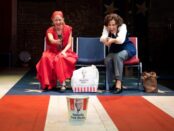
Hillary Clinton wearing a glittery red pantsuit leading a Gene Kelly/Stanley Donen-style production number set in a Busby Berkeleyesque recreation of a McDonald’s with giant sparkling French fries is a highlight of the insipid and disjointed musical fantasia, "Soft Power." It’s just one of its many lame sequences including a "The Music Man"-type explanation of the U.S. electoral system led by a singing and dancing judge. We’re in for two hours of painfully unfunny self-indulgence. Holden Caulfield from "The Catcher in the Rye" pops up too. [more]
Panama Hattie
While the original production had a great many one-of-a-kind stars supporting Merman, one of the distinctions of the York production is its cast: Montel has been able to obtain the services of Klea Blackhurst for Hattie Maloney, the Ethel Merman role. Blackhurst, you may know, has specialized in Merman for years including her tribute show "Everything the Traffic Will Allow" as well as appearing in the Merman roles in revivals of "Anything Goes," "Red, Hot and Blue," "Call Me Madam" and The York’s staging of "Happy Hunting." Montel has also surrounded her with seasoned theater veterans including Stephen Bogardus, Simon Jones, Gordon Stanley and David Green. The members of the singing and dancing chorus are equally talented. [more]
The Decline and Fall of the Entire World As Seen Through the Eyes of Cole Porter
As part of its Fall 2019 Musicals in Mufti Cole Porter Series, The York Theatre Company has smartly revived this 1965 Ben Bagley - Cole Porter revue not seen in New York in 54 years. Pamela Hunt’s delightfully sophisticated production uses four talented performers at the height of their powers: Danny Gardner, Lauren Molina, Diane Phelan and Tony Award nominee Lee Roy Reams, with the estimable Eric Svejcar at the piano. Hunt has tweaked the show a bit eliminating five of the songs which have inappropriate lyrics for modern sensibility and handed Reams the role of speaking Bagley’s droll narration rather than dividing it up between the original five performers. Although the Muftis are performed concert style with book in hand, these performers appear to be letter perfect and hardly look at their sheet music. [more]
Forbidden Broadway: The Next Generation
This is the latest edition of creator, writer and director Gerard Alessandrini’s enduring musical spoof skewering present and past NYC theater that he inaugurated- in 1982 and has had over 20 incarnations. Mr. Alessandrini’s erudite, affectionate and acerbic script once again lambasts Broadway while lovingly celebrating its history during its 20 numbers. “Theater isn’t art, unless it hurts.” It’s that aching sense of the collectively treasured memorable greatness of Broadway clashing with its mercenary concerns that enables each version of the show to resonate while entertaining. Plus, it’s very funny and offers a showcase for talented malleable performers. [more]
The Wrong Man
"The Wrong Man" is a new musical by multi-platinum songwriter Ross Golan with "Hamilton"’s director Thomas Kail. Like "Hamilton," it began as a concept album and grew into a stage performance. Unlike Hamilton‘s epic sweep of history, this subject is contemporary and has a narrower focus, following the fortunes of one man, Duran, who is down on his luck in Reno, Nevada. The intimate setting of The Robert W. Wilson MCC Theater Space’s Newman Mills Theater is a good place to show off the production. [more]
Fifty Million Frenchmen
Still delightful, mainly due to Porter’s score, the book by Herbert Fields (who went on to write six more Porter shows) has its charms with its snappy Jazz Age dialogue which makes fun of the ugly Americans in Paris, loaded with money but making one faux pas after another while mangling the French language. The version being used by the York Theatre production is that of the 1991 Tommy Krasker/Evans Haile adaptation for the Cole Porter Centennial first performed at the French Institute/Alliance Française which reduces the cast from 100 to a manageable eleven. It also reallocates some of the songs and includes some of the songs cut both on the road and after the opening. [more]
The Green Room
These four characters are, unfortunately, not interesting enough to fill a 90-minute musical, especially one that covers territory better served by other shows like "A Chorus Line," "Fame" and "Merrily We Roll Along," all superior to the earnest, but predictable "Green Room." Even the crisis that drives the play—will Anna wear a revealing costume in Cliff’s play?—is laughable nowadays when nudity is common. Cliff’s play is backed by his—and Anna’s—Dad with the proviso that all four pass their courses. They all depend upon each other to study, but leave everything to the last minute. Even when it’s likely that they will pass, Anna’s refusal to wear a skimpy costume, one it turns out that even a high school participant in the Jimmy Awards would find modest, is a red herring that is soon resolved. [more]
Felix Starro
The score with Ms. Hagedorn’s sharp lyrics and composer Fabian Obispo’s pointed melodies in the manner of Stephen Sondheim and John Kander is quite accomplished with its rousing group numbers and rich solos. Highlights include an eerie sequence with one sick person after another seeking rejuvenation, a Billy Flynn "Chicago"-style bit documenting Felix’s past popularity and an acidic anthem by a mercenary San Francisco female florist who deals in black market identity papers for illegal immigrants. [more]
Contact High: A New Musical
Hass directed and his stilted staging is adequate. Simple entrances and exits, cast members going through the theater’s aisle and basic character interactions occur. Some performances are excessively broad diluting the narrative’s impact. Playing a major part in a show as well as directing it is problematic. Hass’ joint choreography with Dana Norris is an uninspired series of rudimentary movement, jumping up and down, moving wheelie chairs around and clunky robotic flourishes. Hallowed masterpieces of musical theater are often alchemical artistic collaborations among a creative team. Without experienced objective directorial oversight, "Contact High" is lumpy. [more]
Waiting for Johnny Depp
What’s best about "Waiting for Johnny Depp" is Vivino’s performance. My, does she ever get a workout during the play’s 100-minute running time. She has 15 or so musical numbers (some of them reprises), ranging from dizzyingly ecstatic to utterly despondent. She belts, rocks out, sings pretty during the ballads. She carries nearly all of the spoken word, too, though sometimes she has exchanges with the recorded voice of Rita’s highly disagreeable mother. The ghastly ringtone whenever Mom (or that agent with his caveats) calls is like a bugle blast at the gates of hell. (Sound designer Tom Valdez gets a bit of a workout too.) Vivino bounces around the stage, executes choreographer Juson Williams’ dance steps, goes offstage for quick costume and wig changes, and interacts with both the audience and musical director/pianist Logan Medland. [more]
Bat Out of Hell-The Musical
The score is derived from the catalog of songwriter Jim Steinman’s "Bat Out of Hell" album trilogy whose songs were immortalized by Meat Loaf. Mr. Steinman’s accomplishments as a composer and lyricist are monumental. As a librettist he is dreadful. His negligible scenario borrows heavily from "Peter Pan" (a doomed character is actually named Tink), the hoary stilted dialogue is reminiscent of Flash Gordon cliffhangers and it’s all often ill-matched with his iconic songs. Much of it is supposed to be funny. It all makes "Bat Out of Hell-The Musical" a numbing dysfunctional slog. Very often, on-stage actions are projected on to a very large screen opposite them with characters followed around by videographers dressed in black. We get to watch schlock twice simultaneously. [more]
Broadway Bounty Hunter
Composer-lyricist Joe Inconis’ follow up to his teen favorite, "Be More Chill," is not only a showcase for musical comedy actress Annie Golden but a tribute to the Blaxploitation and Martial Arts movies of the 1970’s and 1980’s. While "Broadway Bounty Hunter" is very entertaining, it might have been a better show if had not been so anxious to not be a parody or a satire. Written by Iconis and longtime collaborators Lance Rubin and Jason Sweettooth Williams, energetic cast, fully attuned with their concept has been directed and choreographed with fierce energy by Jennifer Werner who has previous created the dances for five of Iconis’ last six shows. [more]
Two’s a Crowd
Co-written by and starring Rita Rudner (who is not only a playwright and performer but also an author, film writer, producer and director, with many TV appearances to her credit), "Two’s a Crowd" suggests that it’s creator has run out of original ideas and is recycling old ones--not only others, but her own. It really lands with a thud, which also may have a lot to do with trying to present it as a musical. [more]
Rock of Ages
"Pour Some Sugar on Me" by Def Leppard in a smashing live rendition accompanies a lusty production number at a seedy Los Angeles strip club with scantily clad pole dancers and creepy patrons. It’s a splashy set piece in this uproarious Off-Broadway revival commemorating the tenth anniversary of the Broadway hit "Rock of Ages. " It’s also notable because previously Def Leppard wouldn’t allow their songs to be included in this 1980’s hit singles jukebox musical. “Rock of Ages” in a recorded version is heard after the show ends and the audience leaves. [more]
I Spy A Spy
Cluttered, lively and quaint, the zany musical comedy "I Spy A Spy" is reminiscent of the sort of lightweight material directorial legend George Abbott would have had a go at in the late 1960’s. This show recalls the Abbott efforts "How Now, Dow Jones" and "The Education of H*Y*M*A*N K*A*P*L*A*N" that William Goldman analyzed in his classic 1969 behind the scenes account "The Season." Abbott did his best with those disappointments just as the creative team for I Spy A Spy does. [more]
Dog Man: The Musical
Kids may love this show—and the Dog Man books themselves—largely because the outlandish situations are similar to scenarios in their own hyper-imaginative make-believe play. Except that, at the Lucille Lortel Theatre, young audiences see a fully realized version of such fantasies, with vibrant production values plus some catchy tunes. Tim Mackabee’s cartoonish unit set—Harold and George’s treehouse—is quiet at first but is soon swarming with marauding buildings, a wacky robot and other assorted craziness. Heidi Leigh Hanson’s costumes are bright and cleverly imagined. David Lander’s lighting design helps us imagine lightning storms, bomb explosions and what amounts to a municipal volcano. Director/choreographer Jen Wineman keeps everything moving along at a quick clip. [more]
Dragon Spring Phoenix Rise
Sometimes you don’t need a long, complex story — or even an engaging one — to hook an audience. At the showing of "Dragon Spring Phoenix Rise" at The Shed that I attended, audiences clapped and hooted for heroes and villains alike, despite being given no logical reason to do so. The heroes and villains possessed no distinguishing character traits, other than differing accents, and they voiced no discernible reasons to be fighting. The fighting was just that awesome.The visual bombast and fight choreography of "Dragon Spring," a world premiere Shed commission, are thrilling enough to recommend the show as an expensive diversion, at the very least. There are moments when the show’s production elements come together so spectacularly that they almost lift the rest of the show with them. Almost. [more]
The Secret Life of Bees
Nottage’s book is faithful to the novel while at the same time reducing some of the melodrama and streamlining the story to reduce the number of characters to a cast of 13. Sheik’s score may be his most lush and melodic and the use of guitar and cello gives the music an appropriate folk feeling. The songs are a mix of gospel, R&B and pop which gives each of the main characters a song that explains their deepest thoughts. The rousing gospel numbers, “River of Melting Sun,” “Tek a Hol a My Soul” “Hold This House Together, “Our Lady of Chains,” make use of a great many beautiful voices in unison. [more]
Camp Morning Wood: A Very Naked Musical
Living up to its title, a racially and physically diverse game company of ten male performers really are nude throughout "Camp Morning Wood: A Very Naked Musical." It succeeds as a joyous flesh parade but disappoints as an actual theater piece. What might have been an engaging encounter group-style exploration depicting facets of the gay male experience is instead labored with a flatly comical cornball plot that’s dragged out to two hours with an intermission. [more]
A Strange Loop
Twenty-five-year-old African-American Michigan native and New York University graduate Usher is an usher at a Disney Broadway musical who is writing an autobiographical musical about his troubled life. His religious Christian parents are scornful of his sexuality and dubious of his career goals as he doesn’t emulate the commercial simplisticness of Tyler Perry who gets skewered in a production number. This exploration is light on plot and so we get a series a of overheated vignettes often laden with wan shock value. The often didactic dialogue relies on scatology peppered with the N-word. Dark comedy crossed with poignancy abounds. [more]
Midnight Street
Cohen is clearly an intelligent, well-read man, familiar with the twists and turns of different periods and styles. "Midnight Street" is chock full of ideas, poetic meanderings and some worthwhile melodies but just doesn’t add up. His direction can’t overcome the pretentious language and heavy-handed symbolism. Only a Lotte Lenya or, perhaps, a Patti LuPone might have given Mr. Cohen’s songs the right gravity, not to mention finding sense where none exists. [more]
Octet
Malloy, who wrote the book, music and lyrics, has taken a novel approach, staging Octet as if it were a 12-step program in which all the members of the group express their inner thoughts through a cappella singing all the while following the precepts of an AA or OA meeting. Annie Tippe has taken this sophisticated mass of brilliance and shaped it around the sensational talents of a small cast which performs miracles of acting and singing. [more]
Enter Laughing the Musical
As David, Chris Dwan does not make one forget the inimitable Grisetti who spun every moment into a comic turn. However, Dwan is charming as the undaunted hero who must deal with problems behind his ken but always comes up with a possible solution even if it doesn’t work out. David Schramm’s alcoholic and hammy Harrison Marlowe is not quite as clipped as that of the late George S. Irving whose signature role this became but his sarcasm and slow burns are still entertaining. Though Farah Alvin’s Angela Marlowe is not as affected as her predecessor as the predatory performer, she still is delicious as an actress who falls in love with all of her co-stars. [more]