
Good Time Charlie
A fitting tribute to Ryan Haddad’s family covering the last two generations as well as depicting the changes in gay life in the same period.
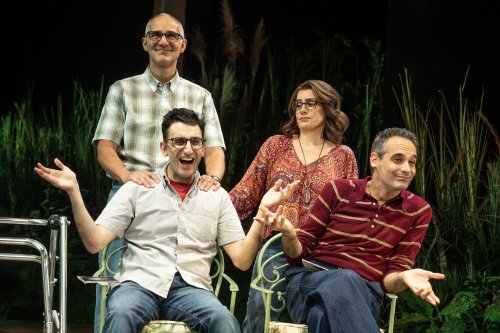
The cast of Ryan J. Haddad’s “Good Time Charlie” at The Public Theater (Photo credit: Joan Marcus)
Ryan J. Haddad’s deliciously comic but ultimately poignant Good Time Charlie having its world premiere at The Public Theater is his first non-monologue play. This time he uses seven actors including himself to play nine relatives in this theatrical autobiography. Ostensibly, a tribute to his gay Uncle Charlie (in actuality his father’s first cousin), it is also Haddad’s own autobiography of his early years (which eventually brought him into theater) and his immediate family. Covering the years 1976 to the present, it is a hilarious catty review of musicals and musical films as well as the more serious social mores of two generations’ attitudes towards homosexuality, that of Charlie’s generation and that of Ryan’s. The theatrical in-jokes will tickle regular theatergoers and some will get the meta theater references to Fun Home (whose original cast included the play’s Beth Malone and TV’s Smash which also include the participation of Michael Cristofer.
Haddad’s latest play puts his family on stage. They initially argue about who introduced him to the theater first. Uncle Charlie says he took him to the national tour of Phantom of the Opera when Ryan was eight. His mother Judy reveals that she and his father took him to New York shows like Fame, 42nd Street and Grey Gardens previously. While his Aunt Janice, his mother’s sister, insists she took him to his first play, The Red Shoes, at the Cleveland Playhouse’s children’s theater series. In any case, Ryan sees Charlie as his Auntie Mame to his Patrick Dennis, while his lesbian Aunt Janice complains that she was his first gay mentor but doesn’t get credit in Ryan’s new play which ought to be called Good Time Janice.
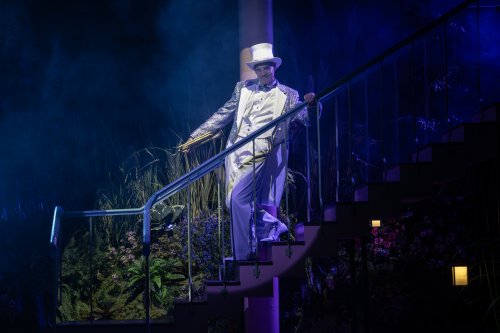
Jonathan Raviv as Uncle Charlie in a scene from Ryan J. Haddad’s “Good Time Charlie” at The Public Theater (Photo credit: Joan Marcus)
Haddad begins Charlie’s story when he goes off to Heidelberg College in Ohio, 1976, ostensibly to become a dentist which is his parents’ (Charlie, Sr. and Joan) choice. Unknown to his parents he meets at a gay bar Lou, 21 years older, a film studies professor at the same college he is attending and they discover immediately that they are simpatico. They discover that they both go to the New Mayfield Repertory Cinema whose artistic director Sheldon is Lou’s best friend. When Charlie meets Sheldon, it is “the beginning of a beautiful friendship” to quote Casablanca. He now has the love of his life Lou and his soul mate Sheldon.
Several years later in 1983, Charlie’s parents discover he is gay and refuse to believe it. As a condition of continuing to pay for his dental school, they insist he see a psychiatrist but he adds they have to go too, a condition they agree to. However, they end up refusing to meet Lou for the next 12 years and continue to ask if Charlie has changed. On the other hand, when Ryan reveals to his parents that he is gay in 2008 at age 16, they are not pleased (their other two sons have not prepared them for this eventuality) but accept this decision just warning him to use condoms and not fall for the first guy who is interested in him.
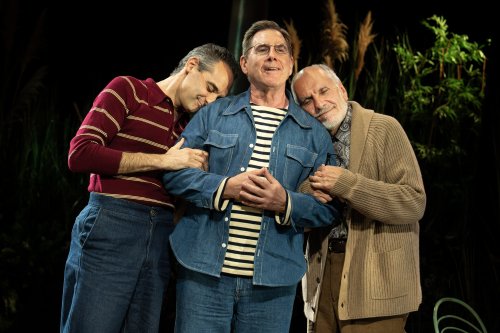
Jonathan Raviv as Charlie, Tim Bagley as Lou and Michael Cristofer as Sheldon in a scene from Ryan J. Haddad’s “Good Time Charlie” at The Public Theater (Photo credit: Joan Marcus)
The second act delineates Ryan’s college career which leads to his moving to New York to break into the theater while he works at Samuel French. In the meantime, Sheldon who is Lou’s contemporary ages rapidly and as a result he and Charlie are unable to make it to Ryan’s one-man show at Dixon Place. Ultimately, though Charlie admits he would like to have been a major star, he realized instead that he has influenced Ryan’s career and gotten to know Lou and Sheldon which would not have happened if he had moved to New York to act.
Part of the fun of the play is the interpolation of iconic songs from Broadway’s finest shows, either as numbers in young Ryan’s home-produced musicals or examples used by his family. Artemis Pebdani as his Great Aunt Joan gets to sing Bernadette Peters’ “Falling in Love with Love” in his production of Cinderella adapted from the television starring Brandy. Jonathan Raviv as Charlie enters in sequined suit and top hat singing “It’s Today” from Mame as proof he was Ryan’s Auntie Mame. Cristofer as Sheldon sings Doris Day’s hit song “My Secret Love” from Calamity Jane which he says changed his life. Charlie attempts to end Act One with “Will You” from Grey Gardens as a reminder to Ryan to return home after college. Ultimately, Ryan uses their suggestion of “September Song” from Knickerbocker Holiday both as an audition piece as well as a reminder that the older members of his family are slipping away.
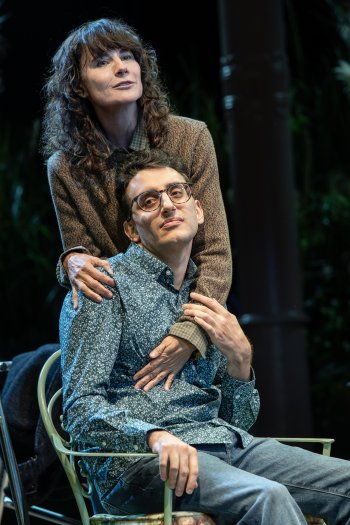
Beth Malone as Aunt Janice and Ryan J. Haddad as Ryan in Haddad’s “Good Time Charlie” at The Public Theater (Photo credit: Joan Marcus)
For the theater queens in the audience and on stage, Good Time Charlie has references to Annie, The Secret Garden, The Sound of Music, My Fair Lady, Song of Norway, Ethel Merman and Patti Lupone in Gypsy, Judy Garland in A Star is Born, Carol Channing in Hello, Dolly!, Pearl Bailey in House of Flowers, and Barbra Streisand in Funny Girl, among others. Ironically, Beth Malone who has been nominated for a Tony Award for her performance in a musical for Fun Home does not get to sing a song.
Danny Sharron, who directed Haddad’s last play Hold Me in the Water at Playwrights Horizons, has assuredly staged the play as though it was improvised or spontaneous though it has been thoroughly scripted. The cast is cheerful throughout in this comedy except for when they are seriously arguing about choices of which they disapprove. As his own emcee, Haddad is genial and urbane as himself at various ages. Raviv’s Charlie gives a layered performance as the conflicted uncle who knew what he wanted but did not want to hurt his parents. As his older partner Lou, Tim Bagley gives able support. Playing Sheldon, the best friend to both of them, Christofer brings authority to the role of the film studies specialist who has seen everything. Playing both Ryan and Charlie’s parents, Nael Nacer and Artemis Pebdani demonstrate remarkable versatility making the two sets entirely different. (Of course, they represent different generations.) Last but not least is the excellent Malone, not onstage often enough, who makes all of her pointed lines land, proving that the women are given short shrift.
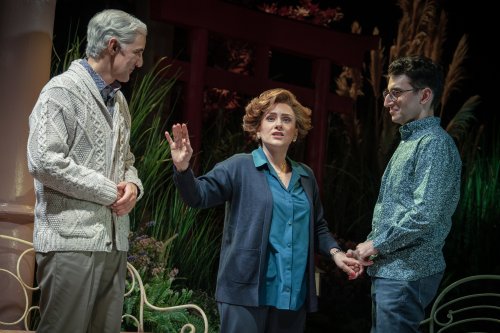
Nael Nacer and Artemis Pebdani as Charlie’s parents and Ryan J. Haddad as Ryan in a scene from Haddad’s “Good Time Charlie” at The Public Theater (Photo credit: Joan Marcus)
The play takes place on Afsoon Pajoufar’s lovely and colorful Japanese garden, Charlie and Lou’s backyard in Shaker Heights, Ohio, complete with an authentic torri (Japanese archway), with a patio holding a circular glass table and a small bar cart. Other set pieces are brought in as needed. Changes of Barbara Samuels’ lighting design help with the shifts in time and mood. The costumes by Enver Chakartash alternate between casual clothing appropriate for 1976 to the present period and the glamorous outfits for the theatrical scenes. Robert Pickens’ hair and wig design help Nacer and Pebdani with their changes from one set of parents to the other. The fight between Charlie and his father has been convincingly staged by Thomas Schall.
Good Time Charlie is a fitting tribute to Ryan Haddad’s family covering the last two generations. Its delightful theater gossip about shows and stars is entertaining while its depiction of gay life during the same period of time is enlightening as well as engrossing. The expert cast keep interest high throughout this two-act play. Haddad’s first large cast play (aside from his monologue and solo plays) demonstrates a fine ear for dialogue and an astute eye for dramatic situations, suggesting we can expect more excellent plays from him. Director Danny Sharron’s smooth staging makes this a memorable evening in the theater.
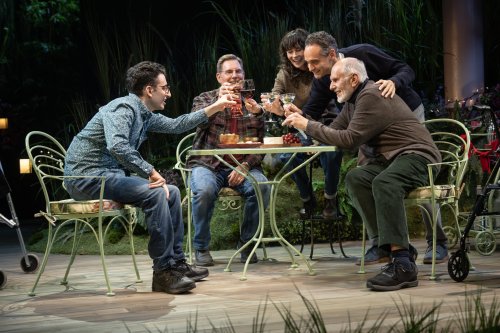
The cast of Ryan J. Haddad’s “Good Time Charlie” at The Public Theater (Photo credit: Joan Marcus)
Good Time Charlie (through October 25, 2026)
The Public Theater
Martinson Hall, 425 Lafayette Street, in Manhattan
For tickets, visit http://www.publictheater.org
Running time: two hours and 15 minutes including one intermission


Leave a comment