
ON THE TOWN WITH CHIP DEFFAA… AT “THE EDGE MOTEL”
It’s been years since I’ve so greatly enjoyed a play, in a small venue, that arrived with almost no advance publicity. "The Edge Motel" -- written by Tom Rowan, directed by Ron Lasko, and starring Max Andrae, Beckett Fleet and Hannah Heil--came as a most-welcome surprise.
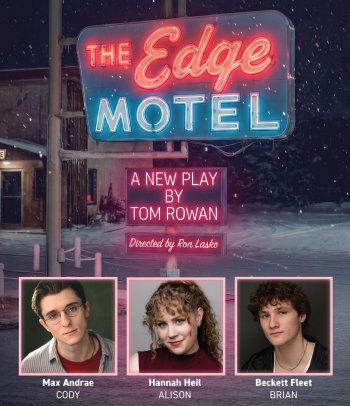
“The Edge” poster
One thing I’ve always loved about New York is the sheer number of theatrical productions that are available to see at any given time. And you never know where you might find writers and actors doing good work.
During the many years that I covered entertainment for the New York Post, when I was going out nightly, I enjoyed taking chances and checking out what was being presented in all sorts of venues, Off Broadway and Off Off Broadway. And you could sometimes see, in Off Off Broadway productions mounted on shoestring budgets, unknown writers and actors who would go on to great success.
I don’t go out as often as I did when I was younger. But I still get a great kick out of finding shows and actors in all sorts of venues, receiving minimal publicity, that I’ve enjoyed so much I can’t wait to get home and write about them. And this play is one such case.
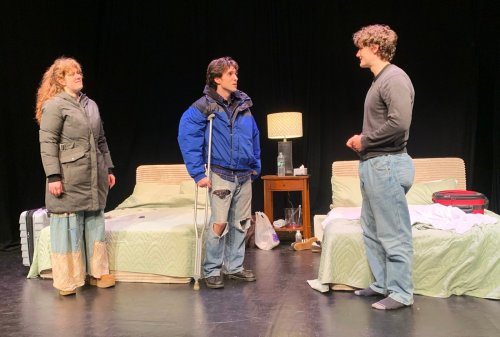
Hannah Heil, Max Andrae and Beckett Fleet in a scene from Tom Rowan’s “The Edge Hotel” at Theater for the New City (Photo credit: Max Ruby)
For me, one of the happiest surprises of the past year was catching the world-premiere production of The Edge Motel, a new play by Tom Rowan, directed by Ron Lasko. This was part of the Dream Up Festival, presented by Theater for the New City (Crystal Field, Artistic Director).
I almost did not go to see the play. The only day that I was free to check out the play during its limited festival run was a day when it was raining so fiercely out where I live in New Jersey that our county was under a “life-threatening flash-flood warning,” and part of the highway that I normally take into the city was already closed due to flooding. So it was not easy getting into the city. And my feet were thoroughly soaked before the trip into the city even started, just walking from my home to my car. I wound up watching the play with cold, thoroughly soaked feet.
But I’m sure glad I went.
The Edge Motel is a well-crafted, intricately plotted play. And playwright Tom Rowan certainly has a good feel for dialogue. (He’s a member of the Ensemble Studio Theatre, whose work I’ve enjoyed quite a bit over the years. And I’d also heard good things from friends about a play that he had in the Dream Up Festival last year, which I was not able to get to; so I was eager to see this new play of his, whether or not I wound up writing about.)
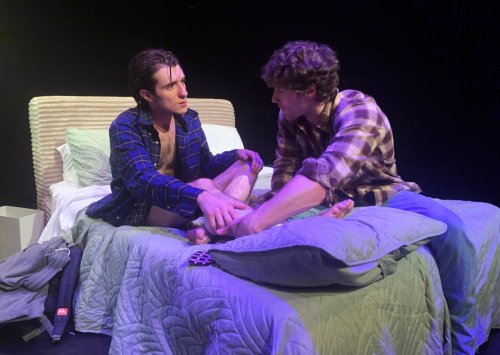
Max Andrae and Beckett Fleet in a scene from Tom Rowan’s “The Edge Hotel” at Theater for the New City (Photo credit: Max Ruby)
This new play has just three characters, and one simple set. The running time is one hour and 45 minutes, with no intermission. And The Edge Motel held me from beginning to end. A bit of judicious pruning would make this good play even better. (More about that later.) But it’s been years since I’ve enjoyed so much a play that arrived with almost no advance publicity. This one really took me by surprise.
The play is full of unexpected twists and turns. I can’t say too much about the storyline without spoiling things for future playgoers. This year’s Dream Up Festival has just ended. But this is such a well-written play, I certainly hope that it will eventually be published—as several other plays by Rowan have—and have future productions.
The play is centered around a mysterious stranger, an engaging vagabond. And right from the start, we want to know more about him.
Now, plays about mysterious strangers—engaging vagabonds whom we want to know more about—have a long and honorable history. (George M. Cohan, for example, scored one of the biggest successes of his dazzling career with his play The Tavern, centered on a charming, mysterious vagabond who shows up at a tavern one dark and stormy night.) But Rowan has taken an age-old starting point for a show and has created something wholly unique, and wholly of-the-moment. I found it very satisfying.
In the play, two college-age friends, Brian (played by Beckett Fleet) and Alison (played by Hannah Heil) are driving west in Colorado during a snowstorm.
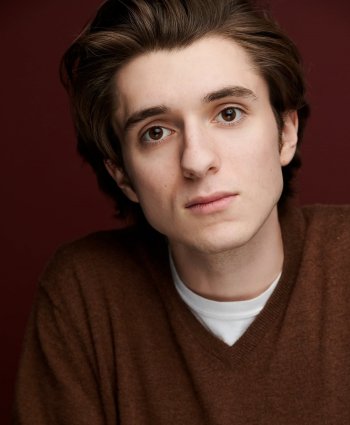
Max Andrae
They stop to pick up an injured, penniless hitchhiker on crutches, Cody. And when the snow storm gets too intense for them to drive any further that night, Brian and Alison stop to stay overnight at a cheap motel.
They share with Cody some food that they buy. He tries to bid them goodbye, saying he will continue hitch-hiking. But they know no one will be out driving on this bitterly cold stormy night. And this curious stranger doesn’t even own a coat. Brian, taking a liking to him, gives Cody his own coat. And makes a splint for Cody’s injured leg.
Brian and Allison finally invite this penniless stranger to share the motel room that they’ve rented, feeling it would be heartless to leave him outside to try and fend for himself in the storm.
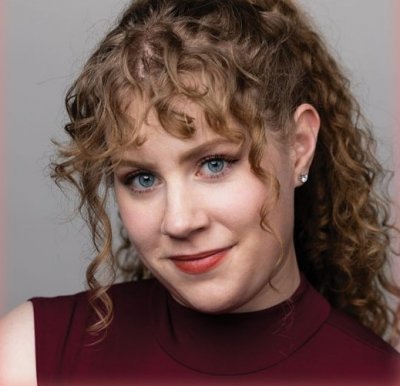
Hannah Heil
Alison wonders, though, if perhaps they’re being conned by this stranger—being manipulated into feeling responsible for him, and helping him. He seems so utterly guileless—that’s part of his boyish charm. But they realize they know virtually nothing about him.
But Cody is so likeable that both Alison and Brian begin to form bonds with him—she, quite reluctantly; Brian, more enthusiastically. She still feels a certain wariness, telling Cody: “I hate that you’re fun.” Cody replies: “I’m sorry.” And we can’t help but smile and warm to him. There’s something endearing about him. (And actor Max Andrae, as Cody, underplays his lines so perfectly, so naturally.)
When Cody goes to use the bathroom, Alison turns on the TV. She sees a news bulletin. Authorities are looking for a man who’s attempted to assassinate the President, offering a $100,000 reward. Allison sees on the news a grainy, surveillance-camera photo of the man who’s wanted for attempting to kill the President, and notes with distress: “It’s Cody.”
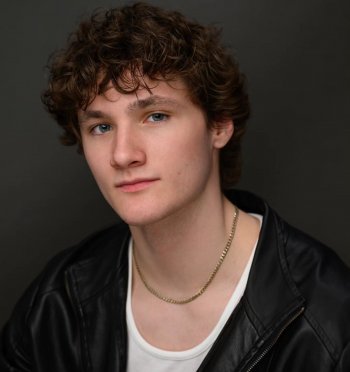
Beckett Fleet
Oh! I’m afraid I can’t say more without spoiling the play for any future viewers. (I hate even saying this much; I’m already giving away an important surprise.) But by now we’re definitely hooked by this play, if we weren’t already. And we want to know more about each of these individuals. We realize that all three of them are strangers to us.
The play is well-cast and well-directed. (The actors were all new to me; I’ve often enjoyed director Ron Lasko’s work.) Hannah Heil is credible throughout as the troubled, brooding, skeptical Alison.
Handsome Beckett Fleet is memorable and likeable as the wholesome, corn-fed, closeted midwestern college boy.
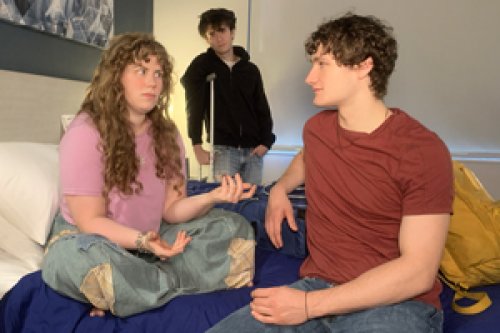
Hannah Heil, Max Andrae and Beckett Fleet in a scene from Tom Rowan’s “The Edge Hotel” at Theater for the New City (Photo credit: Max Ruby)
And I can’t imagine anyone playing better the enigmatic stranger, Cody, than Max Andrae. He delivers a terrific performance, using his innate charisma to great advantage. He’s got presence. And he’s a find. (He is the only holdover from this play’s staged reading at the Ensemble Studio Theatre last spring, which I was unable to attend.) And there’s excellent chemistry between Fleet and Andrae.
I mentioned earlier that I think the play would benefit from some very judicious pruning. Let me give an example. The first time, one character names shortcomings of President Trump—and we soon see that all characters are of the same opinion—it feels like a natural, dramatically necessary conversation.
But the next time a character names shortcomings of President Trump, it doesn’t feel so natural or dramatically necessary. It feels too didactic for my tastes–more like a playwright wanting to tell us of Trump’s failings than what the characters would be saying to one another at this point in real life (since they’ve already shared their political views, and inter-personal attractions are becoming clearer). That was one of the few moments in the play that just didn’t ring true for me. And it felt too much like preaching to the converted. (Mind you, I agreed with every criticism of Trump being made, but the commentary was needlessly slowing up the action.)
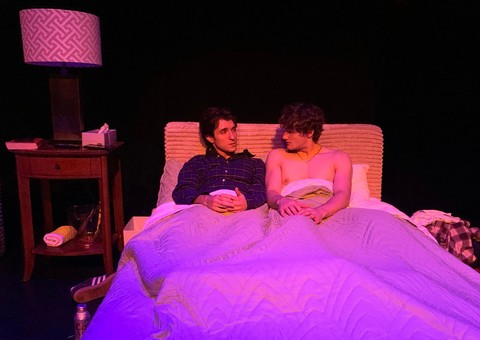
Max Andrae and Beckett Fleet in a scene from Tom Rowan’s “The Edge Hotel” at Theater for the New City (Photo credit: Max Ruby)
Late in the show, when the lights began fading to black, I thought at first that the play was ending. That moment felt like an acceptable place to end. I would have been okay with it ending right then and there, leaving us to imagine what the future might hold for these three characters we’ve come to like. But the lights remained lowered while some changes were slowly made to set up for one additional scene. The information shared in that very last scene (following that “false ending”) turned out to be invaluable, and it gave the play an even more satisfying conclusion. But that final scene simply felt too long to me. (As did the blackout needed for the transition to the final scene.) And I hated seeing this intriguing play lose even a bit of momentum.
These are relatively minor flaws, I must stress, in a play that I enjoyed a lot. And festival productions—mounted quickly on limited budgets—are often works-in-progress.
This play got to me. It could also make a good, inexpensive-to-produce indie film.
As for the prolific Tom Rowan, he has another play set to open this month—Burning Leaves, opening September 26th at the Gural Theatre in the A.R.T./NY theater complex on 53rd Street. If my schedule permits, I’d like to see that. I’m impressed by his writing, even if I can’t always be everywhere I’d like. And I’m so jammed this month. But I’d like to see more of his work. (Incidentally, I do own—and enjoy–one of Rowan’s books: RENT: F.A.Q., about Jonathan Larson’s Pulitzer Prize-winning musical. He also wrote a book on A Chorus Line which I suspect I’d enjoy, too.)
It’s always a nice surprise to find a virtually unpublicized play in a smaller venue that it is this rewarding. I’d enjoy seeing this play again someday, and seeing more of these actors.
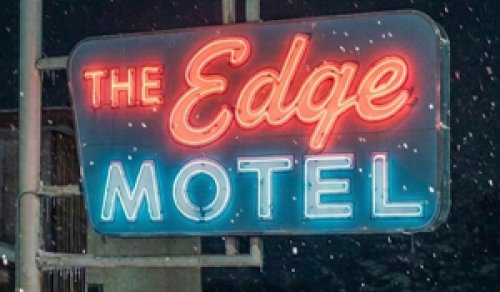
“The Edge Motel” logo
Now, if I can step up onto the soapbox for a moment…. I wish this good play could have been promoted more. I also wish that I could tell you more about the three actors—all of whom were new to me. But the play’s web page includes bios of only the playwright and the director—no bios of the actors. (Actors, you must be pro-active! Always make sure your bios are part of any web page for any show you’re in. And see if you can get your bios included in the printed programs!)
I’ve saved every program from every show I’ve ever seen. I’ve sometimes cast actors in shows that I’ve written or directed, or have invited actors to sing on albums that I’ve produced because I liked the actors’ work in shows I’ve seen, and the actors included some kind of contact info in their bios. But I know nothing about these three actors. (I know more about one actor I chanced to meet briefly in the lobby before the play!)
It would have cost virtually nothing to have printed bios of the actors available at the theater for reviewers; but there were no such printed bios available. (I asked at the box office.) It would also take very little time, effort, and money, to create a lobby display board, with headshots and brief bios of the actors in the show. If actors wanted to provide a link to their own web site—and every good actor should have his own website—they could do so.
The printed program that was provided to audience members included a bio of the playwright but no one else. No bios of the actors. There was an invitation to smartphone users to scan a code if they wanted more info. But that isn’t much help for those who don’t use smartphones.
I’m sorry, but I feel that actors deserve better. I started out as a performer before I became a writer, director and producer, and I still sympathize with aspiring actors. Younger actors doing festival productions typically work hard for little or no financial compensation; part of their “compensation” is the exposure they hope to get to the general public, and to reviewers, and to industry professionals who might want to hire them someday. Providing brief bios of actors to everyone (especially reviewers) who comes to see them in shows should always be part of the deal.
Someday I might even want to hire these actors myself for a play. But to me, at present, they’re all “mysterious strangers.”
— CHIP DEFFAA


Leave a comment