
Sukkot
Matthew Leavitt's charming play blends Irish laughter and Jewish guilt as a non-observant family finds healing in their seven days together under a sukkah.
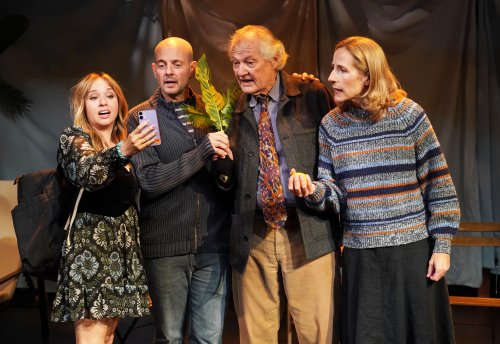
Natalie Lander, Jonathan Slavin, Andy Robinson and Liza Seneca in a scene from Matthew Leavitt’s “Sukkot” at 59E59 Theaters (Photo credit: Carol Rosegg)
Matthew Leavitt’s Sukkot begins with a deceptively simple premise: a grieving widower builds a sukkah because he believes it is the closest remaining path to his late wife. From that premise emerges one of the most satisfying new family plays to arrive this season, a comedy-drama that understands grief not as a singular emotion but as an unruly collection of contradictions. It is uproariously funny without ever mocking pain, deeply moving without reaching for sentimentality, and wise enough to recognize that families often express love most fluently through irritation. The 6th Act’s superb production at 59E59 Theaters, directed with remarkable assurance by Joel Zwick, allows Leavitt’s finely calibrated script to breathe, laugh, and ache in equal measure.
The title refers to the Jewish festival commemorating the Israelites’ forty years of wandering in the wilderness, a week spent dwelling in temporary shelters while celebrating life’s abundance despite uncertainty. That paradox proves to be the play’s emotional engine. Patrick, an Irish Catholic retired professor whose Jewish wife died of cancer a year earlier, finds himself speaking with a rabbi on the phone about her headstone unveiling and, almost accidentally, discovers the tradition of building a sukkah. Having never encountered one before, he constructs his own improbable version—complete with charmingly misguided decorative instincts, as in nothing screams out “joy” like twinkling Christmas lights—and insists that his three adult children join him inside it for the holiday. It is an act born simultaneously of devotion, desperation, and denial, an attempt to rebuild not merely a structure but an entire family identity that vanished with his wife.
Leavitt wisely avoids making the sukkah itself into an easy comic gimmick. Instead, the fragile enclosure becomes a theatrical pressure cooker, compressing years of unresolved tensions into seven days of forced togetherness. Asher, the son who sacrificed his own life to care for his dying mother, still lives at home, unemployed and emotionally stranded. Mairead, the accomplished physician, carries the corrosive guilt of believing she did not do enough during her mother’s illness. Eden, drifting toward middle age without the settled life expected of her, masks profound anxiety beneath an easygoing charm. Like all memorable stage families, they are recognizable not because they resemble stereotypes but because each sibling has become trapped inside the role the family assigned them years ago.
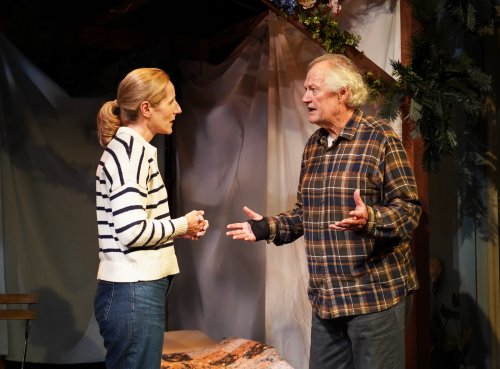
Liza Seneca and Andy Robinson in a scene from Matthew Leavitt’s “Sukkot” at 59E59 Theaters (Photo credit: Carol Rosegg)
What distinguishes Sukkot from countless dysfunctional-family dramas is Leavitt’s ear. His dialogue possesses the effortless rhythm of genuine conversation while remaining relentlessly theatrical: jokes arrive precisely when emotions threaten to overwhelm, and moments of startling honesty appear almost by accident, as though the characters have surprised themselves by speaking aloud what they have spent years repressing. Patrick’s earnest crash course in Judaism—learning how to build a sukkah and acquire the requisite palm, myrtle, willow, and etrog from the wonderfully named YoucanJewIt.com, before dutifully making the inevitable pilgrimage to Lowe’s for construction supplies—is funny precisely because his devotion is so sincere.
When Mairead and Eden ask why Asher never helped their father with the project, his deadpan explanation that “Jews are not really made to build things. In history, they only had one good carpenter,” lands as one of the evening’s biggest laughs, perfectly capturing the family’s habit of using wit to sidestep pain. Few playwrights navigate this tonal terrain so gracefully. Humor and heartbreak never compete here; they deepen one another.
Zwick, best known for directing broad popular comedy, particularly My Big Fat Greek Wedding, demonstrates an especially elegant understanding of this balancing act. His direction never telegraphs the emotional peaks, trusting both the script and performers to discover them organically. The pacing is brisk without feeling hurried, allowing the comedy to accumulate naturally while giving quieter revelations the room they require. The production feels lived in rather than staged, as though we have simply been invited into a family that has existed long before the curtain rose and will continue wrestling with itself after it falls.
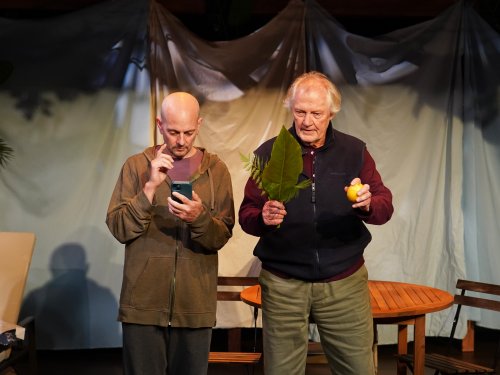
Jonathan Slavin and Andy Robinson in a scene from Matthew Leavitt’s “Sukkot” at 59E59 Theaters (Photo credit: Carol Rosegg)
Andy Robinson gives a beautifully layered performance as Patrick, refusing every temptation to sentimentalize grief. His Patrick can be maddeningly stubborn, unintentionally selfish, and almost absurdly determined, yet Robinson reveals the unbearable loneliness beneath every misguided decision. Jonathan Slavin is equally marvelous as Asher, whose wit functions both as armor and self-inflicted wound. Slavin makes Asher’s bitterness unexpectedly lovable, allowing us to understand how prolonged caregiving can leave someone emotionally marooned long after the crisis has ended. Natalie Lander brings radiant warmth to Eden, gradually exposing the fear hidden beneath her breezy evasiveness, while Liza Seneca delivers perhaps the evening’s most quietly affecting work as Mairead, whose compulsive competence masks reservoirs of guilt and tenderness. Together they achieve that rare theatrical miracle: they never seem like actors portraying relatives but people who have been irritating and loving one another their entire lives.
The physical production exhibits similar restraint. Mark Mendelson’s inviting sukkah anchors the stage without overwhelming it, functioning simultaneously as realistic setting and resonant metaphor for the fragile shelters we construct against loss. Colleen Doherty’s sensitive lighting and Chris Moscatiello’s evocative sound design subtly shift the atmosphere from domestic realism toward something almost dreamlike, while never abandoning the emotional truth of the story. Caitlin Cisek and Oriana Sophia’s costumes sketch each sibling’s personality with unobtrusive precision, reinforcing the sense that these characters have arrived carrying the accumulated weight of lives lived elsewhere before reluctantly returning home.
One can quibble over a few narrative conveniences—the family’s unfamiliarity with certain Jewish traditions occasionally stretches plausibility, and the closing movement edges toward reassurance a shade more quickly than the preceding complexity might suggest. Yet these are vanishingly small reservations in a play whose emotional intelligence consistently outweighs its minor improbabilities. Sukkot succeeds because it understands that mourning is itself a kind of wandering, an extended journey through unfamiliar terrain where joy can feel almost like betrayal. Leavitt has written a seriously comic gem, one that earns every laugh while quietly preparing the ground for moments of genuine emotional force. By the time this bruised, funny, exasperating family emerges from its temporary shelter, one leaves believing not that their wounds have healed, but that they have rediscovered the fragile possibility of continuing together. In the theater, that kind of hope is rarer—and more moving—than certainty.
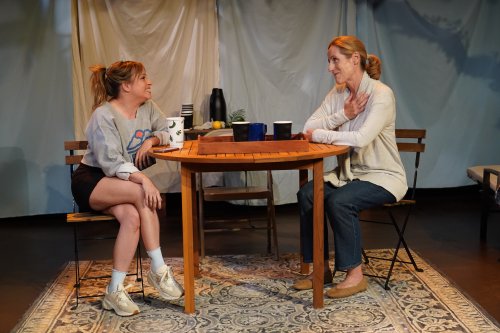
Natalie Lander and Liza Seneca in a scene from Matthew Leavitt’s “Sukkot” at 59E59 Theaters (Photo credit: Carol Rosegg)
Sukkot (through August 9, 2026)
The 6th Act
59E59 Theaters, Theater B, 59 East 59th Street, in Manhattan
For tickets, visit www.59e59.org
Running time: one hour and 45 minutes without an intermission


Leave a comment