
Lines
Bellamy Brewster and Ewan Lloyd transform actors' dreams into a haunting psychological nightmare, exposing the terrifying cost of being chosen.
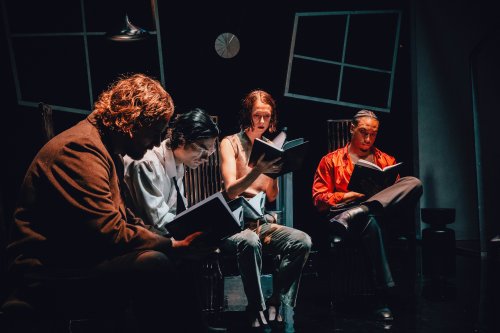
The cast in a scene from Bellamy Brewster and Ewan Lloyd’s “Lines” at Theatre 154 (Photo credit: Courtesy of Big Little House)
A theatrical audition has always carried the faint aura of ritual: a small room, a handful of strangers vested with authority, and an actor asked to compress talent, vulnerability, and desperation into a few fleeting minutes. Lines, a taut new psychological chamber play by Bellamy Brewster and Ewan Lloyd, recognizes that the audition is already a form of theater—and then pushes that premise into increasingly disquieting territory. Brewster, who also directs, transforms the familiar rituals of casting into a claustrophobic examination of power, ambition, and the hidden price of artistic validation.
Set entirely within the confines of an audition room, the play begins with recognizable industry conventions before gradually mutating into something far more sinister. As the process unfolds, the rules become increasingly rigid, the room itself seems to contract, and what initially appears to be a professional evaluation evolves into an unsettling psychological contest. The central question lingers over every exchange: What, exactly, is the cost of being chosen?
The mythology of artistic greatness has long been nourished by the spectacle of bodily sacrifice. Cinema, perhaps more than any other medium, has encouraged audiences to mistake authentic suffering for artistic truth, as though pain itself were an indispensable collaborator in the creative process. Some of the most revered performances in film history are accompanied by stories of punishing endurance that have become almost as legendary as the works themselves.

Kelechi Udenkwo as Marcus , Genevieve Ngosa Daniels as Isabella and Bryce-David King as Vernon in a scene from Bellamy Brewster and Ewan Lloyd’s “Lines” at Theatre 154 (Photo credit: Courtesy of Big Little House)
Carl Theodor Dreyer’s The Passion of Joan of Arc (1928) remains one of the supreme monuments of silent cinema, its visual language built upon an astonishing succession of unforgiving close-ups that transform the human face into a battlefield of spiritual agony. At the center stands Renée Falconetti, whose Joan seems less to perform suffering than to embody it. That uncanny intensity, however, was not achieved through inspiration alone. Dreyer demanded extraordinary physical hardship from his actress, reportedly requiring her to kneel for extended periods on unforgiving stone floors until her exhaustion and anguish registered with the precise emotional temperature he sought. The camera’s relentless gaze captured not merely the character’s torment but, to an unsettling degree, the performer’s own. Falconetti emerged from the production emotionally and physically depleted, never appearing in another film, leaving behind a single cinematic performance that feels almost impossibly singular precisely because of the immense personal cost exacted in its creation.
Nearly a century later, the culture of artistic self-denial continues to exert its strange fascination. For Dallas Buyers Club, Matthew McConaughey transformed himself with an alarming weight loss of nearly fifty pounds to portray Ron Woodroof, a man dying of AIDS during the epidemic’s darkest years. The physical alteration became inseparable from the performance itself, its severity functioning as both evidence of commitment and a kind of promotional mythology surrounding the film. During McConaughey’s drastic regimen, friends reportedly expressed alarm at his increasingly gaunt appearance. Yet when one exclaimed, “My God, we need to get you some help,” the actor recognized he had reached what he described as the “perfect spot”—a chilling phrase that encapsulates the peculiar logic of method acting, where physical deterioration becomes a marker of art. At least he was rewarded by the Academy with the Best Actor statuette that year.
These stories endure because they flatter our romantic belief that great art must demand great suffering. They invite us to imagine that authenticity can be measured in bruises, hunger, or exhaustion. Yet they also raise an uncomfortable question: whether the masterpieces we celebrate are monuments to artistic genius alone, or to an industry that has too often mistaken the abuse of the body for the highest expression of artistic devotion.

James Louis Wagner as Ellis in a scene from Bellamy Brewster and Ewan Lloyd’s “Lines” at Theatre 154 (Photo credit: Courtesy of Big Little House)
The Lines ensemble meets Brewster’s escalating psychological demands with remarkable precision. As the Moderator, Paul Niebanck delivers a chillingly clinical performance as the man with the clipboard, projecting an unnervingly authoritative calm as he manipulates both the rules of the audition and the contestants themselves. James Louis Wagner anchors the drama as Ellis, bringing an almost painful desperation that captures a seasoned actor teetering on the edge of hope and collapse. Genevieve Ngosa Daniels charts Isabella’s transformation with striking assurance, allowing her character’s buoyant optimism to harden gradually into a razor-sharp instinct for survival. Penny Balfour lends Julia a deeply layered weariness, suggesting decades of artistic compromise beneath every measured glance and carefully chosen word.
Equally compelling, each contributing a distinct shade to the production’s mounting unease, Kelechi Udenkwo gives Marcus a magnetic physical presence, his coiled intensity grounding the play’s escalating danger. Co-playwright Ewan Lloyd brings Isaac to life with an affecting combination of vulnerability and quiet resolve, revealing an inexperienced young actor struggling to preserve his integrity as the psychological pressure mounts. Bryce-David King captures Vernon’s slow unraveling with agonizing clarity, making paranoia feel both inevitable and profoundly human. As Victoria, Nancy Kimball delivers a hauntingly stoic performance, embodying with heartbreaking restraint the immense personal cost that artists are so often asked to bear in pursuit of acceptance.
Lines’ mounting tension is heightened by Spencer Barnett’s evocative original score and Fahd Sayeed’s immersive sound design, which subtly blur the boundary between external reality and the performers’ unraveling inner lives. Gianna Reisen’s movement direction further deepens the sense of emotional entrapment, lending physical expression to the invisible pressures exerted upon artists desperate for approval.

Penny Balfour as Julia in a scene from Bellamy Brewster and Ewan Lloyd’s “Lines” at Theatre 154 (Photo credit: Courtesy of Big Little House)
The production’s design team creates an atmosphere of mounting psychological dread with remarkable cohesion. Pili Weeber’s minimalist scenic design transforms the audition room into a claustrophobic pressure cooker whose stark confines become a silent accomplice to the drama, while Edvin Thompson’s sharply tailored costumes and restrained palette subtly reveal shifting hierarchies of power, ambition, and vulnerability. Obid Abdurakhmanov’s superb lighting completes the illusion, employing severe angles, oppressive shadows, and abrupt changes in intensity to chart the play’s unsettling descent from an ordinary casting call into a nerve-rattling psychological thriller. Together, these elements create an environment that is as emotionally imprisoning as it is visually compelling.
One of the production’s most haunting devices is the Moderator’s deceptively cordial refrain. The opening assurance, “You are being considered,” initially lands as a simple welcome, even a promise of possibility. But as the play progresses, that phrase mutates into its cruel inverse—”You are no longer being considered”—repeated seven devastating times with bureaucratic precision. Each utterance strips away another layer of hope, transforming the language of opportunity into an instrument of psychological punishment. By the final repetition, the phrase lands with an almost existential chill, exposing how easily the machinery of judgment can reduce human aspiration to a cold, impersonal verdict.
Lines (through July 3, 2026)
Multi-Title Group, Inc.
Theatre 154, 154 Christopher Street, in Manhattan
For tickets, visit www.linestheplay.com
Running time: 80 minutes without an intermission


Leave a comment