
Camping
Over 25 years, two women return to the same tent, navigating inadequate men, buried hopes, and a love for each other neither can fully admit nor escape.
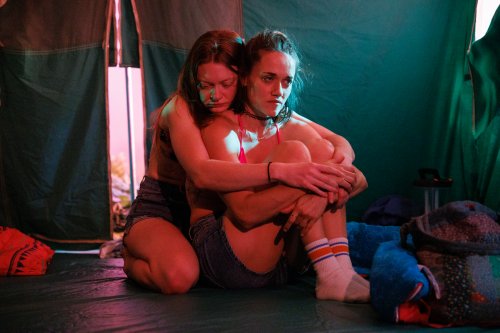
Colby Minifie and Alice Kremelberg in a scene from Victoria Lynne Barclay’s “Camping” at HERE Arts Center (Photo credit: Maria Baranova)
Victoria Lynne Barclay’s Camping arrives at the end of a theatrical season crowded with stories about young women struggling to imagine futures larger than the worlds that shaped them. Yet this remarkable debut, supported by a compassionate director in Adrienne Campbell-Holt, feels less like another entry in that conversation than its haunting afterword. Spanning 25 years in 85 concentrated minutes, Barclay’s play traces the lives of two Ohio women, Ari and Brit, from adolescence to early forties without ever leaving the confines of a forever-borrowed camping tent. What begins as a simple conceit gradually reveals itself as something richer: a study of desire deferred, identity postponed, and love so deeply rooted that it survives decades of denial.
The tent itself becomes one of the most eloquent settings to appear on a New York stage this season. Ari steals it from her brother at fifteen and never returns it. Over the years it transforms into sanctuary, confessional, refuge, battleground, memory palace, and mausoleum for unrealized possibilities. Krit Robinson’s scenic design understands that simplicity can be theatrical abundance. The canvas structure occupies HERE’s intimate downstairs Dorothy B. Williams Theatre with an almost mythic presence, simultaneously cramped and expansive. Beyond its thin walls, Salvador Zamora’s exquisitely detailed sound design conjures rainstorms, festivals, squealing children, boorish husbands, campgrounds, highways, and entire decades of American life. Vittoria Orlando’s lighting filters through mesh panels and zippered openings with such natural grace that sunlight, moonlight, and lantern glow seem less designed than remembered.
Watching Ari and Brit age before our eyes is one of the production’s quiet miracles. Sarita P. Fellows’ exquisitely calibrated costumes chart these shifts with remarkable precision, moving from oversized teenage T-shirts and carefree festival attire to the practical uniforms of adulthood, each new layer registering another compromise, another responsibility, another year lived. Together, performance and design create the uncanny sensation of watching entire lives transpire in real time.
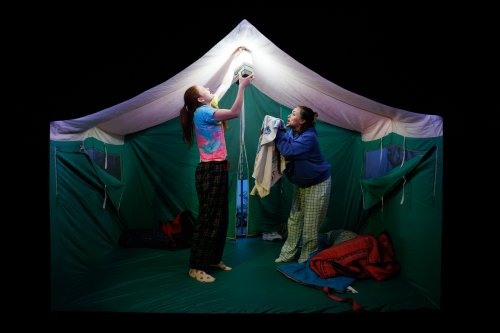
Colby Minifie and Alice Kremelberg in a scene from Victoria Lynne Barclay’s Camping” at HERE Arts Center (Photo credit: Maria Baranova)
Barclay’s achievement is all the more astonishing given that this is her first professional production. The play unfolds through a series of carefully selected encounters, each returning us to the tent at a pivotal moment. At fifteen, Ari and Brit are preparing to lose their virginity simply to escape the humiliation of being the last girls in school who have not. Twenty minutes later, they sit amid the emotional wreckage of the experience. A bloodstain on the sleeping bag lingers as an inadvertent emblem of the evening, a mute witness to the gulf between expectation and reality: the elephant in the tent as they attempt to reconcile cultural mythology with physical reality. The conversation that follows is funny, devastating, and painfully recognizable. Throughout the evening Barclay demonstrates an uncanny ear for the language of young women—the jokes, evasions, bravado, self-deprecation, and coded longings that conceal deeper truths.
What emerges over time is not merely a friendship but one of the most intricate love stories currently playing in New York. Ari and Brit have been entwined since birth, neighbors in a trailer park, companions through every formative humiliation and triumph. They know one another with an intimacy that exceeds romance even as it continually gestures toward it. Their connection exists in that difficult territory where friendship, devotion, desire, resentment, dependence, and yearning become impossible to separate. Theater often struggles to depict such relationships without reducing them to categories. Barclay refuses simplification. The result feels startlingly true.
For all the years that pass, both women remain haunted by the same insecurities that first took root in adolescence. Brit has spent her life shrinking herself to fit the limitations others imagined for her, tending bar in the same town, marrying a man whose infidelities merely confirm the low regard in which she holds her own prospects. The class shame she feels in the presence of Ari’s educated, affluent friends never fully dissipates, while the religious beliefs that shaped her childhood leave her unable to confront the feelings she harbors for her closest companion. Ari’s struggles are no less profound. Intellectually aware of her queerness and emotionally drawn toward Brit, she nevertheless chooses the apparent safety of a conventional life, marrying a wealthy college boyfriend rather than risking the vulnerability that genuine honesty would require. Both women become experts in accommodation, constructing lives around avoidance and compromise, until the distance between what they want and what they allow themselves to pursue grows quietly heartbreaking.
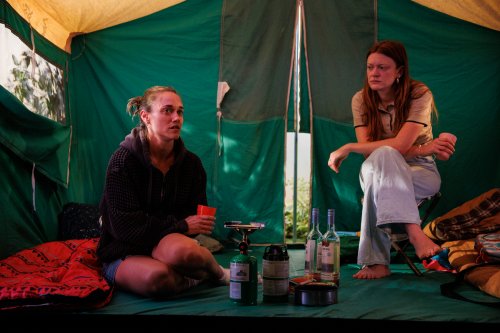
Alice Kremelberg and Colby Minifie in a scene from Victoria Lynne Barclay’s “Camping” at HERE Arts Center (Photo credit: Maria Baranova)
Campbell-Holt directs with exceptional confidence and emotional precision. The challenge of staging eight scenes across a quarter century in a single location could easily produce monotony. Instead, the production moves with the inevitability of memory itself. Every shift of a sleeping bag, every repositioning within the cramped tent, every silence and glance acquires dramatic significance. Campbell-Holt understands that the play’s action occurs less in external events than in what remains unspoken between these women. She trusts the audience to perceive the emotional earthquakes beneath ordinary conversation.
That trust is rewarded by two extraordinary performances. Colby Minifie gives one of the finest stage performances of the year as Ari, charting a gradual evolution from restless teenage wit to a woman carrying the accumulated weight of compromise. Minifie’s gift lies in her ability to communicate entire histories through a fleeting expression. She makes Ari’s intelligence, insecurity, humor, longing, and heartbreak visible simultaneously. Watching her age before our eyes feels less like acting than time-lapse photography of a soul.
Alice Kremelberg is equally magnificent as Brit, whose apparent toughness conceals profound vulnerability. Brit’s tragedy is not simply that she represses her feelings for Ari but that she has spent a lifetime convincing herself she does not deserve anything better than the life she inherited. Kremelberg captures this self-erasure with heartbreaking subtlety. The performance never solicits sympathy; instead, it reveals the quiet devastation wrought by class anxiety, religious conditioning, and the gradual surrender of personal possibility. Her haunted stillness becomes one of the evening’s most powerful dramatic forces.

Colby Minifie and Alice Kremelberg in a scene from Victoria Lynne Barclay’s “Camping” at HERE Arts Center (Photo credit: Maria Baranova)
Barclay is especially perceptive about the social machinery that shapes women’s lives. Again and again, Ari and Brit find themselves accommodating expectations they never consciously chose. Men drift through their stories as husbands, lovers, disappointments, obligations, and occasionally outright burdens. Yet Camping is never polemical. Its critique emerges through lived experience: bad sex accepted as normal, ambitions quietly abandoned, desires translated into obligations, futures chosen by default rather than conviction. The play understands that regret is often less about mistakes than about opportunities never fully imagined.
What lingers longest, however, is the tenderness. Beneath every argument, every betrayal, every missed opportunity lies an abiding devotion. One unforgettable exchange about marriage, sex, and fantasy encapsulates the entire relationship in a single look from Ari to Brit—a look that contains 25 years of longing, hope, disappointment, regret, and love. Barclay, Minifie, and Kremelberg understand that some truths become too large for language, and in that fleeting silence the play reveals its deepest wound. More than any confession or confrontation, the moment forces us to contemplate the peculiar agony of loving someone so completely that the feeling becomes inseparable from your very being—a yearning so enduring that it settles into the body itself, beyond remedy, beyond explanation, and beyond the reach of time. Few playwrights possess the confidence to allow subtext to carry so much weight. Fewer still can make it resonate so deeply.
By the time the aging tent begins to strain against weather and time in the play’s final moments, Camping has become something rare: a work of piercing emotional intelligence that feels both intimately specific and universally recognizable. It is a breathtaking debut from a major new playwright, a triumph of direction and design, and a showcase for two performances of extraordinary depth. Most movingly, it is a reminder that the great love stories are not always the ones that follow conventional paths. Sometimes they unfold over decades, hidden in plain sight, waiting inside a tent where two girls once imagined their future and never quite stopped trying to find their way there.
Camping (through July 11, 2026)
Presented by Colt Coeur hosted by HERE Arts Center
Dorothy B. Williams Theatre at HERE Arts Center, 145 Avenue of the Americas, in Manhattan
For tickets, visit www.here.org
Running time: 85 minutes without an intermission
Over 25 years, two women return to the same tent, navigating inadequate men, buried hopes, and a love for each other neither can fully admit nor escape.


Leave a comment