
The Maids
Kip Williams' updated version of the Jean Genet one act makes more use of video screens than he did in his Oscar Wilde adaptation last season.
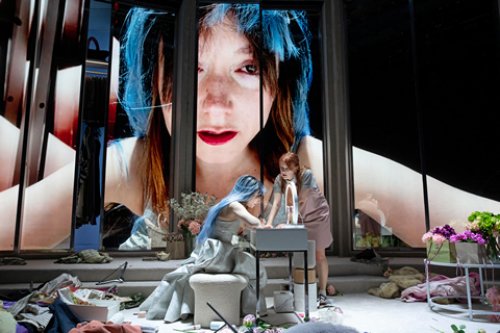
Lydia Wilson as Claire and Phia Saban as Solange in a scene from Kip Williams’ production of Jean Genet’s “The Maids” at St. Ann’s Warehouse (Photo credit: Julieta Cervantes)
Kip Williams’ Donmar Warehouse Production of Jean Genet’s The Maids has arrived at St. Ann’s Warehouse and proves to be a stunning visual experience. We first see Rosanna Vize’s set which is visible from three sides on which the audience sits, an all-white bedroom or dressing room with a 13-foot high wall of mirrored closets. Out of these closets peek fabulous designer couture created by Marg Horwell. Initially the stage is literally a garden of flowers, chrysanthemums, gladioli, hydrangeas, mostly pink. A vanity sits center stage with a ring light, a cream-colored sunken sitting area on stage left, a huge bed on stage left, covered by purple satin sheets and a white duvet. This is slightly obscured from us by diaphanous sheer curtains on three sides when the play begins.
Williams has adapted and updated Genet’s 1947 play to contemporary London while remaining faithful to the original plot and characters. Sisters Claire and Solange work as maids for the exacting and onerous Madame, the daughter of a billionaire who has become an online influencer with millions of followers and a life of extreme privilege and social prestige. There are advantages to working for Madame like being given her castoff designer clothes or being taken to opening nights. However, she is abusive and insulting, capricious and unpredictable. The verbal and psychological abuse is excessive explaining their love/hate relationship with her.
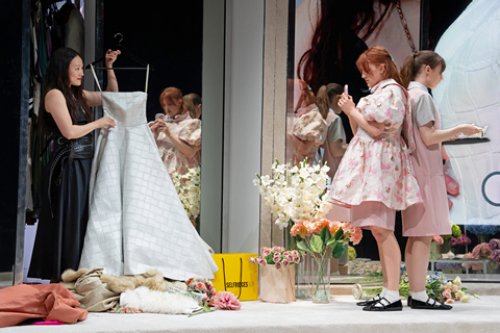
Yerin Ha as Madame, Phia Saban as Solange and Lydia Wilson as Claire in a scene from Kip Williams’ production of Jean Genet’s “The Maids” at St. Ann’s Warehouse (Photo credit: Julieta Cervantes)
However, either to punish her or themselves, they play a nightly ritual where one of them plays Madame and other plays one of the maid. They try on her clothes, they mimic her voice and mannerisms, they put on make-up, and “Madame” insults her maid viciously. Now they have gone one step further. They have anonymously accused Madame’s boyfriend of embezzling her father’s money and he is now awaiting arraignment. When Madame returns from court devastated at how her charmed life is going, she worries about being cancelled and what her followers will think. And little does she know that when they bring her usual tea tonight it will be laced with enough poison to kill her.
Part of the play is an eye-filling fashion show with Solange and Claire trying on Madame’s gowns or taking them out of her closet to ogle them. However, what is most remarkable about Williams’ production is his use of technology as he did in his Picture of Dorian Gray with Sarah Snook on Broadway and his recent Dracula with Cynthia Erivo on the West End. The video technology used in The Maids is startling, almost overpowering at times. The mirror-lined closets and doors become giant screens that show us Madame’s online posts as well as her live footage of Solange, Claire and herself (from video designer Zakk Hein). Using Tiktok filters and effects she turns them grotesque or changes their face or features. Eventually in a dream sequence, Solange leads Claire through Madame’s closets and they visit a hallucinatory world of fantasy that we see on the screens. The fact that the screens are 13 feet high adds to the power and the effectiveness of these images.
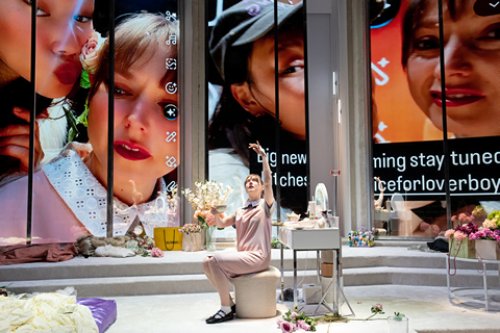
Lydia Wilson as Claire in a scene from Kip Williams’ production of Jean Genet’s “The Maids” at St. Ann’s Warehouse (Photo credit: Julieta Cervantes)
Unfortunately, the images overpower the play to the point that it is often difficult to concentrate on the dialogue or the characters, unlike in The Picture of Dorian Gray where the images told the story. The profusion of flowers is also disconcerting, making Madame’s room somewhat surreal. As staged by Williams it is often difficult to keep Lydia Wilson’s Claire and Phia Saban’s Solange straight. In the original play, the sisters impersonate each other and call each other by the other’s name, while Madame often mixes them up. Here with the visual excess, it is difficult to recall which is which even though Solange has red-hair and Claire is a brunette. While in the original play, it appeared that Solange was the stronger one, here it is seems as if Claire may be the alpha sister.
Yerin Ha’s Madame, however, is hilarious. With her own 1.7 million followers since her star turn as Sophie Baek on the fourth season of Bridgerton, she is perfect to play this role. She is by degrees egotistical, bitchy, self-involved, gossipy, judgmental. She tears apart her friends and associates. She insults Solange and Claire, finding fault with their work and their cleanliness. She gives them expensive presents from her own closet and then five minutes later takes them back. She is so wrapped up with her life and her boyfriend and her followers that she had no time for anything else. And then she can change on a dime and appear to be sweet and understanding. Her one long scene is almost a giant monologue as she hardly ever listens to Solange or Claire’s answers to her questions. She talks so fast that she never gives us a chance to react to her rants and her demands. It not only is a superlative performance but it takes us and the play by storm.
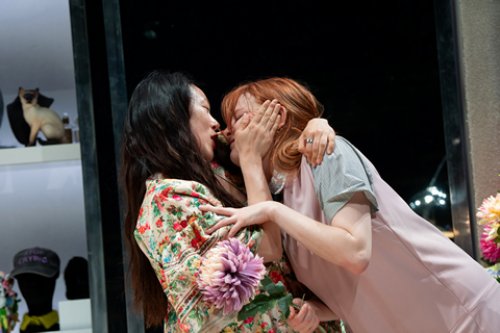
Yerin Ha as Madame and Phia Saban as Solange in a scene from Kip Williams’ production of Jean Genet’s “The Maids” at St. Ann’s Warehouse (Photo credit: Julieta Cervantes)
Although the production is often exhausting, it has clearly been thought out to the last detail. Dan Balfour’s soundscape includes recognizable classical pieces while this is enhanced by DJ Walde’s original score. Designer Jon Clark shifts the lights for various effects and moods, adding to the visuals on the screens. Hein’s video is synchronized perfectly to the action on stage from the three actresses. Willams’ adaptation of the almost 80-year-old play is excellent at finding contemporary language and products to make it feel current, although at times the English place names may give American audiences a slight disconnect. However, this study of social class and money still remains in clear focus. While the play now seems to be less interested in the psychology of the three characters, three psychopathic personalities, the visual display makes this a theatrical experience not to be missed. No description can do justice to what is seen on stage at St. Ann’s Warehouse.
The Maids (through June 14, 2026)
St. Ann’s Warehouse, 45 Water Street, in DUMBO, Brooklyn
For tickets, http://www.stannswarehouse.org
Running time: one hour and 45 minutes without an intermission


Leave a comment