
Ivanov
New American Ensemble takes a rarely revived Chekhov play and reveals it to be the seething masterpiece no one ever "got" until now.
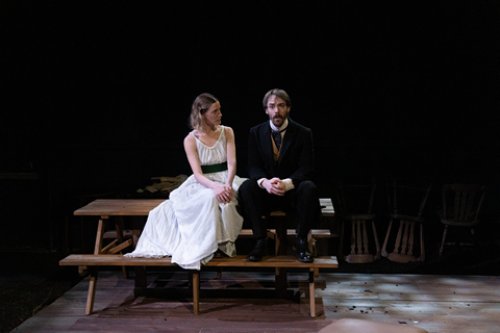
Quinn Jackson as Anna Petrovna Ivanov and Zachary Desmond as Nicholai Ivanov in a scene from the New American Ensemble revival of Anton Chekhov’s “Ivanov” at the West End Theatre (Photo credit: Bronwen Sharp)
Ivanov, that early and somewhat ungainly specimen in Anton Chekhov’s canon, often carries the reputation of a draft rather than a destination—a play in which the great themes appear in embryo, not yet refined into the devastating precision of the later works. But such literary bookkeeping feels beside the point in the face of what New American Ensemble has accomplished here. Whatever structural awkwardness the play may possess is not smoothed over so much as metabolized, transformed into a volatile theatrical engine. What emerges, under the direction of Michael DeFilippis, is a production that refuses tonal obedience. Humor erupts with a kind of reckless abundance, tipping easily into farce—doors nearly slamming, bodies nearly colliding—only to recoil, just as suddenly, into a stark and unvarnished earnestness. The laughter does not dissipate; it curdles, lingers, implicates. DeFilippis understands that Chekhov’s instability is not a flaw to be corrected but a feature to be exploited, and he orchestrates these careening shifts with a confidence that feels both muscular and unnervingly precise.
The result is not a smoothing-out of Ivanov’s rough edges but a sharpening of them, until the play’s tonal volatility begins to resemble something like emotional truth. Farce and despair, in this staging, are not opposites but adjacent rooms, separated by the thinnest of walls—and DeFilippis moves us between them with an assurance that makes the journey feel, if not comfortable, then at least inevitable. There is a governing idea of New American Ensemble’s arresting production: it is all vanity, yes, but vanity with consequences. The question is not whether the world endures—it does—but what damage is inflicted by those who briefly presume to stand on it.
Scenic designer Ashley Basile places the stage to one side, a fully operational bar to the other. Theater and intoxication, spectacle and anesthesia. You decide where to look first, but the production has already decided for you. You are implicated. Immersive theater, so often an empty gimmick, here becomes argument. From the moment you enter, you are not watching decay—you are seated within it.
Beneath your feet, the ground refuses illusion. This is not a floor but earth itself…mulch, in fact…and the act of entering feels less like attending a play than trespassing on something or someone buried. Ahead, a wooden platform rises from the soil like a makeshift ark—or perhaps an altar erected by people who have mistaken elevation for salvation. Above it hangs a dead tree, suspended by fraying ropes. Beneath it stands Ivanov, held in a stillness so complete it feels less like repose than suspension, his gaze tilted skyward with the baffled resignation of a man who has only just grasped the terms of a game of Life already concluded. There is something uncanny in the way he occupies the space—at once fixed and flickering, as if he might dissolve if looked at too directly. He seems to hover between states, neither fully present nor entirely absent, a figure caught in the thin, trembling membrane between being and erasure.
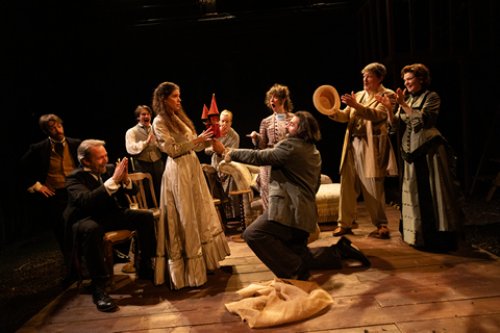
The Company of the New American Ensemble revival of Anton Chekhov’s “Ivanov” at the West End Theatre (Photo credit: Bronwen Sharp)
Around him, the audience gathers, making their pre-show sounds, against his stillness. The company assembles as well, already a community, already complicit. It is a tableau the production revisits later with quiet insistence, but not innocently; by the time it reappears, it has absorbed the full weight of the intervening action. What first registered as stark composition returns altered, freighted with memory, its surfaces no longer neutral but marked—almost bruised—by what has transpired. The image does not repeat so much as accumulate, gathering meaning until it becomes less a picture than a reckoning.
Basile’s scenic design is as unflinching as it is oppressive. She carves two passageways through the audience and thrusts the stage into their midst, collapsing any pretense of distance. The dead tree dominates, its pale trunk both skeletal and obscene, its roots exposed like nerves. The wooden platform and staircase seem less constructed than unearthed, relics already halfway to ruin. The space closes in on itself. There is no escape route that is not also an entrance. The tree becomes the production’s central metaphor: grotesque, hypnotic, and impossible to ignore. It is at once natural and violently displaced, a monument to something severed. The ropes that suspend it suggest a world held together by strain alone. Everything here is bound, constrained, awaiting collapse.
Adeline Santello’s costumes strip away period ornamentation in favor of something more revealing: again constraint. Clothes hang too loose or cling too tightly, bodies misfitted to their social skins. Earth tones dominate, as if everyone has already begun their return to dust. Anna’s cross glints not as faith but as burden; this is what is left after turning away from her own faith for a man that can no longer bear to look at her. These are garments that confine rather than express, uniforms for lives already narrowing.
Sarah Woods’ lighting renders the space with painterly precision, casting Ivanov in a dim, otherworldly glow that feels less like illumination than diagnosis. Later, a fireworks sequence explodes across the ceiling in a synthesis of light and sound so startling we are mesmerized by the fact that we are actually indoors. Stan Mathabane’s sound design opens with a solitary piano that feels liturgical in its gravity. When an owl calls from above—a folkloric harbinger of both wisdom and death—the moment lands first as absurdity, then as dread.
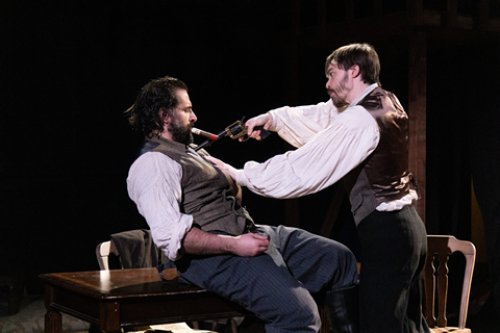
Mike Labbadia as Misha Borkin and Zachary Desmond as Ivanov in a scene from the New American Ensemble revival of Anton Chekhov’s “Ivanov” at the West End Theatre (Photo credit: Bronwen Sharp)
Paul Schmidt’s translation proves invaluable. The language arrives not as literary artifact but as living speech, sharp and unguarded. When cruelty surfaces—and it does, frequently—it lands without cushioning. You do not observe it; you flinch.
DeFilippis deploys direct address with unnerving precision. Characters turn outward, not in theatrical aside but in genuine appeal. We are the community they cannot escape. We are the witnesses who will not intervene. Lambert Tamin’s Lvov pleads silently for action; Zachary Desmond’s Ivanov wields the audience like an accomplice. The effect is cumulative and damning.
What emerges is not merely a portrait of a man but of a system that produces him. Chekhov’s “superfluous man” becomes here something more insidious: the inevitable byproduct of a structure that grants power without purpose. The men are not aberrations but outcomes. Their failures radiate outward, absorbed disproportionately by the women who endure them.
Ivanov, who fancies himself a latter-day Hamlet, mistakes that prince’s paralysis for purposelessness—a telling misreading. Where Hamlet is propelled, however fitfully, by inquiry, disgust, and, eventually, revenge, Ivanov is propelled by nothing at all. He is not stalled so much as emptied. In Chekhov’s design, he is a man who has mistaken self-awareness for depth, and exhaustion for tragedy. His wife, Anna—Jewish, estranged from her family, and dying of tuberculosis—asks almost nothing of him beyond presence. Stay home. Sit beside me. He refuses. Not out of cruelty exactly, nor even indifference, but because proximity itself has become intolerable: to her, to his circle, to his own interior life. He articulates this with a kind of weary insistence, as if repetition might lend coherence to a feeling that resists explanation. The question hovers: why is everything—every person, every obligation, every moment—so unbearable?
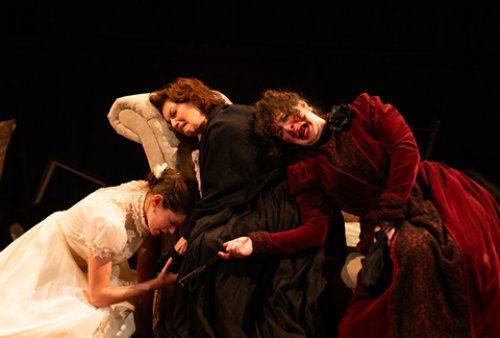
Maya Shoham as Sasha, Mary Bacon as Zinaida and Alexandra Pearlasa Marsha Babakina in a scene from the New American Ensemble revival of Anton Chekhov’s “Ivanov” at the West End Theatre (Photo credit: Bronwen Sharp)
In this production, the answer emerges less through explication than through atmosphere. Ivanov moves within a community that has curdled into grotesquerie, a social ecosystem of minor vanities and major delusions, a parade of figures who tilt, at any given moment, toward caricature. It is, unmistakably, a kind of clown show—though not one that invites uncomplicated laughter. The people around him, himself included, have long since crossed the line from comic to corrosive. What alienates Ivanov, then, is not principally the moral or political rot that critics so often locate in Chekhov, but something more amorphous and, in its way, more devastating: ennui of a particularly virulent strain. The world has not betrayed him; it has bored him past the point of recovery. That boredom metastasizes into revulsion, and revulsion into withdrawal, until even the possibility of connection feels like an imposition. The tragedy is not that Ivanov suffers greatly, but that he cannot locate a reason to suffer at all—and so inflicts that vacancy on everyone around him.
Alcohol flows freely, and with it comes both comedy and revelation. The drunkenness is not stylized but embodied—messy, unvarnished, painfully familiar. Laughter erupts, then curdles. What is medicated becomes clear: despair, resentment, a creeping sense of obsolescence. The humor is recognition; the tragedy is its accuracy.
Quinn Jackson’s Anna Petrovna Ivanova is incandescent in her hope, carrying it like a fragile lantern until it gutters. Her eventual collapse is not sudden but earned, the culmination of a faith stretched beyond endurance. When it breaks, it does so with a rawness that feels almost indecent to witness.
Desmond’s Ivanov is equally compelling: charming, evasive, and fatally convinced of his own exceptionality. He resists easy categorization—monster, victim, fraud—and the performance wisely refuses to resolve the ambiguity. His unraveling is both inevitable and mystifying, a slow-motion catastrophe he cannot—or will not—halt.
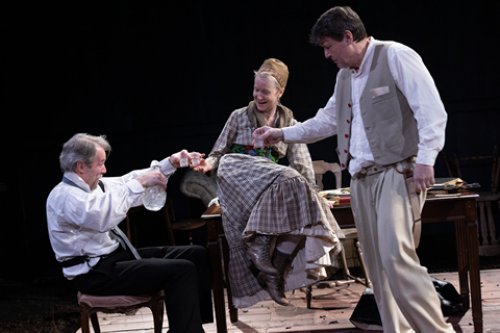
Paul Niebanck as Pavel Lebedev, Maude Mitchell as Avdotya Nazarovna and Ilia Volok as Count Maley Shabelsky in a scene from the New American Ensemble revival of Anton Chekhov’s “Ivanov” at the West End Theatre (Photo credit: Bronwen Sharp)
Throughout, a subtle choreography of avoidance emerges: characters recoil from touch, from proximity, from one another. Human contact becomes fraught, almost unbearable. Only Borkin, played with oily charisma by Mike Labbadia, seems immune, his physical ease masking a predatory instinct. There is an ever-so-tender performance by Maya Shoham as Sasha, Ivanov’s devoted—and perhaps deluded—would-be redeemer. Shoham locates, with exquisite care, the fragile line between youthful conviction and emotional self-deception. Her Sasha loves not wisely but with a kind of luminous insistence, clinging to the belief that feeling deeply is itself a form of salvation. What makes the performance so affecting is its refusal to condescend to that belief. Shoham plays her not as naïve, but as brave in the particular, perilous way that only the young can be—staking everything on a man who has already begun to disappear.
Tamin’s Dr. Lvov provides the production’s moral center, though “center” may be too stable a term for a figure so acutely isolated. His clarity reads as both strength and burden, his presence a reminder of truths the others cannot afford to acknowledge.
Ilia Volok’s Count Shabelsky, by contrast, drifts between pathos and absurdity, a relic of a class already extinct yet somehow lingering. Mary Bacon’s Zinaida and Paul Niebanck’s Lebedev sketch a marriage equal parts comedy and quiet despair, their rhythms alternating between farce and something more unsettling. Alexandra Pearl’s Martha reveals, through the smallest physical shifts, a loneliness and ambition Borkin exploits, as she slowly realizes she has mistaken attention for love and entered a courtship already turning against her. Maude Mitchell’s Avdotya surveys the room with vinegary clarity, her thin veneer of warmth barely masking a sour, incisive judgment that proves the sharpest understanding of anyone onstage. Casey Worthington’s Ksoykh is irredeemably oblivious, so consumed by a lost card hand that the world’s collapse barely registers as more than an inconvenience.
In a striking departure, the production stages Ivanov’s death in full view. It is abrupt, grotesque, and impossible to aestheticize. The audience, implicated from the start, cannot look away. Nor, crucially, are we allowed release. The final image returns us to the beginning: the company gathered, Ivanov once more suspended in bewildered stillness. But the light has shifted, bruised and suffocating. Everything is the same, or rather nothing really is.
Ilia Volok as Count Malvey Shabelsky, Alexandra Pearl as Martha Babakina, Mike Labbadia as Misha Borkin and Mary Bacon as Zinaida in a scene from the New American Ensemble revival of Anton Chekhov’s “Ivanov” at the West End Theatre (Photo credit: Bronwen Sharp)
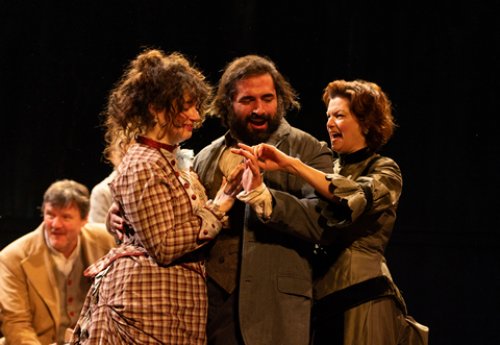
Ilia Volok as Count Malvey Shabelsky, Alexandra Pearl as Martha Babakina, Mike Labbadia as Misha Borkin and Mary Bacon as Zinaida in a scene from the New American Ensemble revival of Anton Chekhov’s “Ivanov” at the West End Theatre (Photo credit: Bronwen Sharp)
New American Ensemble may be young, but this production announces a company of rare precision and ambition. Every element—the mulch underfoot, the bar at your shoulder, the dead tree overhead—feels deliberate, considered, necessary. In a theatrical landscape often defined by haste, such care is not merely admirable. This true theatre company in every sense of the word is most welcome and we look forward to productions in their future.
Ivanov (extended through April 12, 2026)
New American Ensemble
West End Theatre, 263 West 86th Street, in Manhattan
For tickets, visit www.newamericanensemble.org
Running time: two hours and 45 minutes with one intermission


Thank you so much for your detailed review! It is wonderful when a viewer is able to analyze a production with such depth and sensitivity.
Thank you, Shari. This review was a labor of love. I feel very strongly about someone wanting to start a repertory company in this current artistic and political climate. NYC hasn’t had such a company since Pearl and Jean Cocteau Rep ceased operations. New American Ensemble is a welcome addition to the NYC theater scene and I eagerly await their next production.