
Touch
A burned-out 5th-grade teacher is shaken by a chance meeting with a former student, spiraling into anxiety, regret, and desire—a reckoning with consequences.
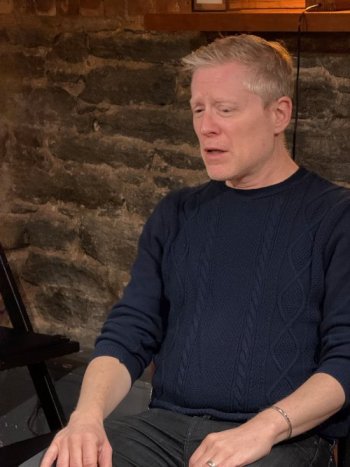
Anthony Rapp in Kenny Finkle’s “Touch” at The East Village Basement (Photo credit: Table 7 Strategies/Kevin Kulp)
In Touch, a work of disarming modesty and unnerving emotional precision, a life that has been carefully tamped down begins, almost imperceptibly, to leak. The play, written by Kenny Finkle, sensitively directed by Jonathan Silverstein, and performed with aching lucidity by Anthony Rapp, takes as its subject a man whose disappointments have calcified into habit, and whose sense of self—once animated by artistic ambition—has settled into something quieter, if no less fraught.
There is, at first glance, something almost perversely austere about Touch: Rapp, seated for 90 uninterrupted minutes, inhabiting the brittle interiority of a middle-aged gay man whose emotional register oscillates between panic, irritation, and quiet devastation. And yet the experience proves not merely engaging, but quietly transfixing. Its modesty is its method, its intimacy, its force.
The production unfolds in the aptly named East Village Basement, a year-old space that resembles a brick-walled living room stripped to its bones—no couch, little ornament, books mostly providing only the suggestion of habitation. One descends to it with a certain trepidation, down a narrow, metallic staircase that is less an entrance than an initiation. Inside, an audience of no more than forty gathers in close orbit around Rapp, the proximity so immediate that the usual buffers between performer and spectators dissolve. One does not watch Touch so much as share oxygen with it.
Rapp’s Syd Blatter is a former writer, or perhaps more precisely, a man who still thinks of himself in relation to the writer he failed to become. Now teaching fifth grade, he has constructed a life defined by modest routines and carefully observed boundaries, a structure that seems less chosen than conceded. This fragile equilibrium is upended by a chance encounter with a former student—an interruption that functions less as inciting incident than as emotional detonator.
What follows is not a conventional narrative but a slow, recursive unspooling. Syd circles his past rather than confronting it head-on, his recollections arriving in fragments colored by anxiety, self-justification, and a persistent, unarticulated longing. The play traces the uneasy intersections of regret and desire, where memory becomes both refuge and accusation. Author Finkle is particularly attuned to the ways in which intimacy—especially the kind that crosses generational and professional lines—can blur into something ethically precarious, even when no explicit transgression is named.
The result is a portrait of a man caught in the undertow of his own history, grappling with the consequences of connections that resist tidy moral accounting. Personal failure here is not melodramatic but ambient, a low-grade condition that permeates Syd’s sense of self. And yet, the play resists judgment. Instead, it offers something more unsettling: an insistence on the persistence of feeling, on the way certain encounters—fleeting, ambiguous, perhaps even inappropriate—can reverberate across years, shaping a life in ways both intimate and irrevocable.
In its quiet way, Touch becomes a meditation on the durability of human connection and the uneasy knowledge that some actions, once set in motion, cannot be fully contained or undone.
The play, written with exquisite observational acuity by Finkle, begins in the most New York of predicaments: a panic attack on a crowded subway car. Syd—Rapp’s character and our guide through this delicately fractured narrative—describes, with almost Chekhovian specificity, the seasonal confusion of outerwear and the claustrophobia of public transit: overdressed, overheated, immobilized, unable even to reach the water at his feet. It is a minor crisis rendered monumental through the precision of its telling, a reminder that the city’s daily discomforts are often the gateways to more existential unease. It is disclosed almost parenthetically—an afterthought smuggled in under the guise of anecdote—that in his frantic bid for air, for escape, for the mere restoration of equilibrium, he has abandoned what one would in this day and age refer to as their “lifeline”: the bag containing the small but essential proofs of existence in a city like this—wallet, identification, phone, credit cards, cash—left behind on the departing train, receding into the tunnel with a quiet, devastating finality.
From this opening vignette, the play expands—not outward, exactly, but inward. A chance encounter on that street with a former student, Julissa Rodriguez, becomes the hinge upon which the narrative turns. Her recognition—“Mr. Syd?”—is both comic and destabilizing, tethering him to a past he has neither fully escaped nor meaningfully transcended. “You remember Joseph Gonzalez?..Joseph’s a queer now. Well you know he was always one…Oh, snap I’m just connecting that you’re probably a queer too, right? Oh but I have to tell Joseph.” Through her, we are introduced or reintroduced to Joseph, another former student, now an aspiring writer. Syd, too, once harbored such ambitions; the symmetry is not lost on him, nor on us.
What follows is less a linear narrative than a carefully modulated act of revelation. Finkle parcels out information with a sleight of hand that feels at once casual and exacting, as though Syd himself were uncertain which details merit emphasis and which might be safely elided. The pleasure lies in this very withholding—in the way expectations are gently raised, then quietly subverted. The play resists the gravitational pull of more obvious dramatic trajectories, choosing instead a subtler, more oblique path. If its resolution arrives with a touch too much neatness, one senses this is less a failure of imagination than a concession to form; the emotional truths uncovered along the way remain stubbornly, productively unresolved.
It is, ultimately, Rapp’s honest performance that anchors the evening. At such close range, there is no room for artifice, and he offers none. His Syd is a man of thwarted potential and lingering grievance, his disappointments worn not as badges but as barely concealed bruises. And yet, in the act of recounting—of reaching, however tentatively, toward connection—he becomes unexpectedly expansive. The paradox of Touch is that in charting a life constricted by regret, it achieves a kind of emotional weight rare in contemporary theater.
In a production so rigorously committed to restraint, one might be tempted—mistakenly—to overlook the contributions of its designers, whose work operates with a discretion that borders on invisibility. Yet the cumulative effect of the design elements in Touch is anything but negligible. Rather, it is precisely through their refusal to call attention to themselves that they achieve a kind of aesthetic coherence, an atmosphere attuned to the play’s quiet devastations.
The scenic and props design by Thomas Jenkeleit offers just enough of a world to anchor Syd’s recollections without ever over-determining them; the space feels less constructed than gently suggested, as though memory itself had furnished the room. Bart Fasbender’s work is similarly restrained, threading the evening with a sonic texture so subtle it is almost subliminal, yet essential in shaping the play’s emotional undercurrents. The costume design by Jennifer Paar locate Syd with quiet precision—neither exaggerated nor symbolic, but entirely lived-in—while the lighting design by Hayley Garcia Parnell modulates the space with a delicacy that borders on the imperceptible, guiding the audience through shifts in time and feeling without ever announcing the transition.
Together, these elements form a kind of negative space around Finkle’s writing, a collective act of design that privileges absence over assertion. In doing so, they honor the play’s central aesthetic: that what is most haunting is often what is least adorned.
One leaves the East Village Basement not with the sense of having witnessed a grand production, but of having been entrusted with something smaller and more fragile: the contours of a life that, in all its disappointments, insists on being felt.
Touch (through March 29, 2026)
The East Village Basement, 321 East 9th Street, in Manhattan
For tickets, visit www.todaytix.com
Running time: 90 minutes without an intermission


Leave a comment