
A Midsummer Night’s Dream (Smoking Mirror Theatre Company)
A magical, richly performed Shakespearean revival that balances the uproarious comedy, romantic enchantment, and deliciously dark theatrical mystery.
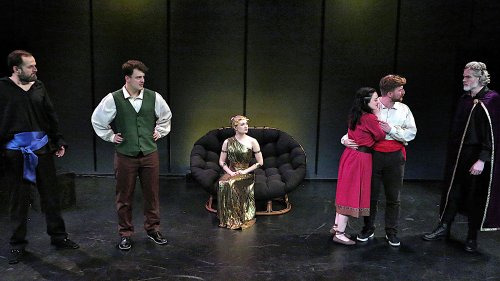
Anthony Savage Thorn as Egeus, Kaleb Baker as Demetrius, Catherin Desciak as Hippolyta, Isabel Criado as Hermia, Aaron Cirillo as Lysander and James Mackey as Theseus in a scene from Smoking Mirror Theatre Company’s production of Shakespeare’s “A Midsummer Night’s Dream” at A.R.T./New York Theatres (Photo credit: Jonathan Slaff)
At A.R.T./New York Theatres, Smoking Mirror Theatre Company’s production of Shakespeare’s A Midsummer Night’s Dream, running through September 13th, offers the kind of theatrical escape that the play itself promises: a passage from the ordinary world into a place where logic loosens its grip, desire becomes unstable, and the boundary between comedy and nightmare grows deliciously thin. Co-directors John Gordon and Ruby Rich gift us a faithful restaging that conveys the fun and magic of Shakespeare’s original text while adding just enough distinctive flourishes to make a familiar work feel freshly discovered.
It helps that A Midsummer Night’s Dream is among Shakespeare’s strongest comedies. Its plot may be famously convoluted, but the writing is remarkably clear. Shakespeare divides the action among three overlapping worlds: a pair of royal lovers whose affections are anything but settled, a troupe of blue-collar amateur actors attempting to mount a play celebrating the marriage of Theseus and Hippolyta, and the imperious fairy court presided over by Oberon and Titania. Over the course of one long, enchanted night in the forest, these worlds collide. Love potions, magical transformations, mistaken identities, romantic betrayals, and theatrical incompetence become the ingredients for a comedy that can be as uproarious as it is uncanny, with the mischievous sprite Puck serving as its gleeful agent of chaos.
What makes the play endure is precisely this strange tonal doubleness. Shakespeare can move from the broadest physical comedy—the immortal business of an actor playing a wall—to something much darker and more psychologically suggestive. The forest is a playground, but it is also a place where the civilized rules of Athens dissolve, where desire can become irrational and frightening, and where people discover impulses they might prefer to keep buried. Smoking Mirror understands this mixture of humor and danger. The production never allows the comedy to become merely frivolous; lurking beneath the laughter is the sense that the night could turn in almost any direction.
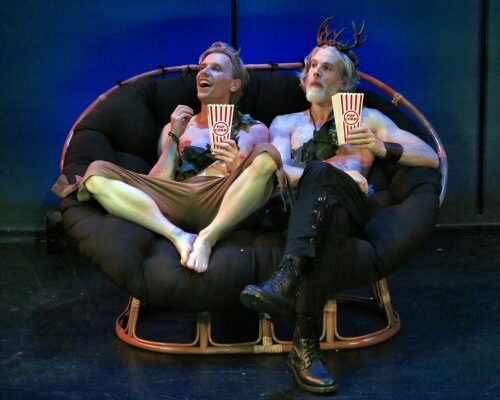
Martin Challinor as Puck and James Mackey as Oberon in a scene from Smoking Mirror Theatre Company’s production of Shakespeare’s “A Midsummer Night’s Dream” at A.R.T./New York Theatres (Photo credit: Jonathan Slaff)
The cast is particularly adept at sustaining that balance. From the opening moments, James Mackey establishes the production’s commanding theatrical presence as Theseus, Duke of Athens, opposite Catherin Desciak as Hippolyta, Queen of the Amazons. Their impending marriage is interrupted by Egeus (Anthony Savage Thorn), who demands that Theseus intervene in his daughter Hermia’s refusal to marry the man he has chosen for her. It is an appropriately orderly beginning to a play that will soon abandon order altogether. Mackey later doubles as Oberon, King of the Fairies, and the contrast between his two worlds is striking. Tall, athletic, handsome, and possessed of long gray hair, he brings a sensuality to Oberon that is not always foregrounded in productions of Midsummer. There is something almost dangerous in his physical presence, an impression that the fairy king is not merely mischievous but genuinely capable of disrupting the human world. Mackey also composes some of the production’s music and shoulders a substantial portion of its dramatic architecture with considerable assurance.
Martin Challinor’s Puck provides the production with its essential connective tissue. Challinor understands that Puck should be more than a cute supernatural troublemaker: he is the mechanism by which the play’s carefully arranged reality comes undone. His performance possesses both enchantment and an edge of menace, allowing Puck to seem at once playful, elusive, and faintly dangerous. There is a glint in the performance that suggests that the havoc being created is not necessarily malicious—but neither is it entirely innocent.
Abdullah Nasser gives Nick Bottom an especially appealing interpretation, resisting the temptation to play Shakespeare’s famously self-important amateur actor as nothing more than an ass. Nasser finds the recognizable human motivation beneath Bottom’s vanity: this is a man who desperately wants to be seen, admired, and taken seriously. His confidence is absurd, but his need for an audience is not. The other Mechanicals—Thorn as Peter Quince, the carpenter; Robert Daniels as Francis Flute, the bellows-mender; Rosalind Joyce as Tom Snout, the tinker; Samuel Andrews as Snug, the joiner; and Caroline Feduccia as Robin Starveling, the tailor—respond to Bottom with the exasperated disbelief of people who have clearly encountered this particular appetite for the spotlight before. Their collective dynamic makes the Mechanicals feel less like a collection of comic types than a group of working people who have somehow agreed to indulge one man’s conviction that he is destined for a one-man show.
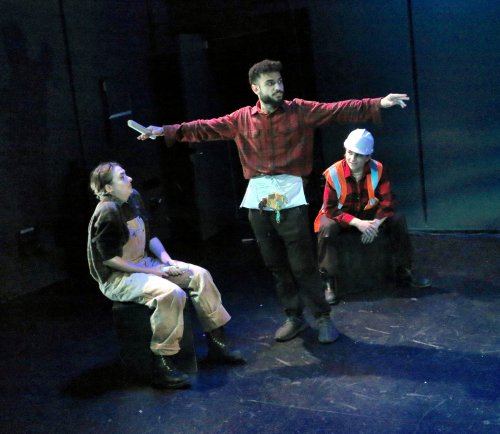
Rosalind Joyce as Snout, Abdullah Nasser as Bottom and Samuel Andrews as Snug in a scene from Smoking Mirror Theatre Company’s production of Shakespeare’s “A Midsummer Night’s Dream” at A.R.T./New York Theatres (Photo credit: Jonathan Slaff)
The four lovers—Isabel Criado as Hermia, Aaron Cirillo as Lysander, Julianne Lorndale as Helena, and Kaleb Baker as Demetrius—are equally successful in navigating Shakespeare’s deliberately absurd romantic geometry. The performers embrace the instability created by Puck’s interventions without losing sight of the emotional stakes underneath the confusion. As affections ricochet from one character to another, they manage to make the lovers’ bewilderment genuinely funny while keeping us invested in the hope that, once the magical dust settles, the correct pairings will somehow emerge.
The production’s visual and aural elements deepen its dreamlike atmosphere without overwhelming the performers. Co-directors Gordon and Rich, who also plays Titania, Queen of the Fairies, approach the material with an affectionate understanding of its theatrical possibilities, creating spectacle without turning the production into a contest between actors and scenery. Judy Fowler’s choreography contributes an ethereal quality, giving the fairy world a physical vocabulary that feels distinct from the more grounded human characters. Nicole Blodig’s lighting is similarly responsive to the play’s constant changes in temperament, moving comfortably between comedy, romance, mystery, and menace.
Janet Holmes and Ruby Rich’s costumes wisely resist locating the production too precisely in any particular historical period. They simply seem right for this elastic world, where the contemporary and the fantastical can coexist without explanation. The music, directed by Cam Gray, is particularly effective in expanding the production’s sense of enchantment. When Titania is surrounded by her fairy attendants—Feduccia as Cobweb, Andrews as Mote, Joyce as Peaseblossom, and Desciak as Mustardseed—the musical dimension becomes especially lovely, with the performers singing beautifully while several members of the company double as game and capable musicians. The sound of the ensemble gives the fairy kingdom an atmosphere of its own, making it feel less like an ornamental backdrop than an alternate realm.
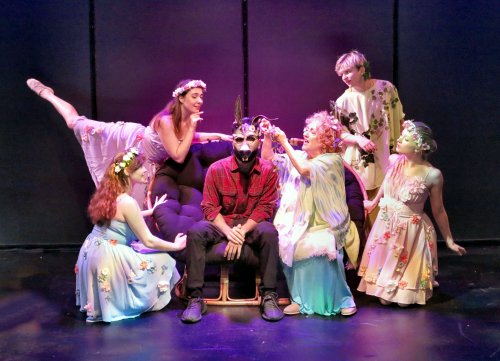
Caroline Feduccia as Cobweb, Rosalind Joyce as Peaseblossom, Abdulah Nasser as Bottom, Ruby Rich as Titania, Samuel Andrews as Mote and Catherin Desciak as Mustardseed in a scene from Smoking Mirror Theatre Company’s production of Shakespeare’s “A Midsummer Night’s Dream” at A.R.T./New York Theatres (Photo credit: Jonathan Slaff)
The staging itself is refreshingly economical. An oversized Papasan chair settee becomes the perfect resting place for a Bottom transformed into an ass and stretched out in blissful oblivion, while a scattering of black boxes suggests places to sit or rest within the forest. These modest choices accomplish exactly what they need to: they establish the world the characters move in. The production understands that A Midsummer Night’s Dream already contains its own special effects. What matters is giving Shakespeare’s language, the performers, the movement, the music, and the audience’s imagination enough room to work.
The result is a production that honors the text without treating Shakespeare as a museum piece. Smoking Mirror Theatre Company finds the comedy, but also the unease; the romance, but also its irrationality; the spectacle, but also the intimate human foolishness underneath it. A Midsummer Night’s Dream is, after all, a play about what happens when the familiar world disappears for a night and people discover how little control they actually have over themselves. This production understands that the best way to make Shakespeare feel fresh is not to force novelty upon him, but to trust the peculiar magic that is already there.
A Midsummer Night’s Dream (through September 13, 2026)
Smoking Mirror Theatre
Jeffrey and Paula Gural Theatre at A.R.T./New York Theatres, 502 West 53rd Street, in Manhattan
For tickets, visit www.midsummernightsdreamnyc.eventbrite.com
Running time: two hours and 30 minutes including one intermission


Leave a comment