News Ticker
- November 5, 2026 in Off-Broadway Plays // The Morbs
- November 5, 2026 in Off-Broadway Plays // Livia
- November 4, 2026 in Features // Abingdon Theatre Company Celebrates 34 Years of Opening Doors
- November 2, 2026 in Event Listings // This Week at TheaterScene: November 2–15, 2026
- November 2, 2026 in Spotlight // Jerry Herman (1931–2019): The Best of Times, From Our Seats
- November 1, 2026 in Off-Broadway Plays // The Kick Inside
- October 31, 2026 in Musicals // Copperfield! The New Musical
- October 31, 2026 in Spotlight // Terrence McNally (1938–2020): Theater Changes Hearts
- October 31, 2026 in Broadway Plays // 860
- October 30, 2026 in Features // This Week at TheaterScene: November 2–8, 2026
- October 30, 2026 in Off-Broadway Plays // A Ghost in Your Ear
- October 28, 2026 in Concerts // The New York Pops: “007: James Bond Forever”
- October 27, 2026 in Music // Queeney Todd: The Demon Bottom of Fleet Street
- October 27, 2026 in Broadway Plays // Other Desert Cities
- October 27, 2026 in Spotlight // Stephen Sondheim (1930–2021): The Last Giant, Seen From Our Seats
- October 26, 2026 in Spotlight // Duncan Sheik (1969–2026): The Sound of Spring Awakening
- October 26, 2026 in Spotlight // Anna Louizos Tribute
- October 25, 2026 in Off-Broadway Plays // Degenerates
- October 25, 2026 in Musicals // Slam Frank
- October 24, 2026 in Off-Broadway Plays // The Ask
- October 23, 2026 in Off-Broadway Plays // The Bald Soprano
- October 23, 2026 in Off-Broadway Plays // Phyl
- October 22, 2026 in Off-Broadway Plays // Machine Learning
- October 21, 2026 in Off-Broadway Plays // King of the Yees
- October 19, 2026 in Off-Broadway Plays // Good Time Charlie
- October 16, 2026 in Off-Broadway Plays // Night of January 16th
- October 16, 2026 in Off-Broadway Plays // Fish
- October 15, 2026 in Musicals // Midnight
- October 14, 2026 in Off-Broadway Plays // Kramer/Fauci
- October 11, 2026 in Musicals // Soon
- October 11, 2026 in Off-Broadway Plays // Burning Leaves
- October 4, 2026 in Broadway Plays // School Girls; Or, The African Mean Girls Play
- September 30, 2026 in Musicals // Our Sinatra
- September 29, 2026 in Off-Broadway Plays // Crazy Mama: A True Story of Love and Madness
Archive
Director Jared Mezzocchi uses the proximity of the actors to the audience to its best advantage. We don’t even question when one of our ranks is pulled out to play Young Sunny. It adds to the sense of community that is the cornerstone of this production. Kudos to Mezzocchi and the four actors in intuitively divining who in the audience is most right for participation. As the play dashes back and forth in time, the actors are kept moving, narrating as they go along. Again physical life clearly dictates whether they are in character or in narration mode. Mezzocchi incorporates projection design to complement the telling of the history of the ever-changing neighborhood. It provides a welcome steady stream of point-of-reference when one considers the land was once dry tundra in the shadow of a glacier twice the height of the Empire State Building.
[more]
For decades under James Morgan’s leadership, the York Theatre Company has occupied a unique spot in New York’s theater world—celebrating musical-theater, past, present, and future. Theater companies would come and go, but the York was always there, its presentations informed by Morgan’s knowledge of—and passion for—musicals.
[more]
Welcome to 'Lakeplay," a character study-play written by Drew Valins and directed by Hamilton Clancy. It is billed as “a terrifying adventure” but does not live up to that description. There are moments of suspense, but not terror-filled. If being frightened by a story is what you are looking for, this is not the show for you. The show is more of a work in progress with issues relating to the venue, sets, and unevenness of some of the scenes.
[more]
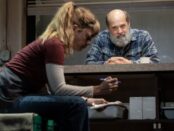
Despite this obvious shortcoming of The Counter, Anthony Edwards, a growing New York stage presence after much TV and movie fame, resolutely ignores it, never letting Kennedy's contrived writing come between him and the character (as a frustrated fan of ER, I've seen this steadfastness before). The scraggly bearded Edwards portrays Paul, a retired firefighter from far upstate New York whose geniality occasionally gives way to pronouncements about the monotony of his remaining days and the unfairness of his former ones. Although these gnawing thoughts are "secrets," he shares them with Katie (Susannah Flood), a fairly new transplant to the area who is also a waitress in the diner he frequents when nobody else is around. That's essential for Kennedy's ludicrous plot, because Paul's inner turmoil manifests itself in a grave request for Katie to do something that, if overheard, would cause any sentient adult to immediately contact the authorities, resulting in the play ending not too long after it begins, unless Kennedy felt like keeping the story going through a depiction of Paul's psychiatric treatments.
[more]
The problem with the show is two-fold: first, it doesn’t have anything new to say about dating other than trying to turn it into a cabaret commentary, and visually the show looks the same throughout with the staging having Lucy sit at the same place at the table and the 16 men (all played by the versatile Taylor Crousore) sitting or standing opposite her. None of his men are allowed to be charming or ingratiating, not only showing the negative side of modern dating, but making a great deal of this one-act musical feel too much the same.
[more]
We’ve come a long way from "Annie Get Your Gun" to the new musical "Distant Thunder" produced by Amas Musical Theatre at the A.R.T./New York Theatres. The Irvin Berlin song “I’m an Indian, Too” from "Annie" is filled with silly clichés about our indigenous people that "Distant Thunder" puts to rest. "Distant Thunder," written by Lynne Taylor-Corbett and Shaun Taylor-Corbett (book) and Shaun Taylor-Corbett and Chris Wiseman (music and lyrics), (with additional music and lyrics by Robert Lindsey-Nassif and Michael Moricz,) deals sensitively with issues facing Native Americans today. All of the actors are members or descendants of Native Americans and all give body and soul to their characters.
[more]
Gabriel Kahane’s pair of song cycles are a welcome throwback to when lyrics were poetry and told great stories. Think of the 70's when the airwaves were blessed with the voices and songwriting of Harry Chapin, Joni Mitchell and Cat Stevens and you will have a basic understanding of what Kahane has successfully put together here.
[more]
Barry Primus’ "Soup in the Second Act" is described in press materials as a "dramatic comedy" but it's more drama than comedy. The humor comes from old-fashioned actor jokes such as this one: "Two actors bump into each other on Times Square. 'God, where have you been? I haven't seen you in such a long time.' 'I'm doing a one man play all over the country.' So the other says, 'That's great. That's great. Anything in it for me?'" If you like that sort of thing, you'll enjoy "Soup in the Second Act" (which is itself the punchline for another actor joke).
[more]
Krzysztof Knapczyk, who has performed in countries such as Greece, Germany, and the U.S., aims to expand the Pop Opera project to American and international audiences. "Performing in New York was a huge step for me," he says. "Now, I want to bring this concept to stages all over the world—bridging the gap between opera, pop, and musicals in a fresh and exciting way."
[more]
While the play is compelling, the question is what is the message? Is the play asking would we have done what the son did? The father is quoted by the son as calling him a traitor while the son defends his action as that of a patriot who was appalled by his father’s attacking the Capitol. The play is, to a great extent, preaching to the converted as only people who consider what happened on January 6th an insurrection would attend the play, while MAGA proponents will not view it that way. The ending is somewhat predictable though the twists and turns of the story do not always take the expected path.
[more]

"Dickhead," written by Gil Kofman and directed by Richard Caliban, is a story about the patriarch of a dysfunctional family in the midst of a near-total disintegration. The action is centered on Richard (Ezra Barnes), an abrasive, abusive lawyer who is rightly called “a dick” by his wife and just about everyone who interacts with him. He is also called Dick, as a nickname for Richard. The only time he is called "Dickhead" is midway through the action, in a maybe friendly comment by his oldest friend Howard who is given a solid portrayal by Chuck Montgomery. In the opening scene, Richard is in the office of his therapist Dr. Adams (Frank Licato) on a cell phone call with a tech support person at the internet company. This action provides a portrait of Richard’s personality: nasty, abrasive, ego-centric; a real dick. It also indicates that things are not going well in Richard's home life and job. Barnes' performance is well-tuned to the character, although, at times, getting close to being too much of a dick. Licato effectively embodies the therapist who is not as balanced as he appears to be in the opening. Licato gives a good performance of another character late in the play, the doctor’s wife.
[more]
The final work of the evening was Takehiro Ueyama’s “Heroes,” dedicated to the brave, hard-working citizens of Japan who helped pull themselves out of the devastation of World War Two. Set to darkly emotional music by Kato Hideki and Ana Milosavljevic (played live) and a recording of John Adams’ moody, but energetic “The Chairman Dances – Foxtrot for Orchestra,” “Heroes” was filled with a wide range of emotions beginning with a long duet, a portrait of a deeply emotionally involved couple who, heartbreakingly, wind up parting, Ueyama’s choreography skillfully, but subtly illuminating a wealth of emotions.
[more]

The spate of Sondheim shows both this past season and opening this fall is given prime place in this musical revue. Unsurprisingly, the new "Merrily We Roll Along" which ran all of last season comes in for the most ribbing as the subtitle hints. Collins-Pisano plays Daniel Radcliffe in a parody of the show’s “Good Thing Going” and then is joined by Stern and Hayward as his co-stars Lindsay Mendez and Jonathan Groff as they review the troubled history of the show which famously flopped in its first Broadway iteration in 1981 in a revised version of the song “Old Friends.” Collins-Pisano sings to that show’s “Franklin Sheppard, Inc.” about Radcliffe's stage career after the Harry Potter films. This is followed by a tribute to "Company" which had a female Bobby to the tune of “Bobby, come on over for dinner.” Most if not all of the "Forbidden Broadway" revues have featured one of its actresses as the ubiquitous Patti LuPone and here we have Stern belting “The Ladies Who Crunch,” the scenery that is, satirizing "Company"’s most famous song.
[more]
Four hardened male plainclothes police officers are being coached for a “suppression hearing” – that is a court proceeding prior to trial to challenge the legality of the evidence taken from the crime, whether it be drugs, statements, or identification. In "The Witness Room," there are two bags of cocaine that were removed from the crime scene, but the sloppiness of the affidavits filed by the four police officers means some “rehearsal” is necessary for all four men to be in agreement on what actually happened months earlier when a man was arrested. This is not as dense as "Rashomon." In place of the exquisite storytelling that offered subjective, alternative and somewhat contradictory versions of the same incident, "The Witness Room" gives us a very real situation where the slightest discrepancy either frees a criminal or sends an innocent person to jail.
[more]
"The Goldberg-Variations" by George Tabori (written in 1991, now having its belated new York premiere) is a confused and confusing conflation of Bible stories and backstage bickering amongst a playwright, his director, designer and actors. Now at the Theater for the New City, the overlong production, directed by Manfred Bormann keeps the audience scratching their heads as each part of the Good Book is explored.
[more]
"Honor," a one-act play, written and superbly directed by T.J. Elliott, explores the conceptual nuances of “honor” within the context of a corporate investigation into a case of harassment and intimidation brought against a corporate executive. It is a clashing of privilege and ego between executives, revealing some ugly truths about corporate management while also dealing with the ambiguities of personality and individual perceptions. The play is short and solidly to the point, and I don’t see how expanding it will add anything to the mix. It is a beautifully executed production and will resonate with anyone with a passing familiarity of executive corporate culture.
[more]
Quintero who obviously knows his Greek plays and Greek mythology is extremely faithful to the original myth and to Euripides’ play. What he has added is a contemporary vernacular all in rhyme, music played by two guitars and a beatbox, and the odes of the chorus presented as song. This gives the 2,500 year old story a modern sensibility, often lacking in productions of Greek tragedy. Although Quintero has had a career as an actor, particular at the Hudson Valley Shakespeare Festival the last five summers, what is most remarkable is that this is his first work for the theater, both as playwright and composer. Medea Re-Versed looks and sounds like the work of an experienced dramatist of many years standing.
[more]
If, to paraphrase Mark Twain, a liar's greatest enemy is laughter, then the new musical comedy "Ghost of John McCain" is certainly no friend of Donald Trump. It's also not a hagiography of the late Arizona senator and famed prisoner of war who, after dying in 2018, is condemned for his own political shortcomings to another captivity, this time in Donald Trump's warped subconsciousness. When the show sticks to this satirically low-brow conceit, it rollicks along humorously, thanks in no small part to a nimble cast unafraid of being supremely silly. But Ghost of John McCain also has an off-putting penchant for strained seriousness, as if losing faith in the power Twain proclaimed.
[more]
However, in the sweeping new musical epic retitled Monte Cristo, canny and adept librettist Peter Kellogg ("Desperate Measures," "Penelope") has streamlined the story, reduced the number of characters and created a much less melodramatic ending that is more satisfying than the original while still covering 20 years in the lives of its characters. The score by Stephen Weiner, who collaborated with Kellogg on "Penelope," an entertaining musical version of Homer’s The Odyssey, has written a lush, romantic score which in every way complements the grand storytelling of love, injustice and revenge. Directed by Peter Flynn as part of The York Theatre Company’s Fall 2024 NEW2NY Series, the production belies the fact that this is a concert version book in hand and that the cast had only four days of rehearsal. It is one of the most accomplished musical productions to be seen currently in NYC.
[more]
There is no program for the event nor a press script, which makes sense, since "The Spirits’ Speakeasy" is less theater and more experience. There are missed opportunities for the actors to move the attendees around so they experience more of what is going on in both rooms. My companion and I thoroughly enjoy catching up with each other, so much so that when Margery finally arrives in the lounge to give a few lackluster readings (based on the billets dropped into the box but presumably not seen by her, and half of the guests names she calls out do not answer anyway) we are unfazed. Finally, Houdini bursts into the room, challenges Margery’s authenticity by calling her a fraud, and insists she participate in a mysterious magic box trick, which was dramatic and fun. All told, although the activities of the evening are infrequent, we do not feel the evening is a disappointment at all.
[more]
While "That Parenting Musical" will not tell you anything you didn’t already know, it is a pleasant and undemanding way to spend an evening. The six attractive performers four of whom appear continually as other characters are good company and keep the show moving. That Parenting Musical is the latest in the series of cabaret style revues around a single theme. It is obvious Graham and Kristina Fuller are fully versed in their subject matter.
[more]
This adaptation, directed by John Hickok, uses the Fitzgerald story as a counterpoint to a tale of a couple caught in the legal vagaries of the United States and Canadian immigration laws. The connection between their experiences at the border and the satirical nature of the Fitzgerald piece does not work even with the addition of musical numbers. It would be better to make a show of the original story without the contemporary border issues thrown into the mix.
[more]
“Larina Waltz,” choreographed by Ashley Page to the lilting melodies of Tchaikovsky, opened the program. It was a dynamic expression of the classical ballet bona fides of this youthful company. Arrayed in a line of five couples, the men in black tunics and the ladies in white tutus, they performed unison partnering showing off the easygoing style that became more evident as the program progressed. Couples peeled off until only one remained, soon replaced by a succession of couples, all of whom performed charming, if not dazzling, turns, lifts and complicated steps, the men leaping and the women showing off balance and grace. This was a charming lagniappe, a gift to warm up the audience’s expectations.
[more]
Of course, with Farrow and LuPone under the direction of six-time Tony Award winner Jack O’Brien, this is an occasion for cheering although this comedy drama, a cross between a female version of "The Odd Couple" and "Breaking Bad" is both predictable and razor thin. However, it is also a scenario for two consummate actresses to strut their stuff. The roles are not a great stretch for either of them – Farrow has often played grown-up waifs and LuPone has often been seen in recent years as a New York sophisticate, but these are the kind of performers that hold your attention at all times, making you afraid to look away and miss anything.
[more]
Under Igor Golyak's hyper-inventive direction the production's form is masterfully daring, ignoring the barriers of past, present, and future, as well as performance and life. Golyak's double disrespect for temporal and fourth-wall distancing is most evident in the actors' frequently unsettling playfulness, including a foreboding sing-a-long with the audience during a pretend Jewish wedding. Smilingly staged by both Catholic and Jewish classmates when such interreligious bonhomie was still possible, the echoes of these characters' younger, imaginative selves continue to linger as some of them mature into monsters, their brutality imbued with an anachronistic childlike quality that strengthens the devastating sense of a lost innocence.
[more]
In this return engagement of the site-specific "The Voices in Your Head" we are often asked to give pause in order to consider how differently we all process our grief. Earlier this summer another play, someone spectacular, tackled the same subject matter but in a more predictable way. With that play, we never forgot we were in a theater watching a support group navigating their weekly session (but for that evening without the benefit of their group leader). While that was presented in thrust staging (the audience surrounding the actors on three sides), The Voices in Your Head created by Grier Mathiot and Billy McEntee welcomes us as new members to the group.
[more]
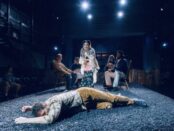
The libretto by the composer and musicologist Walter Simmons is very faithful to the O’Neill play, almost entirely dialogue taken from the original script. Unfortunately, they chose to shorten the text by 25% (as well as cutting the two intermissions) so that the tragedies happen one on top of the other with little time for intense emotional flights. This also dilutes the sense of irony that all the characters are down on their luck. Reducing the cast list by two tightens the play but changing the little daughter to a son and then keeping in the reference to playing with dolls seems inappropriate. Using O’Neill’s original text leaves hardly any room for arias and the opera sounds mostly like recitative set to music. The orchestrations which began with trumpet calls and included triangle and violin solos added to the power of the story. Conductor Christian Capocaccia did fine work with the orchestra but putting them behind the stage affected both the sound and the singers ability to follow them.
[more]
Rebecca Hoodwin, Arielle Flax, Fady Demian, Arielle Beth Klein and Melissa Woolf in a scene from
[more]
While "Counting and Cracking" is an unforgettable epic of a family and a country, it is also a study of the fight for democracy and the lengths people will go to fight for their beliefs. The title comes from Apah’s definition of democracy: “Democracy means the counting of heads, within certain limits, and the cracking of heads beyond those limits.” The play could not be more timely as we go into the last weeks of this fraught election campaign. Counting and Cracking will be one of those evenings in the theater that will become legendary both for its storytelling, its staging and its message.
[more]
"In Search of Elaina" is a story by Kara Ayn Napolitano that digs into the weeds of a remembered past. It explores what happens when the life left behind catches up and crashes into the carefully laid-out landscape of now. Joy Donze skillfully directs a strong ensemble on this journey into the clash of the now with the memory of then.
[more]
Betsy Aidem and Colleen Litchfield in Matthew Freeman’s “The Ask” at the wild project (Photo
[more]
Levin’s lyrics have unusual and surprising rhyme patterns which add to their interest. The powerful score with music by Ron Abel (who also plays a mean piano with the orchestra of five which sounds much bigger than it actually is) is performed by big talent: Lianne Marie Dobbs’ Dominique, Ben Jones’ Michael Boardman, Maya Lagerstam’s Olivia and Allyson Kaye Daniel in a series of roles including that of the Evangelist impress with the size of their voices and their technique. The uncredited orchestrations include violin and bongo solos which add texture to the songs.
[more]
Although meaningful dialogue is written in iambic pentameter, not all text is so structured. There is a skill in delivering lines within the structure of iambic pentameter, but it is equally important that the rhythm of all the dialogue be consistent. The lines must be spoken as if they were a normal speech pattern without paying attention to the structure. Unfortunately, the delivery by the ensemble varies widely, ranging from sounding like a textual reading to a clear, direct delivery to one completely out of character for the words spoken. As a result, the interconnections between the elements of the story are lost, causing a breakdown in clarity.
[more]
However, instead of telling Fleming’s story in chronological order, it travels backwards and forwards in time beginning with Fleming’s Nobel Prize acceptance speech in Stockholm in 1945, then skipping to Athens, Greece, in 1952, then traveling back to New York and London’s St. Mary’s Hospital in 1946, then further back to St. Mary’s lab in 1940, and finally ending Act 1 with Fleming’s discovery of penicillin at St Mary’s in 1928. Not only does all this alternate with the Jess/Aaron story in Edinburgh in the present, it often divides the stage in two and tells both stories simultaneously. There seems to be no gain in telling Fleming’s story out of order, as it makes it confusing and hard to follow, while asking us to keep track of the contemporary story with its permutations and additional characters at the same time.
[more]
The revue alternates between skits by James Hindman and Lynne Halliday and songs with music by Jeffrey Lodin (who is also the music director at the piano) and lyrics by Mark Waldrop, the intrepid director. While the material is diverting and entertaining, it feels derivative rather than original. There appears to have been an attempt to not offend anyone so that everything is rather low key and tame. Some of the tropes though pertinent have already been dramatized: “To You, My Friend,” sung by two women at a college reunion, resembles but feels like a pale imitation of Jerry Herman’s “Bosom Buddies” while “Gonna Get the Band Together” suggests the 2018 Broadway musical with a similar name. “Reunion” in which two old friends reminisce has too much the feel of a "Saturday Night Live" skit.
[more]
"Hurricane Season" is the sort of vanity production in which one assumes that the author thinks he or she has invented the next step in the avant-garde. Unfortunately, Estes’ production will give most theatergoers a headache attempting to follow his play as well as the unnecessary flashing video. Whatever the play wants to say about “erotic desire and national anxiety,” it is lost in the proceedings on stage. Incidentally in the cause of transparency, Hurricane Season is not the least bit erotic though there is a certain amount of simulated sex.
[more]
Tarlton’s work is not without promise. As a social critique of people who are surgically attached to their smartphones, it is somewhat spot-on. (Heaven forbid we miss that recent post documenting what was ordered in the latest restaurant!) At points when actors were immersed in their phones rather than looking at or speaking to each other, the silence of audience realization, or rather revelation, was deafening.
[more]
Even those who are not necessarily fans of the theatre will find it difficult to deny the talents of the actors on stage. There are also a handful of themes that provide a truly engrossing experience from the perspective of the viewer.
[more]
Foster is a joy as the princess from the swamps who can swim, lift weights, dance all night, commit multiple contortions as she tries to get a good night sleep, and field any disaster that comes her way including the queen’s disdain. She is quick on her feet and in her tongue. She also stops the show with her rendition of the score’s most famous song “Shy” (used as the title to Mary Rodgers’ memoir published in 2022) but she is also memorable singing “The Swamps of Home” and “Happily Ever After,” with their witty lyrics by Barer, who often collaborated with Mary Rodgers. Is there anything she can’t do and anything she can’t make funny?
[more]
Doménica Feraud who has also written "Rinse, Release" has made a career of writing about very human psychological problems. While "Someone Spectacular" is rather untheatrical in its presentation as there are no fireworks which you might have expected in the situation, the characters become more absorbing as we get to know them, their stories and their problems. Not only is it all very real but it is easy to identify with one or the other as we all have gone through some loss in our lives. Tatiana Pandiani’s direction is smooth and fluid if a bit too serene. Some may also find the play comforting if they are going through the same thing or have suffered a loss recently. For the record, that title is explained near the end when Thom states “I lost someone spectacular” which how all the characters feel about their losses.
[more]
"Odd Man Out" takes what is essentially a radio drama and puts the audience within the physical context of the story. You can hear the characters moving. You can smell the flowers in the garden or the blooming tree in the yard. You can hear and feel the rain. It is a sensory augmentation of what was once only an aural experience. Smelling a rose is no longer an act of imagination but one of immediacy, and that enhances the suspension of disbelief that an audience undergoes to make them actual though passive participants in the action of the story.
[more]
"Airport and the Strange Package" effectively combines good old-fashioned paranoia with witty references to Kafka’s classic. King and his collaborators have fashioned a frightening but entertaining portrait of airport security gone crazy. After all, what modern traveler hasn’t feared the awesome, if arbitrary, power of the Transportation Security Administration?
[more]
Max Wolf Friedlich's "Job" starts out with a bang or, more accurately, a near bang that elicits a couple of immediate worries: first, something awful will happen to a seemingly benign character and, second, a potentially overreaching playwright does not have anywhere dramatically to go after such a skillfully crafted throat-grabber. While the stress of the former concern rises and falls and rises again, the sense of foreboding from the other one eventually fades away as the thoughtful depths of Friedlich's compact, mind-bending two-hander become increasingly apparent. Given this gradual profundity, Job is the rare work that genuinely rewards repeat attendance, an opportunity undoubtedly appreciated by theatergoers who have seen Job in either or both of its off-Broadway stints during the past year (the play's world premiere at the SoHo Playhouse received an enthusiastic review from our Editor-in-Chief Victor Gluck).
[more]
The dynamic and exciting dances include the five elements of voguing: catwalk, duckwalk, hand performances, floor performances and spins and dips in various combinations. The competitions which include almost every song are taken from real ballroom events and the names are appear on the rear wall over the glitter curtain in Brittany Bland’s projection design. These include Virgin Vogue, Pretty Boy, Realness, Body, Bizarre, Opulence, New Way Vs. Old Way, Labels, Women’s, and All American. One razzle dazzle competition is the Tag Team Performance to the song “Mungojerrie & Rumpleteaser” which pitted “knockabout clowns” Jonathan Burke and Dava Havuesca in matching costumes with ballerina Baby as Victoria and gymnastic Bryce Farris subbing for Primo as Tumblebrutus.
[more]

"Memory" brought back “Untitled,” a masterpiece from 1978. This work had everything that made Pilobolus the world class dance troupe it became. Choreographed by Pilobolus founders Robby Barnett, Alison Chase, Martha Clarke, Moses Pendleton, Michael Tracy and Jonathan Wolken, and using disarmingly and misleadingly pleasant music by Robert Dennis, “Untitled” began with two women (Feliz and Klinkman) wearing ornate 19th century dresses as they lay on the ground having a pleasant picnic. (Costumes by Kitty Daly and Malcolm McCormick.) As they rose they slowly grew into giants, their legs clearly those of men. These now eight-foot tall women moved gracefully about soon joined by two fully dressed men (Loman and Langford) who flirt with them. As the two ladies were lowered onto their own legs, their supporters proved to be two naked men (Chaparro and Ellis), a bit of a shock to the audience, softened by the beauty of the two. The two women wafted about blissfully unaware of the four men until the naked men resumed their positions under the women’s skirts as they floated off. This combination of period nicety, nudity and psychology and superb movement made for a hauntingly memorable work.
[more]
Seemingly not trusting the material, director Brian Mertes has used all kinds of stage gimmicks including having the two actors photographed live by a team of three videographers whose equipment runs on a track around one side of the stage while a huge screen covers the second half on which we see the actions of Wood and Curran blown up to one story high. (Aside from the distraction, those who sit in the audience on stage left may find this blocks part of their view.) The meeting at Trump Tower which precipitates the ostensible action is played by the two actors and six miniature (nude!) puppets by famed designer Julian Crouch. At various points the two actors enter a booth in the back of the stage for no explained reason, as if in a session at the United Nations. There is also unexplained dancing and singing that seems to have little to do with the events at hand.
[more]

The cast does a beautiful job interpreting their characters. Watson plays Reynaldo as an anxious, emotionally fragile person ready to fulfill their employer's slightest request. Moore imbues Jacques de Boys with the haughty imperiousness of someone who feels his position is one of substance and importance, even if only for a brief moment on stage. Ethridge puts an interesting spin on his Boatswain, giving him a laid-back, almost California surfer vibe. It is not quite what one may expect from a character in a 17th century play but the characterization provides an interesting contrast. Parks embodies the Stage Manager with a flat-affect, matter-of-fact efficiency as expected until she reveals an inner child excited about trying new ways of being. DeBoer gives The Messenger an energy and perspective that delivers the play's central theme by showing the other characters and the audience that it is possible to escape the limitations of a static definition of self and explore the wonders of imagination.
[more]
When was the last time you saw a new play in which you cared about the characters and wanted them to end up together? "The Sabbath Girl: A New Musical" is that kind of show. A delightful and charming rom-com adapted by Cary Gitter from his 2020 play of the same name, "The Sabbath Girl" brings together two unlikely people from very different worlds, both at crossroads in their lives. With sensitive performances by Marilyn Caserta and Max Wolkowitz, lovely music by Neil Berg, graceful and emotional lyrics by Berg and Gittter, and a poignant story, The Sabbath Girl is a must-see this summer.
[more]
"It’s Not What It Looks Like," is a two-hander, written by John Collins in collaboration with Chesney Mitchell. It is the winner of the 2023 Soho Playhouse Lighthouse Series competition for new plays. The play is a cleverly devised procedural drama that does justice to its title: somebody died, but the how and why are unknown. It is a mystery with which to spend a summer evening.
[more]

The play doesn’t tell us enough about any of the characters which gives the actors little to work from. What does Lotte do for a living or is she a trust fund kid? As Lena Drake plays her, she seems totally adrift besides her hatred of her mother. While David Z. Lanson’s Demetrius is described as a professional (albeit failed) comedian, he has nothing to say that is very funny. The jokes tend to fall flat. Asking for drink, Demetrious says, “Anything you’d use on a medieval axe wound is fine.” As the entitled Esme, Laura Botsacos is self-absorbed, egotistical and unsympathetic. However, the author makes us think that she is the wisest one of all as she is usually right. It is she who says “At what point in life do we stop blaming mom?” - a statement the audience must be thinking as well. While James Andrew Fraser’s Clancy at first appears very dense, he does have a large vocabulary and catches many nuances, so he is not as dumb as he comes across on a first impression.
[more]
I just got back from the Bucks County Playhouse, which I always enjoy visiting, to catch the world-premiere production of “Last of the Red Hot Mamas,” a new musical about Sophie Tucker. The show’s not ready for Broadway yet. It’s got lots of flaws which need fixing, and I’ll get to those flaws shortly. But—and this is rarer and much more important--it’s also got lots of vitality.
[more]
So, this was all about the best-performing arts colleges in the London list. There are many scholarships available for theatre and drama in the UK. Furthermore, you can get in touch with private organisations and other government bodies that offer aid to students. Needless to say, you’ll have to practice a lot to emerge as a successful individual in the field.
[more]
Actor Ryan Spahn’s first play "Inspired by True Events" at the new Theatre 145 (formerly the Ohio Space) is a professional, skillful production. Unfortunately, as a backstage thriller it leaves something to be desired. The first shock does not occur until two-thirds of the way through, making most of the play a simple waiting game for something to happen. What the playwright needs is to study classic stage thrillers like Emlyn Williams’ "Night Must Fall" and Frederick Knott’s "Wait Until Dark" to learn how suspense is built into this genre.
[more]
María Irene Fornés’ rediscovered "La Viuda" is a valuable addition to her better known canon. It is a challenging play in that it is basically an 80-minute monologue with other characters in flashback occasionally interrupting Angela’s narration. Director Olga Sanchez Saltveit makes a fine case for this play with a spirited and lively production but she has not solved all of the play’s inherent problems. Performed in repertory with Sam Collier’s "A Hundred Circling Camps," "La Viuda' is a worthy part of Dogteam Theatre Project’s inaugural season.
[more]
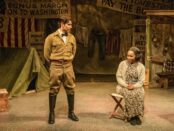
A Hundred Circling Camps, written by Sam Collier and superbly directed by Rebecca Wear, is a story based on the "Bonus March" of 1932. It is more than a play about a historical event. It is also a commentary on the nature of citizens exercising their right to assemble and petition the government to redress grievances, rights established in the First Amendment to the U.S. Constitution. It is a show worth seeing because of its story and the actors' performances. The Bonus March of 1932 was a demonstration by veterans of World War I asking that the financial promises made by the U.S. government be honored in advance of the original payment date of January 1945. The economic situation for people in the United States was desperate during the Great Depression, and the veterans, most with families to support, felt that the money promised would help them survive.
[more]
"Bill’s 44th" is a story of loneliness told within the context of a birthday celebration. It is a wordless puppet show for grown-ups created and presented by Dorothy James and Andy Manjuck. James and Manjuck combine to inhabit Bill, a middle-aged man with a belly paunch and a paper-maché bald head with bushy eyebrows, a mustache, and deep, empty eye sockets. His legs are those of Manjuck, and his arms are those of James and Manjuck. It is a remarkable display of puppetry. Their collaboration brings emotional heft to the puppet with actions that are choreographed to perfection. Jon Riddleberger plays a supporting role as a pizza delivery man and later as the puppeteer of a human-sized dancing carrot stick.
[more]
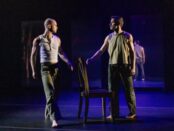
Jakob Karr conceived, choreographed and directed his full-length dance/drama, "Ain’t Done Bad" currently heating up the Irene Diamond Stage at the Pershing Square Signature Center just west of Times Square. It is a courageous, if generic look at the trials and tribulations of a young gay man confronting his inner demons and his hard-as-stone father.
[more]
In "Empire," Caroline Sherman and Robert Hull attempt to tell a very big story but are unable to bring this unwieldy tale into suitable shape. The time traveling framework is both unnecessary and obtrusive. Both the historic characters and the fictional ones are underwritten and there are too many names to keep straight. While the music is catchy, the lyrics are often too unsophisticated and repetitious to make their mark. The cluttered setting and the busy staging don’t help to tell the story. "Empire" is an ambitious but unsuccessful musical which is defeated by its very form.
[more]
Ehrenpreis’ "Clowns Like Me" is sad, but true, and with the help of writer and director Jason Cannon, the brutally honest tale finds all the humor that’s possible. Within a very few minutes we are introduced to all the tools to discuss an obvious manifestation of his obsessive-compulsive disorder: cleanliness. Out come the goggles, gloves, cleaning rag, spray bottle and his co-stars Swiffer and Dirt Devil in this elaborate Ginger and Fred dance to clean where the average person would see no dirt.
[more]

Correa who for many years worked for Congresswoman Constance A. Morella knows his way around government and his characters are very convincing. The casting of Diane Paulus’ production is superb and Taylor and Villafañe make excellent sparring partners. The encounters which take place mainly in N’s congressional office that of first Minority Leader and then later Speaker of the House (the same set by Myung Hee Cho) include fast-paced repartee, quips, retorts and wordplay, all worth listening to. You are required to listen intently as the dialogue is fast paced and rapid fire. When we meet them A has just won her first primary in the Bronx and Queens, defeating the Democratic Party candidate that N has supported. In the course of the five scenes of the play, we next meet them when N needs A’s vote to regain the Speakership, while the last scene takes place four years later when the Republicans have regained the House and N is packing up her office, having stepped down from her position as party leader.
[more]
«
1
…
9
10
11
12
13
…
68
»
Copyright Jack Quinn, 2001-2026