
The Morbs
Three sorority sisters take shelter in a cabin in the woods of New Hampshire from the latest outbreak of a terrifying illness.
Posted on November 5, 2026 by  Victor Gluck, Editor-in-Chief in Off-Broadway Plays, Plays, Still Open
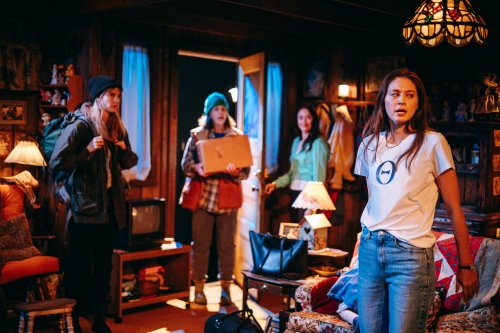
Alexandra Templer, Jennifer Regan, Rachel Ravel and Emma Kikue in a scene from Jen Diamond’s “The Morbs” at A.R.T./New York Theatres (Photo credit: Geve Penn)

Victor Gluck, Editor-in-Chief
Jen Diamond’s The Morbs attempts to do two things: create a thriller from a new pandemic called “The Morbs” as well as examine female friendship with the reunion of three sorority sisters who used to be best friends when they meet five years after graduation. Diamond is not entirely successful at either: the play does not become scary until the last 20 minutes and too much is left unsaid about the women’s friendships to really understand them. The cast directed by Lily Kanter Riopelle is excellent but they can’t fill in the gaps of what is not there.
Tatum, Trish and Wendy were attending their fifth-year homecoming (at an unnamed college) since graduation when informed of a nearby outbreak of The Morbs in the vicinity so that they must evacuate. However, as Tatum’s father is a big wheel in the MHC which monitors those infected, they were able to drive to Tatum’s family cabin in New Hampshire until the quarantine is over. There they encounter Tatum’s Aunt Harriet who has had The Morbs which has left her hollow, lacking in memories, a shell of her former self. (The more dangerous form of the Morbs makes people violent, like a rabid dog.) The women take the commitment test and oath which will help in revealing if one of them comes down with it and then they settle in to distract themselves while a blizzard rages outside.
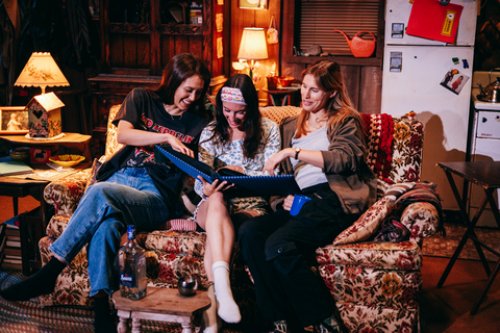
Emma Kikue, Rachel Ravel and Alexandra Templer in a scene from Jen Diamond’s “The Morbs” at A.R.T./New York Theatres (Photo credit: Geve Penn)
The women, who have not been in touch for a long time, attempt to revive their old friendships and catch up. Tatum is insulted that Wendy has avoided her since graduation but it appears she was not able to help Wendy when her mother contracted The Morbs in the first outbreak. They all last saw each other at Trish’s wedding to Eddie two years ago and now the couple have a little girl Poppy who is home with the father. Wendy seems to fear Harriet but has been told there is nothing to be afraid of. Tatum has good memories of the cabin where she lived with her mother for six years after her parent’s divorce. (Her father is now quite wealthy with his own private jet and a house in Aspen.)
The girls reminisce, trade gossip about former classmates, examine photo albums, play games, drink and listen to music. There are a couple of scares like when an animal knocks on the door and Harriet makes an unexpected visit from her nearby house on the same property. And then one of them comes down with The Morbs and the other two have to deal with the danger.
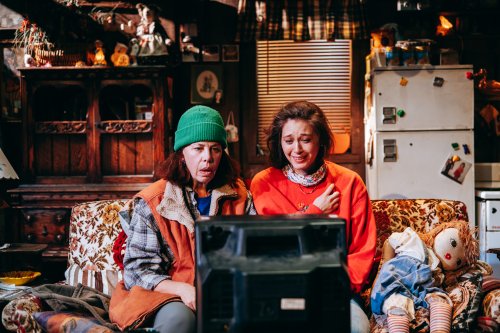
Jennifer Regan and Emma Kikue in a scene from Jen Diamond’s “The Morbs” at A.R.T./New York Theatres (Photo credit: Geve Penn)
Considering the premise, the play ought to have more urgency considering the risk they run. There is hardly any discussion of the world outside the cabin except for the snow. The women do not seem to take it all seriously until the suggestion that one of them has contracted it but until then it is not a reality for them. There are too many unexplained items: where is the college the women attended, where do they now call home? How has Tatum’s father gotten rich running the MHC? The symptoms are at first very few and then it seems the list includes too many things. The violent ones appear to have to be killed but we are told little about this. Diamond has an excellent ear for dialogue and for characterization, but she is rather weak on structure and tension: the play has too many short scenes which diminish the buildup to the climax.
Riopelle has staged the play well considering the small, cluttered stage. The actresses don’t so much change as reveal themselves. As Tatum, the queen bee, Emma Kikue is commanding, always in charge. Rachel Ravel’s Trish is obviously a follower who lets others take the lead. As Wendy, the outsider, Alexandra Templer is an independent woman, in control of her life. It is her character who has brought the Health Department protocols and insists they all take the commitment. Jennifer Regan’s Aunt Harriet is strange from the moment we meet her, a woman who does not seem to be all there, but is no threat. The one thing these fine actresses can’t overcome is the lack of an arc leading to the conclusion as well as the many short scenes that break the rhythm of the play. Avery Reed’s costumes define the women from the time each of them enters the play.
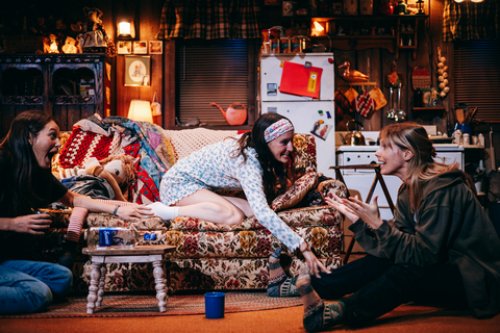
Emma Kikue, Rachel Ravel and Alexandra Templer in a scene from Jen Diamond’s “The Morbs” at A.R.T./New York Theatres (Photo credit: Geve Penn)
All of this takes place on the remarkable set by Christopher and Justin Swader: a completely realistic cabin in the woods, obviously lived in and a little shabby, containing everything you would expect to find except the bathroom which we are told is an outhouse in the woods. Natasha Dell has done an extraordinary job as prop supervisor as not an inch of the set is not covered in objects from the magnets on the door of the refrigerator to the items on the book shelves. Paige Seber’s lighting perfectly handles the change of time as one day segues into another. The many lamps which are used as sources of light are realistic for a cabin the woods. The sound design by Brandon Bulls makes us jump at each knock on the door: friend or foe?
Jen Diamond’s The Morbs is a product of the recent pandemic. Her characters are well defined. Unfortunately, there is little tension until almost the final scene which. This undermines the play as a thriller, though the relationship between the women is well defined. It would help if we knew more about the illness and its effects, and so much was not left to the imagination.
The Morbs (extended through November 21, 2026)
Egg & Spoon Theatre Collective
Jeffrey and Paula Gural Theatre at A.R.T./New York Theatres, 502 W. 53rd Street, in Manhattan
For tickets, visit http://www.eggandspoontheatre.org
Running time: one hour and 50 minutes without an intermission



Leave a comment