
The Kick Inside
An intriguing experiment in theatrical surrealism, rich in visual invention and committed performances, ultimately undone by its own fragmented execution.
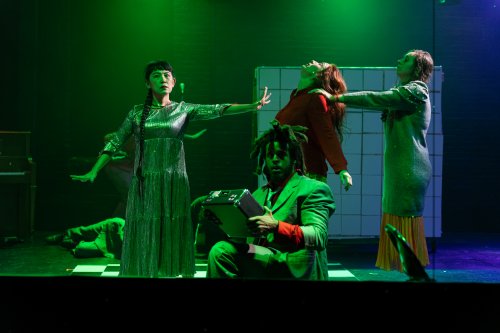
Yuki Kawahisa, Essence Lotus, Tatyana Kot and Frankie Placidi in a scene from Nicolás Noreña’s production of “The Kick Inside” at HERE Arts Center (Photo credit: Jose Miranda)
There is a particular kind of theatrical ambition that announces itself by refusing to behave: unidentified characters appear and disappear without explanation, dialogue slips away from ordinary meaning, furniture acquires a consciousness, dogs may be men, men may be aliens, and the laws of narrative causality are treated as little more than suggestions. Such work can be exhilarating, provided that the disorder has some underlying design, some accumulating intelligence that makes its apparent randomness feel like a form of discovery. The Kick Inside, an experimental, surrealist assemblage conceived and directed by Nicolás Noreña with his Brooklyn-based company The Million Underscores, has all the ingredients of an intriguing theatrical experiment. What it too rarely has is the sense that those ingredients have been made into a satisfying whole. Inspired loosely by Kate Bush’s 1978 debut album of the same name, the production is an elaborate exercise in the exquisite-corpse tradition, bringing together thirteen New York playwrights, including the late Richard Foreman, whose presence feels particularly appropriate to a work that seems determined to test just how much eccentricity an audience can absorb before its capacity for wonder gives way to bewilderment.
The ostensible organizing principle is Alenka, played by Tatyana Kot, a woman who has grown dissatisfied with the limitations of language and increasingly alienated by the ways people communicate with one another. Across a succession of twelve newly assembled vignettes and Foreman’s pre-existing contribution, she wanders through a world in which rooms have voices, technology becomes a kind of witchcraft, strangers materialize in unexpected places, and the distinction between human beings, animals, and other forms of existence grows progressively less dependable. The journey takes her through apartments, dry cleaners, diners, libraries, locksmiths, and bus stops, encountering assorted conspiracies, philosophical pronouncements, extraterrestrial visitors, and miscellaneous bodily abnormalities along the way. There are ideas about language as a means of controlling people, about the inadequacy of words to express experience, and about the possibility that the world around us possesses an intelligence that human beings have become too accustomed to overlooking. The trouble is not that these ideas are inherently obscure. It is that the production seems content to introduce them without developing the relationships between them, leaving the audience to perform an increasingly exhausting exercise in retrospective interpretation.
There are moments when the experiment suggests the genuinely peculiar pleasure it might have delivered. Jess Barbagallo’s “The Apartment” is among the most engaging, giving Alenka the opportunity to converse with the consciousness of her own room, voiced by Alenka Kraigher, while a mysterious man (Timothy Scott) also appears to have established an intimate relationship with the walls. The premise has a wonderfully unsettling domestic intimacy in which the familiar world becomes a receptacle for anxieties that cannot quite be articulated. Here, the walls are not merely metaphors for the secrets people keep; they are active participants in the drama, and the possibility that a room might know its inhabitants better than they know themselves is an idea worth pursuing. John Jesurun’s “The Bus Stop” also finds a promising theatrical register, offering a Beckettian encounter involving a potentially dying alien and Felix Teich as a dog who is also a man. Its absurdity has enough internal logic to sustain the scene without requiring the audience to construct an entire philosophy around it. Nazareth Hassan’s “The Locksmith,” meanwhile, benefits from a deliciously unreliable assortment of mangled proverbs and misremembered expressions. Essence Lotus, in particular, takes evident pleasure in delivering these linguistic contortions, finding comic precision in material whose more abstruse philosophical implications might otherwise become oppressive.
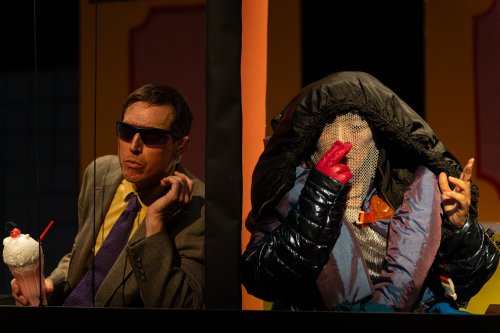
Benjamin Forster and Yuki Kawahisa in a scene from Nicolás Noreña’s production of “The Kick Inside” at HERE Arts Center (Photo credit: Jose Miranda)
The production’s visual imagination is often more persuasive than its writing. Normandy Sherwood’s set is a constantly rearranging contraption of fabric, foam core, cardboard, curtains, and movable walls, its conspicuously handmade construction giving the stage the appearance of a particularly unruly children’s playhouse, perhaps one designed by someone who had spent an afternoon contemplating the more disquieting possibilities of Pee-wee’s Playhouse or Punch and Judy. Doors and partitions open onto unexpected spaces, rooms appear and vanish, and the scenery occasionally seems to acquire a personality of its own. Sherwood’s use of hanging fabric and carefully positioned apertures can be especially effective, creating frames within the stage picture that restrict the audience’s view and turn spectatorship into an exercise in looking around corners. In one particularly imaginative sequence, characters appear suspended in outer space through openings in a floor-to-ceiling celestial curtain, their heads and limbs emerging at improbable angles from an unseen scaffold. Yet the ingenuity is compromised by the practical limitations of the construction: the scenery can be noisy and visibly flimsy, while certain actions performed at floor level are frustratingly inaccessible to substantial portions of the audience. There is a difference between making spectators work to see something and making it impossible for them to see it.
Daisy Long’s lighting helps establish the shifting atmospheres, moving between subdued, muddy environments and more aggressively fluorescent ones, while Robin Margolis’ sound design supplies the familiar noises of everyday life that occasionally anchor the production’s more free-floating excursions into abstraction. The most consistently pleasurable sound element, however, is Marija Kovačević’s live Foley performance. Working in full view, she creates an assortment of effects with the resourcefulness of an old-fashioned radio dramatist, giving physical immediacy to actions that might otherwise remain theatrically weightless. Her contribution is particularly valuable because it offers something concrete and responsive in a production that too often seems to have abandoned the ordinary pleasures of theatrical cause and effect. During an early scene change, the performers continue moving while the scenery is rearranged, one actor even cartwheeling across the stage. For a brief stretch, the mechanics of the production become the performance itself, and the distinction between transition and dramatic action disappears. It is an exciting moment of theatrical self-awareness, suggesting that Noreña understands the possibilities of making the apparatus visible rather than merely using it to illustrate an idea. Unfortunately, this particular flash of invention does not develop into a sustained approach.
The performers, an international ensemble comprising Kot, Kraigher, Scott, Lotus, Teich, Benjamin Forster, Yuki Kawahisa and Frankie Placidi, deserve considerable credit for their willingness to inhabit the production’s constantly shifting circumstances. They move fluidly between characters and environments, accommodating abrupt changes in tone, identity, and physical vocabulary without appearing to question the demands being placed upon them. Forster and Kawahisa, among others, take on a succession of eccentric personae, including the increasingly conspiratorial inhabitants of a world populated by technological witches, secret agents, and extraterrestrial visitors. Kawahisa’s Jeannie, the so-called Tech Witch, is particularly memorable in her elaborately eccentric presentation, while Lotus brings a wonderfully mischievous theatricality to the production’s verbal absurdities. In Penny Arcade’s “The Diner,” two Secret Service agents sit with an enormous papier-mâché milkshake as Alenka adopts an extravagantly Brooklyn-inflected waitress persona, only to be confronted by Jeannie and her elaborate theories about technology, human enslavement, and the expansion of destructive impulses beyond our own planet. The scene has a comic vitality that comes from the performers’ ability to play the ridiculous circumstances with complete conviction. Indeed, the actors are frequently better than the material they have been given, and their commitment makes the production’s occasional flashes of genuine comedy and physical invention all the more frustrating.
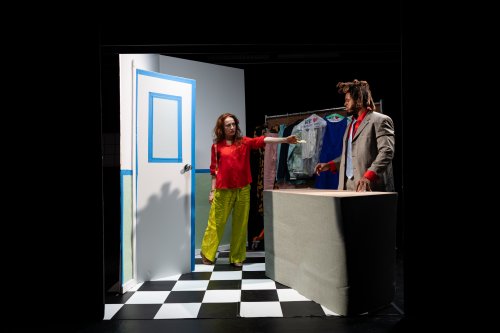
Tatyana Kot and Essence Lotus in a scene from Nicolás Noreña’s production of “The Kick Inside” at HERE Arts Center (Photo credit: Jose Miranda)
What becomes increasingly difficult to overlook is the absence of accumulation. The exquisite-corpse method is, by definition, a celebration of discontinuity: its collaborators contribute fragments without necessarily knowing what the others have produced, allowing chance to determine the eventual shape of the work. That can be a productive artistic constraint, but it does not absolve the final production of the responsibility to shape the material. Richard Foreman understood the value of repetition, excess, and deliberate frustration; in his work, the seemingly arbitrary recurrence of an image or verbal tic could become an organizing principle in itself. Here, by contrast, one idea is introduced, another arrives to replace it, and the first is abandoned before it has acquired enough theatrical weight to resonate.
The production opens with an uncredited scene, “The Cinema,” that briefly establishes a level of theatrical invention and promise the subsequent vignettes never quite recapture. As a group of spectators gradually files out of a theater-within-the-theater, leaving a weeping Alenka alone as Kate Bush’s “Moving” plays, the scene establishes an evocative atmosphere of estrangement and emotional dislocation. It is an economical, visually suggestive beginning, and the production’s failure to return to that level of artistic promise is particularly unfortunate. Alenka, supposedly the connective tissue of the evening, becomes an especially puzzling casualty of this process. She undergoes various transformations, including a late appearance in a blonde wig that prompts other characters to remark on her familiarity, but the production eventually loses interest in her altogether. By the time the ending arrives, she has effectively disappeared from the dramatic landscape. Whatever emotional or psychological journey she was meant to undertake remains largely inaccessible, and the central character begins to feel less like the protagonist of a fragmented narrative than an excuse for moving between unrelated theatrical experiments.
There is something admirable, even invigorating, about Noreña’s willingness to embrace theatrical excess without worrying about conventional narrative expectations. Experimental theater need not provide a tidy plot, an identifiable moral, or a reassuring conclusion, and difficulty, disorientation, and deliberate resistance to interpretation can all be productive artistic strategies. But surrealism and absurdism are not simply licenses to confuse. They require their own forms of precision (the Resident Acting Company’s exquisite current revival of Ionesco’s absurdist The Bald Soprano is proof positive), and a production that makes communication its central concern might reasonably be expected to establish some kind of communication with its audience, even if that communication is deliberately fractured, elusive, or unsettling. There is a meaningful distinction between inviting spectators to participate in the creation of meaning and assigning them the entire responsibility for inventing it. Too often, The Kick Inside seems to mistake the latter for the former. Its dialogue can be intriguingly opaque, but it can also become so portentous that the audience is left wondering whether a particular pronouncement is intended to illuminate something or merely to sound as though it does. The occasional appearance of a striking image or a clever verbal construction cannot compensate indefinitely for the lack of a larger theatrical argument.
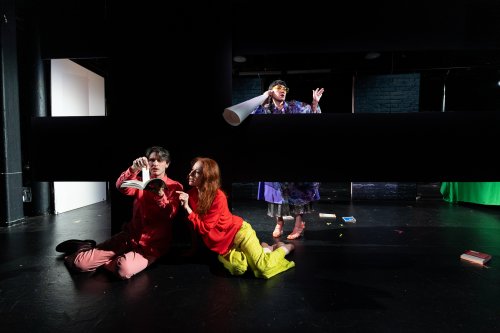
Timothy Scott, Tatyana Kot and Yuki Kawahisi in a scene from Nicolás Noreña’s production of “The Kick Inside” at HERE Arts Center (Photo credit: Jose Miranda)
The Kick Inside contains enough invention, eccentricity and sheer theatrical audacity to suggest a far more compelling evening than the one that finally emerges. Its handmade scenery, resourceful Foley, committed performers, and sporadically inspired scenes offer genuine pleasures, and there are stretches when its disorder feels like a welcome liberation from the predictable machinery of conventional drama. But the production never quite converts its fragments into a larger experience, and its apparent refusal to make connections eventually becomes less an aesthetic provocation than an artistic limitation. The ambition is considerable, and the company’s willingness to take such extravagant risks is commendable. What is missing is a comparable rigor in the execution, a shaping intelligence capable of transforming the chance collisions of the exquisite-corpse process into something that resonates beyond the individual moments. By the end, the mystery has not deepened so much as dissipated, and the exhilarating possibility of theatrical chaos has given way to the weary sensation of watching one interesting thing after another being left behind.
The Kick Inside (through November 7, 2026)
The Million Underscores
Mainstage Theater, HERE Arts Center, 145 6th Avenue, in Manhattan
For tickets, visit www.here.org
Running time: 90 minutes without an intermission


Leave a comment