
The Bald Soprano
A brilliantly choreographed absurdist comedy in which six superb actors turn the collapse of language and logic into uproarious, timeless theatrical magic.
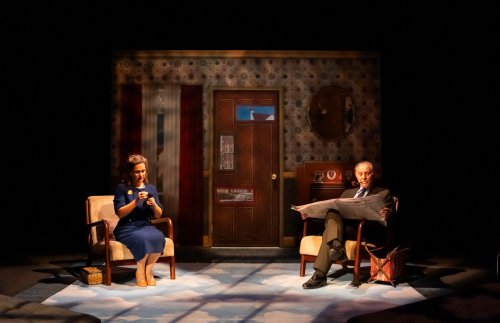
Rachel Botchan and Dominic Cuskern as Mrs. and Mr. Smith in a scene from The Resident Acting Company’s revival of Eugene Ionesco’s “The Bald Soprano” at The Sheen Center for Thought and Culture (Photo credit: Al Foote)
Eugène Ionesco’s The Bald Soprano, that mischievous masterpiece of the Theater of the Absurd, is a play in which the ordinary becomes extraordinary, conversation becomes combat, and the most reassuring conventions of civilized behavior are gradually revealed to be elaborate disguises for the bewildering emptiness beneath them. In its splendid revival by the Resident Acting Company at the Frank Shiner Theater at The Sheen Center for Thought and Culture, this mid-century assault on the logic of everyday life emerges as both an uproarious theatrical entertainment and a surprisingly penetrating examination of humanity’s seemingly inexhaustible capacity to speak without communicating. Directed by Bradford Cover with a precision that never smothers the madness, the production makes an exceptionally persuasive case for Ionesco’s enduring genius. The six-member ensemble, several of whose performers have a history with the play stretching back to The Pearl Theatre Company’s 2011 staging, approaches the material with the confidence of artists who understand that the most effective way to perform nonsense is to believe in every syllable of it.
The premise is deceptively simple. In the living room of a suburban London home, Mr. and Mrs. Smith exchange domestic pleasantries, discussing their evening and the minutiae of family life with the grave solemnity of people who have never entertained the possibility that their words might be meaningless. Their maid, Mary, announces the arrival of their guests, Mr. and Mrs. Martin, whose own conversation takes an astonishing detour when they gradually establish that they are, in fact, husband and wife. The Fire Chief subsequently arrives, ostensibly in search of a fire, and stays to contribute a collection of stories whose grammatical coherence only makes their logical derangement more delightful.
Meanwhile, an inexplicably erratic clock chimes, doorbells ring without reliably announcing anyone, relatives named Bobby Watson multiply at an alarming rate, and the characters proceed toward a finale in which language itself appears to have suffered a complete nervous breakdown. Ionesco conceived the play, his first major dramatic work, while studying English through a language-learning textbook whose sample dialogues exposed the peculiar hollowness of conventional conversation. The resulting theatrical experiment, which premiered in Paris in 1950, remains a marvel of comic construction: a play ostensibly about nothing that manages to say an extraordinary amount about the human condition.
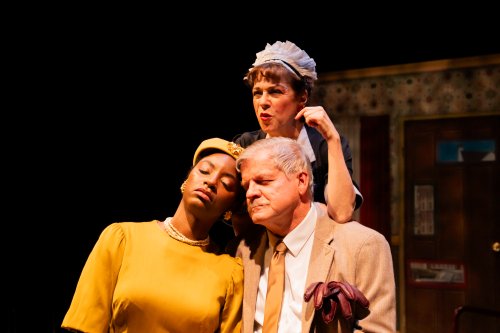
Anique Clements and Andy Paterson as Mr. and Mrs. Martin, with Carine Montbertrand as Mary (in back) in a scene from The Resident Acting Company’s revival of Eugene Ionesco’s “The Bald Soprano” at The Sheen Center for Thought and Culture (Photo credit: Al Foote)
Cover, who also appeared as Mr. Smith in The Pearl Theatre Company’s legendary 2011 production, brings to this revival an unusually intimate understanding of the play’s mechanics. His direction treats Ionesco’s dialogue almost as a musical composition, carefully calibrating its pauses, repetitions, accelerations, and sudden changes of volume until the performance acquires the momentum of a comic symphony whose instruments are six increasingly exasperated human beings. The opening exchanges unfold with a studied domestic naturalism; the performers sit, converse, and observe the small courtesies of social life as though participating in a perfectly respectable drawing-room comedy.
Gradually, however, the rhythms become more insistent, the silences more uncomfortable, the gestures more agitated, and the conversation more aggressively detached from reason. By the time the characters are shouting at one another in an escalating torrent of similar-sounding words and disconnected assertions, the production has transformed a roomful of polite acquaintances into a miniature civilization coming apart at the seams. Cover’s achievement lies in allowing the absurdity to accumulate rather than forcing it upon the audience. The laughter comes from watching these people remain so utterly convinced of their own rationality while the foundations of their reality crumble beneath them.
Rachel Botchan and Dominic Cuskern as Mrs. and Mr. Smith, respectively, establish the production’s immaculate comic equilibrium. Botchan, reprising her role from 2011, plays Mrs. Smith with an almost supernatural commitment to the everyday, delivering her character’s increasingly preposterous observations in the tone of a woman discussing the preparation of supper or the proper arrangement of household furnishings. Her most astonishing lines seem to emerge without the slightest awareness that anything might be amiss, and the resulting contrast between her composure and the content of her speech is a continuing source of delight.
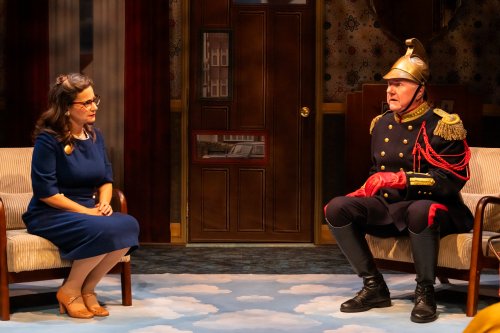
Rachel Botchan as Mrs. Smith and Dan Daily as the Fire Chief in a scene from The Resident Acting Company’s revival of Eugene Ionesco’s “The Bald Soprano” at The Sheen Center for Thought and Culture (Photo credit: Al Foote)
Cuskern’s Mr. Smith supplies an equally compelling counterweight: stiff, self-satisfied, and faintly imperious, he delivers absurd pronouncements with the authority of a gentleman addressing Parliament. Their early discussion of the Watson family, in which death, marriage, identity, and family relationships become hopelessly entangled, demonstrates how deftly the actors distinguish between the apparent seriousness of their characters and the sheer derangement of their circumstances. Neither performer winks at the audience or signals that a joke is being told. Their straight-faced commitment gives Ionesco’s verbal contortions their full comic force.
Anique Clements and Andy Paterson, as the visiting Mrs. and Mr. Martin, bring a different but equally satisfying flavor of absurdity to the proceedings. Where the Smiths appear serenely committed to their domestic routines, the Martins seem to be navigating a universe in which even the most elementary facts require exhaustive investigation. Their extended recognition scene, a masterpiece of escalating logical futility, begins with a series of apparently innocuous observations about their travels, residence, and family circumstances. Each coincidence brings them closer to a conclusion that any reasonably attentive person might have reached almost immediately, yet they proceed with the solemn deliberation of detectives unraveling an international conspiracy. Clements makes Mrs. Martin’s bewilderment wonderfully expressive, while Paterson’s Mr. Martin contributes a grave, painstaking earnestness that heightens every absurd discovery. Their eventual recognition of one another as spouses is not merely a comic set piece but a miniature demonstration of Ionesco’s method: logic, applied with sufficient rigidity to a world that has ceased to make sense, becomes indistinguishable from lunacy. The actors’ impeccable timing and carefully modulated reactions make this sequence one of the production’s richest pleasures.
Dan Daily and Carine Montbertrand provide the evening with an additional burst of comic invention. Daily, returning to the role of the Fire Chief that he played in The Pearl’s 2011 production, gives the character an appealing mixture of bluster, childishness, and professional disappointment. Having arrived to investigate a fire that does not exist, he finds himself obliged to occupy the evening with stories whose internal logic is no more dependable than the doorbell that summoned him. Daily recounts these increasingly convoluted fables with the polished assurance of a seasoned raconteur, making their nonsense all the funnier by refusing to acknowledge it as such. His Fire Chief is both an intruder into the Smiths’ domestic routine and a perfect embodiment of its underlying absurdity: even the authority figure whose profession depends upon identifying emergencies cannot locate a single emergency worth attending to. Montbertrand’s Mary, meanwhile, is a wonderfully disruptive presence. Her physical expressiveness, sharp changes of vocal register, and distinctly different social bearing give the maid a theatrical vitality that contrasts with the other characters’ comparatively rigid behavior. Her revelation of her relationship with the Fire Chief, along with her unexpected excursion into poetry, further destabilizes an evening already threatening to escape the boundaries of recognizable reality. Together, Daily and Montbertrand demonstrate how much comic richness Ionesco has distributed among characters who might otherwise be treated as secondary players.

The cast of The Resident Acting Company’s revival of Eugene Ionesco’s “The Bald Soprano” at The Sheen Center for Thought and Culture (Photo credit: Al Foote)
The production’s design team creates an ideal environment for this carefully controlled collapse of order. Harry Feiner’s set provides a recognizable mid-century English sitting room without cluttering the intimate performance space, allowing the actors to orient themselves toward one another and the audience while keeping every exchange visible. His lighting subtly shifts the atmosphere as the domestic comedy grows increasingly sinister, helping the final eruption of verbal and physical chaos register as more than an exercise in volume. Jeremy Pitzer’s costumes establish the period with pleasing specificity, distinguishing the characters’ social positions while giving the Fire Chief an especially memorable appearance.
PJ Ju’s sound design is a comic triumph in its own right. The clock’s wildly unhelpful chimes and the doorbell’s increasingly exasperating interruptions establish a world in which even the most basic mechanisms of domestic life refuse to behave sensibly. These sounds are not decorative embellishments but participants in the comedy, contributing to the impression that the universe itself has become an uncooperative houseguest. The cumulative effect is a production in which the visual and aural elements support the acting without competing with it, allowing the ensemble’s precision to remain at the center of the experience.
What makes this revival particularly satisfying is its refusal to treat absurdism as a historical curiosity requiring elaborate contemporary updating. The Smiths and Martins inhabit their recognizable mid-century world, with no need for technological gimmickry to make their predicament intelligible to a twenty-first-century audience. Ionesco’s concerns are already everywhere around us: in the public repetition of empty formulas, in conversations where each participant seems to be waiting for an opportunity to speak rather than listening, and in the increasingly familiar spectacle of confident declarations surviving intact after their underlying logic has disappeared. The play’s celebrated circular structure brings the argument home with devastating efficiency. Following the climactic verbal explosion and a blackout, the action begins again, with the Martins occupying the Smiths’ original positions and repeating the opening exchanges. The people have changed places, but nothing fundamental has changed at all. Individuality dissolves into repetition; language, ostensibly the instrument by which we distinguish ourselves and understand one another, becomes the mechanism through which we reveal our sameness. The joke is exhilarating, but its implications are quietly chilling.
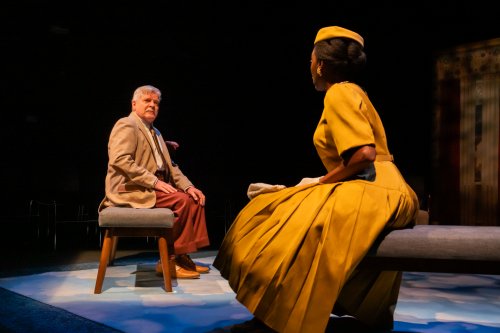
Andy Paterson as Mr. Martin and Anique Clements as Mr. Martin in a scene from The Resident Acting Company’s revival of Eugene Ionesco’s “The Bald Soprano” at The Sheen Center for Thought and Culture (Photo credit: Al Foote)
The Resident Acting Company, which grew out of The Pearl Theatre Company after that distinguished institution concluded its 33-season history, is particularly well suited to this material. Its commitment to ensemble performance is evident in the remarkable consistency of the acting, the precision of the collective rhythms, and the generosity with which each performer supports the others. Under Cover’s assured direction, The Bald Soprano becomes a demonstration of theatrical craftsmanship in which the apparent absence of order depends upon an extraordinary amount of discipline. The production is funny because its performers are exact, unsettling because they are sincere, and enduringly relevant because the absurdities they expose are not confined to a fictional London sitting room.
More than three-quarters of a century after Ionesco first sent his bourgeois characters careening into linguistic oblivion, his play continues to illuminate the distance between talking and understanding, between the reassuring rituals of civilization and the chaos those rituals are designed to conceal. This revival honors that achievement with uncommon intelligence, infectious energy, and a company-wide commitment to the pleasures of theatrical invention. The bald soprano herself may remain elusive, but the brilliance of this production is unmistakable.
The Bald Soprano (through November 1, 2026)
The Resident Acting Company
Frank Shiner Theatre, The Sheen Center for Thought and Culture, 18 Bleecker Street, in Manhattan
For tickets, visit http://www.racnyc.org
Running time: 70 minutes without an intermission


Leave a comment