
Lean-To
A tender woodland comedy where loneliness, love and vulnerability collide amid Britney Spears, revelations, and the restorative chaos of human connection.
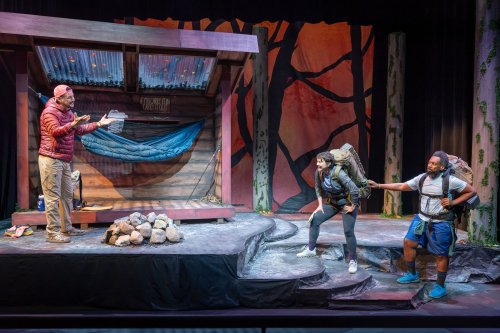
John Alejandro Jeffords, Larisa Oleynik and Joshua David Robinson in a scene from Stephen Sheffer’s “Lean-To” at 59E59 Theaters (Photo credit: Burdette Parks)
A multi-day hike is supposed to be restorative: an interval in which the civilized world recedes, the body remembers that it has muscles, and the mind, deprived of its usual electronic distractions, is given a chance to wander. But the woods have their own ideas about solitude. In Stephen Sheffer’s warm, funny, unexpectedly poignant Lean-To, now playing at 59E59 Theaters, a rustic shelter becomes the unlikely site of a three-person collision involving loneliness, romance, race, vulnerability, betrayal and the peculiar intimacy that can arise when strangers are forced to share a roof. Directed with considerable sensitivity by Jesse Jou, the play gradually reveals itself as a small-scale comedy about the enormous difficulty of being alone with oneself—and the equally enormous difficulty of being alone with someone else.
The evening begins with Xavier, a gay bartender and enthusiastic outdoorsman played by John Alejandro Jeffords, arriving at the lean-to by himself. There is something immediately touching about the young man’s solitude. Xavier has chosen the trip despite the fact his friends were unavailable and because, in the absence of a boyfriend, there is no one else to bring along; the empty shelter therefore represents both freedom and a slightly painful confirmation of his circumstances. Jeffords gives him a winning mixture of intelligence, self-consciousness, practical competence, and yearning. Xavier can light a campfire with a single match and dispense useful wilderness advice while simultaneously worrying about whether he is putting too positive a spin on his own life. He hangs his hammock, changes into his hiking shoes, surveys his temporary kingdom, and then belts out Britney Spears’ “Oops!…I Did It Again,” before setting up his phone to record a video for his eventual return to civilization. The sequence is comic, but it is also unexpectedly tender: Xavier’s performance of self-sufficiency becomes a way of admitting how much he wishes he had somebody beside him.
His solitude is interrupted by the arrival of Yvonne, an attorney played by Larisa Oleynik, and Zed, a therapist played by Joshua David Robinson, a couple only four months into an interracial relationship that is already beginning to reveal its fault lines. Xavier graciously allows them to share the shelter, and the three quickly settle into the strange social choreography of people who have met by accident but are about to learn rather more about one another than they anticipated. Yvonne is chatty, anxious, self-deprecating, and compulsively prepared; Zed is quieter, more guarded, and initially rather less enthusiastic about sleeping outdoors than his girlfriend. Yet their differences have a complementary quality. Yvonne’s nervous oversharing and Zed’s patient reserve suggest both the attraction that brought them together and the complications that may ultimately pull them apart.

Larisa Oleynik and Joshua David Robinson in a scene from Stephen Sheffer’s “Lean-To” at 59E59 Theaters (Photo credit: Burdette Parks)
Sheffer is particularly effective when he permits his characters to move beyond their immediate circumstances and expose the histories beneath their present behavior. Zed, who would much rather be in a hotel, gradually begins to confront his complicated relationship to the outdoors, rooted partly in childhood experiences at summer camp and partly in the racial anxieties that make the supposedly universal romance of “the great outdoors” anything but universal. Recalling his childhood anger and his experiences growing up between Jamaica, Canada, Britain and the United States, he reflects on how that anger was “prescribed”—a response to expectations that he had absorbed before he was old enough to recognize them. Robinson delivers this material with an almost disarming casualness, which makes the revelation land harder. His understatement gives Zed an interior life that is easy to underestimate until suddenly the character seems to have been carrying an entire history just outside the frame.
Oleynik, meanwhile, makes Yvonne’s nervous talkativeness into a form of emotional percussion. She can turn a discussion of sleeping pads, trail food, or toothbrushes into an inadvertent psychological inventory, and Oleynik is wonderfully alert to the feeling underneath the chatter. She understands that Yvonne’s compulsive friendliness is not merely a comic tic but a survival strategy: if she keeps talking, planning, joking, and anticipating every possible contingency, perhaps she can prevent the world from surprising her. Jou makes excellent use of the actors’ contrasting energies, finding comic business in everything from the couple’s tent-pitching to an amusing toothbrush challenge while allowing the silences between them to accumulate significance. The production understands something that theater often forgets: silence is not an absence of action. It can be action slowed down enough for us to see it.
Indeed, Lean-To is in many ways a play about the loudness of silence. Jou’s sensitive direction gives the performers room to inhabit pauses rather than treating every moment without dialogue as dead air. Yvonne and Zed’s gradual construction of their tent becomes a small domestic ritual; Xavier’s solitary activities acquire a gentle poignancy; and, later, Yvonne’s wordless attempt to process what has happened becomes one of the production’s most affecting passages. There is a palpable sense that the forest has stripped away the usual social machinery. People cannot simply leave the room, answer an email, summon an Uber, or retreat behind the distractions of urban life. They have to remain physically present—and therefore emotionally present—with one another.
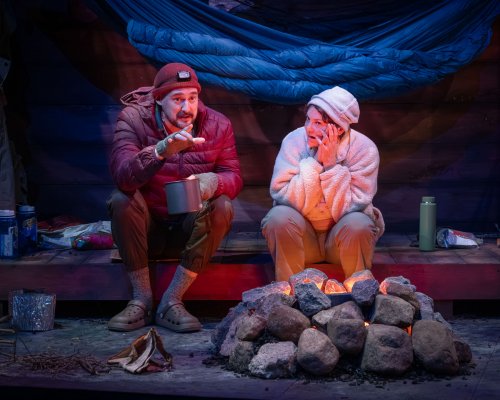
John Alejandro Jeffords and Larisa Oleynik in a scene from Stephen Sheffer’s “Lean-To” at 59E59 Theaters (Photo credit: Burdette Parks)
The production’s scenic and sound design are consummate complements to this intimacy. Connor Gallerani’s beautifully conceived environment makes the lean-to both convincingly rustic and theatrically expressive. Pebbles scatter across the ground, trees surround the shelter, and the structure itself possesses a sturdy, primitive reality, while the deliberately artificial-looking vegetation subtly reminds us that even our idea of “nature” is something we construct. The compactness of the setting keeps the characters in close quarters, making every glance and awkward adjustment visible. Gallerani may very well be the go-to designer for sets that make expansiveness shrink to make actors confront each other in minimal space as he did so brilliantly in Twenty Somethings’ production of Dirty Bird at Brooklyn’s ErF Gallery.
Jennie Gorn’s sound design is equally accomplished, and arguably the production’s secret emotional engine: birdsong, wind, crickets, the nearby river and the crackle of fire create an acoustic landscape that continues even when the characters stop speaking. Elaine Wong’s lighting traces the movement from afternoon into night with similar delicacy, while Krista Grevas’ layered autumn hiking costumes complete the convincing illusion of people who have actually dressed for the woods rather than for a theatrical representation of them.
The play’s most electrifying sequence arrives near the end, when a revelation sends Yvonne into a magnificent, thoroughly justified eruption. Oleynik attacks the passage not as a conventional comic monologue but as the accumulated exhaustion of a woman who has spent too much of her life trying to make romantic disappointment intelligible. “I’m not new at this game,” Yvonne observes, before confronting the absurdity of being a woman “on planet Earth” attempting to navigate the game of love. She imagines the future retelling of the latest disaster to her friends, another anecdote to be polished and recycled, and finally arrives at the melancholy recognition that perhaps the pursuit itself has become intolerable. Oleynik gives the speech both fury and resignation: it is funny because Yvonne can still see the absurdity of her situation, and heartbreaking because she can see it so clearly.

John Alejandro Jeffords, Larisa Oleynik and Joshua David Robinson in a scene from Stephen Sheffer’s “Lean-To” at 59E59 Theaters (Photo credit: Burdette Parks)
If there is one place where one would want Lean-To to push even further, it is precisely here. Yvonne’s expansive rant is so emotionally and intellectually rich that it almost demands a vocal response from the men—not necessarily an argument or an attempt to explain themselves, but some verbal counterweight that might allow the three characters to collide one last time rather than leaving Yvonne to carry the climax almost entirely herself. The stunned silence has its own theatrical logic, and Jou wisely resists cluttering the moment, but Robinson’s Zed and Jeffords’ Xavier have become such compelling presences by then that one longs to hear what each man might say after Yvonne has finally said everything she can no longer keep inside. That desire, however, feels less like a complaint than a testament to how thoroughly the production has invested us in all three people.
What ultimately makes Lean-To so appealing is the generosity with which it regards its characters. Sheffer does not treat their mistakes as evidence that they are bad people; rather, they are people who are still learning how their intentions collide with consequences, how affection can coexist with fear, and how self-knowledge does not necessarily arrive before we hurt one another. Beneath the Britney Spears, camping minutiae, nervous jokes, and awkward romantic maneuvering is a deeply big-hearted meditation on connection. The woods may provide the setting, but the real wilderness here is human intimacy. Xavier begins the evening alone, cheerfully constructing a little private world for himself; by morning, that world has been disrupted, and all three characters have been forced into a degree of honesty that no amount of urban convenience could have produced. In its quiet, comic, compassionate way, Lean-To reminds us that solitude can be restorative, companionship can be perilous, and making mistakes may be less important than what we learn once we have made them.
Lean-To (through October 10, 2026)
New Light Theater Project and Pendragon Theatre
59E59 Theaters, Theater B, 59 East 59th Street, in Manhattan
For tickets, visit http://www.59e59.org
Running time: 95 minutes without an intermission


Leave a comment